Last Updated: May 22, 2026
This article is reviewed annually to reflect the latest market regulations and trends
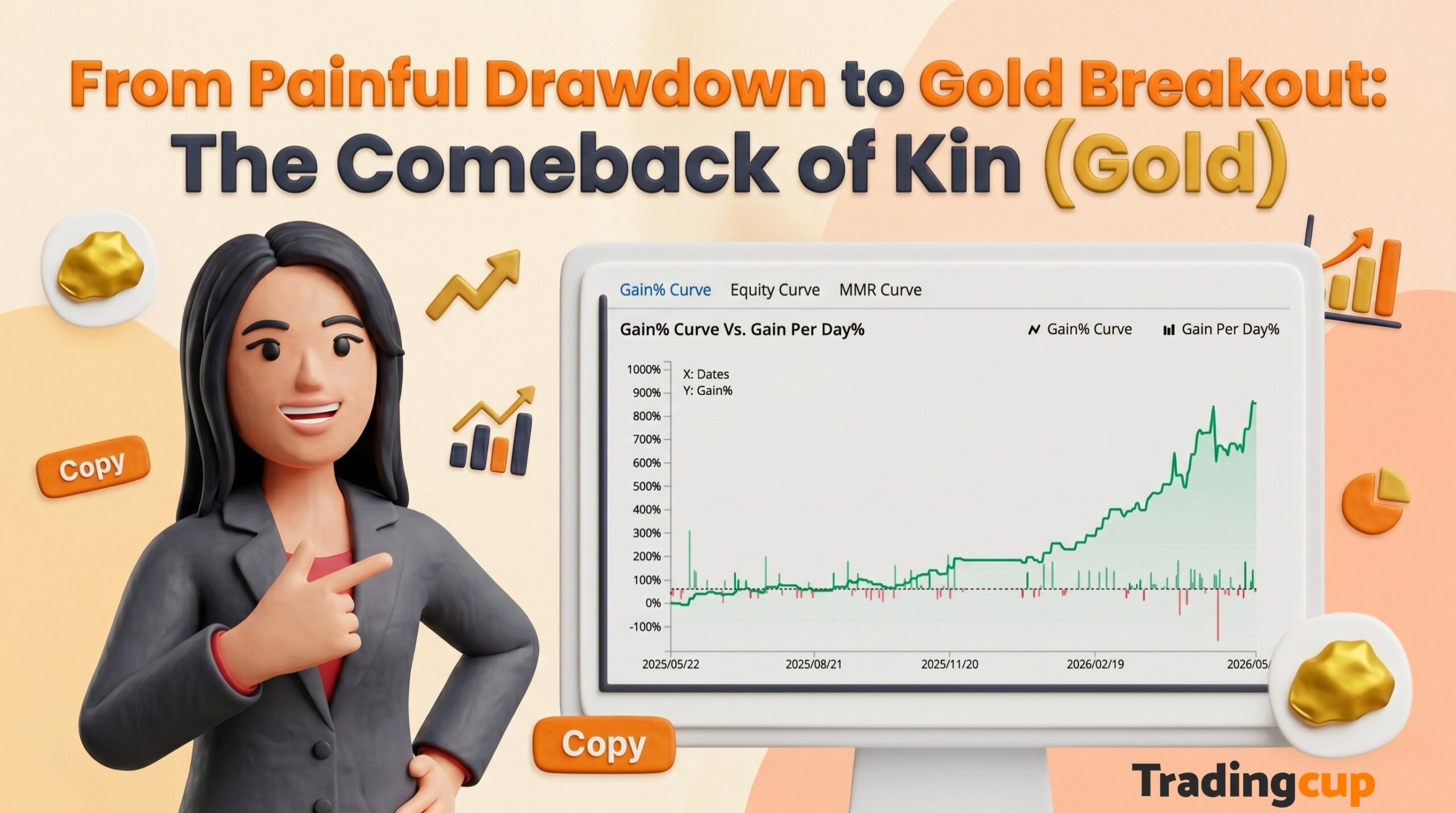
Kin (Gold) rebuilt its performance by pivoting from a weak forex strategy to an automated gold breakout approach, yielding an +817.72% return and a 46.51 Calmar ratio. While its strict pre-planned risk limits offer a robust structure, followers must properly size allocations to weather gold’s natural volatility.
TL;DR:
- Strategic Evolution: Following a heavy drawdown in November 2024 caused by poor trend-holding and averaging losses in forex, the strategy successfully pivoted to a disciplined gold breakout approach.
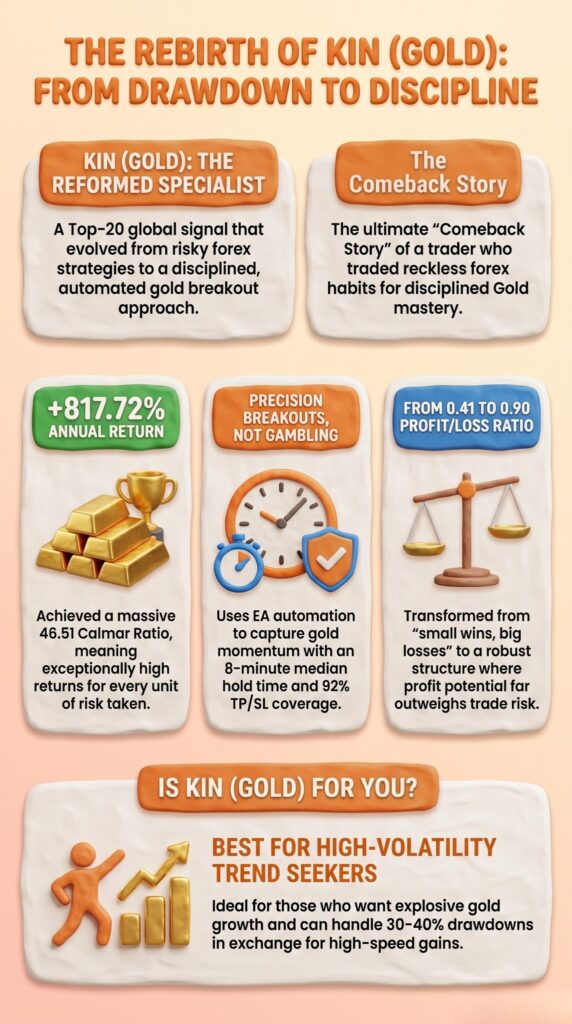
- High Return Efficiency: The shift to XAUUSD delivered an explosive +817.72% one-year return backed by a remarkable Calmar ratio of 46.51, proving high profit generation per unit of drawdown.
- Robust Trading Structure: While early forex trading suffered from a weak 0.41 profit/loss ratio, the gold strategy improved its average P/L ratio to 0.90, making risk to the account significantly more controllable.
- Ultra-Short Momentum: Operating via automated EA execution, the strategy utilizes pending buy/sell stop orders to capture swift breakout momentum, maintaining a rapid median holding time of just 8 minutes.
- Strict Exit Boundaries: High execution discipline is maintained with 92.26% of orders entering with pre-planned take-profit and stop-loss levels, often using protective trailing stops to lock in gains.
- Key Risks to Watch: The strategy is highly concentrated in gold volatility and carries a past-year max drawdown of 17.58%, meaning copy traders should prepare for potential future drawdowns of 30% to 40%.
Disclaimer: The information in this article is for educational purposes only and does not constitute financial, investment, or trading advice. Copy trading carries substantial risks, including the potential loss of your entire invested capital. Past performance of copied traders or strategies is not a reliable indicator of future results. You may be replicating high-risk trades, overleveraged positions, or strategies incompatible with your financial goals. Always conduct independent research into a trader’s historical performance, risk metrics, and strategy before copying them. Never invest funds you cannot afford to lose. Consult a licensed financial advisor to ensure copy trading aligns with your risk tolerance, financial objectives, and regulatory requirements in your jurisdiction. This article does not endorse specific traders, platforms, or strategies, and all trading decisions remain your sole responsibility.
How Did Kin (Gold) Rebuild Performance After a Painful Forex Drawdown?
Some trading signals are powerful not because they have never fallen, but because they can stand up again after a fall and complete a real evolution.
As one of the top-20 quality signals in Tradingcup’s global ranking, what makes Kin (Gold) most worthy of recognition is not that its past record was flawless. On the contrary, it experienced a heavy drawdown in November 2024, when the weaknesses of its early forex strategy—adding positions after losses and holding against the trend—were fully exposed by the market. Yet that failure also became the dividing line for its later rebirth.
After that, Kin (Gold) upgraded its signal strategy into a more disciplined gold breakout approach: entering with lighter positions, setting take-profit and stop-loss levels, and following trend momentum.
This is what makes it most compelling. It is not a signal that never made mistakes; it is a signal that truly changed after making them.
How Did Shifting to Gold Deliver an 817% One-Year Return Efficiency?
According to the raw trading records, the strategic focus of Kin (Gold) over the past year has shifted almost entirely to gold, or XAUUSD.
Two numbers stand out the most: a one-year return of +817.72% and a Calmar ratio of 46.51.
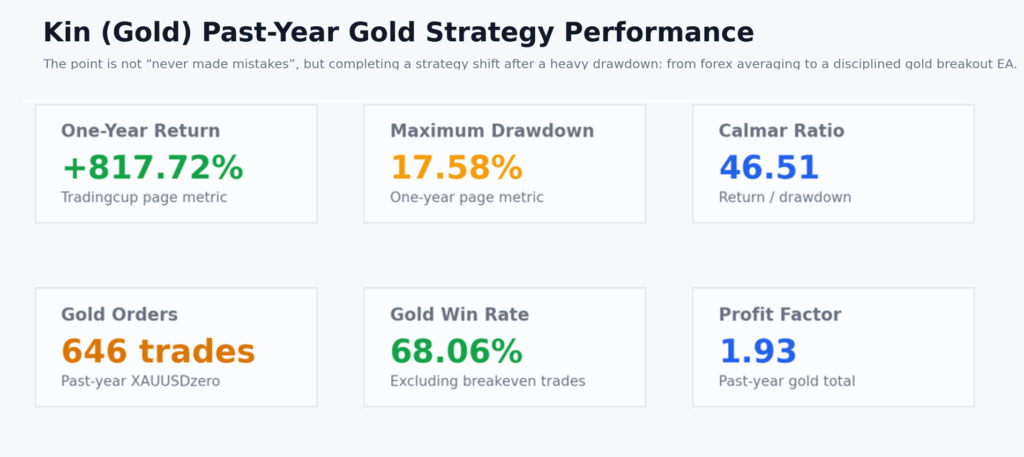
The return alone is already striking. But what gives this number real weight is the Calmar ratio behind it. In trading, the greatest concern is not earning too little, but taking an equally exaggerated drawdown to obtain those returns. Many signals look aggressive on the surface, but the performance may have been exchanged for very high risk.
What is more valuable about Kin (Gold) over the past year is that it has indeed remained aggressive, but not in an undisciplined way. A Calmar ratio of 46.51 suggests that, during this year of gold trading, it achieved very high return efficiency. Put simply, for each unit of drawdown endured, it generated far more return than an ordinary trading signal.
Why Was the Pivot to XAUUSD Considered a True Strategic Rebirth?
Early Kin (Gold) also made money, but the way it made money was not exactly elegant. In the EURUSD and GBPUSD forex trades from one year earlier, its win rate reached 77.81%, which looked even better than the past-year gold win rate of 68.06%. The problem was that the average profit/loss ratio of the early forex trades was only 0.41. In other words, it often made small profits, but a single loss could offset several winning trades.
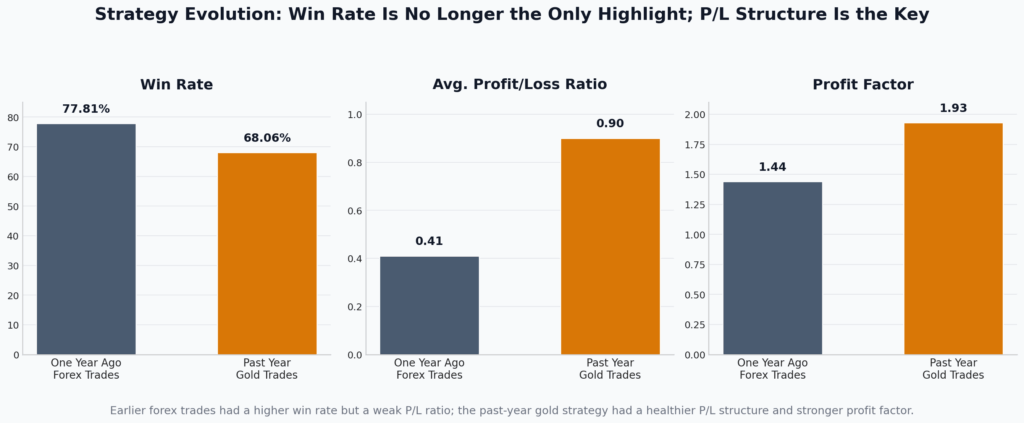
The gold strategy over the past year has been completely different. The average profit/loss ratio of gold trades rose to 0.90. Although the win rate was not as high as that of the early forex strategy, the quality of each trade improved, and the threat that losses posed to the account became more controllable. This is the signal’s “rebirth”: not making the win rate look prettier, but making the trading structure more robust.
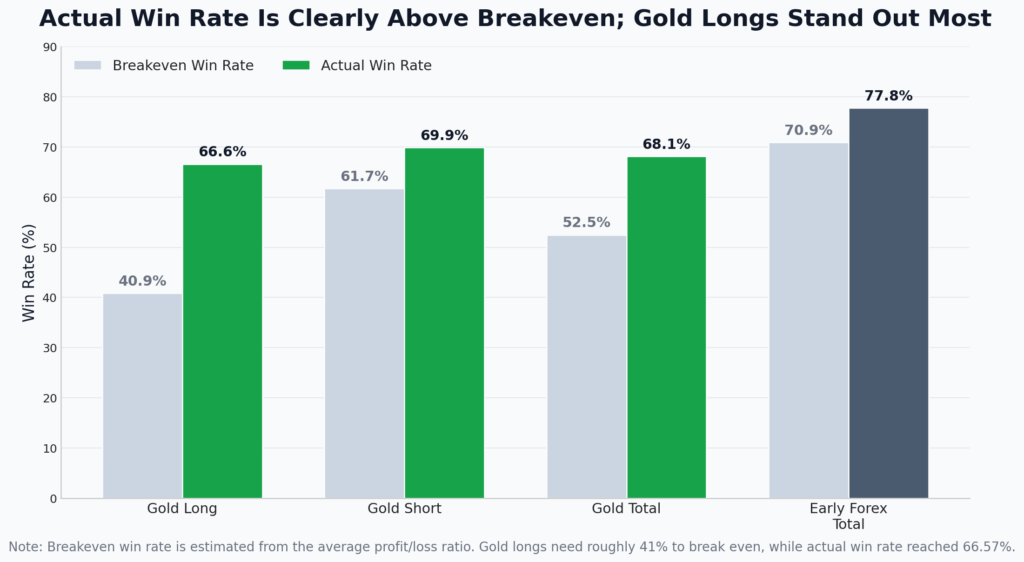
The clearest evidence comes from gold long positions. Over the past year, the average profit/loss ratio of gold longs was about 1.44. In theory, a win rate of only around 41% would be enough to break even, yet its actual win rate reached 66.57%. Gold short positions were also solid: the theoretical breakeven win rate was around 62%, while the actual win rate was about 69.93%. This indicates that Kin (Gold) did not rely purely on luck over the past year. It showed a clear edge in gold directional judgment and entry timing, especially on gold long positions, where its performance was particularly strong.
What Core Advantages Drive the Automated Gold Breakout Strategy?
From the order structure, Kin (Gold) used automated EA execution over the past year.
The style of this gold strategy is closer to a breakout approach. The signal sets Buy Stop or Sell Stop pending orders in advance and waits for gold prices to break key levels before entering. Gold itself is highly volatile and often carries strong trend momentum. Once a breakout is confirmed, meaningful room can be released within a short period. The median holding time of Kin (Gold) over the past year was only about 8 minutes, which shows that it is more focused on capturing ultra-short-term momentum than holding long-term trends.
How Does Strict Take-Profit and Stop-Loss Logic Enforce Trading Discipline?
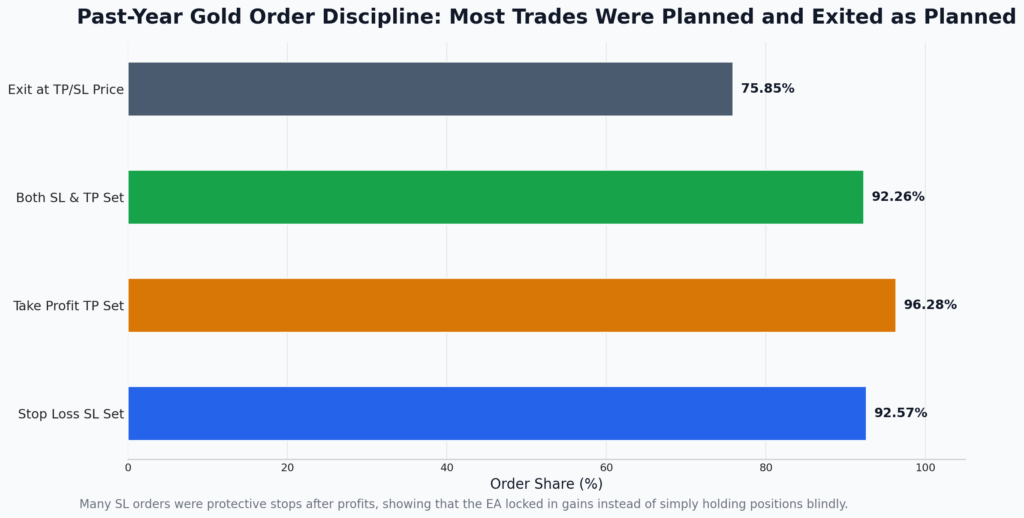
Many people evaluate trading signals only by return and win rate. But what truly determines whether a signal can be followed over the long run is often its exit discipline. In the past year of gold trading, Kin (Gold) had one detail that deserves particular credit: 92.26% of its orders were placed with both take-profit and stop-loss levels, and about 75.85% of orders ultimately exited at the corresponding TP/SL prices.
This means the current gold strategy is not closing positions randomly, nor is it holding losing trades stubbornly. Most trades were planned with take-profit and stop-loss levels before entry, and once triggered, the strategy exited according to rules. More specifically, many stop-losses were not simple loss-cutting stops. After the price moved into profit, the EA moved the stop-loss to a protective level in order to lock in gains. For copy traders, this is more important than a high win rate alone, because it shows that the strategy has boundaries, discipline, and a willingness to admit losses.
What Critical Risks Should Copy Traders Monitor in a Volatile Market?
The past-year performance of Kin (Gold) has been strong, but it may not be suitable for everyone.
First, the strategy is highly concentrated in gold, which means both returns and risks come from gold volatility. If gold enters a sideways market, the win rate may decline significantly. Based on the past-year maximum drawdown of 17.58% and potential changes in the fundamental environment for gold, anyone copying the signal should be psychologically prepared for a possible future drawdown of 30% to 40%.
Second, this is not a conservative signal. It is more suitable for traders who understand gold volatility, can accept the rhythm of a short-term EA strategy, and are willing to follow with reasonable position sizing. It is more like a fierce horse that has already been retrained: very fast, much more disciplined than before, but still requiring copy traders to control their capital allocation carefully.
Conclusion: Does the Evolution from Past Mistakes Justify Following the Signal?
The current Kin (Gold) is no longer the old signal that relied on reverse position-adding to gamble on probability.
Over the past year, its gold strategy has become lighter in position sizing, more disciplined, and more willing to accept losses according to rules. It remains an aggressive signal and is not suitable for those seeking low volatility. But if you can accept the natural volatility of gold trading and are looking for a more explosive gold trading signal on Tradingcup, Kin (Gold) is indeed worth adding to your watchlist.
Looking for the Best Copy Trading Strategy?
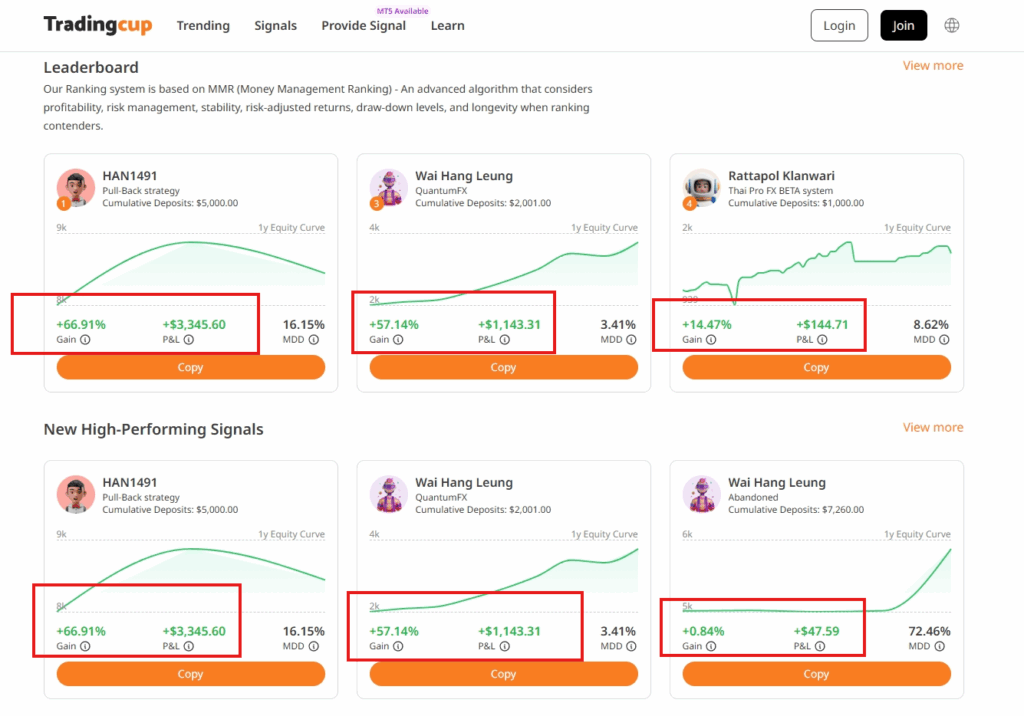
We’ve compiled a leaderboard of the most outstanding traders with excellent drawdown control and clear trading styles. This way, you’ll never feel lost when choosing who to follow and won’t blindly chase trends. Click to view the latest trader rankings and find out who is truly worth copying! Choose the right person, copy the right strategy, and from today, let copy trading truly create value for you.
Bonus Guide
What Makes an Effective Trading Portfolio?
- Diversification: Spread funds across various asset types (e.g., stocks, bonds, real estate, cash, precious metals) and industries/regions to reduce exposure to single-market volatility.
- Asset Allocation: Tailor allocations based on your risk tolerance, goals, and time horizon. Conservative portfolios emphasize fixed income, while aggressive ones lean into equities.
- Risk-Reward Balance: Each asset has different risk/return profiles. Ensure your portfolio avoids excessive exposure to high-risk or low-return assets.
- Low Correlation: Combine assets with correlations below 0.3 to enhance stability and provide a cushioning effect during market swings.
- Dynamic Rebalancing: Review and adjust your portfolio regularly as markets or personal goals change to stay aligned with your risk-return expectations.
- Clear Objectives: Define your financial goals (retirement, housing, education) before designing your strategy and time horizon.
- Discipline & Logic: Stick to your trading plan without emotional decision-making. Regularly reassess assumptions and market conditions.
(Disclaimer: This article is for informational and educational purposes only. It should not be considered financial advice. Always conduct your own research and consult with a qualified financial advisor before making any trading decisions.
For more detailed insights on developing daily trading routines, risk management, and effective position sizing strategies, explore additional articles on Trading Cup. Our trading experts at ACY and FinLogix are also great resources to guide your journey towards trading excellence.

Discover Our Best Trading Signals
At Tradingcup, you can browse through a selection of signals and review past performance before you decide to copy.
Become A Signal Provider
Share your expertise and become a signal provider so other traders can copy your trades.
Stay tuned to our blog for more trader spotlights and leaderboard updates.
Trading involves risks.
Visit the Tradingcup blog through the link below for more updates: https://www.tradingcup.com/learn
Related Copy Trading blogs:
- Understanding Market Liquidations: Liquidity Sweeps and Runs Explained
- 7 Essential Daily Habits of Successful Traders to Outperform Their Peers
- 10 Strategies You Can Copy off Our Best Copy Traders
- 5 Strategies Every Trader Can Master To Trade Better In A Trading Contest
- 2026 Copy Trading Scams Exposed: How to Spot Fraud
- A Swing Trading Strategy with an 83 Percent Win Rate and Low Drawdowns
- Forex Martingale Strategies Explained, The Good, The Bad and The Ugly
- Pyramiding Trading Tutorial – Pros & Cons & How to Use It
