Last Updated: April 6, 2025
This article is reviewed annually to reflect the latest market regulations and trends.
What is drawdown in forex trading? You place a few solid trades, confidence soaring until one big loss wipes out the week’s gains and shakes your trust in your system.
Sound familiar?
Let’s break down what drawdown means and how top traders use it as a compass, not a curse.
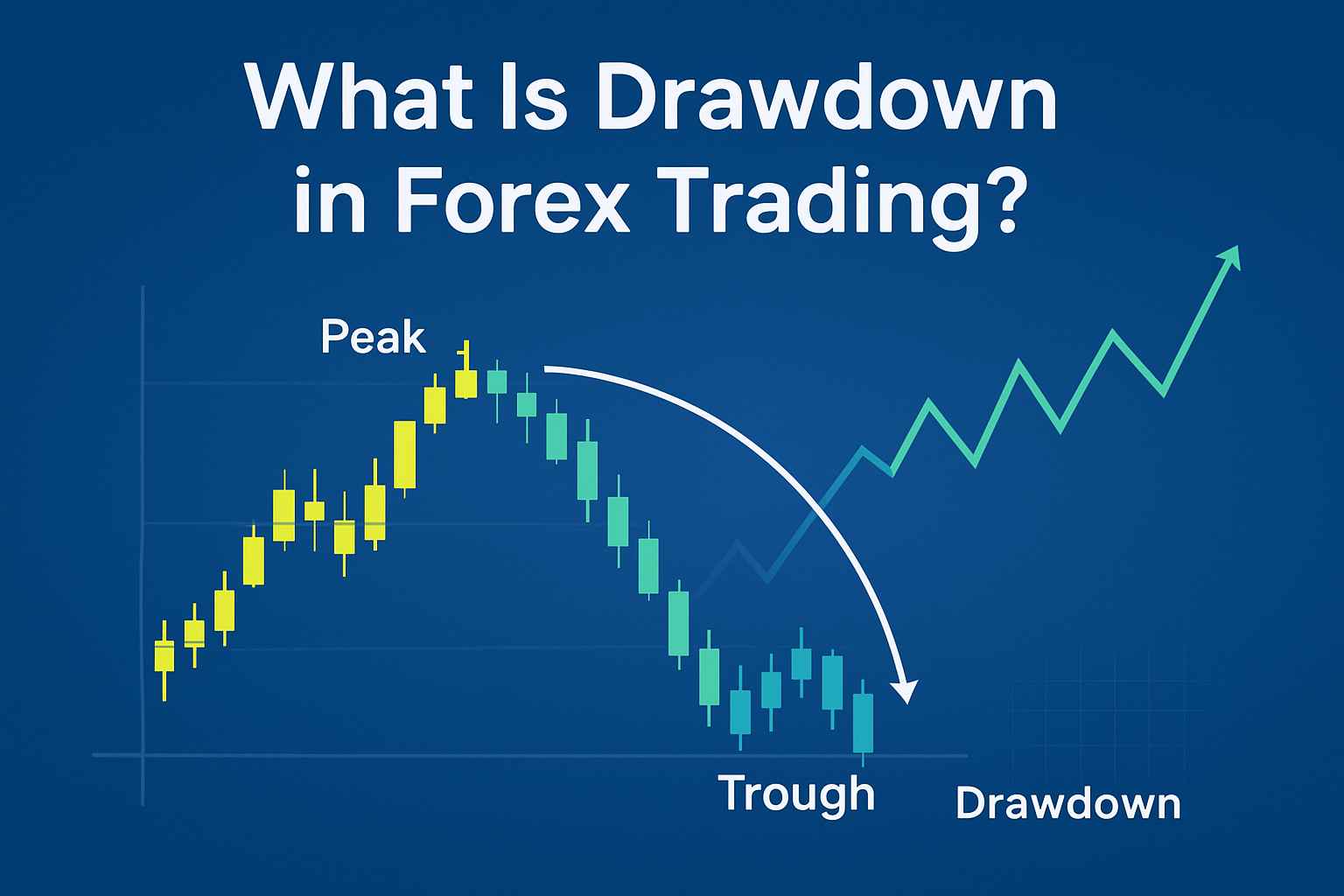
In simple terms, drawdown refers to the decline your trading account experiences from a peak to a trough, often measured as a percentage.
It’s not just about a single losing trade; it’s about the cumulative losses during a period of negative performance.
Understanding the maximum drawdown in your strategy is crucial, especially in forex trading, where volatility is high and emotional decisions can amplify risk.
Why Drawdown Analysis Matters for Every Forex Trader
But what does drawdown actually mean for a trader? It’s a clear reflection of your risk management practices and your risk tolerance.
Without a solid plan to mitigate drawdowns, even a strong strategy can spiral out of control. This is especially important when trading leveraged products like CFDs, where small market movements can have a big impact.
Whether you’re a beginner or an experienced trader, learning to embrace the peak to trough decline as a performance metric, not a failure, is one of the most empowering shifts you can make.
In this blog, we’ll explore the different types of drawdowns, how to calculate them, and the proven methods traders use to navigate tough periods and come back stronger.
Therefore, it is an essential measure of historical financial risk borne by a portfolio, which makes it a key figure to look at when comparing the performance of different trading fund management strategies.
It is also important to have a look at the time it takes to recover a drawdown when assessing different funds, also called the recovery window.
Understanding Drawdown in Trading and What Does it Mean

Definition of Drawdown
An inevitable part of the financial markets, a drawdown in trading represents a measure of a peak-to-trough decline of your investments or portfolio over a specific time once they have recovered.
The drawdown is often shown as a percentage, but it can also be expressed in absolute monetary terms.
It is important to highlight that a drawdown in trading isn’t the same as a loss – even though many traders see a drawdown as unrealised loss.
While a loss means that your exit price was lower than your entry price with long positions (or higher than your entry price with short positions), a drawdown is just a temporary peak-to-trough measure of a given position.
Formula for Drawdown
Drawdown (in percentage) = [ [(Historical high (peak) – Historical low (trough)] / Historical high (peak) ] * 100
Example of Drawdown
Let’s say you opened a trade on Gold (XAUUSD) at the opening price of 3131 on April 3, 2025. Just two trading days later, by April 7, the price had dropped to 2981 following a major geopolitical shock—President Trump announced sweeping tariffs on 165 countries, sparking a wave of uncertainty across global markets.
In this case, if Gold peaked at 3131 and then dropped to a trough of 2981 before recovering, your drawdown during this period would be:
Drawdown (in percentage) = [(3131 – 2981) / 3131] * 100 = 4.79%
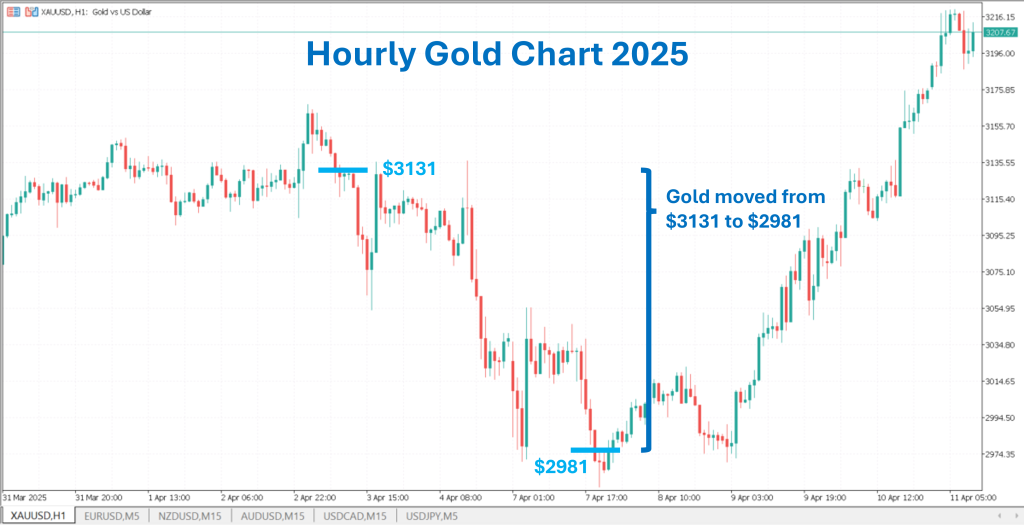
This example highlights how quickly drawdowns can occur in forex trading, especially during times of heightened market volatility.
Even strong assets like Gold can experience sharp price drops, underscoring the importance of managing risk effectively within your trading account.
How to Handle a Losing Streak: Managing Maximum Drawdown with Smart Stop-Loss Strategies
When you start trading in the forex market or trading CFDs, it’s exciting to think about winning trades and growing your account balance.
But what happens when things don’t go your way?
What if you hit a series of losing trades?
That’s where understanding maximum drawdown and using a smart stop loss strategy becomes super important.
Drawdown is essential to understand because it tells you how much your trading capital drops during a tough period.
Think of it like this. If your account hits a new peak of $5,000, but then drops to $4,000 before going back up, your drawdown is $1,000, or 20% drawdown as a percentage.
That’s the drop from the highest point to the lowest point during that time.
This drop is called a relative drawdown, and it helps you see how risky your trading style is during a specific period.
If you’re not careful and don’t use proper risk management, you could face severe drawdowns that are hard to recover from.
So how do you protect yourself?
- First, always use a stop loss. It’s like a safety net that closes your trade automatically if the market moves against you. This stops you from losing more than you planned.
- Second, control your risk per trade. A good rule is to risk only 1% to 2% of your trading capital on any single trade.
- Third, prepare for market volatility. Prices move fast, especially in the forex market. Having a plan helps you stay calm and avoid emotional trading or even worse, revenge trading, where you try to win back losses and end up making things worse.
If you don’t plan for the worst-case scenario, you might be surprised by large drawdowns and potential losses that damage your confidence and your account.
Understanding drawdown risk isn’t about being afraid to trade.
It’s about being smart.
By learning how to handle a losing streak the right way, you give yourself the best chance to grow your account steadily, even when things get tough.
Why Is Drawdown Important in Trading?
Knowing your drawdown in trading is essential for adjusting your risk and money management rules.
It helps improve your overall trading strategy and protects your investments from unnecessary exposure to risk.
For traders and investors using a copy trading solution, understanding drawdown is especially important.
Before copying a trader, looking at their drawdown history gives you insight into how much risk they take and how well they manage losing periods.
This can help you decide whether their strategy matches your risk tolerance.
Generally, a lower drawdown provides more confidence that the trader is managing their account responsibly, especially during volatile market conditions.
Our copy trading leaderboard showcases the Top 20 performing traders, including their exact drawdowns, trading history, and performance metrics.
This makes it easier for you to select a trader who not only has strong returns but also demonstrates consistent and disciplined risk management.
Whether you’re just starting or looking to diversify your portfolio, drawdown is a powerful tool to evaluate performance and protect your capital while following other traders.
How Can You Reduce Your Drawdown in Trading?

There is no one-size-fits-all answer to what a good drawdown in trading is, as it depends on many criteria, such as your risk aversion, your capital, your goals, and your strategy.
Still, it is often recommended to keep a drawdown in trading below 20%.
One of the best ways to reduce your drawdown in trading is to use diversification.
As you probably know, diversification is a key concept in modern portfolio theory that theoretically allows you to mitigate risks while increasing your overall profit by investing in different asset classes, currencies, financial products, sectors, countries, etc.
You can also carefully select the assets you focus on to avoid investing in too volatile markets that are likely to widen your drawdown in trading.
Money management tools can also help reduce your drawdown.
You can, for instance, adapt your leverage effect and the size of your trading positions to market conditions, as well as use tighter stop-loss orders and set-up take-profits.
Why a low drawdown is essential as a copy trading signal provider?
If you’re aiming to become a successful copy trading signal provider, one thing is clear, investors aren’t looking to follow high-risk trading strategies.
They’re searching for consistency, stability, and smart risk exposure.
That’s exactly why we built our Money Manager Ranking (MMR) system. The MMR highlights traders who can grow their accounts while keeping absolute drawdown and floating drawdown under control.
You won’t see traders boasting 200% returns sitting at the top of our leaderboard.
Why?
Because extreme returns usually come with large drawdowns that expose investors to unnecessary risk.
Instead, our leaderboard ranks traders who demonstrate a strong ability to manage risk and maintain a healthy trading account balance throughout each trading period.
As a signal provider, your number one goal should be to climb our leaderboard.
And to do that, you need to focus on managing drawdowns and achieving smart, sustainable growth.
That means using appropriate trade sizes, staying within your limits, and aiming for low-risk, high-reward setups that appeal to cautious but committed traders.
If your drawdown would cause your followers to panic or lose confidence, it’s time to adjust your strategy.
Think long-term.
Traders who keep their future drawdowns low and balance their trading goals with careful risk management are the ones who gain more followers and increase their income.
Don’t try to be a hero.
Stay focused, trade smart, and build trust through consistent performance.
The path to becoming a top signal provider starts with a low-drawdown approach that shows you respect both the market and your investors’ capital.
Click here to register an account.
For more detailed insights on developing daily trading routines, risk management, and effective position sizing strategies, explore additional articles on Tradingcup.
Related Copy Trading blogs:
- Understanding Market Liquidations: Liquidity Sweeps and Runs Explained
- 7 Essential Daily Habits of Successful Traders to Outperform Their Peers
- 10 Strategies You Can Copy off Our Best Copy Traders
- 5 Strategies Every Trader Can Master To Trade Better In A Trading Contest
- 2025 Copy Trading Scams Exposed: How to Spot Fraud
- A Swing Trading Strategy with an 83 Percent Win Rate and Low Drawdowns
- Forex Martingale Strategies Explained, The Good, The Bad and The Ugly
- Pyramiding Trading Tutorial – Pros & Cons & How to Use It
Our trading experts at ACY and FinLogix are also great resources to guide your journey towards trading excellence.

Discover Our Best Trading Signals
At Tradingcup, you can browse through a selection of signals and review past performance before you decide to copy.
Become A Signal Provider
Share your expertise and become a signal provider so other traders can copy your trades.
Stay tuned to our blog for more trader spotlights and leaderboard updates.
Trading involves risks.
Visit the Tradingcup blog through the link below for more updates: