Last Updated: February 25, 2026
This article is reviewed annually to reflect the latest market regulations and trends.
TL; DR
- Breakout Trading Explained: A strategy capitalizing on strong price movements when an asset breaks key support or resistance levels, offering high-reward potential.
- Tech & Popularity: Advanced AI, algorithmic tools, and endorsements from figures like Timothy Sykes have boosted its popularity and accessibility.
- Risk vs. Reward: While offering substantial returns, breakout trading carries risks like false breakouts (“fakeouts”), demanding robust risk management.
- Copy Trading Potential: Following experienced breakout traders can be a shortcut, but requires due diligence, understanding their strategy, and assessing costs vs. benefits.
- Informed Decisions: Success hinges on continuous learning, disciplined execution, and adapting strategies to evolving market conditions for smarter money protection.
Disclaimer: The information in this article is for educational purposes only and does not constitute financial, investment, or trading advice. Copy trading carries substantial risks, including the potential loss of your entire invested capital. Past performance of copied traders or strategies is not a reliable indicator of future results. You may be replicating high-risk trades, overleveraged positions, or strategies incompatible with your financial goals. Always conduct independent research into a trader’s historical performance, risk metrics, and strategy before copying them. Never invest funds you cannot afford to lose. Consult a licensed financial advisor to ensure copy trading aligns with your risk tolerance, financial objectives, and regulatory requirements in your jurisdiction. This article does not endorse specific traders, platforms, or strategies, and all trading decisions remain your sole responsibility.

“The investor’s chief problem, and even his worst enemy, is likely to be himself.” – Benjamin Graham
The Ultimate Guide to Breakout Trading Strategy: Could Copying Be Your Edge in 2026?

The financial markets are a battlefield of strategies, a relentless quest for an edge. Among the arsenal available to traders, the breakout trading strategy has emerged as a popular, albeit challenging, approach. It promises the thrill of catching a wave just as it forms, riding significant price surges for potentially handsome profits. But is it all smooth sailing? And in an era of information overload and expert claims, could copy trading a seasoned breakout specialist be the key to unlocking consistent returns while safeguarding your hard-earned capital?
This comprehensive guide dives deep into the anatomy of breakout trading. We’ll dissect why it’s gained traction, trace its evolution, weigh its costs against its benefits, and arm beginners with actionable advice. Furthermore, we’ll explore the intriguing possibility of mirroring experts, analyzing a real-world breakout trader, and even glean wisdom from trading legends and timeless charting techniques.
So, What Exactly is This “Breakout Trading Strategy” Everyone’s Talking About?
At its heart, a breakout trading strategy involves identifying key levels of support (a price level where a downtrend can be expected to pause due to a concentration of demand) and resistance (a price level where an uptrend can be expected to pause temporarily, due to a concentration of supply). A “breakout” occurs when the price of an asset decisively moves beyond these established levels.
Traders employing this strategy anticipate that once a price breaks through such a barrier, it will continue to move in that direction, often with strong momentum. The goal is to enter the trade as the breakout happens and ride the subsequent trend. Think of it like a dam bursting – once the barrier gives way, the water (price) rushes out with force.
Key elements include:
- Identifying Key Levels: This is foundational. Traders use historical price data, trendlines, chart patterns (like triangles, flags, ranges), and technical indicators to pinpoint significant support and resistance zones.
- Confirmation Signals: A true breakout is often, though not always, accompanied by a surge in trading volume, indicating strong conviction behind the move. Other confirmations might include momentum indicators or the nature of the candlestick patterns at the breakout point.
- Entry and Exit Points: Precisely timing the entry (as the breakout occurs or on a retest of the broken level) and setting clear profit targets and stop-loss orders are crucial for managing risk.
Why Has Breakout Trading Captured the Market’s Attention?
The allure of breakout trading isn’t accidental; several factors have contributed to its widespread adoption:
- Capitalizing on Momentum: Its core appeal lies in the ability to latch onto strong, often rapid, price movements, offering the potential for high-reward opportunities in a relatively short timeframe.
- Simplicity and Adaptability: The basic concept is straightforward and can be applied across diverse markets, including stocks, forex, commodities, and cryptocurrencies, and on various timeframes.
- Technological Advancements: The rise of sophisticated trading platforms, AI-powered analytics, and algorithmic tools has significantly refined breakout trading. These technologies help filter out false signals, improve precision in identifying levels, and automate execution, making the strategy more accessible and seemingly reliable.
- Influencer Endorsements: Prominent trading educators and figures, like Timothy Sykes, have popularized breakout strategies through educational programs emphasizing disciplined execution. Thought leaders like JIN advocate for integrating advanced tech like ultra-fast data processing into breakout systems. Mike Blackie’s recommendation of tools like the ‘1000pip Climber’ system further validates its effectiveness, especially on shorter timeframes.
- Marketing and Education: Targeted marketing campaigns by brokers and educational platforms have demystified breakout trading, providing actionable insights and making it approachable for novices while appealing to seasoned pros seeking systematic improvements.
This combination of high-reward potential, conceptual simplicity (at least on the surface), technological support, and community endorsement has cemented breakout trading’s place in the modern trader’s toolkit.
A Decade in the Making: The Evolution of Breakout Trading (Pre-2015 to 2026)
Breakout trading isn’t a new kid on the block; its roots trace back to systematic approaches like the famed Turtle Trading system of the 1980s. However, the last decade (and a bit beyond) has witnessed a significant transformation:
- Pre-2015: Foundational Principles
- The Turtle Trading system, a trend-following strategy, laid some of the groundwork by emphasizing buying new highs and selling new lows – essentially a form of breakout trading. This period established the core idea of trading with momentum once key levels were breached.
- The Turtle Trading system, a trend-following strategy, laid some of the groundwork by emphasizing buying new highs and selling new lows – essentially a form of breakout trading. This period established the core idea of trading with momentum once key levels were breached.
- 2015 – 2018: The Algorithmic Ascent
- This era saw an increased adoption of algorithmic trading. For breakout traders, this meant improved signal accuracy as algorithms could scan more data and identify patterns faster than humans. However, it also introduced complexity and the challenge of “algo-driven” false breakouts.
- This era saw an increased adoption of algorithmic trading. For breakout traders, this meant improved signal accuracy as algorithms could scan more data and identify patterns faster than humans. However, it also introduced complexity and the challenge of “algo-driven” false breakouts.
- 2019 – 2021: The Dawn of AI-Assisted Analytics
- The rise of AI-assisted analytics brought enhanced capabilities in detecting true versus false breakouts. Machine learning models began to be incorporated to process vast datasets, including microsecond-level information, for more timely entries and exits.
- The rise of AI-assisted analytics brought enhanced capabilities in detecting true versus false breakouts. Machine learning models began to be incorporated to process vast datasets, including microsecond-level information, for more timely entries and exits.
- 2022 – 2025: Deep Learning, HFT Mitigation, and Geopolitical Impact
- Current strategies involve the integration of deep learning and tools to mitigate the impact of High-Frequency Trading (HFT), aiming for strengthened reliability in volatile markets.
- Geopolitical events (trade disputes, pandemics, conflicts) have significantly increased market volatility, creating more breakout opportunities. For example, the COVID-19 pandemic led to sharp moves in safe-haven currencies and commodity-dependent currencies, while the Russia-Ukraine conflict caused dramatic spikes in energy prices.
- Technological progress has democratized access to sophisticated tools like chart pattern recognition systems, moving averages, Bollinger Bands, and RSI for retail traders.
- However, the prevalence of HFT firms employing scalping algorithms continues to pose challenges through artificial volatility, exacerbating false breakouts. This necessitates robust risk management.
- Current strategies involve the integration of deep learning and tools to mitigate the impact of High-Frequency Trading (HFT), aiming for strengthened reliability in volatile markets.
This evolution highlights a continuous arms race: as markets become more complex and algorithm-driven, breakout strategies must adapt, leveraging technology while emphasizing timeless principles of risk management and confirmation.
Navigating the Terrain: Key Factors to Heed When Trading This Strategy

Before diving headfirst into breakout trading, several critical factors demand your attention. Ignoring them is like sailing into a storm without checking the weather forecast.
- Volume Confirmation: The Unsung Hero?
- A breakout occurring on low volume is often a red flag – it might be a “fakeout.” Genuine breakouts are typically accompanied by a significant surge in trading volume, indicating strong conviction and participation behind the price move. Some sources suggest volume should be three to four times higher than prior periods for strong validation.
- A breakout occurring on low volume is often a red flag – it might be a “fakeout.” Genuine breakouts are typically accompanied by a significant surge in trading volume, indicating strong conviction and participation behind the price move. Some sources suggest volume should be three to four times higher than prior periods for strong validation.
- Market Context and Volatility: Is the Environment Right?
- Breakout strategies tend to thrive in trending markets with good volatility. In choppy, range-bound, or low-liquidity markets, the probability of false breakouts increases significantly. Geopolitical uncertainties can also create unpredictable reversals.
- Breakout strategies tend to thrive in trending markets with good volatility. In choppy, range-bound, or low-liquidity markets, the probability of false breakouts increases significantly. Geopolitical uncertainties can also create unpredictable reversals.
- Timeframe Analysis: Seeing the Bigger Picture?
- Analyzing multiple timeframes can provide a clearer perspective. A breakout on a 15-minute chart might be more reliable if it aligns with the prevailing trend on a 4-hour or daily chart.
- Analyzing multiple timeframes can provide a clearer perspective. A breakout on a 15-minute chart might be more reliable if it aligns with the prevailing trend on a 4-hour or daily chart.
- The Nature of the Asset: Does It Tend to Break Cleanly?
- Some assets are more prone to clean breakouts than others. Illiquid stocks or highly manipulated assets might exhibit erratic behavior, making breakout trading riskier.
- Some assets are more prone to clean breakouts than others. Illiquid stocks or highly manipulated assets might exhibit erratic behavior, making breakout trading riskier.
- News and Catalysts: What’s Driving the Move?
- Breakouts can be triggered by significant news events, earnings reports, or economic data releases. Understanding the catalyst can provide insight into the potential sustainability of the breakout. Tools like StocksToTrade’s Breaking News Chat can offer real-time alerts.
- Breakouts can be triggered by significant news events, earnings reports, or economic data releases. Understanding the catalyst can provide insight into the potential sustainability of the breakout. Tools like StocksToTrade’s Breaking News Chat can offer real-time alerts.
- Patience and Discipline: Are You in Control?
- The fear of missing out (FOMO) can lead to premature entries, while fear of loss can cause early exits. Waiting for confirmation (e.g., a retest of the breakout level or a strong follow-through candle) and adhering to a predefined trading plan are crucial.
- The fear of missing out (FOMO) can lead to premature entries, while fear of loss can cause early exits. Waiting for confirmation (e.g., a retest of the breakout level or a strong follow-through candle) and adhering to a predefined trading plan are crucial.
- Risk Management Protocols: Your Financial Life Vest?
- This cannot be overstated. Predefined stop-loss levels, appropriate position sizing (e.g., risking only 1-2% of capital per trade), and a favorable reward-to-risk ratio (e.g., minimum 2:1) are non-negotiable.
- This cannot be overstated. Predefined stop-loss levels, appropriate position sizing (e.g., risking only 1-2% of capital per trade), and a favorable reward-to-risk ratio (e.g., minimum 2:1) are non-negotiable.
Considering these factors will help you filter out lower-probability setups and focus on breakouts with a higher chance of success, ultimately protecting your capital.
Beyond the Basics: Popular Strategies to Amplify Your Breakout Trades

While the core concept of breakout trading is simple, traders often combine it with other techniques and analyses to improve its efficacy.
- Chart Pattern Breakouts:
- This is a classic. Traders look for well-defined chart patterns like:
- Triangles (Ascending, Descending, Symmetrical): Price consolidates within converging trendlines before breaking out.
- Flags and Pennants: Short-term continuation patterns that form after a sharp price move, followed by a breakout in the direction of the prior trend.
- Rectangles (Ranges): Price trades sideways between horizontal support and resistance before breaking out.
- Head and Shoulders (and Inverse): Reversal patterns that can signal a breakout against the prevailing trend.
- Cup and Handle: A bullish continuation pattern.
- Triangles (Ascending, Descending, Symmetrical): Price consolidates within converging trendlines before breaking out.
- The clearer the pattern and the longer it has taken to form, the more significant the subsequent breakout can be.
- This is a classic. Traders look for well-defined chart patterns like:
- News-Driven Breakouts & Deep Analysis:
- Major economic news releases (e.g., interest rate decisions, employment data, GDP figures), company-specific news (earnings, M&A), or geopolitical developments can trigger powerful breakouts.
- Deep Analysis Involves:
- Anticipation: Understanding scheduled news events and their potential market impact.
- Reaction: Observing the immediate price reaction and volume surge upon news release.
- Confirmation: Waiting for the initial volatility to settle and for a clear directional breakout with confirming volume before entering.
- Fundamental Context: Understanding if the news fundamentally changes the outlook for the asset, suggesting a sustainable trend.
- Anticipation: Understanding scheduled news events and their potential market impact.
- This requires being quick but not impulsive, and having access to real-time news feeds.
- Major economic news releases (e.g., interest rate decisions, employment data, GDP figures), company-specific news (earnings, M&A), or geopolitical developments can trigger powerful breakouts.
- Moving Average Crossovers & Breakouts:
- Traders might look for a price breakout above/below a key moving average (e.g., 50-day or 200-day MA).
- Alternatively, a breakout might be confirmed if, for example, a shorter-term MA crosses above a longer-term MA (a “golden cross”) around the same time as the price breakout.
- Traders might look for a price breakout above/below a key moving average (e.g., 50-day or 200-day MA).
- Volatility Breakouts (e.g., Bollinger Bands):
- Bollinger Bands consist of a moving average plus upper and lower bands set at a certain number of standard deviations away. A “Bollinger Squeeze” occurs when volatility is low, and the bands contract. A price breakout above the upper band or below the lower band after a squeeze can signal the start of a significant move.
- Bollinger Bands consist of a moving average plus upper and lower bands set at a certain number of standard deviations away. A “Bollinger Squeeze” occurs when volatility is low, and the bands contract. A price breakout above the upper band or below the lower band after a squeeze can signal the start of a significant move.
- RSI & Other Oscillator Divergence Breakouts:
- While RSI is often used to identify overbought/oversold conditions, divergence can precede breakouts. For example, if the price makes a new high but the RSI fails to make a new high (bearish divergence), it could warn of a weakening uptrend, and a subsequent break of support might be more significant.
- While RSI is often used to identify overbought/oversold conditions, divergence can precede breakouts. For example, if the price makes a new high but the RSI fails to make a new high (bearish divergence), it could warn of a weakening uptrend, and a subsequent break of support might be more significant.
- Multi-Timeframe Confirmation:
- As mentioned earlier, confirming a breakout signal on a shorter timeframe with the broader trend context on higher timeframes can increase confidence. For instance, a bullish breakout on an hourly chart is generally more robust if the daily and weekly charts also show bullish momentum.
- As mentioned earlier, confirming a breakout signal on a shorter timeframe with the broader trend context on higher timeframes can increase confidence. For instance, a bullish breakout on an hourly chart is generally more robust if the daily and weekly charts also show bullish momentum.
The key is not to clutter your charts with too many indicators (“paralysis by analysis”) but to find a combination that makes sense to you and that you can apply consistently.
Is Breakout Trading Worth The Risk? A Cost-Benefit Analysis
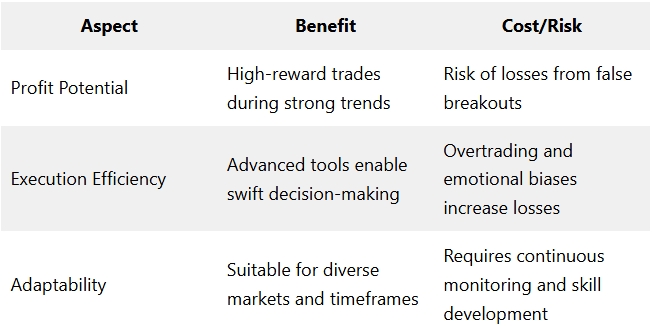
Every trading strategy involves a trade-off between potential rewards and inherent risks and costs. Breakout trading is no exception.
The “Benefit” Side of the Ledger:
- High-Reward Potential: The primary allure. Successful breakouts can lead to rapid and substantial profits as you catch the beginning of a strong trend.
- Clear Entry/Exit Points: Well-defined support/resistance levels and patterns can offer relatively clear signals for entry, stop-loss placement, and initial profit targets.
- Adaptability: The strategy can be applied to various markets (stocks, forex, commodities) and timeframes.
- Technological Support: Modern tools and platforms can aid in identifying setups, managing trades, and even automating execution.
The “Cost/Risk” Side of the Ledger:
- False Breakouts (Fakeouts): This is the Achilles’ heel of breakout trading. Prices can pierce a key level only to reverse sharply, trapping enthusiastic traders. High-frequency trading (HFT) firms can exacerbate this by creating artificial volatility.
- Whipsaws in Choppy Markets: In non-trending, range-bound markets, breakout attempts often fail, leading to a series of small losses (“death by a thousand cuts”).
- Precise Timing Required: Entering too early can lead to being caught in a false breakout; entering too late can significantly reduce the reward-to-risk ratio.
- Brokerage Fees and Slippage:
- Brokerage Fees: Commissions and spreads can eat into profits, especially for active breakout traders who might make multiple trades.
- Slippage: This is the difference between the expected price of a trade and the price at which the trade is actually executed. During fast-moving breakouts, slippage can be significant, especially in volatile or less liquid markets, negatively impacting your entry or stop-loss execution. Competitive margin rates, like those from Interactive Brokers (starting at 7.33% in one example), versus higher rates (e.g., Charles Schwab’s 13.575% for smaller accounts) also impact overall cost, especially if leverage is used.
- Brokerage Fees: Commissions and spreads can eat into profits, especially for active breakout traders who might make multiple trades.
- Time Investment: Effective breakout trading requires diligent market monitoring, chart analysis, and patience to wait for high-probability setups. This isn’t a “set and forget” strategy for most.
- Psychological Pressure: The fear of missing out (FOMO) on a big move, or the frustration of repeated false breakouts, can lead to emotional decision-making and deviations from the trading plan.
The Verdict?
Breakout trading can be profitable, but its success heavily depends on:
- Rigorous Risk Management: Non-negotiable. Using stop-losses, managing position size, and aiming for a good reward-to-risk ratio (e.g., at least 2:1) are crucial to surviving false breakouts and ensuring long-term viability.
- Confirmation Techniques: Not jumping the gun. Waiting for volume confirmation, a retest of the breakout level, or a strong closing candle beyond the level can filter out many false signals.
- Adaptability and Continuous Learning: Markets evolve, so must your approach. What worked yesterday might not work tomorrow.
- Realistic Expectations: Not every breakout will be a home run. Focusing on consistent execution and managing losses effectively is key.
While leveraging margin can amplify returns, it equally amplifies risks if not managed with extreme discipline.
From Novice to Navigator: Your Compass for Starting with Breakout Trading
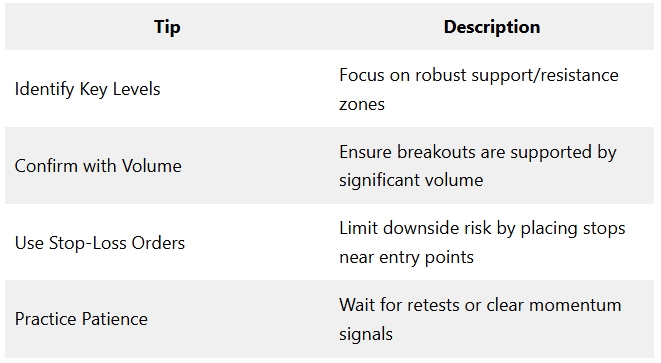
If you’re a beginner keen on exploring breakout trading, a structured approach is paramount. Jumping in unprepared is a recipe for disappointment.
- Build a Strong Foundation:
- Understand Support and Resistance: Learn to identify these key levels accurately using historical price action, trendlines, and round numbers.
- Master Chart Patterns: Familiarize yourself with common breakout patterns: triangles, ranges, flags, head and shoulders.
- Learn Technical Indicators: Understand how to use volume, moving averages (e.g., 50-day, 200-day), and oscillators like the RSI to confirm breakouts and gauge momentum.
- Understand Support and Resistance: Learn to identify these key levels accurately using historical price action, trendlines, and round numbers.
- Develop a Trading Plan: This is your roadmap. It should clearly define:
- What constitutes a breakout signal for you?
- Which markets and timeframes will you focus on?
- Your entry rules (e.g., on the break, after a retest, on a strong closing candle).
- Your exit rules (stop-loss placement, profit targets).
- Your risk management rules (e.g., max risk per trade, max drawdown).
- What constitutes a breakout signal for you?
- Prioritize Risk Management from Day One:
- Use Stop-Loss Orders: Always. Place them strategically, for instance, below the pattern for an upward breakout or just beyond the breakout level, to limit potential losses if the trade goes against you.
- Position Sizing: Risk only a small percentage of your trading capital on any single trade (1-2% is often recommended).
- Aim for a Positive Reward-to-Risk Ratio: Seek trades where the potential profit is at least twice the potential loss (e.g., 2:1 or 3:1).
- Use Stop-Loss Orders: Always. Place them strategically, for instance, below the pattern for an upward breakout or just beyond the breakout level, to limit potential losses if the trade goes against you.
- Confirmation is Key – Be Patient!
- Volume, Volume, Volume: Look for a significant increase in volume to confirm the breakout’s validity. Low-volume breakouts are often traps.
- Wait for a Retest (Optional but Safer): Some traders wait for the price to break out and then return to “retest” the broken level as new support (in an uptrend) or resistance (in a downtrend) before entering. This reduces the chance of being caught in a fakeout but can mean missing some of the initial move.
- Candlestick Confirmation: Look for strong, decisive candles closing beyond the breakout level.
- Volume, Volume, Volume: Look for a significant increase in volume to confirm the breakout’s validity. Low-volume breakouts are often traps.
- Choose the Right Tools and Platform:
- Select a broker and platform that offers good charting tools, reliable execution, and the order types you need (e.g., bracket orders for simultaneous stop-loss and take-profit).
- Tools like ACY Trading Platform are also popular for charting and analysis.
- Select a broker and platform that offers good charting tools, reliable execution, and the order types you need (e.g., bracket orders for simultaneous stop-loss and take-profit).
- Practice, Practice, Practice:
- Demo Trading: Use a demo account to practice your strategy without risking real money. This allows you to get a feel for market dynamics, test your plan, and build confidence.
- Start Small: When you do go live, start with small position sizes.
- Demo Trading: Use a demo account to practice your strategy without risking real money. This allows you to get a feel for market dynamics, test your plan, and build confidence.
- Continuous Learning and Adaptation:
- The markets are always changing. Stay curious, keep learning, and be prepared to adapt your strategy.
- Follow reputable trading educators (the document mentions Timothy Sykes as one who provides resources ), read books, and analyze your trades (both winners and losers) to identify areas for improvement.
- The markets are always changing. Stay curious, keep learning, and be prepared to adapt your strategy.
- Cultivate Discipline and Patience:
- Stick to your trading plan. Don’t let emotions like fear or greed dictate your actions.
- Patience is required to wait for high-quality setups; not every potential breakout is worth trading.
- Stick to your trading plan. Don’t let emotions like fear or greed dictate your actions.
What Are the Real Benefits of Embracing Breakout Trading?

Beyond the obvious profit potential, successfully implementing a breakout strategy can bring several advantages:
- Capturing Significant Price Moves: This is the primary benefit – the ability to participate in strong, often extended, trends from an early stage.
- Defined Risk and Reward: When executed correctly with proper stop-losses and profit targets, the risk on each trade can be predefined, allowing for calculated reward-to-risk assessments.
- Systematic Approach: Breakout trading can be implemented as part of a rule-based system, which can help reduce emotional decision-making and improve consistency.
- Versatility Across Timeframes: Whether you’re a day trader looking for quick scalps or a swing trader holding for days/weeks, breakout principles can be adapted.
- Learning Market Dynamics: Practicing breakout trading forces you to understand concepts like support/resistance, volume analysis, market psychology, and the impact of news – valuable knowledge for any trader.
- Potential for Quick Rewards: Unlike some longer-term strategies, successful breakouts can yield profits relatively quickly as momentum picks up.
- Empowerment Through Technology: Modern AI and algorithmic tools can augment a trader’s ability to scan markets, identify setups, and manage trades more efficiently.
However, these benefits are only realized through disciplined application, robust risk management, and an understanding of the strategy’s inherent limitations, particularly the ever-present risk of false breakouts.
The Wisdom of BNF: Takashi Kotegawa’s Perspective on Copy Trading and Breakout Strategies

Takashi Kotegawa, famously known as “BNF” (or “J-Com man” after a legendary trading error he capitalized on), is a Japanese day trader who reportedly turned around $13,600 into over $200 million. While he is notoriously private and doesn’t offer courses or direct copy trading services, his approach, gleaned from interviews and analysis, offers valuable insights relevant to breakout trading and the idea of following successful traders.
BNF’s Likely Stance on Breakout Trading:
- Focus on Short-Term Momentum & Reversals: BNF primarily focused on short-term price movements, often looking for oversold stocks poised for a rebound or stocks breaking out from short-term consolidation. This aligns with the core idea of breakout trading – capitalizing on shifts in supply and demand.
- Divergence and Key Levels: He was known to look for divergence between price action and indicators (like the RSI) and paid close attention to support and resistance levels on multiple timeframes. Breakouts from these levels would have been key signals.
- Volume Analysis: While not explicitly detailed, most successful short-term traders, including those looking for breakouts, heavily rely on volume to confirm the strength of a move. It’s highly probable volume was a key component of his analysis.
- Adaptability: BNF stressed the importance of adapting to changing market conditions. A breakout strategy that works in one market environment might fail in another. He constantly refined his methods.
BNF’s Likely Stance on Copy Trading:
- Skepticism towards Blind Copying: Given his individualistic and highly adaptive approach, it’s unlikely BNF would endorse blindly copying another trader. He emphasized understanding the why behind market moves, not just following signals.
- Learning from Others, But Developing Your Own Edge: While he studied successful investors, his success came from developing his own unique feel for the market and specific setups. He might advocate learning principles from successful breakout traders but insist that each individual must tailor strategies to their own psychology, risk tolerance, and understanding.
- The “Feel” is Hard to Copy: A significant part of BNF’s success was attributed to his intuitive “feel” for market momentum and turning points. This kind of intuition is developed through intense focus, experience, and constant self-analysis – qualities that cannot be directly copied
. - Risk Management is Personal: BNF was known for cutting losses quickly. While this is a principle that can be copied, the precise execution and psychological fortitude to do so consistently are deeply personal.
In essence, while BNF’s strategies likely incorporated elements of breakout trading (identifying shifts in momentum from key levels), his philosophy would probably caution against relying solely on copy trading. He’d likely stress the importance of deep market understanding, adaptability, and developing one’s own edge through rigorous self-improvement and market observation.
Illuminating Insights: 10 Lessons from “Japanese Candlestick Charting Techniques” for Breakout Success

Steve Nison’s “Japanese Candlestick Charting Techniques” is a seminal work that revolutionized how Western traders view price action. Candlestick patterns offer a visual representation of market psychology and can be incredibly powerful for confirming or refuting breakout signals.
Here are 10 lessons from the book, highly relevant to breakout traders:
- Candles Tell a Story: Each candle (its body, wicks, and color) reveals the battle between buyers and sellers during a specific period. A long white (or green) marubozu at a breakout point signals strong buying pressure and conviction.
- Confirmation is Key: Don’t trade on a single candle pattern in isolation. Look for confirmation from subsequent candles, volume, or other indicators. A breakout candle should ideally be followed by more candles in the same direction.
- The Power of Volume: Nison emphasizes that strong candlestick patterns are more reliable when accompanied by high volume, especially at breakout points. This aligns perfectly with a core tenet of breakout trading.
- Windows (Gaps) as Support/Resistance: Gaps on a chart (called “windows” in candlestick terminology) can act as powerful support or resistance levels. A breakout through a window often signifies a strong move.
- Identifying Reversal Patterns at Key Levels: Before a breakout, the price might form candlestick reversal patterns (like Dojis, Hammers, Engulfing patterns) near support or resistance. Recognizing these can help anticipate potential breakout direction or failure.
- The Significance of Long Wicks (Shadows): Long upper wicks near resistance suggest selling pressure and a potential failed breakout. Long lower wicks near support indicate buying pressure and a potential successful breakout or support hold.
- Continuation Patterns: Candlestick patterns like “Rising Three Methods” or “Falling Three Methods” can confirm that a trend (and thus a breakout in that trend’s direction) is likely to continue.
- The Psychology Behind Patterns: Understanding why certain patterns form (e.g., a bullish engulfing pattern shows buyers have overwhelmed sellers) gives deeper insight than rote memorization. This helps in judging the quality of a breakout.
- Combining Candles with Western Technicals: Nison advocates using candlesticks in conjunction with Western technical tools like trendlines, moving averages, and oscillators (like RSI) for a more robust analysis. This is directly applicable to confirming breakouts.
- Patience and Objectivity: Candlestick analysis, like all technical analysis, requires patience to wait for clear signals and objectivity to interpret them without bias. This is crucial when waiting for a breakout to confirm.
By integrating these candlestick lessons, breakout traders can gain a much deeper understanding of the price action at critical support and resistance levels, helping to filter out false signals and improve the timing of their entries and exits.
The Copy Trading Angle: Could Mirroring Be Your Shortcut?
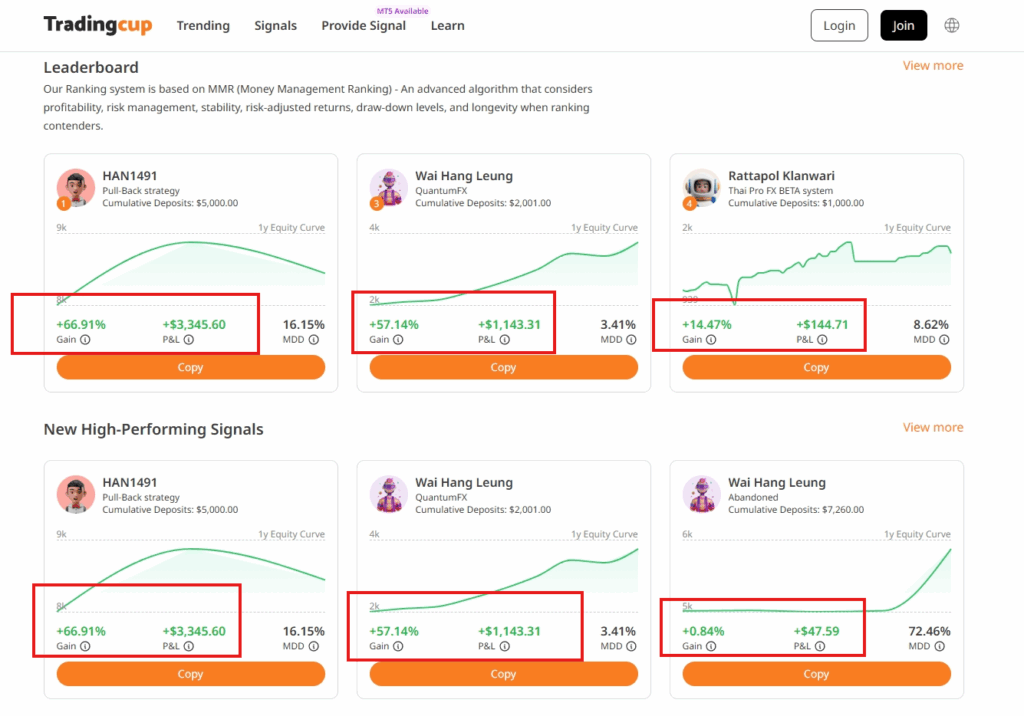
Copy trading, where you automatically replicate the trades of experienced traders in your own account, has gained immense popularity. For those daunted by the complexities of breakout trading or lacking the time to dedicate to analysis, it seems like an attractive shortcut.
Potential Benefits of Copying a Breakout Trader:
- Access to Expertise: You can potentially benefit from the skills, experience, and strategies of a seasoned breakout trader without needing to develop them yourself.
- Time-Saving: It automates the trading process, freeing you from constant market monitoring and analysis.
- Learning Opportunity: By observing the trades and (if available) the rationale of the copied trader, you might learn more about breakout strategies.
- Diversification: You could potentially diversify your own trading efforts by allocating a portion of your capital to copy a breakout specialist.
- Reduced Emotional Trading: Since trades are copied automatically, it can help mitigate the impact of your own emotional biases.
However, the path of copy trading is also laden with potential pitfalls.
Critical Considerations Before Copying a Breakout Trader:
- Due Diligence is Paramount:
- Track Record Scrutiny: Don’t be swayed by short-term high returns. Look for a consistent, verifiable track record over a significant period (ideally 1 year+).
- Risk Management: Analyze their maximum drawdown, average win/loss, and risk-per-trade. A trader with huge gains but also terrifying drawdowns might not suit your risk tolerance.
- Strategy Understanding: Do they clearly explain their breakout methodology? Is it something you understand and are comfortable with?
- Track Record Scrutiny: Don’t be swayed by short-term high returns. Look for a consistent, verifiable track record over a significant period (ideally 1 year+).
- Past Performance is Not Future Guarantee: Even the best traders have losing streaks. The market conditions that favored their past success might change.
- Cost Structure:
- Subscription Fees: Many platforms or traders charge a monthly fee.
- Performance Fees: A percentage of profits (e.g., 10-30%) is common.
- Spreads/Commissions: These are still applicable and can vary.
- These costs eat into your net returns. Ensure the trader’s gross performance is strong enough to deliver good net returns after fees.
- Subscription Fees: Many platforms or traders charge a monthly fee.
- Alignment of Interests: Is the trader genuinely trading to make money from the markets, or are their primary earnings from subscription/performance fees?
- Platform Risk: Ensure the copy trading platform is reputable and secure.
- Over-Reliance: Relying solely on copy trading without developing your own understanding can leave you vulnerable if the trader stops performing or disappears.
- Slippage and Execution Differences: Your trades might not always be executed at the exact same price as the master trader’s, especially in fast-moving breakout scenarios.
Copy trading can be a viable option, particularly for those with limited time or experience, but it’s not a passive road to riches. It requires careful selection, ongoing monitoring, and a clear understanding of the risks involved.
Deep Dive: Analyzing Wai Hang Leung (QuantumFX) – A Breakout Trader to Watch?
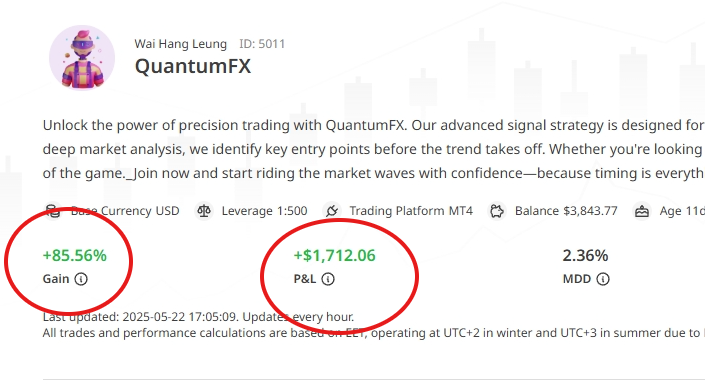
Let’s apply these critical considerations to the provided analysis of Wai Hang Leung (QuantumFX).
Trader Analysis: Wai Hang Leung (QuantumFX)
- Key Metrics & Performance Overview
- Total Gain: +85.56% (as of 2025-05-22)
- P&L: +$1,712.06
- Maximum Drawdown (MDD): 2.36%
- MMR Rank: #3 (indicating high reliability on the platform)
- Subscription Fee: $30/month
- Performance Fee: 10% of profits
- Trading Platform: MT4
- Base Currency: USD
- Account Age: 11 days (as of the analysis date)
- Total Gain: +85.56% (as of 2025-05-22)
- Breakout Trading Strategy Analysis
- Core Approach: Focuses on high-probability breakout setups, identifying key entry points before trends accelerate. Uses deep market analysis to pinpoint optimal entry levels, combining technical indicators (e.g., support/resistance, volume) with trend confirmation tools.
- Asset Classes Traded: Forex (USDJPY, EURUSD, GBPCHF, GBPUSD, AUDUSD), Commodities (XAUUSD – gold), Equity Indices (HK50 – Hong Kong Stock Index).
- Trade Frequency: ~20–30 trades/day (high activity). Trades often open during liquidity peaks (European/US hours) and close within minutes to hours, suggesting short-to-medium-term strategies.
- Core Approach: Focuses on high-probability breakout setups, identifying key entry points before trends accelerate. Uses deep market analysis to pinpoint optimal entry levels, combining technical indicators (e.g., support/resistance, volume) with trend confirmation tools.
- Profitability & Risk Management
- Winning Rate: 80.21% (very strong)
- Expectancy: +$5.82 per trade
- Risk Exposure: Low MDD (2.36%) indicates disciplined stop-loss placement.
- Winning Rate: 80.21% (very strong)
- Fee Impact Example: A $10,000 account copying this strategy would pay a $30/month subscription + 10% of profits. If the trader earns $1,000/month for the copier, the copier pays $100 in fees ($30 + $100 from profit share if the $1000 is the profit after the trader’s split), netting $870 (or $900 if the $1000 is before the 10% fee).
- Top-Traded Pairs & Performance (Illustrative)
Critical Considerations:
- Short Account History (MAJOR RED FLAG): Only 11 days of data is statistically insignificant. It’s impossible to gauge long-term viability or consistency from such a brief period. The performance could be due to luck, favorable short-term market conditions, or even cherry-picked results if the account was recently reset after a poor run.
- Overfitting Risk / Curve Fitting: An extremely high win rate (79.15%) and very low MDD (2.36%) over such a short period are highly suspicious. The strategy might be “curve-fitted” to recent market behavior or, as mentioned, the sample size is too small to be reliable. Such perfect-looking stats rarely persist.
- Volatility Dependency: Trading assets like XAUUSD (gold) and HK50 requires volatile markets. The strategy might underperform significantly during quiet periods.
- Fee Structure Impact: The combined subscription and performance fee will reduce net gains. The trader needs to consistently outperform the market by a significant margin for copiers to achieve worthwhile profits after these costs.
- High Trade Frequency: 20-30 trades a day implies a very active, possibly scalping-like breakout strategy. This can rack up transaction costs (spreads/commissions) quickly, further eating into profits, depending on the broker.
Recommendations:
- VERIFY DATA AUTHENTICITY (Crucial): Can the trade logs be independently verified? Is the platform showing these stats reputable?
- WAIT FOR A LONGER TRACK RECORD: Do not consider copying based on 11 days. A minimum of 6 months to a year of consistent performance is advisable.
- TEST WITH DEMO FUNDS (If Possible): Simulate copying with a demo account first.
- DIVERSIFY: Never allocate a large portion of your portfolio to a single trader, especially one with such a short history.
- MONITOR FEES AND NET RETURNS: Keep a close eye on how fees are impacting your actual take-home profit.
- Understand the “Why”: If possible, try to understand why QuantumFX takes specific breakout trades. What are their criteria? This helps if you ever need to manage positions yourself or if the signal feed is interrupted.
Conclusion on QuantumFX:
QuantumFX shows exceptionally good short-term numbers, suggesting a potentially disciplined breakout approach. However, the extremely short account history is a massive red flag that overshadows all other positive metrics. It is far too early to make any informed decision about copying this trader. The risk of the current performance being an unsustainable anomaly is very high. Extreme caution and extensive further monitoring are warranted. This trader is one to watch from a safe distance, not yet one to copy.
Protecting Your Capital: The Golden Rule of Investing & Trading
Whether you’re trading breakouts yourself or copying someone else, the paramount goal should always be capital preservation. Profits are important, but staying in the game is even more so.
- Never Risk More Than You Can Afford to Lose: This is fundamental. The money you trade with should not be money you need for essential living expenses.
- Position Sizing is Your Shield: Don’t over-leverage or bet the farm on a single trade. Risking a small, fixed percentage of your capital per trade (e.g., 1-2%) ensures that a string of losses won’t wipe you out.
- Stop-Loss Orders are Non-Negotiable: They are your safety net, automatically exiting a trade if it moves against you by a predetermined amount.
- Diversification (Where Appropriate): Don’t put all your eggs in one basket. This applies to strategies, markets, and, if copy trading, even traders.
- Understand Your Risk Tolerance: Be honest about how much volatility and potential loss you can stomach. Choose strategies and traders that align with your psychological makeup.
- Continuous Education: The markets are dynamic. The more you learn, the better equipped you’ll be to make informed decisions and protect your capital.
- Beware of “Get Rich Quick” Schemes: If something sounds too good to be true (like consistently 80% win rates with no drawdown over long periods), it almost certainly is. Approach such claims with extreme skepticism.
- Review and Adjust: Regularly review your trading performance and risk management rules. Are they working? Do they need adjustment based on market conditions or your own experience?
Smarter protection of money isn’t about avoiding all risk – that’s impossible in trading. It’s about understanding, managing, and mitigating risk intelligently so you can survive the inevitable downturns and be there to capitalize on the opportunities.
Conclusion: The Future of Breakout Trading – Innovation and Prudence
Breakout trading, a strategy as old as charted markets yet constantly evolving, remains a potent tool in a trader’s arsenal. Its ability to capture significant momentum early makes it perennially attractive. The past decade has seen technological advancements, especially in AI and algorithmic trading, significantly enhance its precision and accessibility. These tools help combat traditional challenges like false breakouts and timing dependencies.
The strategy’s popularity is fueled by its perceived simplicity, high-reward potential, adaptability, and endorsements from influential figures. Retail traders now have access to sophisticated platforms that democratize strategies once exclusive to institutions.
However, the specter of false breakouts, the reliance on precise timing, and the costs associated with trading (fees, slippage, time) demand a pragmatic approach. Success hinges on rigorous risk management – position sizing, strategic stop-losses, and maintaining favorable reward-to-risk ratios are paramount.
For beginners, a structured journey of learning foundational concepts, mastering tools, practicing disciplined execution, and committing to continuous education is crucial. The interplay of market liquidity, technical indicators, and broader economic factors significantly influences efficacy, requiring traders to be both analytical and adaptable.
Looking ahead, further integration of AI-driven sentiment analysis, institutional-level liquidity tracking, and machine learning algorithms promises to further refine breakout detection and reduce emotional biases.
Ultimately, whether you trade breakouts directly or explore copying an expert like the analyzed (but very new) QuantumFX, the principles of due diligence, critical thinking, and unwavering commitment to capital protection will determine your long-term success. Breakout trading offers a thrilling ride, but only the prepared and prudent will navigate its currents to profitable shores.
Frequently Asked Questions (FAQ) – Your Breakout Trading Queries Answered
Q1: What is the basic principle of a breakout trading strategy?
A1: Breakout trading involves identifying key support or resistance levels and entering a trade when the price decisively moves beyond these levels, anticipating continued momentum in that direction.
Q2: Why is volume important in confirming a breakout?
A2: A significant increase in trading volume accompanying a price breakout suggests strong conviction and participation behind the move, making the breakout more likely to be genuine and sustainable. Low-volume breakouts are often false signals.
Q3: What are “false breakouts” or “fakeouts,” and how can I avoid them?
A3: False breakouts occur when prices temporarily breach a key level only to quickly reverse, trapping traders. To mitigate them, traders wait for confirmation (like a candle closing beyond the level, a retest of the level, or significant volume), use multiple indicators, and employ strict stop-loss orders.
Q4: Is breakout trading suitable for beginners?
A4: Yes, but it requires a structured approach. Beginners must focus on understanding support/resistance, chart patterns, volume confirmation, risk management (especially stop-losses), and practice extensively, ideally on a demo account first.
Q5: What are some common chart patterns used in breakout trading?
A5: Common patterns include triangles (ascending, descending, symmetrical), flags, pennants, ranges (rectangles), and head and shoulders.
Q6: How has technology impacted breakout trading?
A6: Technology like AI and algorithmic tools has improved signal accuracy, helped filter false breakouts, enhanced execution efficiency, and made sophisticated analysis more accessible to retail traders.
Q7: What are the main costs associated with breakout trading?
A7: Tangible costs include brokerage fees (commissions/spreads), slippage (especially in volatile markets), and margin interest if trading on leverage. Intangible costs include the significant time investment for analysis and monitoring.
Q8: What is a good reward-to-risk ratio for breakout trades?
A8: Many traders aim for a minimum reward-to-risk ratio of 2:1, meaning the potential profit is at least twice the potential loss. Some even seek 3:1 or higher.
Q9: Can I use breakout strategies in Forex and stock markets?
A9: Yes, breakout trading strategies are adaptable and can be applied across various markets, including forex, stocks, commodities, and cryptocurrencies.
Q10: What is copy trading, and can it be useful for breakout strategies?
A10: Copy trading allows you to automatically replicate the trades of an experienced trader. It can be useful if you find a skilled breakout trader with a verifiable, long-term track record and a risk profile that suits you. However, thorough due diligence on the trader, understanding their strategy, and considering costs are crucial. The short history of a trader like QuantumFX, for instance, would warrant extreme caution.
For more detailed insights on developing daily trading routines, risk management, and effective position sizing strategies, explore additional articles on Trading Cup. Our trading experts at ACY and FinLogix are also great resources to guide your journey towards trading excellence.

Discover Our Best Trading Signals
At Tradingcup, you can browse through a selection of signals and review past performance before you decide to copy.
Become A Signal Provider
Share your expertise and become a signal provider so other traders can copy your trades.
Stay tuned to our blog for more trader spotlights and leaderboard updates.
Trading involves risks.
Visit the Tradingcup blog through the link below for more updates: https://www.tradingcup.com/learn
Related Copy Trading blogs:
- Understanding Market Liquidations: Liquidity Sweeps and Runs Explained
- 7 Essential Daily Habits of Successful Traders to Outperform Their Peers
- 10 Strategies You Can Copy off Our Best Copy Traders
- 5 Strategies Every Trader Can Master To Trade Better In A Trading Contest
- 2025 Copy Trading Scams Exposed: How to Spot Fraud
- A Swing Trading Strategy with an 83 Percent Win Rate and Low Drawdowns
- Forex Martingale Strategies Explained, The Good, The Bad and The Ugly
- Pyramiding Trading Tutorial – Pros & Cons & How to Use It