Last Updated: December 12, 2025
This article is reviewed annually to reflect the latest market regulations and trends
TL;DR / Highlights:
For investors seeking a strategy that behaves like fixed income, this signal offers a unique approach to the Martingale system.
- Fixed Income Profile: The strategy targets a modest 6-7% annualized return with an exceptionally low drawdown of just 0.63%, making its risk profile similar to investment-grade bonds.
- Unique Martingale System: It employs a rare, light-position Martingale strategy, using extremely small lot sizes (0.01) to prevent catastrophic losses during market shocks.
- Focus on Cross Pairs: Risk is further managed by trading commodity cross pairs (AUDCAD, NZDCAD, AUDNZD), which are naturally more range-bound and less prone to extreme, unidirectional trends.
- Ideal for Stability: This signal is perfect for conservative investors who prioritize capital preservation and steady, compounding growth over explosive, high-risk returns.
Disclaimer: The information in this article is for educational purposes only and does not constitute financial, investment, or trading advice. Copy trading carries substantial risks, including the potential loss of your entire invested capital. Past performance of copied traders or strategies is not a reliable indicator of future results. You may be replicating high-risk trades, overleveraged positions, or strategies incompatible with your financial goals. Always conduct independent research into a trader’s historical performance, risk metrics, and strategy before copying them. Never invest funds you cannot afford to lose. Consult a licensed financial advisor to ensure copy trading aligns with your risk tolerance, financial objectives, and regulatory requirements in your jurisdiction. This article does not endorse specific traders, platforms, or strategies, and all trading decisions remain your sole responsibility.
Beta Signal Low-Risk Martingale Strategy Copy Trading Review

On the Tradingcup leaderboard filled with top performers, Wilfred Knight Pty Ltd is not the kind of trader whose results make people shout “insane operation!” at first glance. Over the past three months, the total return of its trading signal Beta is only about 1.53%. It looks neither aggressive nor eye-catching, yet it quietly climbed into the MMR Top 20.

What truly sets it apart is its extremely low maximum drawdown of just 0.63%, along with an almost perfectly smooth, steadily rising equity curve. With a win rate of around 79%, you immediately realize: this is not a trader chasing explosive profits, but a strategy that puts risk control above everything else.
It doesn’t chase extreme market moves, nor does it fight USD major pairs head-on. Instead, it focuses on mean-reversion trades among commodity-currency cross pairs. Although the essence is a contrarian Martingale-style strategy, its lot-sizing is extremely restrained, pushing the risk of blow-ups to very low levels.
So, is such a “low-profile, non-aggressive” signal actually worth following? Let’s break down its true nature from both data and strategy logic.
What Does the Data Reveal About This Trading Strategy?
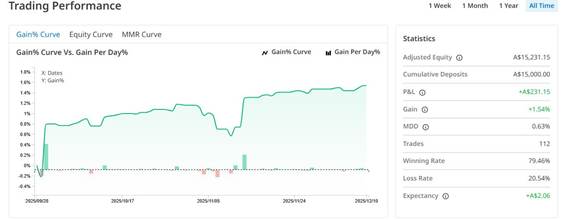
Data as of December 10, 2025
From late September to early December 2025, this signal completed 111 trades. Its core features can be summarized as: small position size, slow pace, contrarian mean-reversion.
• Total return: only 1.53%
A 1.53% return over three months annualizes to roughly 6–7%, similar to current investment-grade bond yields. It is steady rather than aggressive, aligning with the strategy’s emphasis on sustainable accumulation.
• Maximum drawdown: only 0.63%
The system’s primary objective is not high explosiveness, but steady growth under strict drawdown control. Low drawdown is the strategy’s biggest competitive advantage.
• Average lot size per trade: 0.02 lots
Nearly all orders are placed at 0.01 lots, with only slight increases under special market conditions. For an account size of AUD 15,000, this is extremely conservative even a series of adverse moves is unlikely to materially damage the equity curve.
• Average profit per trade: about AUD 2.22
Achieving this level of profit with a minimum lot size of 0.01 reflects stable performance and decent efficiency in capturing small waves and micro-trends.
• Pip distribution: mostly 100–200 pips, with occasional 1,000-pip swings
The strategy mainly profits from short-term oscillations, but in smooth trends it sometimes allows winning trades to extend, forming a blend of range trading plus trend extension.
• Long/short ratio: Buy : Sell ≈ 60 : 51 (about 1 : 0.85)
Long and short positions are roughly balanced, showing that the strategy does not bet on directional trends but instead profits from repeated mean-reversion patterns in cross-pair pricing.
How Does This Martingale Strategy Control Blow-Up Risk?
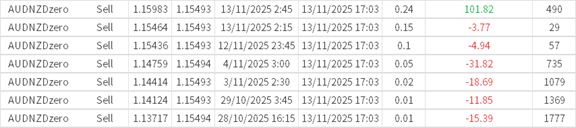
One detail worth noting: although the standard lot size is 0.01, the position size increases significantly during drawdowns, with the largest trade reaching 0.25 lots. For an AUD 15,000 account, this is still relatively light, but structurally it has the clear characteristics of a Martingale system.
And with Martingale strategies, the key question is always: how is blow-up risk controlled?
Why Trade Commodity-Currency Cross Pairs?
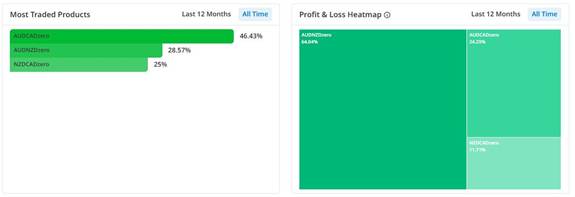
The first layer of risk control comes from choosing three major commodity-currency cross pairs as the primary battlefield:
• AUDCAD
• NZDCAD
• AUDNZD
These three pairs account for nearly all of the strategy’s trades and form the most stable and consistent source of profits: AUDCAD ~44.8%, NZDCAD ~31.3%, AUDNZD ~23.9%. This concentration and structural consistency make the strategy highly replicable.
- Cross pairs rarely trend in long unidirectional moves
Compared with USD majors such as EURUSD or GBPUSD, commodity-currency crosses tend to exhibit limited trend extension and are more prone to oscillating structures. USD pairs are more easily influenced by global macro news, such as economic releases and rate expectations for example the sharp USD selloff after the August Non-Farm Payrolls report.
- Strong range-bound characteristics support mean-reversion
Australia, New Zealand, and Canada are all resource-based economies with similar structures and monetary policies. Particularly AUD and NZD, whose trade structures and geographic characteristics are alike. As a result, AUDNZD naturally exhibits range trading and mean-reverting behaviors, making runaway one-directional moves relatively rare. - Macro shocks are milder
Compared with global events like the Fed, NFP, CPI, etc., macro releases from Australia, New Zealand and Canada tend to have lower global impact, resulting in more controlled volatility ideal for sustaining a light-position contrarian system.
What Makes This a Rare Light-Position Martingale?
Typically, once an account balance exceeds 10,000, many traders increase their minimum lot size to 0.05–0.1 to amplify returns. Yet such aggressive scaling is extremely vulnerable during trending markets, and countless Martingale blow-ups come precisely from this behavior.
In contrast, Wilfred Knight insists on keeping the smallest lot size at 0.01 almost “too conservative.” But it is precisely this restraint that protected the account from multiple potential blow-ups and allowed the strategy to survive long-term.
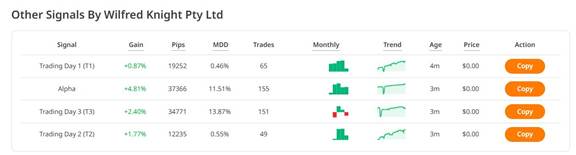
It’s worth noting that Wilfred also operates several similar systems differentiated mainly by weighting across the three cross pairs. For example, the Alpha signal trades only AUDCAD and NZDCAD. On September 5, Canada released higher-than-expected unemployment data, causing CAD to weaken sharply and triggering strong one-directional surges in both AUDCAD and NZDCAD.
How Does This Strategy Mitigate Risk During Extreme Volatility?
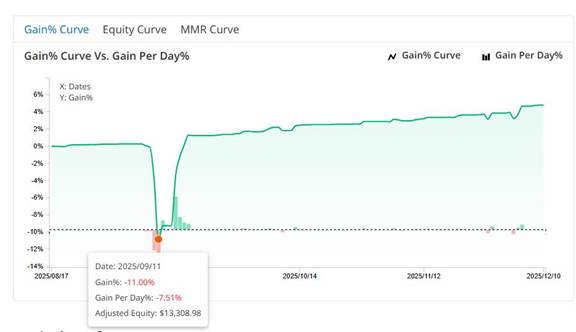
On September 10, Alpha’s short positions in both pairs suffered notable drawdowns, with floating losses expanding to 11.5% due to the Martingale scaling. However, once the market reversed on September 15, all losses were fully recovered.
Crucially, even though AUDCAD’s rally broke its yearly high, this extreme move did not destroy the account the maximum drawdown stayed below 15%. This shows that Wilfred’s light-position design effectively mitigates the most fatal risk of Martingale structures, providing exceptional resilience against extreme volatility.
Summary
In the end, risk and return are always proportional. Many aggressive Martingale strategies target annual returns of 30%, but history repeatedly shows the risks borne by such systems often far exceed 30%, with extreme conditions easily cutting equity in half or wiping accounts entirely.
By contrast, Wilfred’s goal is closer to investment-grade bonds targeting annual returns of 6–7%, with risk controlled to a similar level. This “survive first, win later” philosophy gives the strategy rare long-term sustainability.
Can This Trading Strategy Compete With Bonds?
With Beta’s annualized return currently only 6–7%, investors naturally ask: if the return resembles investment-grade corporate bonds, why not simply buy bonds instead of following this signal?

Therefore, the strategy’s future challenge is clear: how to raise returns while maintaining low blow-up risk only then can it outperform bonds on a risk-adjusted basis.
In recent months, commodity-currency volatility has surged: silver short-squeeze spillovers, RBA rate-cut expectations, Canada’s unexpectedly sharp drop in unemployment all triggered highly directional moves in AUD, NZD, and CAD. Under such conditions, maintaining extremely light positions is indeed prudent. But once these shocks fade and volatility normalize, whether the strategy can increase returns accordingly will determine its long-term competitiveness.
After all, investors care not only about “how much you make,” nor only “how low the risk is,” but the balance of the two reflected in the MMR score.
Who Is This Low Drawdown Signal Suitable For?
If you are looking for a strategy that does not chase explosive returns but focuses on stability and low drawdown, Beta is a highly reliable choice. It is especially suitable for:
- Investors who prefer stable returns
If sharp equity swings make you uncomfortable, Beta’s low drawdown and smooth curve will make long-term holding much easier. - Investors who want to add a “fixed-income layer” to their portfolio
For those already holding high-volatility assets, Beta behaves similarly to investment-grade bonds and helps balance overall risk. - People who have limited time but still want compounding growth
The trading pace is gentle, requires no constant monitoring, and avoids aggressive scaling pressure, ideal for busy investors seeking steady growth.
Of course, if you’re aiming for short-term doubling or high-volatility profits, this light-position contrarian approach may not satisfy you. But if what you want is to be “more stable and better off three years from now,” rather than “make more by tomorrow,” then Beta is an excellent tool.
Looking for the Best Copy Trading Strategy?
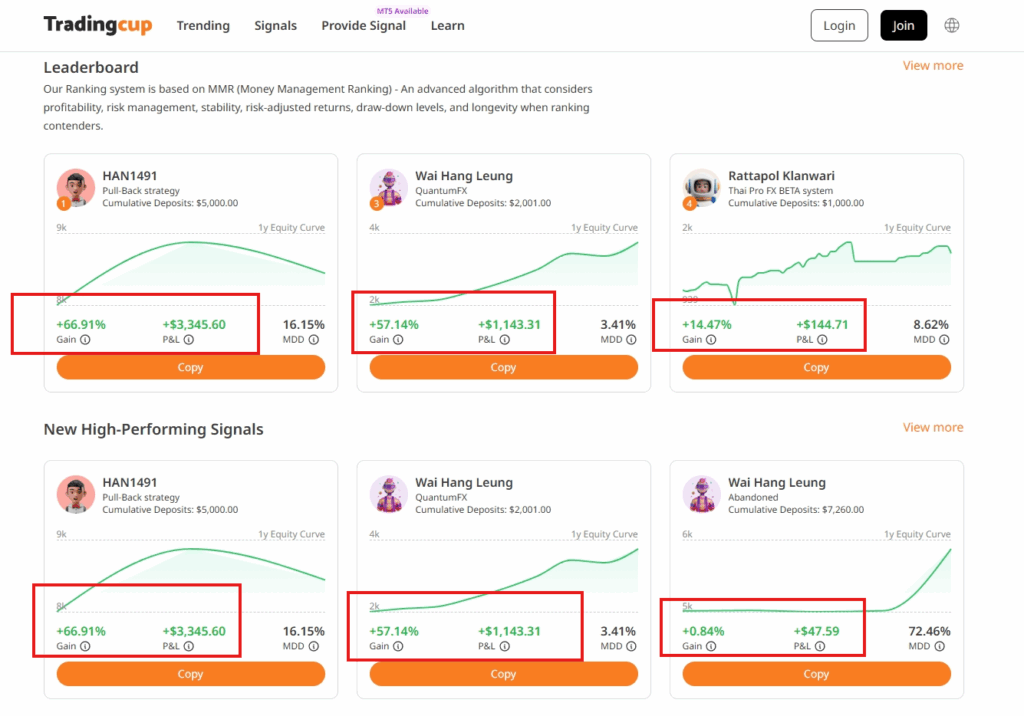
We’ve compiled a leaderboard of the most outstanding traders with excellent drawdown control and clear trading styles. This way, you’ll never feel lost when choosing who to follow and won’t blindly chase trends. Click to view the latest trader rankings and find out who is truly worth copying! Choose the right person, copy the right strategy, and from today, let copy trading truly create value for you.
Bonus Guide
What Makes an Effective Investment Portfolio?
- Diversification: Spread funds across various asset types (e.g., stocks, bonds, real estate, cash, precious metals) and industries/regions to reduce exposure to single-market volatility.
- Asset Allocation: Tailor allocations based on your risk tolerance, goals, and time horizon. Conservative portfolios emphasize fixed income, while aggressive ones lean into equities.
- Risk-Reward Balance: Each asset has different risk/return profiles. Ensure your portfolio avoids excessive exposure to high-risk or low-return assets.
- Low Correlation: Combine assets with correlations below 0.3 to enhance stability and provide a cushioning effect during market swings.
- Dynamic Rebalancing: Review and adjust your portfolio regularly as markets or personal goals change to stay aligned with your risk-return expectations.
- Clear Objectives: Define your financial goals (retirement, housing, education) before designing your strategy and time horizon.
- Discipline & Logic: Stick to your investment plan without emotional decision-making. Regularly reassess assumptions and market conditions.
(Disclaimer: This article is for informational and educational purposes only. It should not be considered financial advice. Always conduct your own research and consult with a qualified financial advisor before making any investment decisions.
For more detailed insights on developing daily trading routines, risk management, and effective position sizing strategies, explore additional articles on Trading Cup. Our trading experts at ACY and FinLogix are also great resources to guide your journey towards trading excellence.

Discover Our Best Trading Signals
At Tradingcup, you can browse through a selection of signals and review past performance before you decide to copy.
Become A Signal Provider
Share your expertise and become a signal provider so other traders can copy your trades.
Stay tuned to our blog for more trader spotlights and leaderboard updates.
Trading involves risks.
Visit the Tradingcup blog through the link below for more updates: https://www.tradingcup.com/learn
Related Copy Trading blogs:
- Understanding Market Liquidations: Liquidity Sweeps and Runs Explained
- 7 Essential Daily Habits of Successful Traders to Outperform Their Peers
- 10 Strategies You Can Copy off Our Best Copy Traders
- 5 Strategies Every Trader Can Master To Trade Better In A Trading Contest
- 2025 Copy Trading Scams Exposed: How to Spot Fraud
- A Swing Trading Strategy with an 83 Percent Win Rate and Low Drawdowns
- Forex Martingale Strategies Explained, The Good, The Bad and The Ugly
- Pyramiding Trading Tutorial – Pros & Cons & How to Use It
