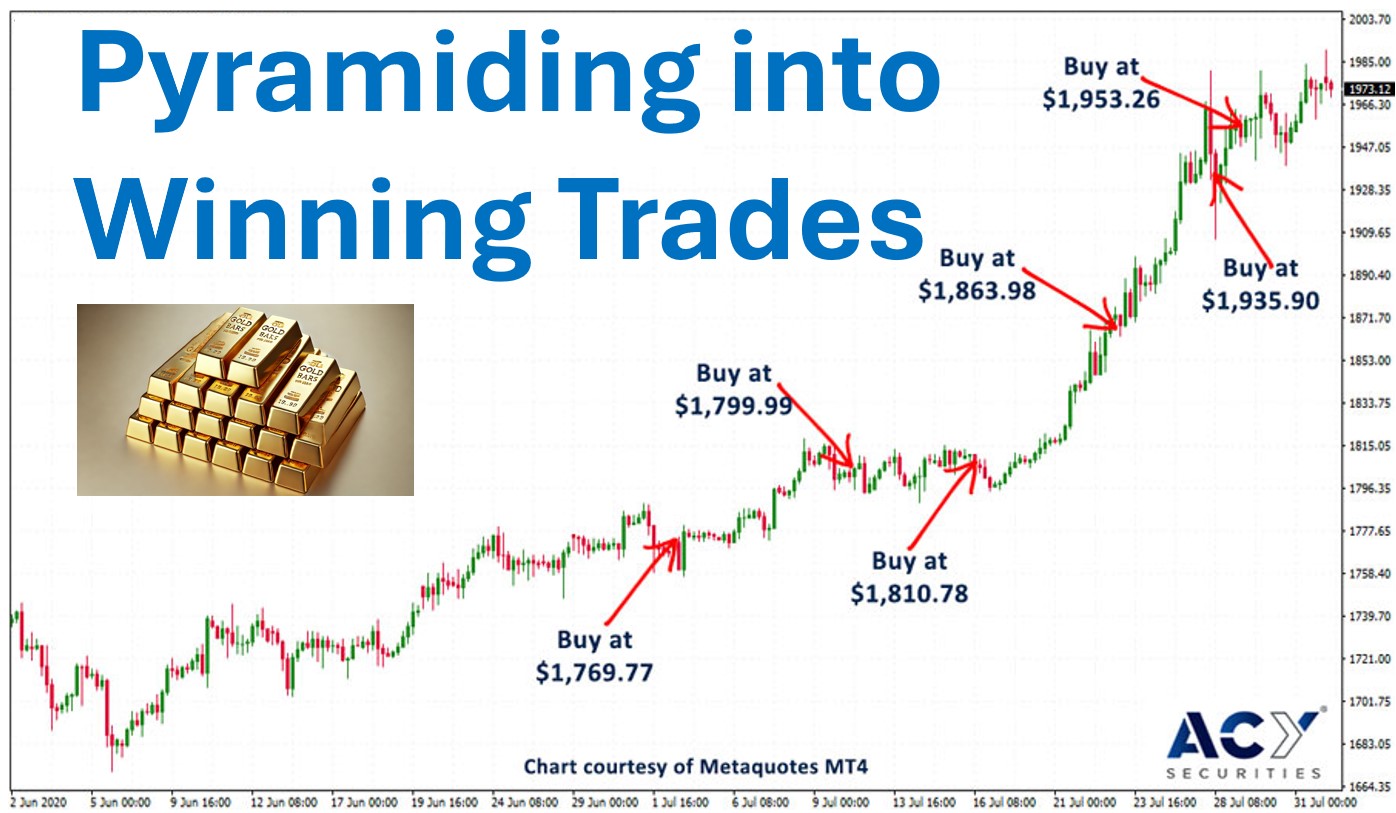
This pyramid trading tutorial will show you how some of the most successful traders turn a single winning trade into an incredible result by strategically adding to their positions at key levels.
Imagine starting with one position, watching it move in your favor, and then strategically stacking more positions on top, each riding the wave of momentum.
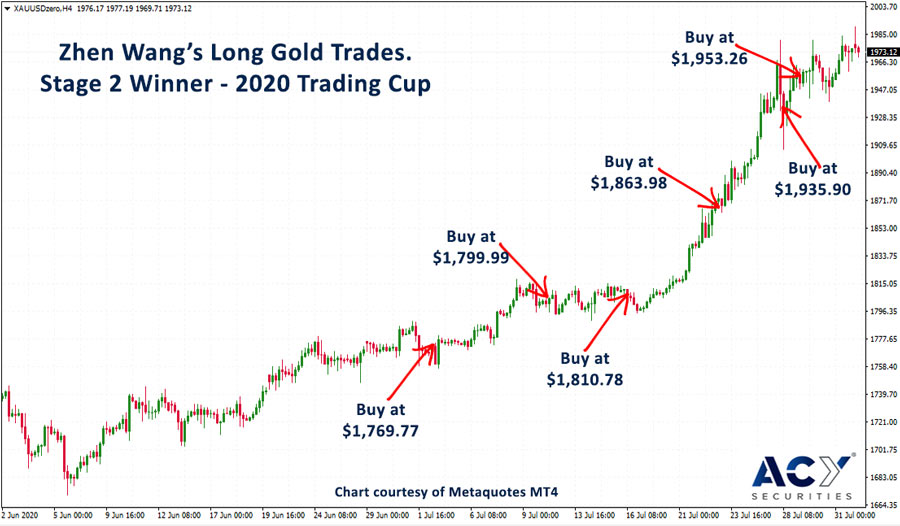
This is exactly how some of the greatest traders in history have supercharged their gains, and how Zhen Wang in the Trading Cup’s Stage 2 managed to generate an impressive return trading gold by pyramiding into his winning positions six times.
In this blog, we’ll break down pyramiding in trading—how it works, why it’s a sensible, high-reward strategy, and how successful traders use it to maximise returns in the gold and forex markets.
But that’s not all. For those interested in copy trading, this approach presents a unique opportunity: top-performing traders who master pyramiding can provide high-impact trading signals for followers to copy, potentially amplifying returns for both the trader and their copiers.
Let’s dive in.
What is Pyramiding in Gold and Forex Trading?
Pyramiding is the act of adding to a winning position as the market continues to move in your favor. Rather than going all-in at once, traders scale into their trades, taking advantage of strong trends while managing risk.
In the gold market, where volatility and momentum play a huge role, pyramiding can allow traders to capitalise on strong bullish or bearish trends by stacking positions strategically.
A well-timed entry followed by additional positions at key breakout points can exponentially increase profits. And when combined with the best trailing stop loss strategies, you can really transform your trading results.
In forex trading, pyramiding works similarly, with traders adding positions as currency pairs move in their favor, often using technical indicators like support and resistance levels, Fibonacci retracements, and trend confirmations to decide when to add.
However, forex traders must be cautious of leverage and margin requirements, as additional positions increase exposure.
Why Do Top Traders Use Pyramiding?
Some of the most legendary traders have used pyramiding to scale up their winnings, including:
- Jesse Livermore, the famous stock trader who built fortunes by aggressively adding to his best trades.
- Larry Williams, who achieved a record-breaking 11,000% return in a futures trading competition using aggressive position sizing techniques.
- Nicolas Darvas, who made $2 million in 1957 trading stocks using a version of pyramiding.
- Zhen Wang, who dominated Stage 2 of the Trading Cup by pyramiding into gold trades six times, turning a single trade into a powerhouse winner.
Pyramiding in Copy Trading – A High-Stakes Strategy for Signal Providers
For traders who provide signals in copy trading, pyramiding presents both a massive opportunity and a risk factor for followers.
A skilled signal provider who executes pyramiding correctly can generate exceptional returns for their copiers, but this strategy requires precise timing, risk management, and discipline to avoid overexposure.
Successful copy traders who use pyramiding often:
- Identify strong, trending markets (such as gold during a breakout).
- Use strict entry rules to avoid adding too early.
- Scale positions only when the market confirms momentum.
- Set clear exit strategies to protect profits.
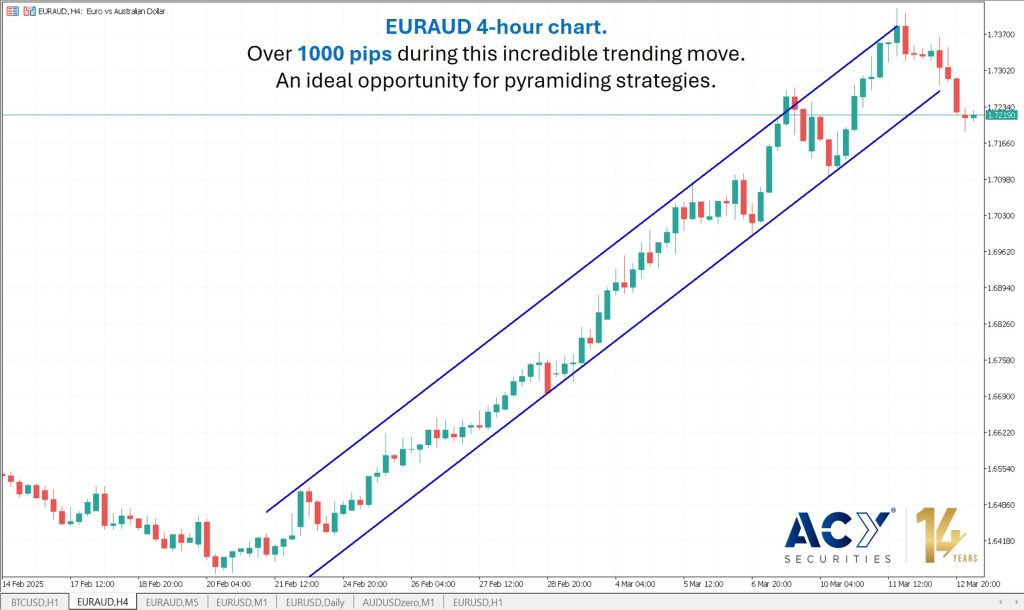
When done right, pyramiding in copy trading can turn modest returns into exponential gains, but traders must ensure their followers understand the risks involved.
Click play on the video below to learn more about pyramiding, plus the pros and cons of this strategy.
In this video tutorial on pyramiding, we run through:
- What is pyramiding in trading?
- Why pyramiding has been so powerful for many traders
- What are R multiples?
- How to look at winning trades in terms of R multiples
- How the Turtle Traders used it with incredible results
- A strategy on how to use pyramiding
- Which strategies are best suited to pyramiding
- What strategies should not use pyramiding
- The best books to read to understand this principle in more detail
Avoiding the Pitfalls: When Pyramiding Is a Bad Idea in Gold and Forex Trading
Pyramiding is a powerful tool when used correctly, but it’s not a strategy that suits every trader or market condition.
The key to making pyramiding work is understanding your risk-to-reward ratio and ensuring it aligns with high-probability trend-following strategies.
If your trades are structured around small profit targets relative to your risk, pyramiding can quickly become inefficient, or even counterproductive.
Why Pyramiding Doesn’t Make Sense with a Low Reward-to-Risk Ratio
At its core, pyramiding relies on letting winners run and stacking positions only when the trade continues to perform strongly.
This approach makes little sense for traders who typically target small profits, such as short-term forex scalpers or traders with an average reward-to-risk ratio of 1:1 or 1:1.5.
Here’s why:
If you typically exit trades quickly, you don’t have enough room to scale into the position before reaching your profit target.
By the time you add positions, you may already be at or near your take-profit level, leaving little space for additional gains.
Your risk per trade increases as you add positions, but if your reward stays small, you expose yourself to greater losses with no significant upside. For example, let’s say you trade forex with an average 1:1 reward-to-risk ratio, meaning you risk 50 pips to make 50 pips.
If you attempt to pyramid into the trade, you may add more positions when you’re already 30-40 pips in profit, meaning the extra positions have almost no room to grow before you need to exit.
The effort to scale up is wasted because your strategy doesn’t allow enough upside.
Pyramiding Works Best for Trend Followers with a Minimum 3:1 Reward-to-Risk
The best traders who use pyramiding successfully are trend followers, looking to identify and ride the strongest market trends. These traders aim for a minimum reward-to-risk ratio of 3:1, meaning they risk 1R to make at least 3R or more.
This is because pyramiding works best when you:
- Identify strong market trends – such as a long, sustained move in gold or a major forex pair.
- Let your trades run – instead of taking small profits quickly.
- Stack new positions at key breakouts – adding exposure only when the trend remains intact.
- Know your R multiples – ensuring that your winners are significantly larger than your losers.
For example, if a gold trader enters long at $2,000 per ounce with a 3:1 reward-to-risk ratio, they may be targeting a move to $2,150 or higher while risking just $50 per ounce. This leaves plenty of room to pyramid into the trade multiple times as the price trends higher.
The Bottom Line on Pyramiding when Trading the Global Markets
Pyramiding isn’t for every trading style. If you focus on small, quick profits, you’re better off using other techniques, as this strategy thrives on big trends and extended price moves.
Knowing your R multiples is crucial—if you don’t have the ability to let trades run and extract large profits, then pyramiding may introduce unnecessary risk without enough reward.
For more detailed insights on developing daily trading routines, risk management, and effective position sizing strategies, explore additional articles on Trading Cup. Our trading experts at ACY and FinLogix are also great resources to guide your journey towards trading excellence.