
Last Updated: July 03, 2025
This article is reviewed annually to reflect the latest market regulations and trends.

Disclaimer: The information in this article is for educational purposes only and does not constitute financial, investment, or trading advice. Copy trading carries substantial risks, including the potential loss of your entire invested capital. Past performance of copied traders or strategies is not a reliable indicator of future results. You may be replicating high-risk trades, overleveraged positions, or strategies incompatible with your financial goals. Always conduct independent research into a trader’s historical performance, risk metrics, and strategy before copying them. Never invest funds you cannot afford to lose. Consult a licensed financial advisor to ensure copy trading aligns with your risk tolerance, financial objectives, and regulatory requirements in your jurisdiction. This article does not endorse specific traders, platforms, or strategies, and all trading decisions remain your sole responsibility.
TL;DR (Too Long, Didn’t Read)
- Don’t have the time to learn the trading grind? With copy trading, a mentor you can find.
- To master the trade, don’t just follow the parade; with smarts and with guide, you’ll take it in stride.
- With a diverse array, you can brighten your day; spread your risk and your play, and keep losses at bay.
- Manage your risk with a plan, like a true savvy man; for a future so grand, it’s all in your hand.
- With AI’s new might, your portfolio takes flight; a future so bright, with all of its light.
“We have two lives, and the second begins when we realize we only have one.” – Confucius
The Inevitable Rise Of Copy Trading: A Thinking Person’s Guide to Smarter Investing
You’re determined to make your money work for you. You’ve heard the whispers of fortunes made in the forex market, but the learning curve seems impossibly steep. The charts, the jargon, the endless analysis, it’s a full-time job you just don’t have time for. Then, you stumble upon a tantalizing concept: copy trading. The promise is seductive: what if you could simply mirror the trades of a seasoned professional? What if their success could be your success, all with the click of a button? But as you stand at this crossroads, a question emerges: what exactly is this “rise of copy trading,” and is it the golden ticket it appears to be, or a gilded trap for the unwary?
This comprehensive guide will not only answer that question but will also provide you with a strategic blueprint for navigating this burgeoning landscape. We’ll delve into the mechanics, the risks, the rewards, and the psychological fortitude required to transform this powerful tool from a mere gamble into a sophisticated component of your investment strategy.
What Are Forex Signals and Copy Trading?
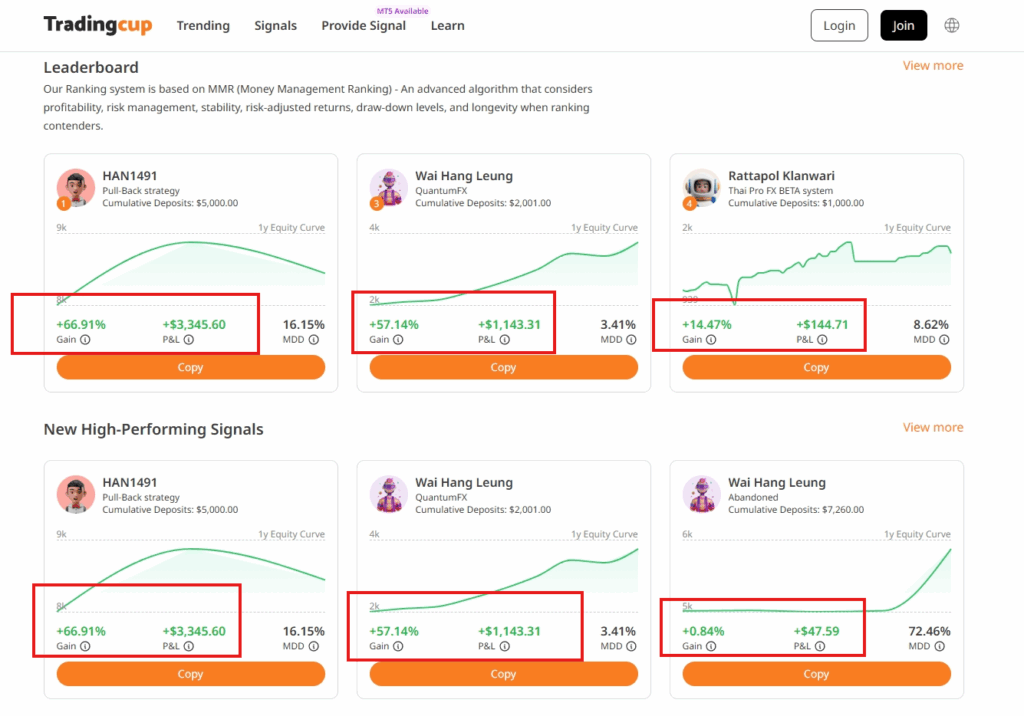
At its heart, copy trading evolved from the simpler concept of forex signals. Imagine a seasoned trader identifying a potentially profitable trade. In the early days, they might have shared this “signal”, comprising the asset to trade, the entry price, and the exit points (stop loss and take profit), through newsletters or chat rooms. It was then up to you to manually execute that trade, a process fraught with delays and potential errors.
Copy trading automates this entire process. It allows you to link a portion of your investment portfolio to that of a “leader” or “signal provider“. When they execute a trade, the exact same trade is automatically replicated in your account, scaled to the amount of capital you’ve allocated. This is not just following a signal; it’s replicating a strategy in real-time.
Is Copy Trading the Perfect Launchpad for a Beginner?
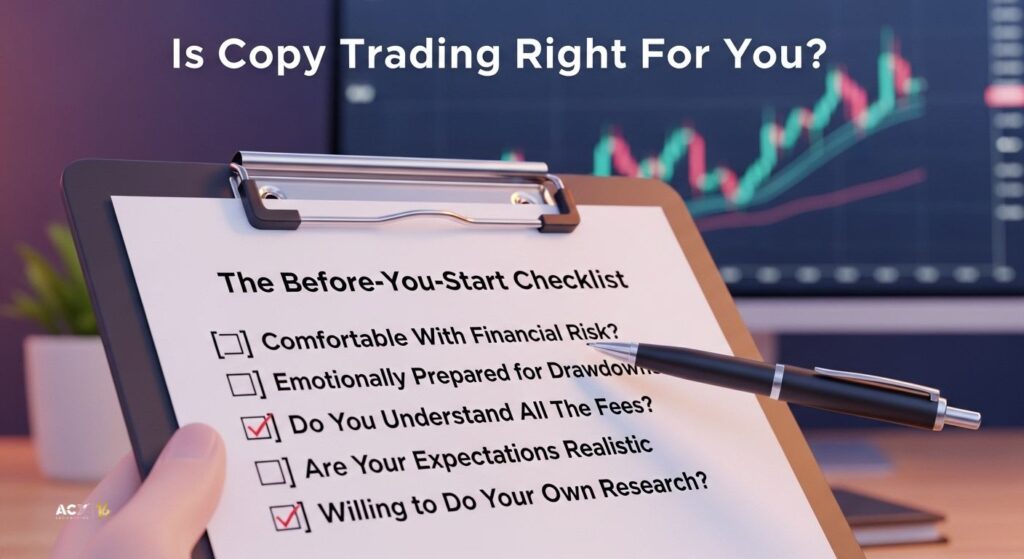
Copy trading isn’t for everyone. Before you jump in, consider this checklist:
- Are you comfortable with risk? All trading involves risk, and past performance is not indicative of future results. Even the best traders have losing streaks.
- Do you have capital you can afford to lose? Never invest money you can’t afford to part with.
- Are you looking for a passive investment? While copy trading is less hands-on, it still requires initial research and ongoing monitoring.
- Do you understand the fee structures? Subscription fees and performance fees can eat into profits.
- Are you patient? Quick riches are rare. Successful trading, even copying, often requires a long-term perspective.
- Are you willing to do your due diligence? Selecting a trader requires careful analysis of their history, strategy, and risk management.
- Do you have realistic expectations? Don’t expect to double your money overnight.
- Are you emotionally prepared for drawdowns? Seeing your account balance dip, even temporarily, can be stressful. Maximum Drawdown (MDD) is a key metric to understand.
If you’ve nodded along to these points with a clear understanding, then copy trading might be a suitable avenue for you to explore.
Who Are the Top Platforms in the Copy Trading Arena?
The ecosystem of copy trading is vibrant and competitive, with several platforms vying for your attention. Giants like eToro are famous for their social-centric, user-friendly interface, making them a popular entry point for many. Others, such as ZuluTrade, offer a broker-agnostic approach, allowing you to connect various brokerage accounts.
However, when it comes to finding a potential edge, especially for those who appreciate a competitive and transparent environment, platforms like TradingCup are carving out a unique niche. Their model, which often revolves around trading competitions, can provide a clearer, performance-backed view of who the truly skilled traders are. If you’re looking for a compelling best eToro copy trading alternative, exploring how forex copy trading for beginners works on different platforms is a crucial step.
The $2,000 Question: A Cost-Benefit Analysis
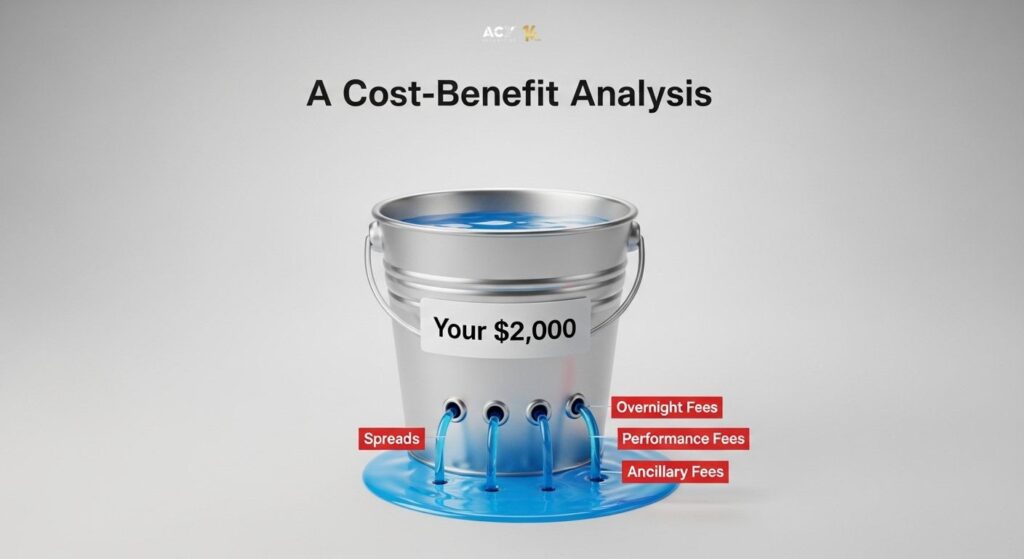
Let’s ground this in reality. You have $2,000 to invest. Is copy trading a financially sound decision? The first thing to understand is that there’s no such thing as a free lunch. Platforms often advertise “zero-commission” copying, but the costs are embedded within the trading process.
These costs can be broken down into:
- Direct Fees: Some platforms or traders charge a monthly subscription fee or a performance fee (a percentage of your profits, typically 8-30%).
- Indirect (Brokerage) Costs: These are unavoidable and are the primary revenue source for most brokers. They include:
- The Spread: The small difference between the buy and sell price of an asset.
- Overnight Fees: Charges for holding leveraged positions open from one day to the next.
- The Spread: The small difference between the buy and sell price of an asset.
- Ancillary Fees: Often overlooked, these include withdrawal fees and inactivity fees that can slowly erode your capital.
When comparing platforms, a detailed cost analysis is vital. For instance, a deep dive into eToro vs TradingCup and determining the best forex copy trading platform for beginners should be a key part of your research, focusing on how these fee structures will impact your net returns.
A Glimpse into the Future: A Hypothetical 1-Year Performance of $2,000
To make this tangible, let’s model a few scenarios for your $2,000 investment. It’s crucial to remember that these are hypothetical projections, not guarantees. They illustrate the vast difference your choice of trader can make.
| Trader Profile | Assumed Gross Annual Return | Gross Profit ($) | Estimated Performance Fee (20% of Profit) | Estimated Trading Costs | Net Profit ($) | Net Annual ROI (%) |
| Conservative | 20% | $400 | $80 | $40 | $280 | 14.0% |
| Moderate | 60% | $1,200 | $240 | $120 | $840 | 42.0% |
| Aggressive | 120% | $2,400 | $480 | $240 | $1,680 | 84.0% |
| Losing Scenario | -30% | -$600 | $0 | -$60 | -$660 | -33.0% |
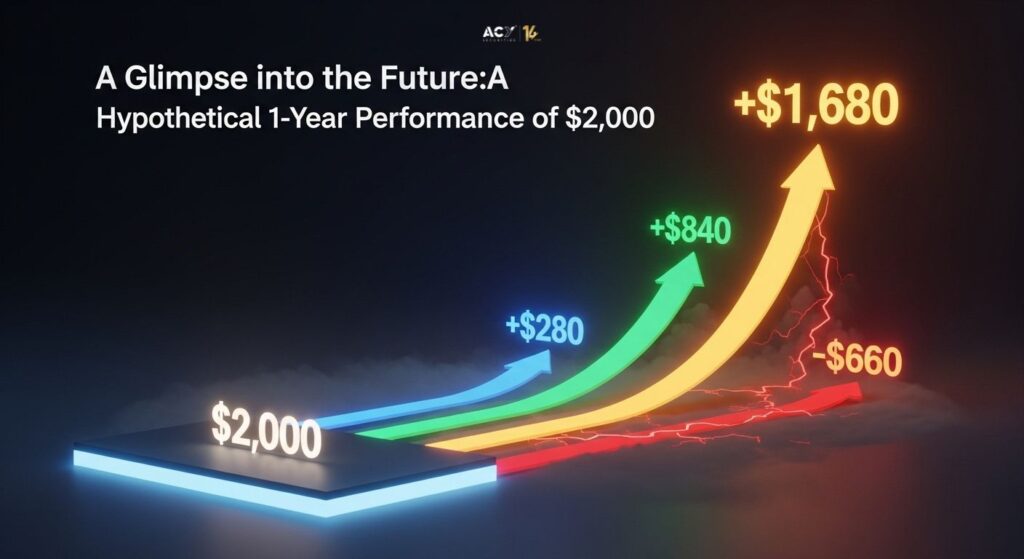
This table clearly shows the immense potential but also the significant risk. An aggressive trader might double your money, but a poor choice could cost you a third of your capital.
The Risk-Reward Tightrope: Can You Walk It?
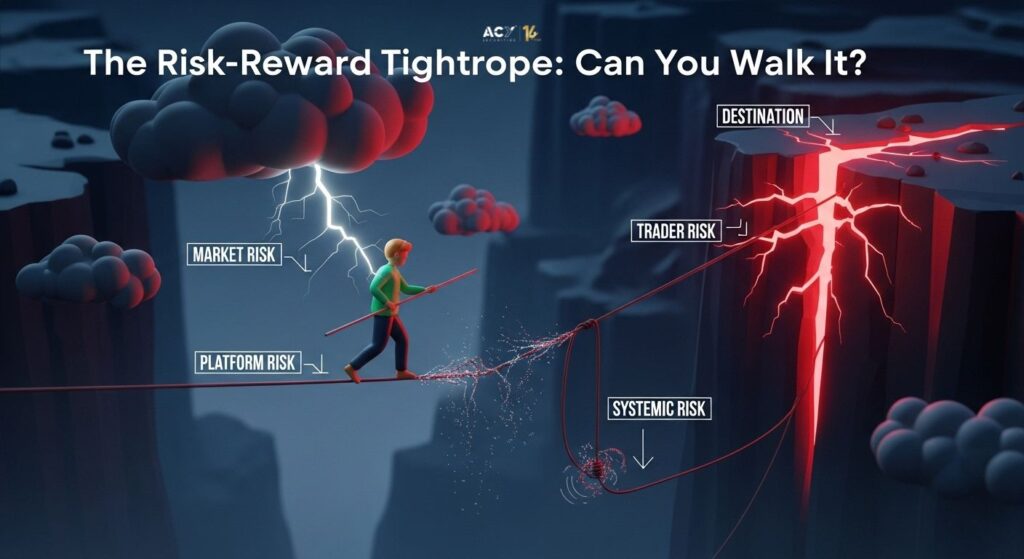
All investing involves risk, but copy trading introduces unique layers of peril that go beyond simple market movements.
- Market Risk: The fundamental risk that the market will move against your position. This is unavoidable.
- Trader Risk: This is the single biggest risk. You are betting on a person. They could have a psychological breakdown , their winning strategy could stop working , or they could simply get reckless.
- Platform Risk: Technical glitches, execution delays (slippage), or system outages can and do happen, potentially costing you dearly.
- Systemic Risk: The very design of these platforms can create “herd behavior,” where a popular trader’s actions cause massive, simultaneous order flows that can distort prices.
Understanding this spectrum is not just about numbers; it’s about being brutally honest with yourself about how much uncertainty you can tolerate.
The Human Element: Are You Outsourcing Logic or Just Inheriting Emotion?

A primary allure of copy trading is the idea of removing your own emotional biases, fear and greed, from the equation. This is a dangerous misconception. You don’t eliminate emotion; you simply transfer its source.
You are no longer anxious about when to click “buy,” but you will feel the full emotional impact of watching your $2,000 fluctuate based on the decisions of a complete stranger. This can create a profound sense of helplessness, leading to irrational decisions like pulling your money out at the worst possible moment. Success in copy trading requires a unique form of psychological resilience: the discipline to trust the process and the trader you have painstakingly vetted, even during inevitable drawdowns.
A Blueprint for Success: The “Manager of Managers” Approach
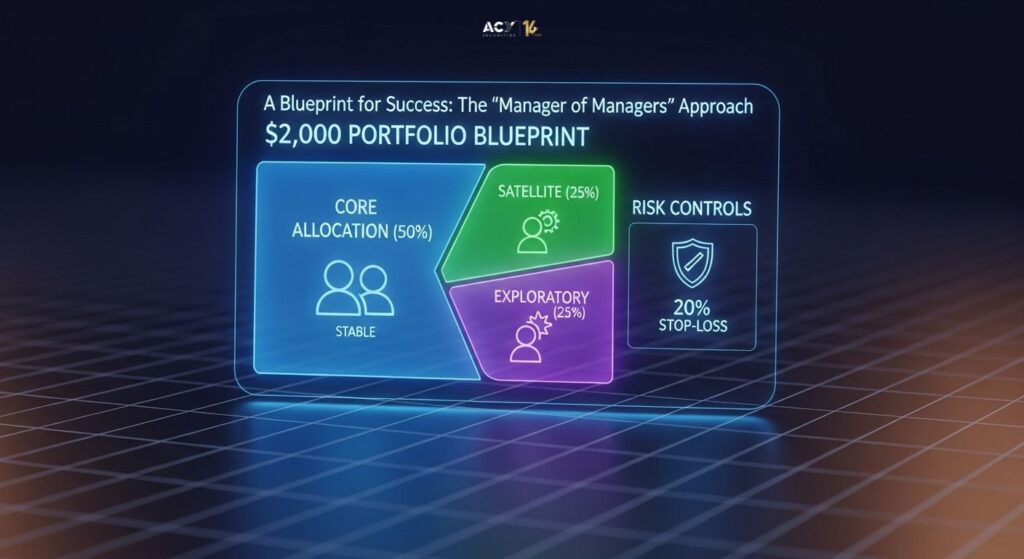
The most successful copy traders don’t behave like passive followers; they act like institutional portfolio managers. They don’t bet the farm on one “star”; they build a diversified, resilient portfolio of traders.
Here’s a practical allocation strategy for your $2,000:
- Select 4 Traders: This allows a meaningful allocation of $500 per trader.
- Construct a Blended Portfolio:
- Core Allocation (50% – $1,000): Allocate to two Conservative Traders with long track records and low drawdowns.
- Satellite Allocation (25% – $500): Allocate to one Moderate Trader, perhaps a swing trader in major forex pairs.
- Exploratory Allocation (25% – $500): Allocate to one Aggressive Trader, focusing on more volatile assets like crypto, with the understanding that this is your high-risk, high-reward play.
- Core Allocation (50% – $1,000): Allocate to two Conservative Traders with long track records and low drawdowns.
- Implement Strict Risk Controls: Use the platform’s tools, like a Copy Stop-Loss, to cap your potential loss on any single trader to a predefined amount (e.g., 20% or $100 per trader).
This structured approach transforms a gamble into a strategy. For those seeking a simplified yet powerful method, exploring a guide on the easiest copy trading strategy for forex by copying 5 traders can provide an excellent starting framework.
The Competitive Landscape: Is Copy Trading Truly a “Better” Mousetrap?
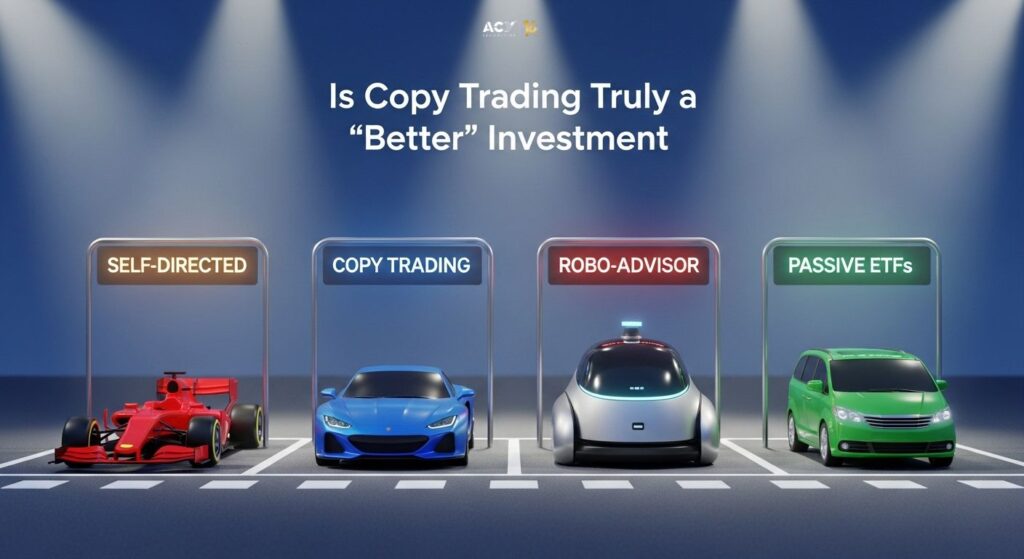
To understand if copy trading is the right choice, you must compare it to the alternatives.
| Attribute | Copy Trading | Passive ETFs (DIY) | Robo-Advisor | Self-Directed Trading |
| Level of Control | Low (over trades), High (over trader selection) | High | Low | Very High |
| Required Expertise | Moderate (in trader selection & risk management) | Low to Moderate | Very Low | Very High |
| Typical Cost Structure | Spreads, performance/subscription fees | Very low expense ratios | Low management fee + ETF fees | Spreads, commissions |
| Primary Risk Factor | Trader Risk | Market Risk | Market Risk | Investor Error |
This reveals that copy trading occupies a unique middle ground. It’s an active strategy marketed with the simplicity of a passive one. It’s not as simple as a robo-advisor, nor does it offer the complete control of self-directed trading. Its superiority is entirely conditional on your willingness to embrace the role of an active portfolio manager.
How Would Steve Jobs Think About the Rise of Copy Trading?
Steve Jobs was a master of simplifying complexity and focusing on the user experience. He famously said, “Simple can be harder than complex: You have to work hard to get your thinking clean to make it simple.”
Applying this philosophy, Jobs would likely be both intrigued and critical of copy trading.
- He’d Admire the Simplicity: The core concept, democratizing access to expert trading strategies with a simple “copy” button, is something he would have appreciated. It elegantly solves a major user pain point: the complexity of financial markets.
- He’d Scrutinize the “Black Box”: Jobs insisted on understanding things from the ground up. He wouldn’t just accept that a trader was good based on a performance number. He’d want to know why they were good. He would be relentless in demanding transparency and a deeper understanding of the underlying strategy, something often missing in the surface-level statistics of many platforms.
- Focus on the “Whole Widget”: Jobs believed in controlling the entire user experience. He would be wary of the fragmented nature of copy trading, where the platform, the trader, and the user are all separate entities. He would likely envision a more integrated system where the technology, the selection process, and the risk management tools work together seamlessly to protect and empower the user, not just to facilitate trades.
In essence, Jobs would challenge the industry to move beyond just making trading easier and to focus on making it genuinely smarter and safer for the end-user.
The Blue Ocean of Investing: 10 Lessons from “Blue Ocean Strategy”
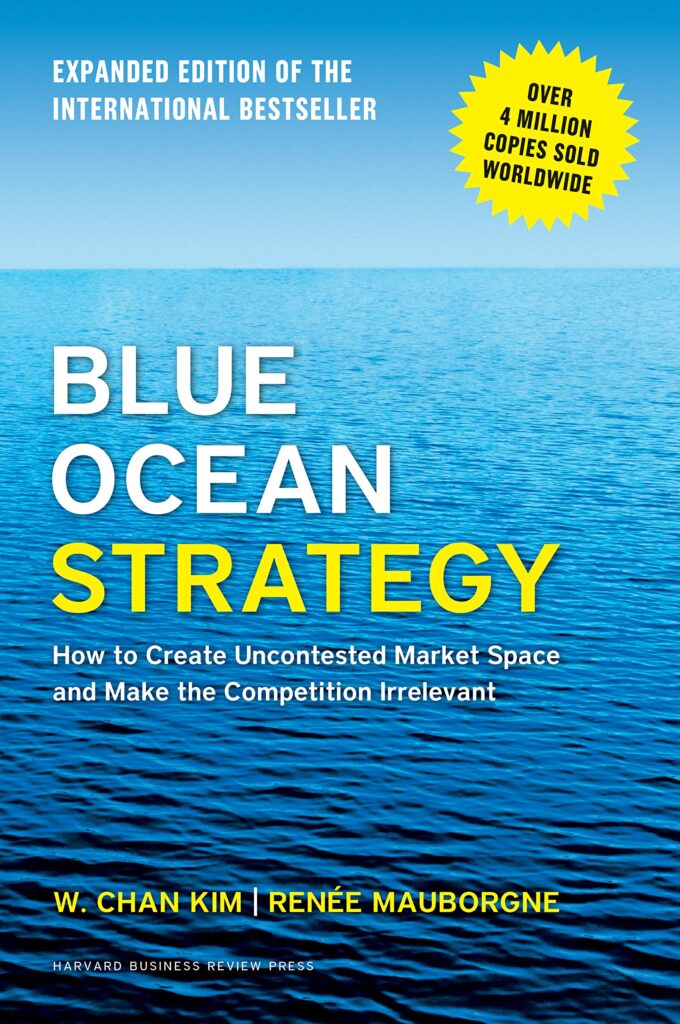
The book “Blue Ocean Strategy” by W. Chan Kim and Renee Mauborgne argues that lasting success comes not from battling competitors in existing market space (“red oceans”) but by creating uncontested market space (“blue oceans”). Copy trading can be viewed through this lens.
- Reconstruct Market Boundaries: Copy trading didn’t invent trading; it redefined the investor’s role from “analyst” to “manager selector.”
- Focus on the Big Picture, Not the Numbers: Don’t get lost in a trader’s daily P&L. Focus on their long-term strategy and risk management, the “strategic canvas.”
- Reach Beyond Existing Demand: Copy trading brought in people who were previously intimidated by the “red ocean” of manual trading.
- Get the Strategic Sequence Right: A good copy trading platform must provide exceptional Utility (easy to use), at the right Price (transparent fees), with a viable Cost structure, and address Adoption hurdles (building trust).
- Overcome Key Organizational Hurdles: For you, the investor, the key hurdle is cognitive: overcoming the bias to chase “hot” traders.
- Build Execution into Strategy: Your strategy isn’t just picking traders; it’s also defining your risk limits (e.g., setting your Copy Stop-Loss) before you start.
- The Four Actions Framework:
- Eliminate: The need for you to perform complex technical analysis.
- Reduce: The time commitment required compared to manual trading.
- Raise: The accessibility of global strategies to novice investors.
- Create: A new investment paradigm based on social proof and automation.
- Eliminate: The need for you to perform complex technical analysis.
- Value Innovation, Not Tech Innovation: The core innovation isn’t just the automation; it’s the value it creates by providing a new way to invest.
- Tipping Point Leadership: The most popular traders on a platform act as “tipping points,” influencing the flow of capital from thousands of followers.
- Create a New Value Curve: Copy trading created a new value curve that blends elements of active management (high return potential) and passive investing (automation, reduced effort).
By thinking in these terms, you can better identify which platforms and traders are truly creating new value versus just competing in the same old bloody red ocean of high-risk, high-churn trading.
The Algorithmic Frontier: Will AI Be the Ultimate Trader to Copy?
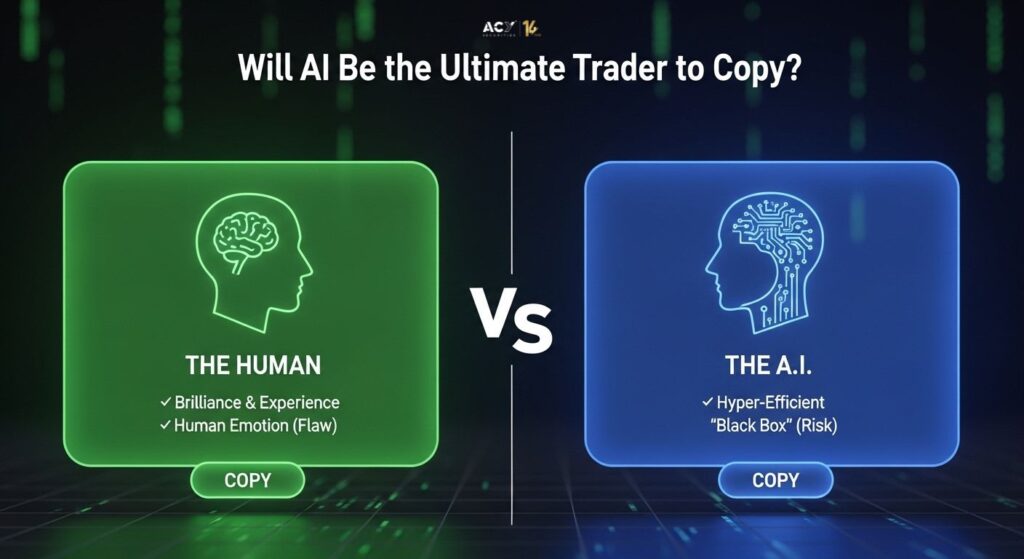
The future of copy trading is inextricably linked with Artificial Intelligence. This isn’t science fiction; it’s happening now and will fundamentally reshape the landscape.
- AI-Powered Due Diligence: Soon, AI will analyze a trader’s entire history to detect hidden risks like Martingale strategies or subtle shifts in behavior that the human eye would miss, providing a more robust “AI Risk Score”.
- Copying the Machine: The logical next step is to remove the fallible human element entirely. The most popular “traders” on future platforms may be AI-driven algorithms, selected for their pure, emotionless, and statistically verifiable performance. This would merge the concepts of copy trading and advanced robo-advisors.
- The New Risk: This solves the problem of human psychological failure but introduces a new one: “black box” risk. Can you trust an algorithm whose decision-making process is too complex to understand?
The rise of AI presents a fascinating future: a choice between copying relatable human managers, with all their flaws and brilliance, or hyper-efficient AI models that offer pure performance.
Final Checklist and Concluding Recommendations
The rise of copy trading is not just inevitable; it’s a paradigm shift in how individuals can access financial markets. But its potential can only be harnessed through diligence, strategy, and a clear-eyed understanding of the risks.
Your Final Checklist Before You Invest:
- [ ] Have I done a brutal self-assessment? Am I emotionally prepared to watch my money fluctuate based on someone else’s actions?
- [ ] Have I researched the platforms? Do I understand the complete fee structure, not just the marketing claims?
- [ ] Have I vetted my traders? Have I looked beyond the headline return and analyzed their track record length, maximum drawdown, and risk scores?
- [ ] Have I built a diversified portfolio? Have I allocated my capital across multiple traders with different strategies?
- [ ] Have I set my risk limits in stone? Have I implemented a Copy Stop-Loss for each trader based on my pre-determined risk tolerance?
- [ ] Am I committed to active oversight? Do I have a schedule for reviewing my portfolio’s performance?
Final Recommendation:
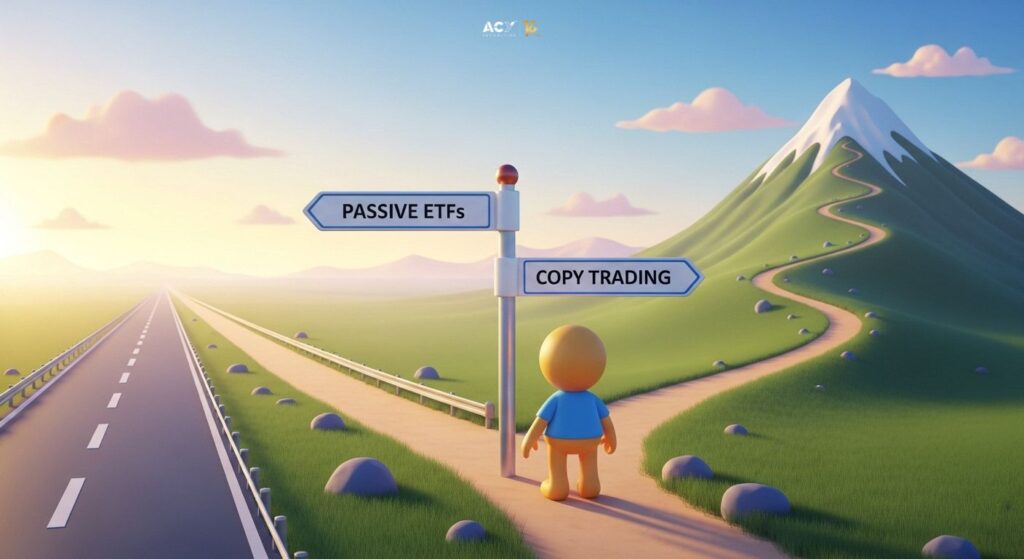
Copy trading is not a replacement for sound investment principles; it is a specialized tool. For the majority of beginners seeking steady, low-effort wealth accumulation, the traditional path of investing in low-cost, diversified ETFs remains the most prudent choice.
However, for the ambitious novice who is willing to take on the role of a “manager of managers”, who is prepared to do the research, manage a portfolio actively, and build psychological resilience, copy trading offers a unique and powerful opportunity. It is a gateway to active strategies, a real-world educational tool, and a potentially potent engine for portfolio growth. The choice is yours. Make it a smart one.
Frequently Asked Questions (FAQ)
1. What is the main difference between copy trading and mirror trading?
Copy trading involves replicating the live trades of a specific individual trader in real-time. Mirror trading is an older concept where you replicate a pre-defined, often algorithmic, strategy rather than a person. The key difference is trusting a person’s ongoing judgment versus trusting a system’s back-tested logic.
2. How much money do I need to start copy trading?
This varies by platform. For example, the minimum amount to invest in a single trader on eToro is $200. Other platforms may have minimum deposits as low as $100. However, to effectively diversify across 3-5 traders, a starting capital of $1,000 to $2,000 is more practical.
3. What are the most important metrics to look at when choosing a trader to copy?
Do not focus solely on the total return. The most critical metrics are the Maximum Drawdown (the biggest loss they’ve ever experienced) , the Track Record Length (look for at least 12-24 months) , and the platform’s Risk Score. Also, consider their communication style and the clarity of their strategy description.
4. Can I lose more than I invest in copy trading?
Generally, on most modern retail platforms and with standard accounts, you cannot lose more than the capital you have in your account. The risk management tools, like a Copy Stop-Loss (CSL), are designed to automatically close your positions to prevent a negative balance. However, it’s crucial to understand and properly set these tools, as you can certainly lose your entire investment in a trader.
5. How are the leader traders paid?
Compensation models vary. Some traders earn a performance fee, which is a percentage of the profits they generate for their copiers. Others might be paid through a platform’s partner program, which rewards them based on the amount of assets copying them. Some platforms also allow traders to charge a flat monthly subscription fee. This incentive structure is important to understand, as it can influence a trader’s risk-taking behavior.
(Disclaimer: This article is for informational and educational purposes only. It should not be considered financial advice. Always conduct your own research and consult with a qualified financial advisor before making any investment decisions.
For more detailed insights on developing daily trading routines, risk management, and effective position sizing strategies, explore additional articles on Trading Cup. Our trading experts at ACY and FinLogix are also great resources to guide your journey towards trading excellence.

Discover Our Best Trading Signals
At Tradingcup, you can browse through a selection of signals and review past performance before you decide to copy.
Become A Signal Provider
Share your expertise and become a signal provider so other traders can copy your trades.
Stay tuned to our blog for more trader spotlights and leaderboard updates.
Trading involves risks.
Visit the Tradingcup blog through the link below for more updates: https://www.tradingcup.com/learn
Related Copy Trading blogs:
- Understanding Market Liquidations: Liquidity Sweeps and Runs Explained
- 7 Essential Daily Habits of Successful Traders to Outperform Their Peers
- 10 Strategies You Can Copy off Our Best Copy Traders
- 5 Strategies Every Trader Can Master To Trade Better In A Trading Contest
- 2025 Copy Trading Scams Exposed: How to Spot Fraud
- A Swing Trading Strategy with an 83 Percent Win Rate and Low Drawdowns
- Forex Martingale Strategies Explained, The Good, The Bad and The Ugly
- Pyramiding Trading Tutorial – Pros & Cons & How to Use It