Last Updated: July 04, 2025
This article is reviewed annually to reflect the latest market regulations and trends.
Disclaimer: The information in this article is for educational purposes only and does not constitute financial, investment, or trading advice. Copy trading carries substantial risks, including the potential loss of your entire invested capital. Past performance of copied traders or strategies is not a reliable indicator of future results. You may be replicating high-risk trades, overleveraged positions, or strategies incompatible with your financial goals. Always conduct independent research into a trader’s historical performance, risk metrics, and strategy before copying them. Never invest funds you cannot afford to lose. Consult a licensed financial advisor to ensure copy trading aligns with your risk tolerance, financial objectives, and regulatory requirements in your jurisdiction. This article does not endorse specific traders, platforms, or strategies, and all trading decisions remain your sole responsibility.
TL;DR (Too Long, Didn’t Read)
- High Win Rate can feel great, but a single loss can seal your fate.
- A big ROI is a pleasant sight, but check the risk taken to win the fight.
- Forget the hype and do the math, Expectancy defines the profitable path.
- Your own Risk Profile is the real key, to trade with calm and let your profits be.
- With Due Diligence you’ll see it through, finding the perfect trader just for you
“The most important quality for an investor is temperament, not intellect. You need a temperament that neither derives great pleasure from being with the crowd or against the crowd.” – Warren Buffett
High Win Rate vs. High ROI: What’s the Real Key to Copy Trading?
You’re busy. Life is a whirlwind of work, family, and a thousand other commitments. You’ve heard about the potential of financial markets, maybe even dipped your toes into Forex, only to find a world of complex charts and bewildering jargon. The learning curve is steep, and time is a luxury you don’t have.
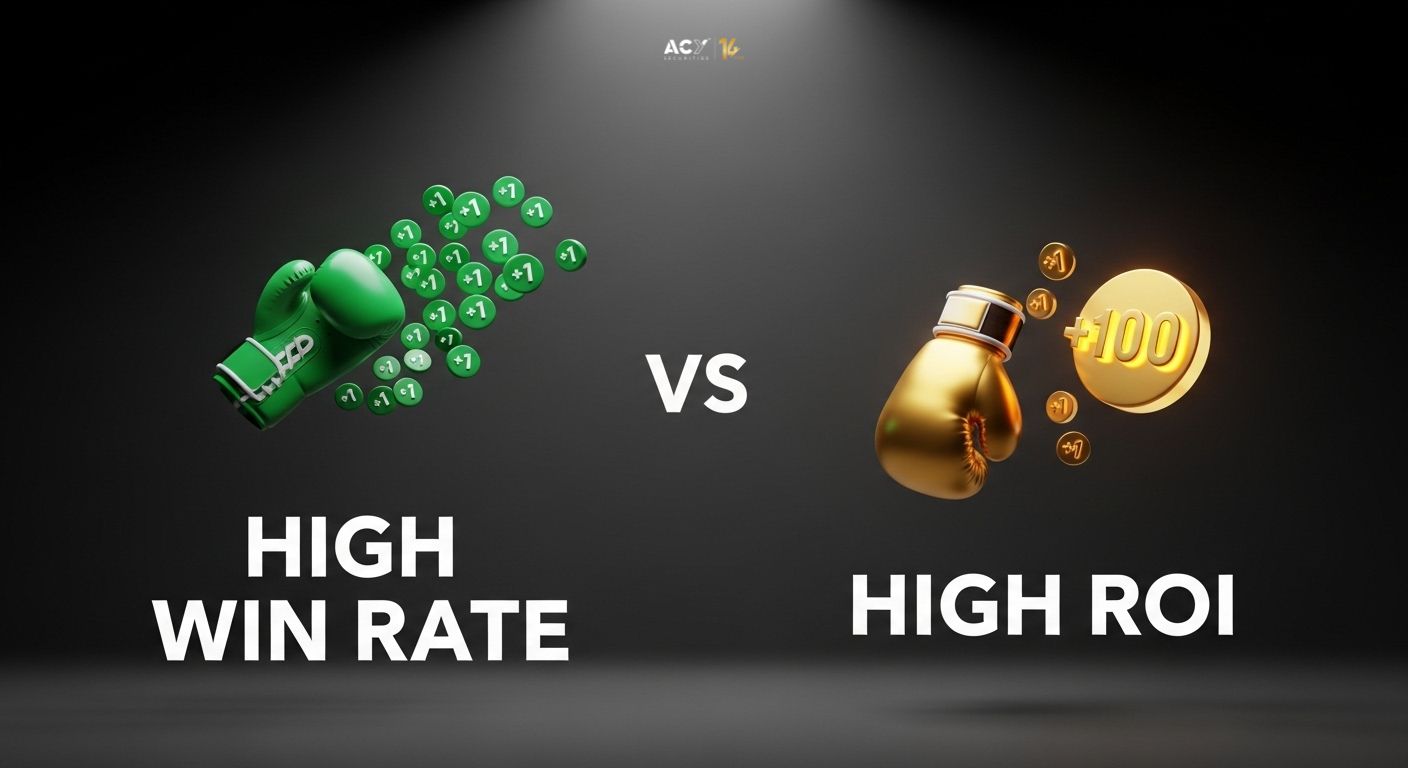
Then you discover a beacon of hope: copy trading. It seems like the perfect solution, a way to leverage the skills of seasoned professionals and participate in the markets automatically. You browse a platform, ready to start, but immediately face a fundamental dilemma: do you copy the trader with a dazzling 85% win rate or the one with a staggering 300% ROI?
This choice isn’t just about numbers; it’s about two different philosophies. One offers the psychological comfort of frequent wins, while the other promises explosive growth, paved with volatility. But framing this as a simple “either/or” question is a dangerous oversimplification and the first trap many new copiers fall into.
This guide will help you move beyond the headlines. We will deconstruct these metrics, explore the strategies behind them, and give you a professional framework for making smarter, more sustainable decisions on your copy trading journey.
First, What Exactly Are Forex Signals and Copy Trading?
Before we dive deeper, let’s clarify the concepts.
- Forex Signals: These are specific trade recommendations, often including an entry point, stop-loss, and take-profit target, generated by an analyst or an automated system. A trader receives the signal and must decide whether to execute the trade manually.
- Copy Trading: This is a more automated evolution. It is a form of portfolio management where an investor (the “copier”) automatically replicates the trades of an experienced trader (the “leader” or “signal provider”) in their own account. When the leader trades, your account trades, all in proportion to the funds you’ve allocated. Platforms like eToro, ZuluTrade, and HFM have built entire ecosystems around this concept.
Is Copy Trading a Perfect Fit for Beginners?
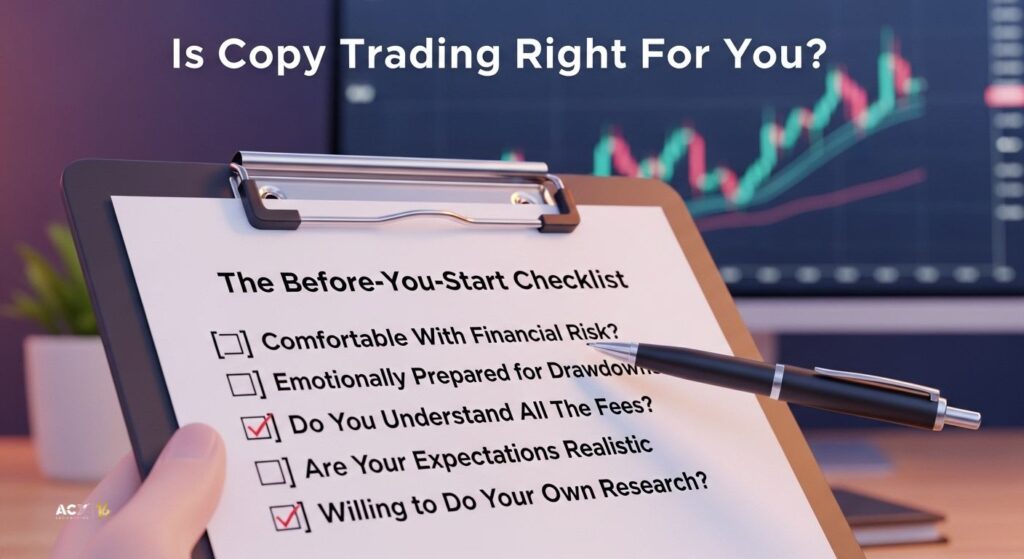
Copy trading isn’t for everyone. Before you jump in, consider this checklist:
- Are you comfortable with risk? All trading involves risk, and past performance is not indicative of future results. Even the best traders have losing streaks.
- Do you have capital you can afford to lose? Never invest money you can’t afford to part with.
- Are you looking for a passive investment? While copy trading is less hands-on, it still requires initial research and ongoing monitoring.
- Do you understand the fee structures? Subscription fees and performance fees can eat into profits.
- Are you patient? Quick riches are rare. Successful trading, even copying, often requires a long-term perspective.
- Are you willing to do your due diligence? Selecting a trader requires careful analysis of their history, strategy, and risk management.
- Do you have realistic expectations? Don’t expect to double your money overnight.
- Are you emotionally prepared for drawdowns? Seeing your account balance dip, even temporarily, can be stressful. Maximum Drawdown (MDD) is a key metric to understand.
If you’ve nodded along to these points with a clear understanding, then copy trading might be a suitable avenue for you to explore.
Deconstructing the Metrics: Why Isn’t It So Simple?
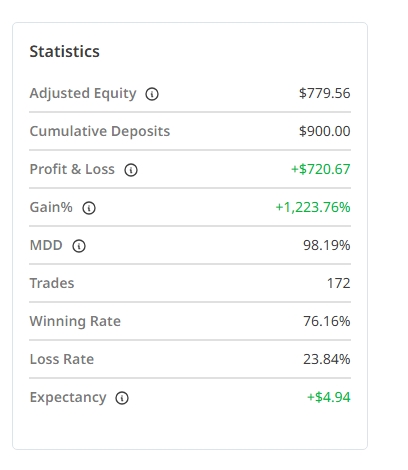
To make professional decisions, you must first understand the tools you’re using. Win Rate and ROI are just headline figures, and relying on them in isolation is a foundational error.
What Does a High Win Rate Really Tell You?
The Win Rate is the percentage of a trader’s total trades that were profitable. It’s calculated as:
Win Rate = (Number of Winning Trades / Total Number of Trades) ×100%
Its appeal is purely psychological. A high win rate provides frequent positive reinforcement, making you feel confident and secure.
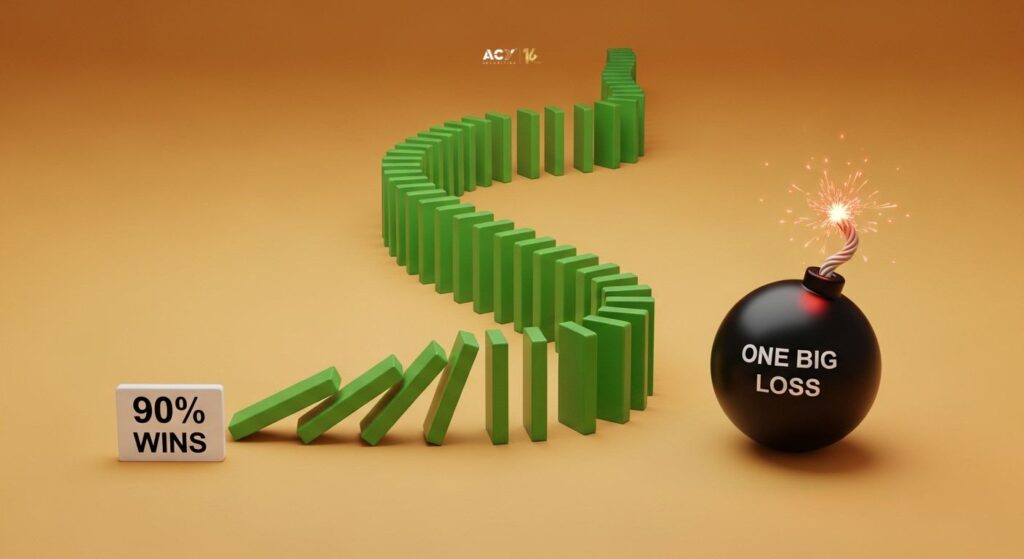
The Danger: A high win rate says nothing about profitability. A trader can win 90% of their trades and still lose money. How? If their average winning trade is tiny, but their average losing trade is massive.
- Example from the study: A trader with a 90% win rate.
- Average Win: $1
- Average Loss: $50
- After 100 trades, they have 90 wins (+$90) and 10 losses (-$500). Their net result is a -$410 loss.
- This “ticking time bomb” scenario is where a single large loss wipes out hundreds of previous wins.
- Average Win: $1
What’s Hiding Behind a High ROI?
Return on Investment (ROI) is the ultimate measure of profit, showing the net gain relative to the initial investment. The formula is:
ROI = (Net Profit / Cost of Investment) × 100%
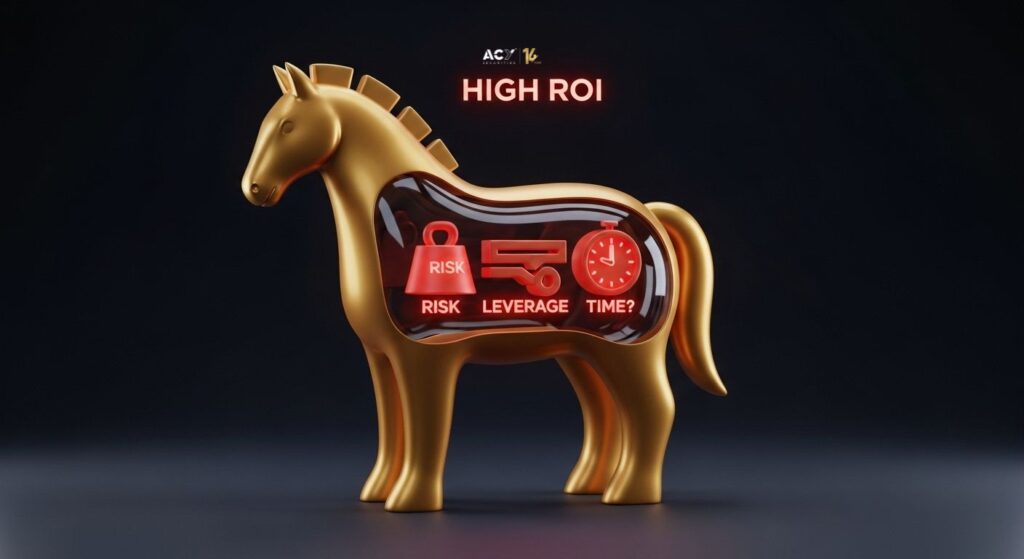
While it gets to the bottom line, the single ROI figure on a profile can be deceptive.
Why High ROI Can Be Dangerous:
- Time Horizon: A 50% ROI over three years is far less impressive than a 25% ROI in one year. You must look at the Annualized ROI to make fair comparisons.
- Risk: The ROI figure tells you nothing about the risk taken to achieve it. An astronomical ROI is almost always the product of extreme leverage and unsustainable risk-taking. Such traders often attract a huge following right before they “lose it all.” As one guide on mastering ROI in copy trading notes, high returns are often linked to high drawdowns, which can be emotionally and financially devastating if you’re not prepared.
- Leverage: Trading with borrowed funds (leverage) dramatically magnifies returns, and losses. A modest 16% loss can become a portfolio-crushing -41.5% loss with leverage.
The Missing Link: Expectancy
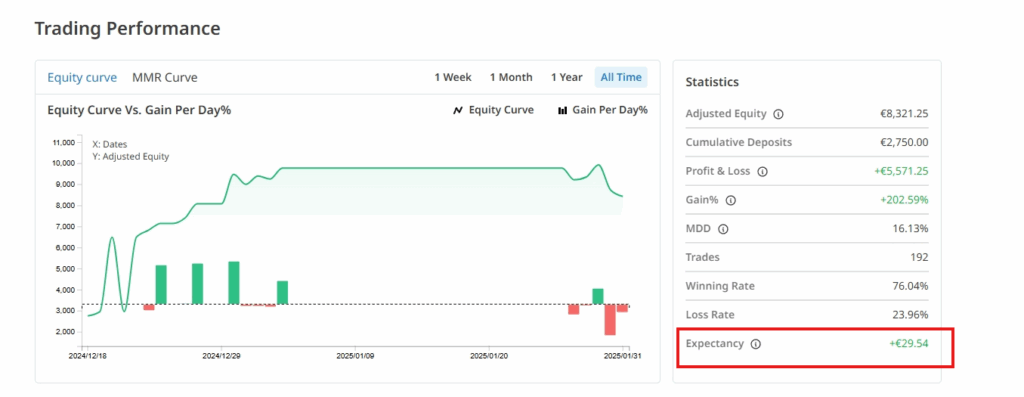
The debate between Win Rate and ROI is flawed because they are two parts of a more important equation. To truly understand a strategy’s viability, you must calculate its Expectancy. This metric tells you what you can expect to win or lose on average per trade.
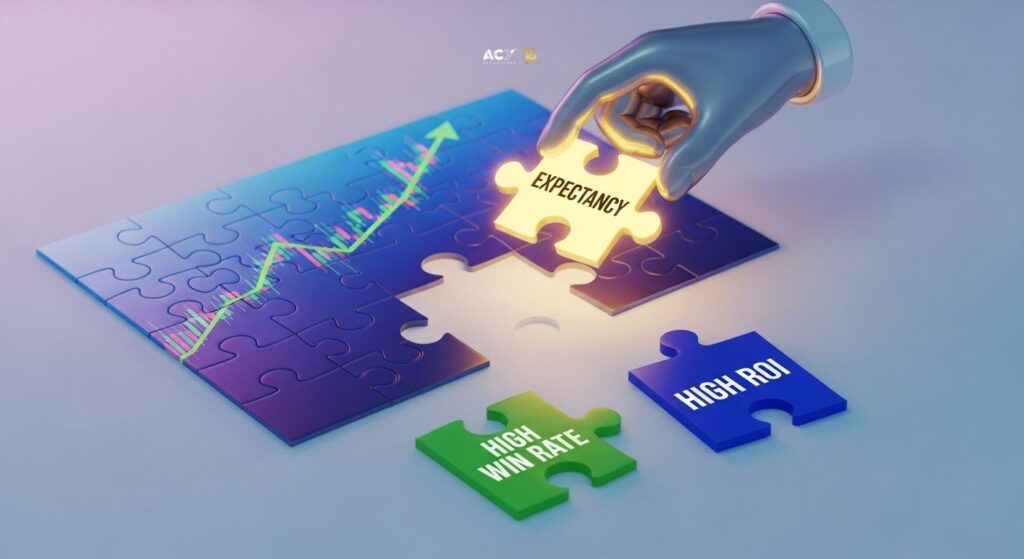
Expectancy = (Win Rate × Average Win Size) – (Loss Rate × Average Loss Size)
A positive expectancy means the strategy is profitable over the long run, regardless of the win rate.
- Example from the study: Let’s compare two traders.
- Trader A (High-Win-Rate): 76% Win Rate, risks $100 to make $80.
- Profit over 100 trades: +$3,680
- Profit over 100 trades: +$3,680
- Trader B (High-ROI/Trend-Follower): 40% Win Rate, risks $100 to make $300.
- Profit over 100 trades: +$6,000
- Profit over 100 trades: +$6,000
- Trader A (High-Win-Rate): 76% Win Rate, risks $100 to make $80.
Here, the trader who lost 60% of the time was significantly more profitable because their strategy had a higher positive expectancy. This is the real metric that matters.
Which Profile Fits You?
Traders generally fall into two archetypes. Understanding them is key to aligning a strategy with your personality.
The High-Win-Rate Trader (The Scalper)

These traders aim for frequent, small profits, often with win rates of 70-80%+. They use strategies like scalping (in and out in minutes) or mean-reversion.
- Pros: The constant positive reinforcement is psychologically comforting and reduces stress. It feels good to be “right” most of the time.
- Cons: The risk structure is a “ticking time bomb.” A single large loss can wipe out dozens of wins because they risk more than they aim to gain (a low Risk/Reward Ratio). These strategies are also highly sensitive to transaction costs, which can eat away small profits.
- Real-World Example: This review of a high-win-rate strategy highlights traders who achieve consistency by targeting small, achievable profits, but it also implicitly warns that this requires tight risk management to avoid the “one big loss” scenario.
The High-ROI Trader (The Trend-Follower)

These traders aim to capture massive market trends, holding positions for days, weeks, or even months. This approach is defined by a low win rate, often 30-50%. They accept many small, controlled losses while waiting for the one big move.
- Pros: The potential for outsized returns and significant long-term growth is enormous. One or two great trades can make an entire year exceptional.
- Cons: The psychological burden is immense. You must endure long and frequent losing streaks without losing faith. The equity curve is not smooth; it’s long periods of flat or declining value punctuated by sharp upward spikes. Many copiers abandon the strategy during a drawdown, right before the big win occurs.
- Real-World Example: As this review of the most profitable traders shows, leaders with the highest ROI often employ trend-following strategies. Their histories are marked by volatility, demonstrating the immense patience required to follow them.
How Would Warren Buffett Approach Copy Trading?

Warren Buffett wouldn’t be a copy trader, but his core principles provide a powerful lens through which to evaluate the Win Rate vs. ROI debate.
- “Rule No. 1: Never lose money. Rule No. 2: Never forget Rule No. 1.” This philosophy immediately invalidates the high-win-rate “ticking time bomb” strategy. Buffett would be horrified by any strategy where a single, foreseeable event could cause a catastrophic loss, no matter how many small wins preceded it. He would focus on capital preservation above all.
- Focus on Long-Term Value, Not Short-Term Noise. Buffett buys businesses, not stocks. He’s concerned with underlying value and a long investment horizon. This aligns more with the high-ROI, trend-following mindset, which requires patience and a focus on the big picture. He would reject the high-frequency churn of scalping as speculation, not investment.
- Understand What You’re Investing In. Buffett famously avoids businesses he doesn’t understand. In copy trading, this translates to thoroughly understanding the leader’s strategy. He wouldn’t just look at ROI; he would demand to know how that ROI was generated, what risks were taken, and if the strategy is repeatable. He would prioritize transparency.
- Temperament is Everything. His quote at the beginning of this article says it all. Buffett would argue that the “right” strategy is the one you have the psychological temperament to stick with through thick and thin. For him, that means ignoring the crowd and avoiding emotional decisions, the very bedrock of surviving a trend-follower’s drawdown.
Buffett’s Verdict: He would reject both metrics in isolation. He would search for a leader whose strategy demonstrates a clear, understandable, and sustainable edge (positive expectancy) and who manages risk with extreme discipline (low chance of permanent capital loss). This aligns more with the philosophy of a high-ROI trader but demands the risk management of a true conservator of capital.
10 Lessons from “Best Loser Wins” by Tom Hougaard
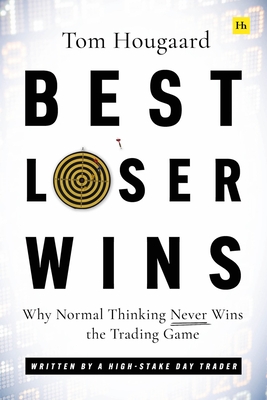
Tom Hougaard’s book is a masterclass in trading psychology. Its lessons are directly applicable to the copy trader’s dilemma, as enduring the path of a chosen leader is a psychological game.
- Your Edge Comes from Execution, Not Analysis. You can pick a leader with a perfect strategy, but if you abandon them during a drawdown, the strategy is worthless to you. Psychological execution is everything.
- Embrace Being Wrong. A high-ROI trader is wrong 50-70% of the time. You must be comfortable with the feeling of losing frequently to win big.
- Stop Focusing on the Money. Obsessing over your account balance leads to emotional decisions. Focus on whether the leader is executing their strategy correctly. This is the only thing that matters.
- The Market is a Master Humiliator. No strategy works forever, and every strategy has drawdowns. Expect to be humbled. A trader’s Maximum Drawdown (MDD) is the most honest metric of the pain you will likely endure.
- You Are Paid to Wait. High-ROI strategies often involve long periods of inactivity. Patience is not just a virtue; it’s a profitable skill.
- Your Feelings Are Poor Indicators. The desire to flee during a losing streak is a powerful emotion. It’s also usually the wrong decision if the strategy’s expectancy is positive.
- The Biggest Winners Feel Like the Biggest Risks. The trades that generate massive ROIs often feel terrifying to hold. You must trust the strategy over your fear.
- Process Over Outcome. Don’t judge a leader on a single trade’s outcome. Judge them on their adherence to a proven, positive-expectancy process over hundreds of trades.
- A Losing Streak is Inevitable. A profitable strategy can easily have 20-30 consecutive losses. Mentally and financially prepare for this before you start copying.
- To Win, You Must Be Willing to Lose. This is the book’s central thesis. The high-ROI path requires accepting many small, manageable losses as the cost of doing business to achieve extraordinary gains.
Your Professional Framework: An Actionable Due Diligence Plan in Copy Trading

Moving from an amateur to a professional copy trader requires a structured evaluation process.
Step 1: Go Beyond the Headlines
Create a dashboard of metrics to get a holistic view.
- Maximum Drawdown (MDD): The single most important risk metric. It shows the most money the trader has lost from a peak to a trough. If this number (e.g., 40%) makes you sick to your stomach, do not copy this trader, no matter the ROI.
- Sharpe Ratio: Measures risk-adjusted return. A ratio above 1.0 is good; it shows the trader generates solid returns for the level of risk they take.
- Follower PnL: Are the people copying this trader actually making money? If the leader’s ROI is high but their followers are losing money, it’s a huge red flag that the strategy doesn’t scale well or is eroded by fees.
- Track Record Length: Look for consistency over 12-24 months. Anyone can get lucky for a few months.
Step 2: Learn to Spot the Red Flags
The copy trading world has traps for the unwary. Learn to spot them.
- Hiding Losses: A trader can show a 99% win rate by simply never closing their losing trades. Always check a trader’s open positions for massive, aging losses.
- The Martingale Strategy: This is a system of doubling your trade size after every loss. It produces a high win rate but is mathematically guaranteed to blow up the account eventually. If you see a trader increasing their risk after a loss, run away.
Step 3: Master Your Tools and Mitigate Risk
Successful copy trading is an active exercise in risk management.
- Diversify: The easiest way to lessen risk is to not put all your eggs in one basket. Spreading your capital across 5-8 traders with different, uncorrelated strategies can smooth out your returns and reduce volatility. Learn how to build a diversified portfolio by copying multiple traders.
- Use a Copy Stop-Loss (CSL): This is your ultimate safety net. It’s a master switch that automatically stops you from copying a leader if your allocated funds drop by a percentage you set (e.g., 20%). It protects you from catastrophic failure and prevents emotional panic-selling.
- Monitor Your Investments: Don’t “set and forget.” Adopt a “set and review” mindset. You don’t need to watch every trade, but you must understand how to monitor your account. A weekly or monthly check-in is sufficient for most.
- Know When to Switch: Before you invest, define your exit criteria. You might decide to stop copying if a trader exceeds their historical MDD or deviates from their stated strategy. Knowing when it’s time to switch traders is a critical skill.
Step 4: The Human Element
Your journey doesn’t end with numbers.
- Grow Your Account Strategically: You don’t have to start big. There are smart ways to grow a small copy trading account by reinvesting profits and carefully managing risk.
- Communicate: Many platforms allow you to interact with leaders. Learning how to effectively communicate with your chosen traders can provide valuable insights into their strategy and current mindset.
- Stay Informed: The market is dynamic. You need to be prepared for how economic news can impact your leader’s strategy. Furthermore, avoid the top mistakes beginners make by understanding the psychological and strategic pitfalls from day one.
- Keep Learning: The best traders are perpetual students. Take advantage of opportunities to learn from experts, such as joining free educational webinars to get real-time feedback from market analysts.
Conclusion: So, What Matters More?
After this deep dive, the answer is clear: the question itself is flawed.
Neither Win Rate nor ROI matters more in isolation.
The true measure of a strategy is its positive mathematical expectancy. But even that is not enough.
The final decision rests on a holistic evaluation of three pillars:
- Mathematical Viability: Does the strategy have a positive expectancy and a strong risk-adjusted return (Sharpe Ratio)?
- Risk Profile: Is the trader’s Maximum Drawdown within your personal financial and emotional ability to endure?
- Psychological Compatibility: Does the journey of the strategy (frequent small wins vs. infrequent huge wins) align with your temperament?
What matters most is finding a leader whose strategy is mathematically sound, whose risks you can afford to take, and whose psychological journey you can endure. The responsibility for this evaluation rests squarely on your shoulders. Adhere to the golden rules of copy trading, and you can transform from a passive speculator into an active, informed portfolio manager.
Frequently Asked Questions (FAQ)
Q1: What is a good Maximum Drawdown (MDD) to look for?
A low MDD indicates good risk control. For a moderate risk profile, an MDD below 20% is desirable, while conservative investors should look for an MDD below 10%. An MDD over 30-40% is a major red flag for most copiers.
Q2: What is a good Sharpe Ratio in copy trading?
The Sharpe Ratio measures return per unit of risk. A ratio below 1.0 indicates poor risk-adjusted returns. A ratio above 1.0 is considered good, above 1.5 is strong, and anything above 2.0 is exceptional for a retail strategy.
Q3: How can I tell if a trader is using the dangerous Martingale strategy?
Look at their trade history after a loss. A Martingale trader will systematically double their position size after each losing trade to try and win everything back at once. This behavior is a clear sign of a strategy that is mathematically doomed to fail.
Q4: Why would a trader have a high personal ROI but their followers are losing money?
This is a critical red flag. It can happen for several reasons: their strategy might not be scalable to larger amounts of capital, or the profits are being consumed by fees, commissions, and slippage (the difference between the expected and actual trade execution price) on the followers’ accounts. Always check the “Follower PnL” if available.
Q5: What is the single most important metric for a copy trader to understand?
While no single metric tells the whole story, the two most critical concepts are Expectancy and Maximum Drawdown (MDD). Expectancy tells you if a strategy is profitable in the long run , and MDD tells you the maximum pain (financial and psychological) you can expect to endure along the way.
(Disclaimer: This article is for informational and educational purposes only. It should not be considered financial advice. Always conduct your own research and consult with a qualified financial advisor before making any investment decisions.
For more detailed insights on developing daily trading routines, risk management, and effective position sizing strategies, explore additional articles on Trading Cup. Our trading experts at ACY and FinLogix are also great resources to guide your journey towards trading excellence.

Discover Our Best Trading Signals
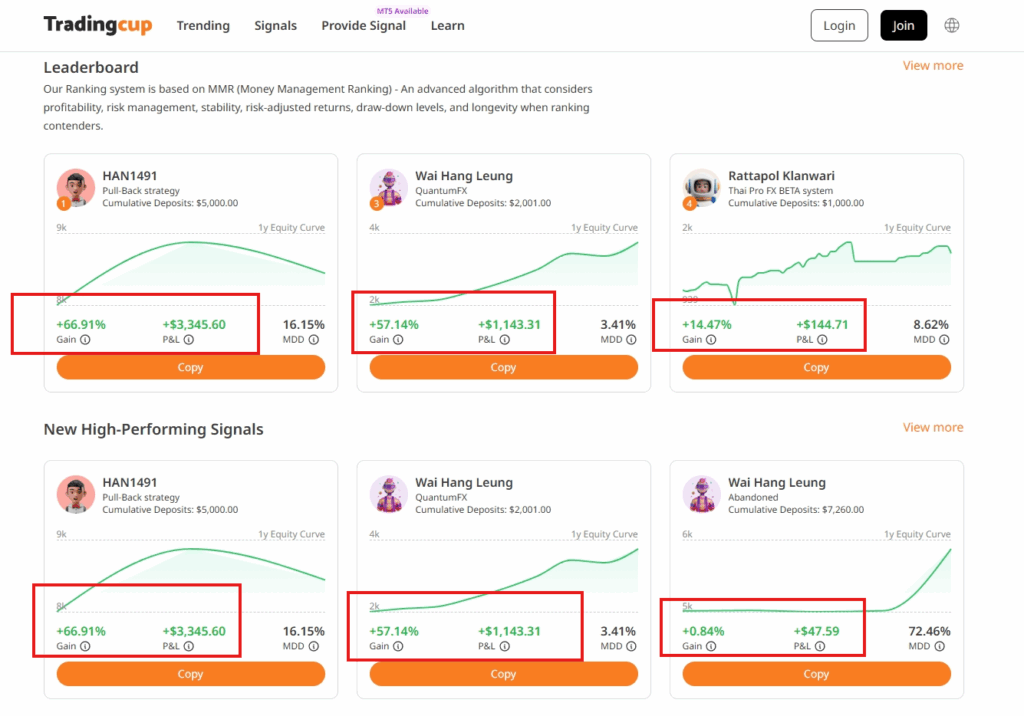
At Tradingcup, you can browse through a selection of signals and review past performance before you decide to copy.
Become A Signal Provider
Share your expertise and become a signal provider so other traders can copy your trades.
Stay tuned to our blog for more trader spotlights and leaderboard updates.
Trading involves risks.
Visit the Tradingcup blog through the link below for more updates: https://www.tradingcup.com/learn
Related Copy Trading blogs:
- Understanding Market Liquidations: Liquidity Sweeps and Runs Explained
- 7 Essential Daily Habits of Successful Traders to Outperform Their Peers
- 10 Strategies You Can Copy off Our Best Copy Traders
- 5 Strategies Every Trader Can Master To Trade Better In A Trading Contest
- 2025 Copy Trading Scams Exposed: How to Spot Fraud
- A Swing Trading Strategy with an 83 Percent Win Rate and Low Drawdowns
- Forex Martingale Strategies Explained, The Good, The Bad and The Ugly
- Pyramiding Trading Tutorial – Pros & Cons & How to Use It