

Forex Martingale Strategies
“Risk comes from not knowing what you’re doing.” – Warren Buffett
TL; DR: In forex trading, the Martingale strategy involves increasing trade sizes after each loss, based on the assumption the market will eventually reverse and recover previous losses. Some traders use this method to lower their average entry price and potentially turn a profit, but it comes with significant risks.
Introduction
The Martingale strategy traces its roots back to 18th-century gambling halls, where players would double their bets after each loss, believing that a single win would erase all previous deficits.
This approach has found its way into share trading, gold trading and forex trading, where some signal providers use the same principle. They increase the size of their position sizes after losing trades in anticipation of a market reversal. By following these traders through copy trading, investors can automatically replicate their trades, including the aggressive risk-taking that comes with the Martingale method.
At first glance, this strategy’s promise of rapid recovery can be appealing, especially for those copying traders who aim to turn losses into gains. However, beneath the surface lies a major risk: in forex markets, where leverage magnifies both profits and losses, a prolonged losing streak can lead to rapid account depletion.
In this article, we’ll break down how Martingale strategies work in copy trading, discuss their short-term appeal, and highlight the risks that traders should consider before following this high-risk approach.
Understanding Forex Martingale Strategies
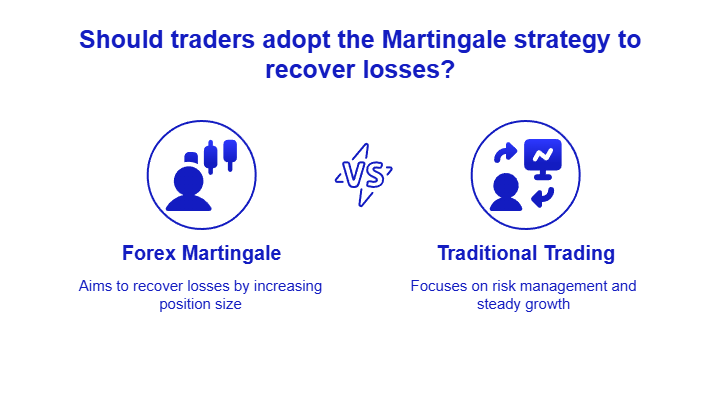
The Martingale strategy in Forex is deceptively simple: after each losing trade, you double your position size, banking on an eventual win to offset all prior losses. Unlike gambling, where outcomes are binary (win or lose), Forex involves price movements measured in pips, and traders often aim to lower their average entry price to break even or profit when the market turns.
How It Works: A Step-by-Step Scenario
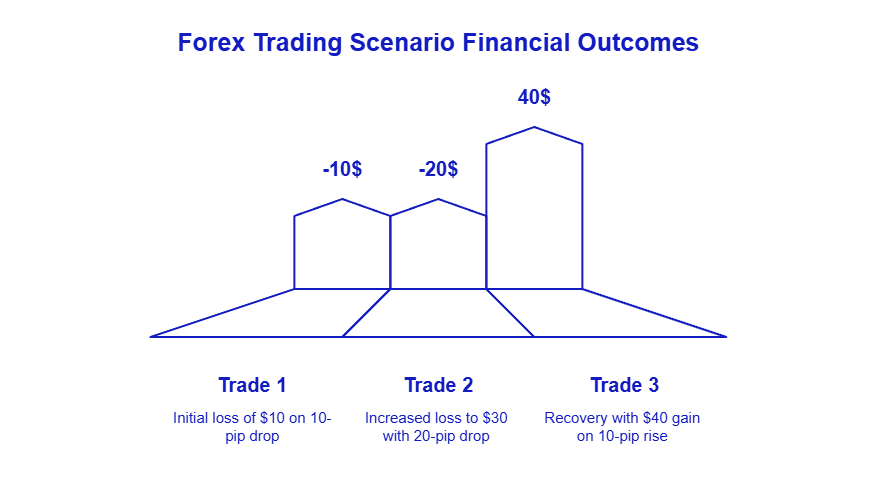
Let’s break it down with a practical scenario using EUR/USD, a popular Forex pair:
- Trade 1: You buy 0.1 lot (10,000 units) at 1.1000. The price drops to 1.0990 a 10-pip loss. With 1 pip equaling $1 for 0.1 lot, you lose $10 and close the trade.
- Trade 2: You double your position to 0.2 lot and buy at 1.0990. The price falls to 1.0980 (another 10-pip loss), costing you $20 (0.2 lot * 10 pips * $1/pip). Total losses: $30.
- Trade 3: You double again to 0.4 lot, buying at 1.0980. The price rises to 1.0990 (a 10-pip gain), earning $40 (0.4 lot * 10 pips * $1/pip). Net result: $40 – $30 = $10 profit.
In this case, the third trade recovers the losses and nets a small profit. But what if the losing streak continues? Here’s how position sizes grow:
| Trade Number | Position Size (Lots) | Cumulative Position (Lots) | Margin Required (100:1 Leverage) |
|---|---|---|---|
| 1 | 0.1 | 0.1 | $100 |
| 2 | 0.2 | 0.3 | $300 |
| 3 | 0.4 | 0.7 | $700 |
| 4 | 0.8 | 1.5 | $1,500 |
| 5 | 1.6 | 3.1 | $3,100 |
| 6 | 3.2 | 6.3 | $6,300 |
After six losses, your position balloons to 3.2 lots, with a cumulative exposure of 6.3 lots. For a $10,000 account with 100:1 leverage, the margin alone consumes $6,300 over half your capital leaving little room for further losses.
The Mechanics in Action
In Forex, some traders keep positions open, adding to them as the market moves against them, rather than closing each trade. For example:
- Buy 0.1 lot at 1.1000.
- Price drops to 1.0990; add 0.2 lot.
- Price drops to 1.0980; add 0.4 lot.
Total lots: 0.7. Average entry price: [(0.1 * 1.1000) + (0.2 * 1.0990) + (0.4 * 1.0980)] / 0.7 = 1.0986. If the price rises to 1.0990, you profit: 0.7 lots * 4 pips * $1/pip = $28. This illustrates how Martingale can lower the average entry price, but the growing position size is the ticking time bomb.
The Allure and the Danger
The Short-Term Appeal
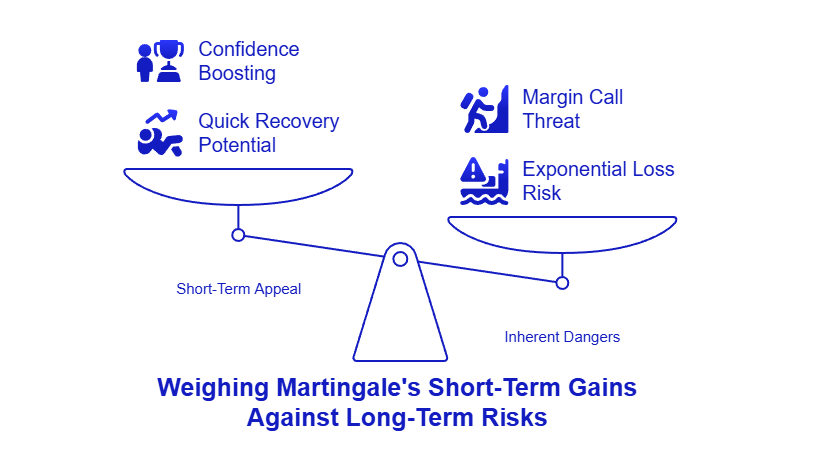
The Martingale strategy seduces traders with its promise of recovery. By doubling positions, you reduce your average entry price, meaning the market doesn’t need to return to your initial level for you to profit. In the example above, the average entry dropped to 1.0986, so a rebound to 1.0990 well below 1.1000 still yielded a gain. This can feel like a cheat code for navigating losing trades, especially in volatile markets where reversals seem imminent.
For short-term copy traders on platforms like tradingcup.com, the allure is amplified by the potential to turn a string of losses into a quick win, boosting confidence and account balances in a single move. However, this appeal is a mirage that obscures the strategy’s dark side.
The Inherent Dangers
The danger lies in the exponential growth of trade sizes. Forex markets don’t guarantee reversals; they can trend relentlessly due to economic data, central bank policies, or geopolitical shocks. A prolonged losing streak can devastate an account:
- Scenario: After six losses with a cumulative 6.3 lots, a further 10-pip drop results in an unrealized loss of 6.3 lots * 10 pips * $10/pip = $6,300.
- Impact: Add the $6,300 margin requirement, and a $10,000 account is pushed to the brink or beyond triggering a margin call or total wipeout.
Leverage, a staple of Forex trading on brokers like acy.com, magnifies this risk. A 100:1 leverage means a 1% adverse move against a 6.3-lot position erases 63% of your capital. The strategy’s reliance on infinite capital and perfect timing clashes with the finite reality of trading accounts and unpredictable markets.
Risk/Reward Analysis and Limitations
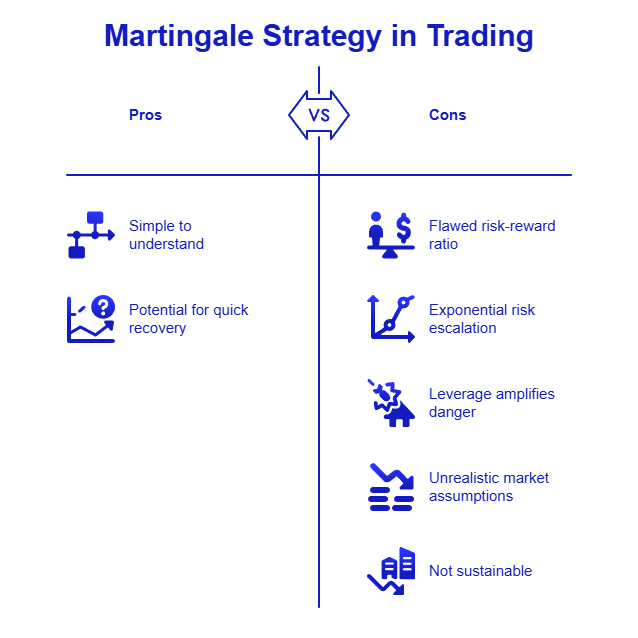
A Flawed Risk to Reward Ratio
The Martingale strategy typically offers a 1:1 risk to reward ratio. If you start with a $10 risk and double after each loss, a win after three trades nets $10 after risking $30 cumulatively ($10 + $20 + $40 in position exposure). Contrast this with safer strategies:
- Conservative Approach: Risk $10 to gain $20 (1:2) or $30 (1:3) per trade, using fixed sizes and stop losses.
- Martingale Reality: Risk escalates exponentially potentially thousands for a fixed $10 reward.
This imbalance makes Martingale a gambler’s bet, not a trader’s tool. Sustainable strategies prioritize limited risk for outsized rewards.
Leverage: A Double-Edged Sword
Leverage amplifies Martingale’s dangers. A 1-pip move against a 0.1-lot position is $1, but against 6.3 lots, it’s $63. With 100:1 leverage, a small market swing can obliterate an account before a reversal occurs.
Market Limitations
Forex markets aren’t coin flips; trends can persist for days, weeks, or months. The Martingale assumption that a reversal is always around the corner ignores this reality. Historical data shows EUR/USD trending over 500 pips in a month, far beyond what most accounts can withstand with doubling positions.
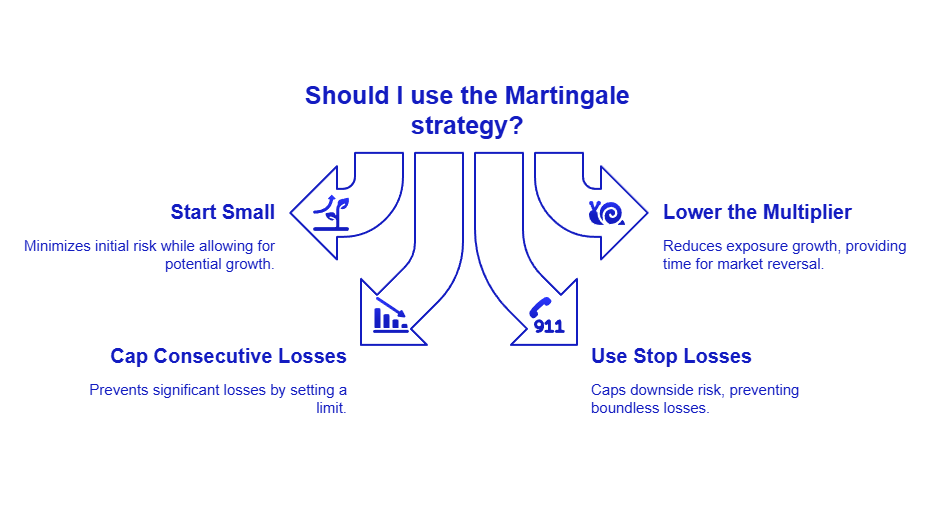
Tips and Best Practices (If You Choose to Use It)
While we strongly caution against Martingale, here are practical tips for those tempted to experiment:
- Start Small: Begin with the tiniest position (e.g., 0.01 lot). A $10,000 account might handle $10 losses initially, but doubling to 0.64 lots after six trades still risks $640 per pip move.
- Lower the Multiplier: Instead of doubling, increase by 1.5x (e.g., 0.01, 0.015, 0.0225). This slows exposure growth, buying time for a reversal.
- Cap Consecutive Losses: Set a limit, say, three losses, then stop. After 0.01, 0.02, and 0.04 lots, accept the $70 loss rather than risking 0.08 lots ($800/pip).
- Use Stop Losses: Pure Martingale avoids them, but a stop loss at 50 pips caps your downside. Without it, losses are boundless.
- Backtest First: Test on a demo account via ACY to see how it fares in trending vs. ranging markets.
Even with these safeguards, the strategy’s risks remain high. Explore safer methods on acy.com’s trading guides.
Conclusion
The Martingale strategy dangles the carrot of quick recovery, leveraging the hope that doubling down will turn losses into profits. Yet, its mechanics exponential position growth, poor risk to reward, and vulnerability to leverage make it a ticking time bomb in Forex trading.
A single prolonged trend can transform a small loss into a total account blowout, a lesson too many learn too late.
For traders’ sustainable success lies in disciplined risk management, fixed positions, stop losses, and strategies targeting 1:2 or 1:3 reward ratios.
Martingale may tempt with short-term wins, but its long-term cost is too steep. Choose knowledge over chance; your capital depends on it.
Ready to master safer trading strategies?
Ready to master safer trading strategies? Sign up or log in on tradingcup.com for expert analyses, personalized advice, and robust resources. Check out acy.com’s broker tools or finlogix.com’s market insights for more. Trustpilot Reviews: See why traders trust us read reviews.
FAQs
What is the basic concept of a Martingale strategy in Forex?
It’s a method where traders double their position size after each loss, expecting a winning trade to recover all losses by lowering the average entry price.
Why can the Martingale method lead to massive losses?
Exponential position growth during a losing streak, paired with leverage, can exhaust margin and capital, risking complete account loss in trending markets.
What are some safer alternatives to the Martingale approach?
Try trend-following with stop losses, breakout trading, or mean reversion with 1:2+ risk to reward ratios. Learn more at tradingcup.com/strategies.
For more detailed insights on developing daily trading routines, risk management, and effective strategy refinement, explore additional articles on Trading Cup. External experts at ACY and FinLogix are also great resources to guide your journey towards trading excellence.

Discover Our Best Trading Signals
At Tradingcup, you can browse through a selection of signals and review past performance before you decide to copy.
Share your expertise and become a signal provider so other traders can copy your trades.
Stay tuned to our blog for more trader spotlights and leaderboard updates.
Trading involves risks.
Visit the Tradingcup blog through the link below for more updates:
https://www.tradingcup.com/learn