
Last Updated: February 25, 2026
This article is reviewed annually to reflect the latest market regulations and trends.

TL; DR:
- Informed Choices Win: Profit in XAUUSD copy trading hinges on diligently selecting skilled, consistent traders and understanding their strategies, not just chasing past high returns.
- Costs & Risks are Real: Factor in platform fees, potential spreads, and the inherent risk of losses. Capital protection through diversification and risk management is paramount.
- Market Dynamics Matter: XAUUSD (Gold) is influenced by inflation, geopolitical events, and seasonal trends. Align your copy trading with current market sentiment (bullish/bearish) and gold’s unique characteristics.
- Long-Term Mindset: Adopt a patient, disciplined approach inspired by investment legends. Focus on “expectancy” (average profit per trade) and consistent performance over months, not quick wins.
- Continuous Learning: Understand how master traders earn, the psychology of financial decisions, and the principles of value investing to protect and grow your capital intelligently.
Disclaimer: The information in this article is for educational purposes only and does not constitute financial, investment, or trading advice. Copy trading carries substantial risks, including the potential loss of your entire invested capital. Past performance of copied traders or strategies is not a reliable indicator of future results. You may be replicating high-risk trades, overleveraged positions, or strategies incompatible with your financial goals. Always conduct independent research into a trader’s historical performance, risk metrics, and strategy before copying them. Never invest funds you cannot afford to lose. Consult a licensed financial advisor to ensure copy trading aligns with your risk tolerance, financial objectives, and regulatory requirements in your jurisdiction. This article does not endorse specific traders, platforms, or strategies, and all trading decisions remain your sole responsibility.
“The biggest risk of all is not taking one. But the art is in the calculated risk, not the blind leap.”
The Warren Buffett Lens on Profit and Loss in Copy Trading

Warren Buffett, the Oracle of Omaha, is renowned for his value investing philosophy, which, while not directly about short-term trading, offers timeless wisdom applicable to managing profit and loss in any investment, including copy trading.
- Rule No. 1: Never Lose Money. Rule No. 2: Never Forget Rule No. 1.
- Application to Copy Trading: This underscores the paramount importance of capital preservation. Before focusing on potential profits, assess the risk of loss with any trader you copy. Is their risk management practices solid? What is their maximum drawdown? Don’t invest more than you can afford to lose.
- Application to Copy Trading: This underscores the paramount importance of capital preservation. Before focusing on potential profits, assess the risk of loss with any trader you copy. Is their risk management practices solid? What is their maximum drawdown? Don’t invest more than you can afford to lose.
- Invest in What You Understand (“Circle of Competence”).
- Application to Copy Trading: While you’re leveraging someone else’s expertise, you should still understand the basics of XAUUSD, what drives its price, and the general strategy the trader employs. Blindly copying without any understanding increases your risk.
- Application to Copy Trading: While you’re leveraging someone else’s expertise, you should still understand the basics of XAUUSD, what drives its price, and the general strategy the trader employs. Blindly copying without any understanding increases your risk.
- Price is What You Pay; Value is What You Get.
- Application to Copy Trading: Don’t just chase traders with the highest recent returns (high price). Look for underlying value: a consistent strategy, good risk management, transparency, and reasonable fees. Is the “value” provided by the trader worth the “price” (fees and risk)?
- Application to Copy Trading: Don’t just chase traders with the highest recent returns (high price). Look for underlying value: a consistent strategy, good risk management, transparency, and reasonable fees. Is the “value” provided by the trader worth the “price” (fees and risk)?
- Our Favorite Holding Period Is Forever (Long-Term Perspective).
- Application to Copy Trading: While copy trading can be shorter-term, a long-term mindset helps. Don’t abandon a good trader after one losing week or month if their long-term expectancy and strategy remain sound. Avoid emotional, short-sighted decisions.
- Application to Copy Trading: While copy trading can be shorter-term, a long-term mindset helps. Don’t abandon a good trader after one losing week or month if their long-term expectancy and strategy remain sound. Avoid emotional, short-sighted decisions.
- Be Fearful When Others Are Greedy and Greedy When Others Are Fearful (Contrarian Thinking).
- Application to Copy Trading: This is more advanced, but it means not necessarily following the most popular trader if they are taking excessive risks during market euphoria, or perhaps considering a solid, conservative trader during market panics if their strategy is designed for such conditions.
- Application to Copy Trading: This is more advanced, but it means not necessarily following the most popular trader if they are taking excessive risks during market euphoria, or perhaps considering a solid, conservative trader during market panics if their strategy is designed for such conditions.
Buffett’s approach emphasizes risk aversion, understanding, and patience—qualities that can significantly improve your experience and potential outcomes in copy trading.
10 Golden Lessons from “The Psychology of Money” for XAUUSD Copy Traders

Morgan Housel’s “The Psychology of Money” offers profound insights into how our biases and emotions affect our financial decisions. Applying these to XAUUSD copy trading can be a game-changer:
- No One’s Crazy: People make financial decisions based on their unique experiences. The trader you’re copying has their own rationale; try to understand their broader strategy rather than judging individual trades.
- Luck and Risk are Siblings: Success (and failure) in trading involves both skill and luck. A trader’s past stellar performance might have had a luck component, and future risks are always present. Don’t over extrapolate past successes.
- Never Enough (The Danger of Moving Goalposts): Define your financial goals for copy trading. Chasing ever-higher returns can lead to taking on excessive risk. Know when “enough is enough” for your risk appetite.
- Confounding Compounding: While more applicable to long-term investing, the principle of consistent, steady gains (even if smaller) compounding over time is more powerful than erratic big wins and losses. Seek traders with consistent expectancy.
- Getting Wealthy vs. Staying Wealthy: Getting wealthy might involve taking some risks. Staying wealthy involves robust risk management and avoiding ruin. Prioritize capital protection when copy trading.
- Tails, You Win (The Long Tail of Returns): A few good decisions or a few consistently profitable traders can account for the majority of your gains. Focus on finding those reliable sources.
- Freedom: The ultimate goal of money is often freedom and control over your time. Copy trading should serve this goal, not become a source of constant stress.
- Man in the Car Paradox: People rarely admire the person in the fancy car; they admire the car and imagine themselves in it. Similarly, don’t just envy a trader’s displayed profits; understand the work, risk, and strategy behind them.
- Wealth is What You Don’t See: True wealth is often the assets not spent. In copy trading, this translates to disciplined profit-taking and not over-leveraging or reinvesting every penny impulsively.
- Save Money (Building a Buffer): Having a financial buffer outside your trading capital reduces the pressure to take desperate risks if your copy trading portfolio experiences a drawdown.
Understanding these psychological aspects can help you make more rational decisions, manage emotions like fear and greed, and stick to your copy trading plan.
Can You Truly Earn by Copy Trading XAUUSD Gold Traders? A Comprehensive Profit and Loss Analysis for 2026 and Beyond

The allure of the gold market (XAUUSD) is timeless, often seen as a safe haven and a store of value. With the rise of copy trading, the question on many aspiring investors’ minds is: “Can you genuinely earn by copy trading XAUUSD gold traders?” The answer is nuanced, leaning towards a conditional “yes,” but it’s paved with the need for diligent research, strategic decision-making, and a profound understanding of both profits and potential losses.
Why Copy Trade XAUUSD?
XAUUSD, the trading symbol for gold against the US dollar, is one of the most popular and liquid trading pairs. Its movements are driven by a confluence of factors including inflation rates, US dollar strength, geopolitical stability, central bank policies, and even seasonal demand (e.g., festivals in India and China).
Copy trading platforms offer a seemingly straightforward path: find a successful gold trader, allocate funds, and automatically replicate their trades. For beginners, it’s a way to potentially tap into the expertise of seasoned professionals. For busy individuals, it offers a more passive approach to engaging with the market. However, the shine of potential profits should not blind one to the inherent risks and costs involved.
Deconstructing the Financials: Understanding the Cost of Copy Trading
Before diving into potential earnings, it’s crucial to understand the expenses associated with copy trading XAUUSD. These can eat into your profits if not carefully managed.
- Subscription/Platform Fees: Many platforms or top-tier traders charge a monthly subscription fee for access to their signals or copy trading services.
- Performance Fees: A common model involves paying a percentage of the profits generated (e.g., 10-30%). This is often calculated using a “high-water mark” principle, meaning fees are only charged on new profits that exceed the previous peak of your investment with that trader.
- Spread Costs: The spread (difference between the buy and sell price) is an inherent trading cost. While you’re copying trades, these spreads still apply to each transaction.
- Slippage: In fast-moving markets, the price at which your copied trade executes might differ slightly from the master trader’s execution price. This “slippage” can be positive or negative.
- Withdrawal/Deposit Fees: Some brokers or platforms may charge fees for funding your account or withdrawing profits.
How Master XAUUSD Traders (Signal Providers) Earn
The traders you copy, often called “signal providers” or “master traders,” earn in several ways:
- Profit Sharing/Performance Fees: This is a primary income source. The more profit they make for their copiers, the higher their earnings from the agreed percentage.
- Subscription Fees: Some charge a flat monthly fee regardless of performance.
- Platform Incentives: Copy trading platforms may offer bonuses, higher revenue shares, or other incentives to attract and retain successful traders who bring in more users.
- Trading Their Own Capital: Most master traders also trade their own funds alongside their copiers, directly benefiting from their successful strategies.
Understanding their motivation, which should align with generating consistent profits for their followers is crucial.
Comprehensive scenario for a copy trader starting with $1,000 to copy a Gold (XAU/USD) trader
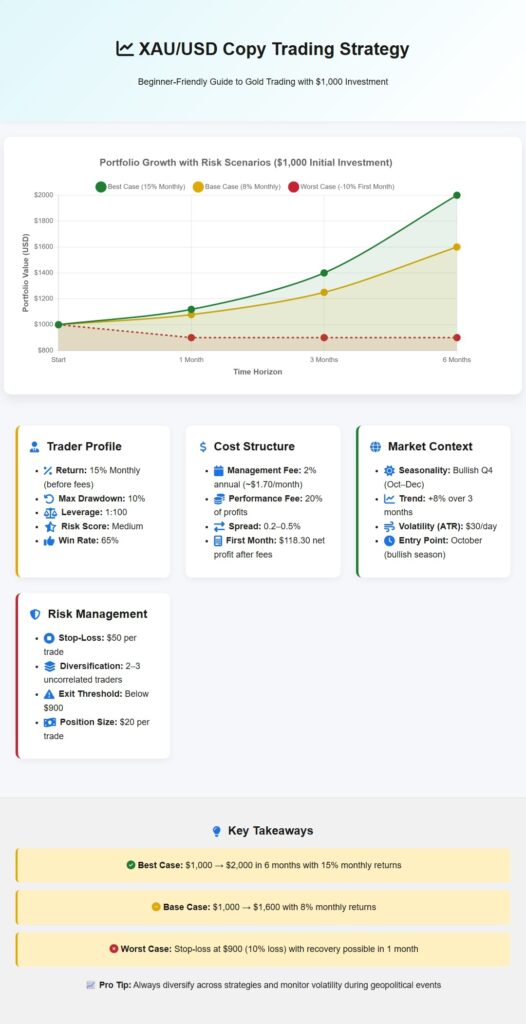
Here’s a comprehensive scenario for a copy trader starting with $1,000 to copy a Gold (XAU/USD) trader on a platform like Tradingcup. This includes hard data, risk assessments, and projected outcomes based on the provided sources and realistic market assumptions.
1. Initial Setup
- Platform: Tradingcup
- Capital: $1,000.
- Asset: XAU/USD (Gold vs. US Dollar).
- Trader Profile: Hypothetical top-performing trader on Tradingcup with:
- Monthly Return : 15% (before fees).
- Max Drawdown: 10% (peak-to-trough loss historically).
- Risk Score: Medium (moderate leverage, diversified strategies).
- Leverage Used: 1:100 (common in Gold trading).
- Monthly Return : 15% (before fees).
2. Cost Breakdown
Platform Fees
- Management Fee: 2% annually (prorated monthly: ~0.17%).
- Performance Fee: 20% of profits.
- Transaction Costs: Spread (0.2–0.5% for XAU/USD, depending on broker).
Your Total Costs :
- First Month:
- If trader earns 15%:
- Gross profit = $1,000 × 15% = $150.
- Performance fee = $150 × 20% = $30.
- Management fee = $1,000 × 0.17% = $1.70.
- Net Profit: $150 – $30 – $1.70 ≈ $118.30.
- Gross profit = $1,000 × 15% = $150.
- If trader earns 15%:
- Annual Cost : If sustained 15% monthly returns (compounded):
- Total fees ≈ 22–25% of annual profits.
- Total fees ≈ 22–25% of annual profits.
3. Trader Performance Analysis
Key Metrics (based on Tradingcup’s trader selection guide ):
- Win Rate: 65% (65% of trades are profitable).
- Average Trade Duration: 48 hours (swing trading strategy).
- Risk/Reward Ratio: 1:2 (risking $1 to gain $2).
- Historical Drawdown: 10% (max loss in a single event).
Your Risk Exposure :
- Position Sizing: Trader uses 2% of capital per trade.
- Your $1,000 portfolio: $20 per trade.
- Your $1,000 portfolio: $20 per trade.
- Leverage Impact: 1:100 leverage means $2,000 exposure per trade (amplifies gains/losses).
4. Market Context: XAU/USD
Seasonal Trends (based on Tradingcup’s XAU/USD analysis ):
- Seasonal Demand:
- Q4 (Oct–Dec): High demand due to holidays, central bank buying, and inflation hedging.
- Q1 (Jan–Mar): Often bearish due to profit-taking.
- Q4 (Oct–Dec): High demand due to holidays, central bank buying, and inflation hedging.
- Current Market Sentiment:
- Assume you’re entering in October (bullish seasonality).
- Recent 3-month trend: +8% (driven by Fed rate cuts and geopolitical tensions).
- Assume you’re entering in October (bullish seasonality).
Volatility (based on historical data):
- Daily Range: $1,800–$1,950 (current price: $1,900).
- ATR (Average True Range): $30/day (high volatility).
5. Risk Management Strategy
Your Plan (based on Tradingcup’s risk management guide ):
- Stop-Loss: 5% of position size ($1,000 portfolio → $50 max loss per trade).
- Diversification: Copy 2–3 traders with uncorrelated strategies (e.g., one trend-following, one scalping).
- Maximum Drawdown Threshold: Exit if portfolio drops below $900 (10% loss).
6. Projected Outcomes
Scenario 1: Best Case (Bullish Market + Trader Success)
- Monthly Return: 15% (net of fees).
- Growth:
- 1 Month: $1,000 → $1,118.30.
- 3 Months: $1,118.30 → $1,400 (compounded).
- 6 Months: ~$2,000 (assuming consistent returns).
- 1 Month: $1,000 → $1,118.30.
- Risks: Sudden geopolitical events (e.g., war) could spike gold prices, boosting returns.
Scenario 2: Base Case (Moderate Returns)
- Monthly Return: 8% (after fees).
- Growth:
- 1 Month: $1,000 → $1,078.
- 3 Months: $1,078 → $1,250.
- 6 Months: ~$1,600.
- 1 Month: $1,000 → $1,078.
Scenario 3: Worst Case (Bearish Market + Trader Drawdown)
- Monthly Loss: -10% (trader hits max drawdown).
- Loss: $1,000 → $900 (stop-loss triggers exit).
- Recovery Time: Assuming 15% monthly returns, 1 month to recover.
7. Final Recommendations
- Start Small: Allocate $500 initially, keep $500 as dry powder for rebalancing.
- Monitor Fees: Track performance fees; switch traders if fees exceed 25% of profits.
- Seasonal Timing: Exit positions by March (seasonal bearish phase) and reinvest in October.
- Backtesting: Use Tradingcup’s historical data to simulate returns (e.g., 2020–2023 XAU/USD trends).
Key Takeaways
- Potential ROI: 8–15% monthly returns (net fees) in favorable conditions.
- Maximum Risk: $100–$200 loss (10–20% of capital).
- Time Horizon: 3–6 months for meaningful growth.
Understanding and Evaluating Trading Performance
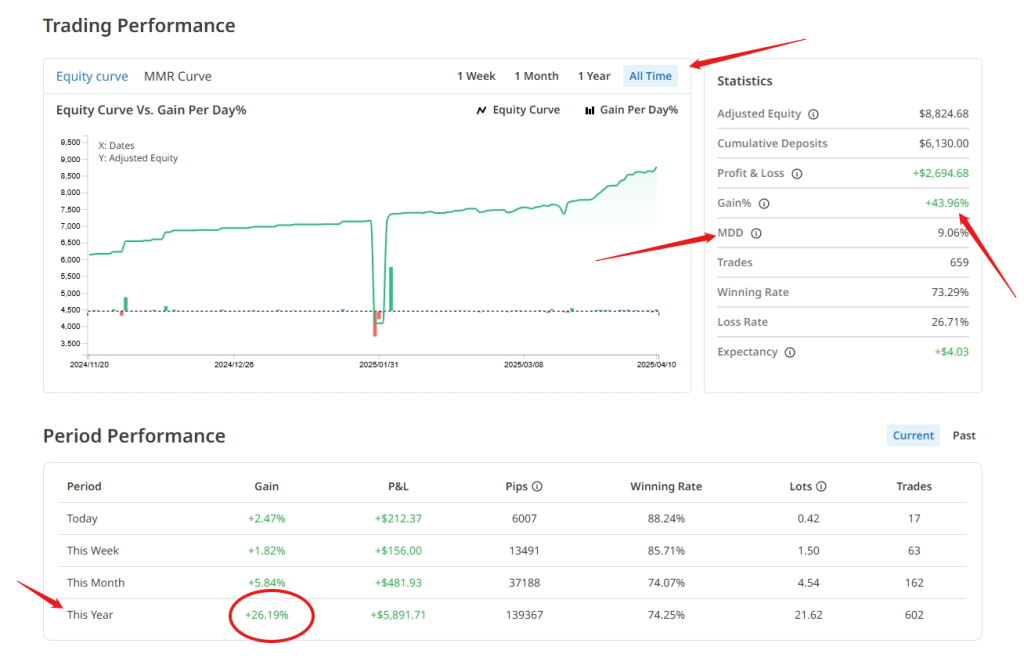
Simply looking at a high percentage gain over a short period can be misleading. A thorough evaluation of a trader’s performance is critical before committing your capital.
- Consistency Over Time: As emphasized by various trading education platforms, it’s best to copy traders who have demonstrated consistency for several months, ideally weathering different market conditions and impactful news events. This suggests their strategy is robust. Look for a track record of at least 6-12 months, if not longer.
- Risk-Adjusted Returns: High returns often come with high risk. Metrics like the Sharpe ratio can help assess returns relative to the risk taken.
- Maximum Drawdown: This shows the largest peak-to-trough decline in the trader’s capital during a specific period. A lower drawdown is generally preferred, indicating better risk management. Are you comfortable with the potential dips in their equity curve?
- Win Rate vs. Risk-Reward Ratio: A high win rate isn’t everything. A trader might win 80% of their trades but if the losing trades are significantly larger than the winning ones, the overall strategy might be unprofitable. Conversely, a trader with a 50% win rate but with winners that are three times the size of losers can be very profitable.
- Number of Trades & Trading Frequency: Understand their trading style. Are they a scalper (many small, quick trades), a day trader, or a swing trader (holding positions for days or weeks)? Does their frequency align with your expectations and the fee structure?
- Expectancy: This is a powerful metric, often highlighted by platforms like Tradingcup. It’s calculated as: (Win Rate x Average Win Size) – (Loss Rate x Average Loss Size) Or, more simply: (Total Profit from Closed Trades / Number of Trades) A positive expectancy means that, on average, the trader’s strategy is profitable per trade over the long run. This shifts focus from individual wins or losses to the statistical edge of their system.
Comprehensive scenario for a copy trader starting with $1,000 to copy three distinct traders (Trade Horizons, Thai Pro FX BETA System, Ali Dogan Scalp)
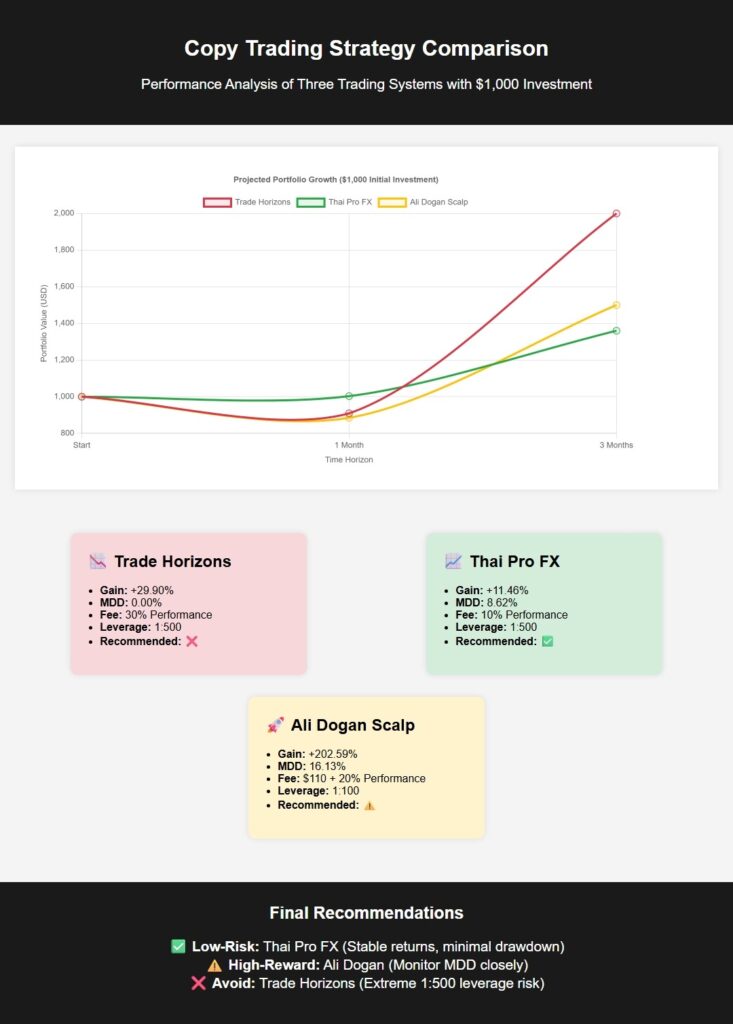
Trader Profiles & Key Metrics
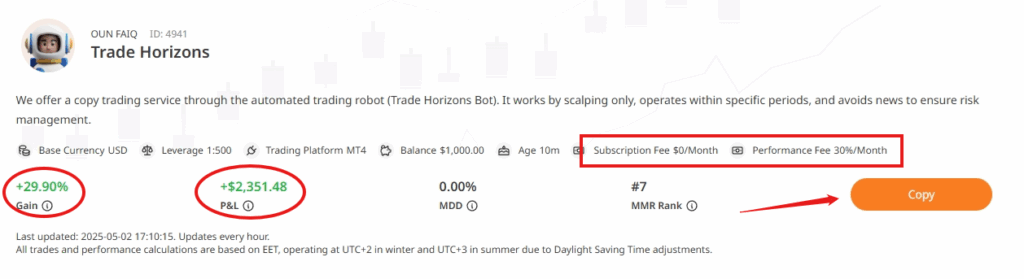
- Gain: +29.90% (all-time).
- P&L: $2,351.48 (on $1,000 balance).
- MDD: 0.00% (no historical drawdown).
- Performance Fee: 30%/month.
- Most Traded Pair: XAUUSD (100%).
- Winning Rate: 76.14%.
- Trades: 1,119.
- Leverage: 1:500.
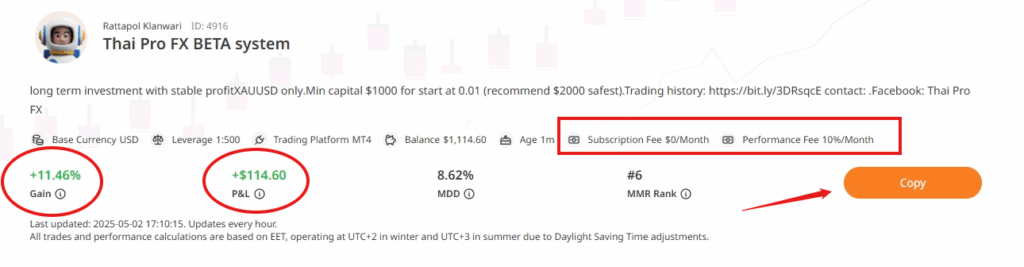
- Gain: +11.46% (all-time).
- P&L: $114.60 (on $1,000 balance).
- MDD: 8.62%.
- Performance Fee: 10%/month.
- Most Traded Pair: XAUUSDzero (100%).
- Winning Rate: 97.01%.
- Trades: 167.
- Leverage: 1:500.
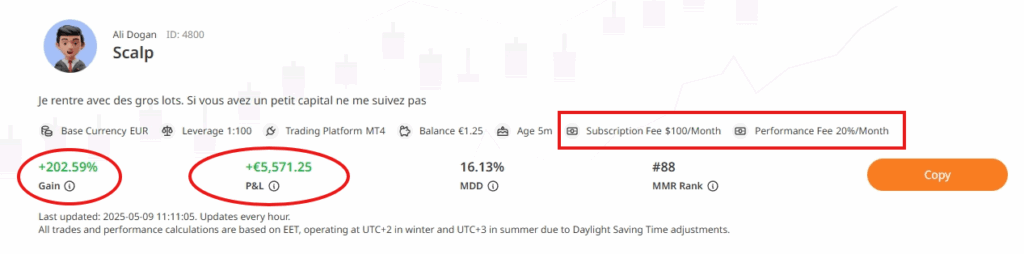
- Gain: +202.59% (all-time).
- P&L: €5,571.25 (on €1.25 balance).
- MDD: 16.13%.
- Performance Fee: 20%/month.
- Most Traded Pairs: XAUUSD (95.92%), USDZAR, EURUSD, NAS100, FR40, GER30 (0.68% each).
- Winning Rate: 76.04%.
- Trades: 192.
- Leverage: 1:100.
Cost Breakdown
1. Trade Horizons
- Subscription Fee: $0/month.
- Performance Fee: 30% of profits.
- Example Calculation:
- If you earn $300 (30% of $1,000):
- Net Profit = $300 – ($300 × 30%) = $210 .
- If you earn $300 (30% of $1,000):
2. Thai Pro FX BETA System
- Subscription Fee: $0/month.
- Performance Fee: 10% of profits.
- Example Calculation:
- If you earn $100 (10% of $1,000):
- Net Profit = $100 – ($100 × 10%) = $90.
- If you earn $100 (10% of $1,000):
3. Ali Dogan Scalp
- Subscription Fee: €100/month (converted to ~$110 USD).
- Performance Fee: 20% of profits.
- Example Calculation:
- If you earn $200 (20% of $1,000):
- Net Profit = $200 – ($200 × 20%) – $110 = $60 .
- If you earn $200 (20% of $1,000):
Risk Exposure
1. Trade Horizons
- MDD: 0.00% (historically no drawdown).
- Leverage: 1:500 → High risk (small price movements amplify gains/losses).
2. Thai Pro FX BETA System
- MDD: 8.62% → Potential loss of $86.20 on $1,000.
- Leverage: 1:500 → High risk.
3. Ali Dogan Scalp
- MDD: 16.13% → Potential loss of $161.30 on $1,000.
- Leverage: 1:100 → Moderate risk (less aggressive than 1:500).
Projected Outcomes
Scenario 1: Copying Trade Horizons
- Assumptions:
- Monthly return matches all-time gain (29.90%).
- Fees: 30% performance fee.
- Monthly return matches all-time gain (29.90%).
- Results:
- 1 Month: $1,000 → $1,299 → Net Profit = $1,299 – ($299 × 30%) = $909.30.
- 3 Months: Compounded growth ≈ $1,000 → $2,000+ (aggressive).
- Risks : High leverage (1:500) → Sudden market reversals could wipe out capital.
- 1 Month: $1,000 → $1,299 → Net Profit = $1,299 – ($299 × 30%) = $909.30.
Scenario 2: Copying Thai Pro FX BETA System
- Assumptions:
- Monthly return matches all-time gain (11.46%).
- Fees: 10% performance fee.
- Monthly return matches all-time gain (11.46%).
- Results:
- 1 Month: $1,000 → $1,114.60 → Net Profit = $1,114.60 – ($114.60 × 10%) = $1,003.14.
- 3 Months: Compounded growth ≈ $1,000 → $1,360.
- Risks: Low MDD (8.62%) but low monthly returns.
- 1 Month: $1,000 → $1,114.60 → Net Profit = $1,114.60 – ($114.60 × 10%) = $1,003.14.
Scenario 3: Copying Ali Dogan Scalp
- Assumptions:
- Monthly return matches all-time gain (202.59% annualized ≈ 16.88% monthly).
- Fees: 20% performance fee + $110/month subscription.
- Monthly return matches all-time gain (202.59% annualized ≈ 16.88% monthly).
- Results:
- 1 Month: $1,000 → $1,168.80 → Net Profit = $1,168.80 – ($168.80 × 20%) – $110 = $885.04.
- 3 Months: Compounded growth ≈ $1,000 → $1,500+ (after fees).
- Risks: High MDD (16.13%) and diversified pairs (XAUUSD + others).
- 1 Month: $1,000 → $1,168.80 → Net Profit = $1,168.80 – ($168.80 × 20%) – $110 = $885.04.
Market Alignment & Seasonality
- Gold (XAUUSD):
- Current Trend: Bullish (as per Trade Horizons’ 29.90% gain).
- Seasonal Factors: Strong demand in Q4 (holidays, inflation hedging).
- Current Trend: Bullish (as per Trade Horizons’ 29.90% gain).
- Thai Pro FX BETA System:
- Focuses solely on XAUUSDzero (spot gold vs. USD).
- Focuses solely on XAUUSDzero (spot gold vs. USD).
- Ali Dogan Scalp:
- Diversified into USDZAR (South African Rand) and EURUSD, which may correlate with global economic sentiment.
Recommendations
- Low-Risk Option:
- Copy Thai Pro FX BETA System (11.46% gain, 97% win rate).
- Why: Steady returns, minimal drawdown, and focus on gold.
- Copy Thai Pro FX BETA System (11.46% gain, 97% win rate).
- High-Risk/High-Reward:
- Copy Ali Dogan Scalp (202.59% all-time gain).
- Why: Aggressive strategy with diversified pairs, but monitor MDD closely.
- Copy Ali Dogan Scalp (202.59% all-time gain).
- Avoid Trade Horizons:
- Despite 29.90% gain, 1:500 leverage poses extreme risk for a $1,000 portfolio.
- Despite 29.90% gain, 1:500 leverage poses extreme risk for a $1,000 portfolio.
Final Takeaways
- Best Choice: Thai Pro FX BETA System for stability.
- Worst Case: Ali Dogan Scalp’s MDD (16.13%) could reduce your $1,000 to $838.70.
- Fees Matter: Performance fees (10–30%) significantly eat into profits.
The XAUUSD Market Pulse: Bullish, Bearish, or Sideways?

The profitability of copy trading XAUUSD is intrinsically linked to the current market environment.
- Bullish Market: A rising gold price generally benefits traders with long-biased strategies. Factors like high inflation, geopolitical uncertainty, or a weakening US dollar often fuel bullish sentiment in gold. Recent analyses in early 2025 have shown periods of strong bullish pressure for gold, testing historical highs (e.g., around $3300-$3400 levels as per some forecasts and analyses from late 2024/early 2025).
- Bearish Market: A falling gold price would favor traders who effectively use short-selling strategies. A strengthening US dollar or rising real interest rates can put downward pressure on gold.
- Sideways/Consolidating Market: Range-bound strategies might thrive here, but breakout strategies could struggle.
Staying Updated: It’s crucial to have a general understanding of the prevailing sentiment for XAUUSD. Follow reputable financial news sources and market analyses. For instance, expert forecasts for 2025 from sources like LiteFinance indicated a generally positive outlook for gold, with various analysts predicting prices potentially ranging from $2,800 to over $3,700, though short-term corrections are always possible. Central bank buying and geopolitical risks were cited as supportive factors.
XAUUSD: Understanding the Trading Pair’s Unique Rhythm
Gold isn’t just any commodity; its price movements are influenced by a unique set of factors:
- Safe-Haven Demand: During economic crises, market turmoil, or geopolitical tension, investors often flock to gold, driving up its price.
- Inflation Hedge: Gold is traditionally seen as a hedge against inflation. When fiat currencies lose purchasing power, gold tends to hold its value or appreciate.
- US Dollar Inverse Relationship: Typically, a weaker US dollar makes gold cheaper for holders of other currencies, increasing demand and price (and vice-versa). Monitor the DXY (US Dollar Index).
- Interest Rates: Higher real interest rates increase the opportunity cost of holding non-yielding assets like gold, potentially dampening its price. Conversely, low or negative real rates can boost gold.
- Central Bank Activity: Large purchases or sales of gold by central banks can significantly impact prices. Reports from the World Gold Council often highlight these trends.
- Seasonal Trends: As highlighted by Forecaster.biz, gold exhibits some seasonality. For example:
- Historically Stronger Periods: Mid-December to Mid-April and Early July to Early September have often shown upward tendencies. January, in particular, has historically been a strong month.
- Historically Weaker/Flat Periods: Mid-April to Early July.
- These patterns are often linked to jewelry demand (e.g., Indian wedding season, Chinese New Year) and investor positioning. However, past seasonality is not a guarantee of future performance.
- Historically Stronger Periods: Mid-December to Mid-April and Early July to Early September have often shown upward tendencies. January, in particular, has historically been a strong month.
When copying XAUUSD traders, it’s beneficial if their strategy implicitly or explicitly accounts for these gold-specific drivers.
Your Action Plan for XAUUSD Copy Trading
- Educate Yourself: Understand XAUUSD, its drivers, and the basics of copy trading.
- Choose Platforms Wisely: Opt for reputable platforms with transparent fee structures and good trader analytics.
- Vet Traders Rigorously:
- Look for consistency (6+ months, through varied market news).
- Analyze their full track record: drawdown, risk-reward, win rate, and especially expectancy.
- Understand their strategy (scalping, swing, etc.) and if it aligns with gold’s characteristics.
- Read reviews but be discerning.
- Look for consistency (6+ months, through varied market news).
- Start Small & Diversify: Don’t put all your eggs in one basket. Consider copying 2-3 traders with different (but solid) strategies once you gain confidence. Start with an amount you’re comfortable losing.
- Implement Risk Management:
- Use stop-loss features if the platform allows manual overrides or settings for copied trades (though some platforms restrict this, meaning you rely on the master trader’s stops).
- Define your maximum acceptable loss per trader or overall.
- Don’t over-allocate capital.
- Use stop-loss features if the platform allows manual overrides or settings for copied trades (though some platforms restrict this, meaning you rely on the master trader’s stops).
- Monitor Performance Regularly: Keep an eye on your investments and the trader’s performance. Be prepared to stop copying a trader if their strategy fundamentally changes for the worse or they deviate from their stated approach.
- Understand the Current Market: Is gold bullish or bearish? Is it trending or ranging? This context helps in selecting traders whose strategies are suited for the current environment.
- Focus on the Long Game: Avoid knee-jerk reactions to short-term fluctuations. Trust the process if you’ve chosen a trader with positive long-term expectancy.
- Protect Your Capital Intelligently: This isn’t just about avoiding losses but also about securing profits and not letting greed dictate decisions.
- Keep Learning: The markets evolve, and so should your knowledge.
The Expectancy Equation in Tradingcup and Beyond
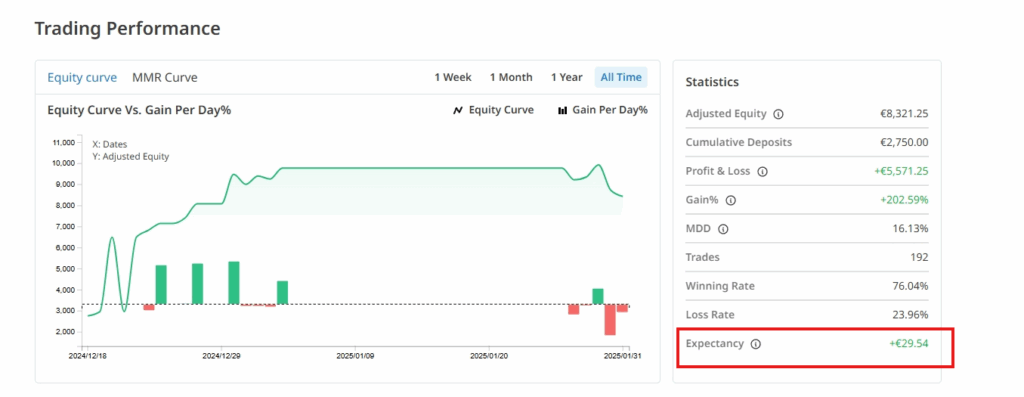
As mentioned, platforms like Tradingcup utilize “expectancy,” calculated as (Total Profit from Closed Trades) / (Number of Trades). This simple yet profound figure tells you the average dollar amount you can expect to win or lose per trade based on the trader’s history. A positive expectancy is the bedrock of a profitable trading system over time. When evaluating a XAUUSD trader, a consistently positive and ideally growing expectancy is a very strong indicator.
The Wisdom of Copying Consistent Traders
The advice to copy traders consistent for a few months is golden. This duration implies:
- Strategy Resilience: Their methods have likely been tested by various market news (e.g., inflation reports, central bank announcements, geopolitical events) and market phases.
- Psychological Fortitude: They’ve managed their emotions and stuck to their plan through ups and downs.
- Proven Edge: It’s harder to attribute consistent success over months solely to luck.
A trader who can navigate the volatile currents of the XAUUSD market for an extended period demonstrates a level of skill and discipline that is desirable in a copy trading context.
Final Thoughts: Is XAUUSD Copy Trading a Golden Ticket?
Copy trading XAUUSD can be a viable way to potentially earn from the gold market, but it’s not a guaranteed path to riches. Success requires the same diligence, risk management, and emotional discipline as any other form of investment. By understanding the costs, thoroughly evaluating trader performance (with a keen eye on consistency and expectancy), aligning with market dynamics, and applying timeless wisdom from investment legends and behavioral finance, you can significantly improve your odds.
The journey is about making informed choices, managing risk astutely, and focusing on the “smarter protection of money.” Treat copy trading as a serious investment, not a lottery ticket, and the glitter of gold might just translate into tangible profits.
Frequently Asked Questions (FAQs) about XAUUSD Copy Trading
Q1: Is copy trading XAUUSD profitable for beginners?
A: It can be, but profitability isn’t guaranteed. Beginners benefit from potentially leveraging expert strategies but must still conduct thorough research on traders, understand the risks involved (including market volatility and costs like fees and spreads), and start with capital they can afford to lose. Success largely depends on selecting genuinely skilled and consistent traders.
Q2: What are the main risks of copy trading gold (XAUUSD)?
A: Key risks include:
- Market Risk: Gold prices can be volatile due to economic news, geopolitical events, and shifts in investor sentiment.
- Trader Risk: The trader you copy might underperform, deviate from their strategy, or make poor decisions, leading to losses. Past performance is not indicative of future results.
- Platform Risk: Technical issues with the copy trading platform could affect trade execution.
- Slippage & Spread Costs: These can impact the profitability of copied trades.
- Lack of Control: You are relinquishing direct control over individual trade decisions.
Q3: How much capital do I need to start copy trading XAUUSD?
A: This varies greatly by platform and broker. Some may allow you to start with a few hundred dollars, while others might have higher minimums. More importantly, only invest what you are prepared to lose, especially when starting. Consider the fees and the need to potentially diversify across more than one trader eventually.
Q4: How do I choose the best XAUUSD trader to copy?
A: Look for:
- Consistent Performance: A track record of at least 6-12 months with steady growth.
- Reasonable Drawdown: Indicates good risk management.
- Positive Expectancy: Shows their strategy is profitable per trade on average.
- Clear Strategy: Understand how they trade and if it suits XAUUSD.
- Transparency: Access to detailed trading history and statistics.
- Manageable Number of Copiers/Assets Under Management: Some argue very large followings can sometimes impact execution for certain strategies.
Q5: Can I lose all my money copy trading XAUUSD?
A: Yes, it is possible to lose all your invested capital. XAUUSD, like any financial instrument, carries risk, and leveraging (if used by the trader) can amplify both gains and losses. This is why capital protection, starting small, and understanding the risks are crucial.
Q6: How is XAUUSD copy trading different from manually trading gold?
A: In manual trading, you make all the decisions: when to buy/sell, how much, and your risk parameters. In copy trading, you are replicating the decisions of another trader. This can save time and leverage expertise but reduces your direct control and introduces reliance on the chosen trader’s skill and discipline.
Q7: What does “expectancy” mean in the context of copy trading, like on Tradingcup?
A: Expectancy is a performance metric that calculates the average amount you can expect to win or lose per trade based on a trader’s historical performance. It’s typically calculated as (Total Profit from Closed Trades) / (Number of Trades) or more elaborately as (Win Rate x Average Win) – (Loss Rate x Average Loss). A positive expectancy is crucial for long-term profitability.
Q8: Is the current market bullish or bearish for XAUUSD, and how does that affect copy trading?
A: As of early 2025, market analysis indicated periods of bullish sentiment for XAUUSD, with potential for further upside based on factors like inflation concerns and geopolitical risks, though corrections are always part of market cycles. If the market is bullish, traders with strategies that capitalize on rising prices may perform well. If bearish, strategies that can profit from falling prices (like short selling) would be more appropriate. Always refer to current market analysis when making decisions.
For more detailed insights on developing daily trading routines, risk management, and effective position sizing strategies, explore additional articles on Trading Cup. Our trading experts at ACY and FinLogix are also great resources to guide your journey towards trading excellence.

Discover Our Best Trading Signals
At Tradingcup, you can browse through a selection of signals and review past performance before you decide to copy.
Become A Signal Provider
Share your expertise and become a signal provider so other traders can copy your trades.
Stay tuned to our blog for more trader spotlights and leaderboard updates.
Trading involves risks.
Visit the Tradingcup blog through the link below for more updates: https://www.tradingcup.com/learn
Related Copy Trading blogs:
- Understanding Market Liquidations: Liquidity Sweeps and Runs Explained
- 7 Essential Daily Habits of Successful Traders to Outperform Their Peers
- 10 Strategies You Can Copy off Our Best Copy Traders
- 5 Strategies Every Trader Can Master To Trade Better In A Trading Contest
- 2025 Copy Trading Scams Exposed: How to Spot Fraud
- A Swing Trading Strategy with an 83 Percent Win Rate and Low Drawdowns
- Forex Martingale Strategies Explained, The Good, The Bad and The Ugly
- Pyramiding Trading Tutorial – Pros & Cons & How to Use It