Last Updated: February 25, 2026
This article is reviewed annually to reflect the latest market regulations and trends.
Disclaimer: The information in this article is for educational purposes only and does not constitute financial, investment, or trading advice. Copy trading carries substantial risks, including the potential loss of your entire invested capital. Past performance of copied traders or strategies is not a reliable indicator of future results. You may be replicating high-risk trades, overleveraged positions, or strategies incompatible with your financial goals. Always conduct independent research into a trader’s historical performance, risk metrics, and strategy before copying them. Never invest funds you cannot afford to lose. Consult a licensed financial advisor to ensure copy trading aligns with your risk tolerance, financial objectives, and regulatory requirements in your jurisdiction. This article does not endorse specific traders, platforms, or strategies, and all trading decisions remain your sole responsibility.
TL; DR
If you want your trading to pay, here’s what the experts say:
- To make your portfolio thrive, don’t copy one, copy five.
- Check the drawdown stat, to see where the real risk is at.
- With an AI-powered mind, top traders leave guesswork behind.
- Use Graham’s wise lore, for a strategy that gives you more.
- With the right tools and a guide, you’ll take the market in stride.
“The investor’s chief problem, and even his worst enemy, is likely to be himself.”
Could Copying 5 Top Traders Replace Your 9-to-5? The Ultimate 2026 Guide
Introduction: The Investor’s Dilemma in a High-Paced World
The desire is undeniable. In a world of stagnant wages and rising costs, the ambition to build wealth to create a financial future independent of a bi-weekly paycheck burns brighter than ever. You see the headlines, you hear the stories, and you feel the pull of the financial markets as a vehicle for genuine financial growth. But then, reality hits. Your calendar is a fortress of meetings, deadlines, and personal commitments. The idea of dedicating hundreds of hours to learning the intricate dance of candlestick charts, economic indicators, and geopolitical news feels less like an opportunity and more like a second, unpaid job.
You may have dipped your toes into the world of forex trading, drawn by its promise of liquidity and opportunity, only to be met with a wall of complexity. The jargon is dense, the learning curve is steep, and the risk of a misstep is high. The dream of financial independence quickly collides with the stark reality of time constraints and a knowledge gap. It’s a common and frustrating dilemma.
This is precisely where the revolution of copy trading enters the picture. It emerged as a groundbreaking solution, a bridge across the chasm separating everyday ambition from expert execution. It democratized access to the world’s largest financial market, allowing individuals to automatically replicate the trades of seasoned professionals. But what if this tool could be more than just a starting point? What if it could be a pathway to something substantial?
This leads to a far more ambitious question, the one that likely brought you here: Can this technology do more than just get you in the game? Can you automate your way to a level of financial success that rivals, or even surpasses, your current job? This isn’t about a single lucky bet. It’s about a strategy. How does an intelligent, discerning individual copy not just one, but a diversified portfolio of five elite traders to build a consistent, robust income stream?
This article is your definitive guide to answering that question. We will dissect the mechanics, quantify the risks, explore the technological frontiers of AI, and apply timeless wisdom from the greatest minds in investing to the modern world of copy trading. This is your blueprint for making smarter decisions on your forex journey.
Part 1: Deconstructing the Dream – What Exactly is Forex Copy Trading?
Before exploring the potential to replace a salary, it’s critical to build a rock-solid foundation of understanding. The term “copy trading” is often used, but its mechanics, the ecosystem it operates within, and its distinction from similar concepts are frequently misunderstood. A clear grasp of these fundamentals is the first step toward using this tool intelligently.
What is Copy Trading in Forex, and How Does it Actually Work?
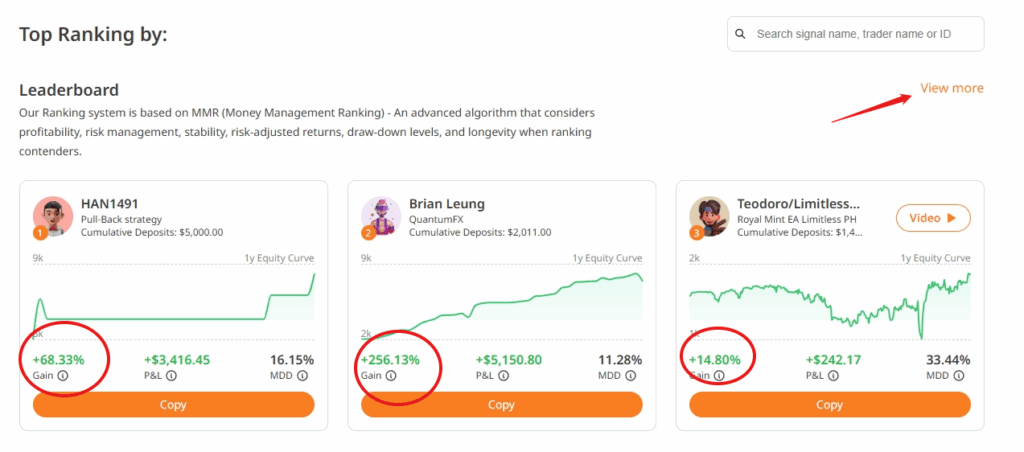
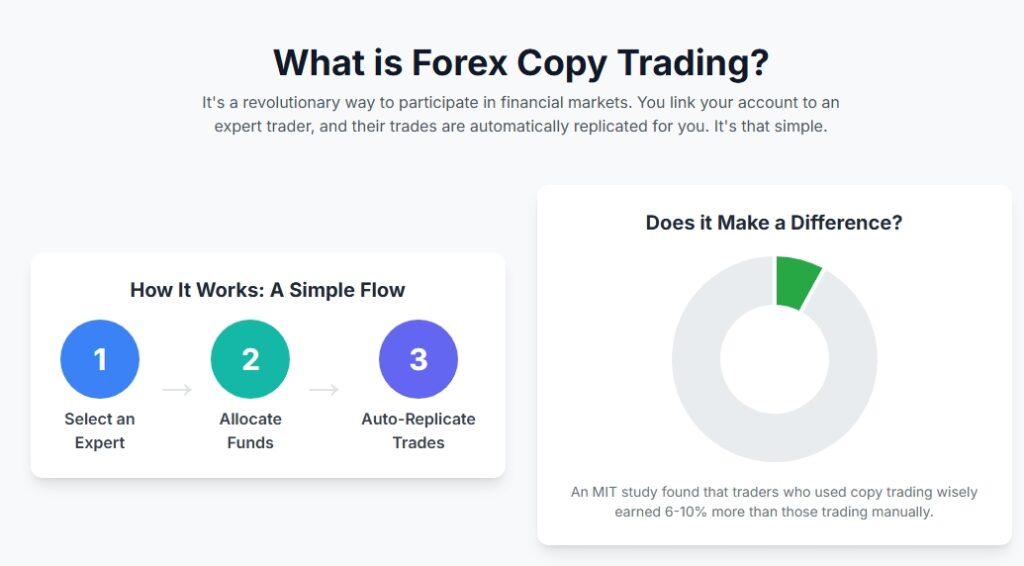
At its most fundamental level, copy trading is a form of portfolio management technology that automates the trading process for an investor by linking their account to that of an expert. The process is elegant in its simplicity yet powerful in its execution.
Here is the mechanical breakdown:
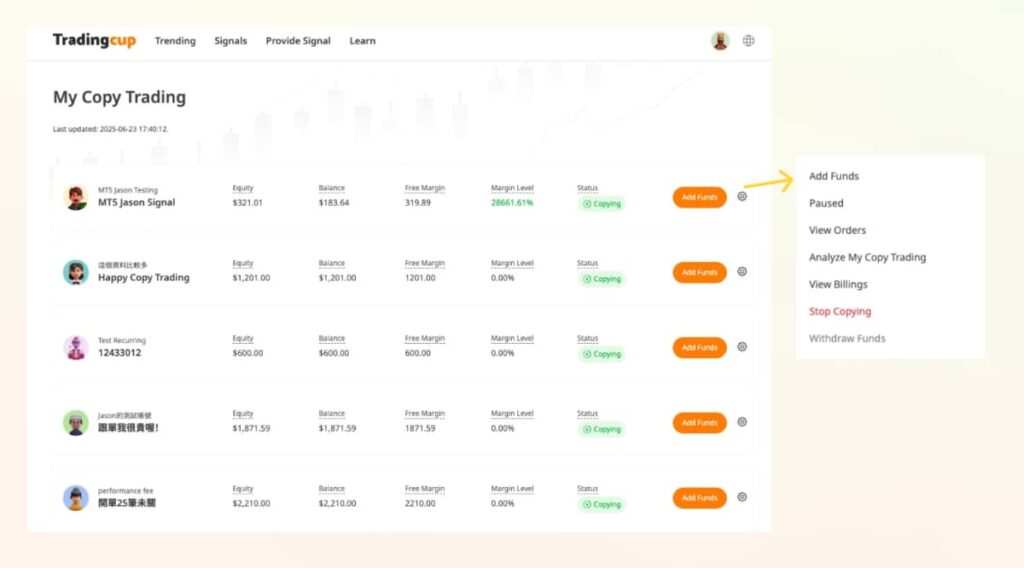
- Selection and Allocation: An investor, known as a “copier,” browses a platform like TradingCup to find an experienced trader, known as a “signal provider,” whose performance and strategy align with their goals. The copier then allocates a specific amount of their investment capital to follow that provider.
- Automated Replication: From that moment on, the platform’s technology creates a direct link between the two accounts. Every trading action executed by the signal provider, opening a position, setting a Stop Loss or Take Profit order, or closing a trade, is automatically and instantly mirrored in the copier’s account.
- Proportional Sizing: The size of the copied trades is not arbitrary. It is typically scaled proportionally to the amount of capital the copier has allocated. For example, if the signal provider risks 1% of their $10,000 account on a trade ($100), a copier who has allocated $1,000 to that provider would see a trade opened with a proportional risk of 1% of their allocation ($10). This ensures the risk profile is mirrored, not just the trade direction.
- Maintained Control: While the process is automated, the copier is not powerless. They generally retain the ability to manually close any copied trade, pause the copying, or sever the relationship with the signal provider entirely at any time.
This system effectively allows someone with little to no trading experience to participate in the forex market with the same strategies used by a seasoned professional. For a more granular exploration of these mechanics, it’s beneficial to review a detailed guide on what copy trading in forex is from the ground up.
Is This Just for Beginners? The Roles of Signal Provider, Copier, and Platform
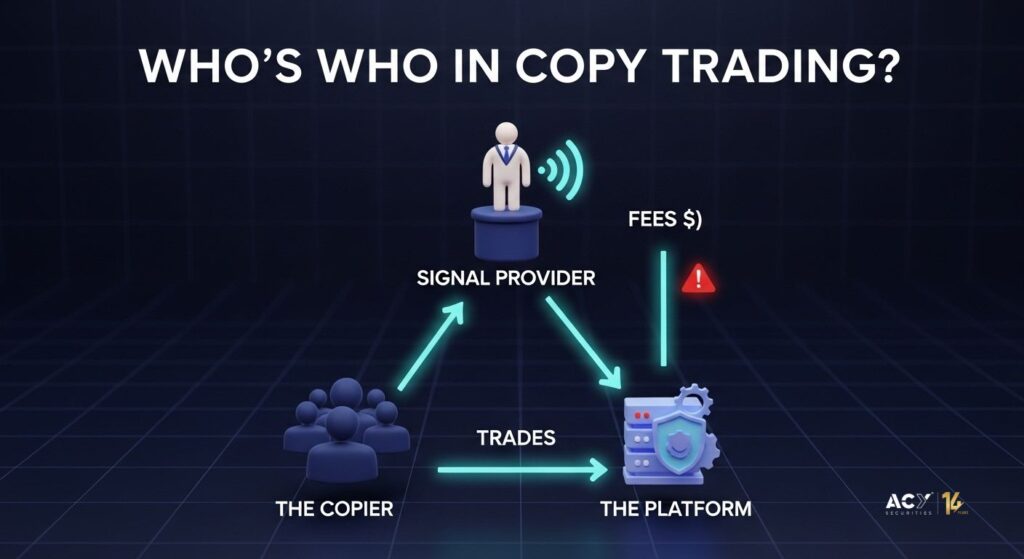
The copy trading ecosystem is a symbiotic relationship between three key participants, each with distinct motivations and roles.
- The Signal Provider (or Master Trader): This is the experienced trader whose strategies are broadcast for others to copy. Their motivation is primarily financial enhancement. They earn income through two main avenues: direct fees from their copiers, which can be a flat monthly subscription or a performance-based fee (a percentage of the profits they generate), and incentives from the platform itself, such as spread rebates, for attracting trading volume. Their success depends on maintaining a strong, verifiable track record to attract and retain followers.
- The Copier (or Follower): This is the investor who allocates capital to replicate the provider’s trades. Their primary motivations are threefold: to access financial markets without the steep learning curve, to save the significant time required for market analysis, and to leverage the proven expertise of professionals in the pursuit of returns. It’s a way to “earn while you learn,” observing professional decision-making in a live market environment.
- The Broker/Platform (The Intermediary): This is the technological and financial linchpin, such as ACY Securities through its TradingCup platform. The platform provides the critical infrastructure that connects providers and copiers, facilitates the automated trade replication, ensures transparent display of performance statistics, and manages the complex process of fee collection and distribution.
It is within this structure that a subtle but profound conflict of interest can arise. The performance-fee model, designed to align the interests of the provider and the copier, can inadvertently create a powerful incentive for the provider to take on excessive risk. Since their earnings are directly tied to the profits they generate, a provider might be tempted to use high leverage or engage in speculative strategies to inflate their performance statistics and climb the platform’s leaderboard. This behavior, driven by the platform’s compensation structure, transfers a higher level of risk directly and silently to the copier’s portfolio. An investor must recognize they are not merely copying trades; they are inheriting the provider’s entire risk appetite, which is itself shaped by the pursuit of higher fees.
Copy Trading vs. Mirror Trading vs. Social Trading: Are They All the Same?
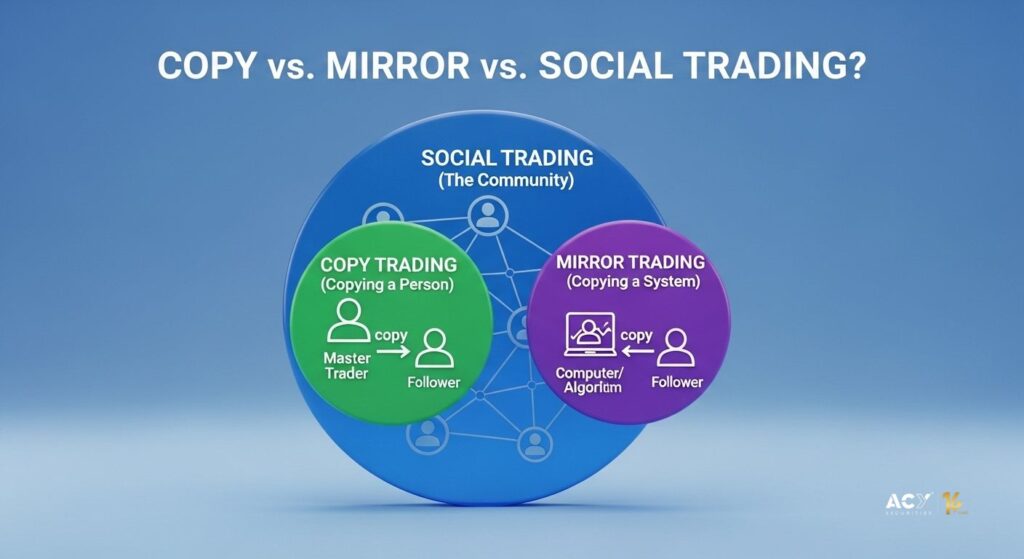
While often used interchangeably, these terms describe distinct, albeit related, concepts. Understanding the differences is key to navigating the landscape effectively.
- Copy Trading: As detailed, this involves following the actions of specific, individual traders. It is a personalized approach focused on leveraging human expertise and decision-making. Platforms like TradingCup specialize in this model, allowing you to select from a roster of vetted individuals.
- Mirror Trading: This term historically refers to replicating predefined strategies, which are often algorithmic or system-based rather than tied to a single person’s discretion. The focus is on a mechanical system with set rules, whereas copy trading focuses on a human manager.
- Social Trading: This is the broad umbrella term for the entire community-based financial movement. It encompasses a wide range of activities, including sharing market analysis on forums, discussing strategies, observing other traders’ portfolios, and community sentiment indicators. Copy trading is a functional subset of social trading; it is the specific tool that automates the execution of another trader’s actions within that social ecosystem.
In essence, all copy trading is a form of social trading, but not all social trading involves automated copying. The strategic focus of this report is on the precise, actionable method of copy trading.
Part 2: The Blueprint for Smarter Copying – How to Start with 5 Traders
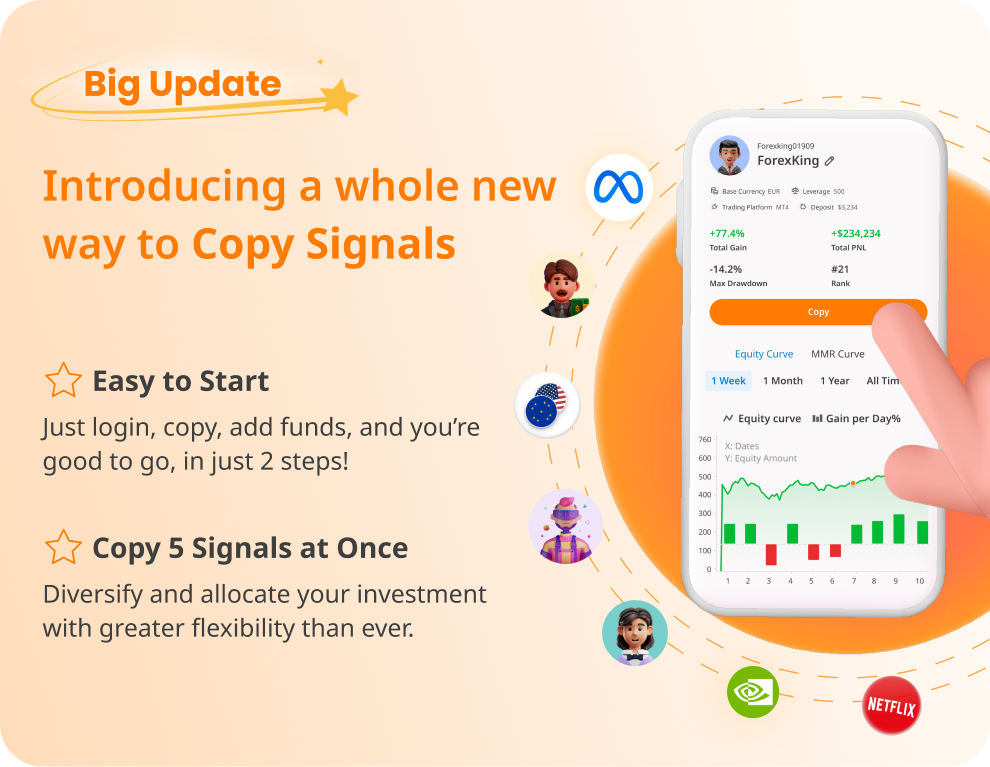
The allure of finding one “perfect” trader to copy is strong, but it’s a strategy fraught with peril. Allocating 100% of your copy trading capital to a single individual exposes your investment to a concentrated and dangerous form of risk known as idiosyncratic risk. This is the risk tied to one specific person: their unique strategy, their psychological biases, their potential for human error, and the chance that their approach simply falls out of favor with the market. The foundational principle of modern portfolio theory is that such specific risks can be drastically mitigated through diversification. This is where the strategy of copying multiple traders comes into play.
Why Stop at One? The Strategic Power of Multi-Signal Diversification
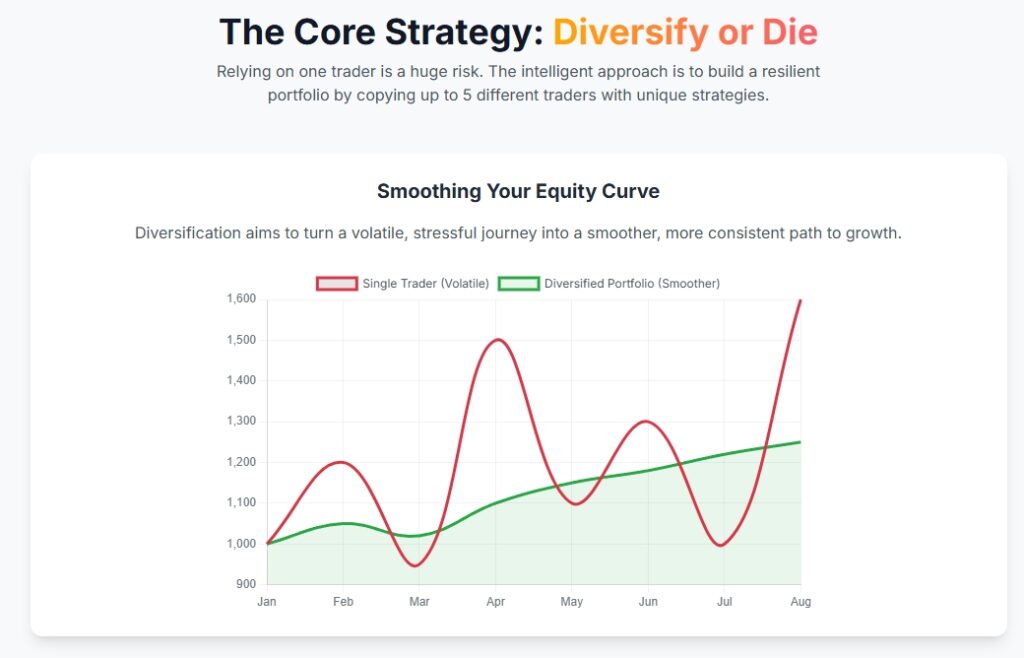
Copying a portfolio of up to five different traders simultaneously is a direct and powerful application of the diversification principle. It transforms copy trading from a simple bet on one person into a sophisticated portfolio management strategy. By spreading capital across several signal providers, a copier can construct a more robust, resilient, and consistent portfolio.
The benefits are significant and multi-faceted:
- Strategy Diversification: This is perhaps the most crucial advantage. No single trading strategy works in all market conditions. A trend-following strategy thrives in clear bull or bear markets but struggles in choppy, sideways markets. Conversely, a mean-reversion strategy might excel in ranging markets but suffer during strong trends. By allocating capital to traders with different methodologies, for instance, a short-term forex scalper, a long-term commodity trend-follower, and an index-based swing trader, the overall portfolio is not dependent on one specific market environment. The struggles of one strategy can be balanced by the successes of another.
- Asset Class Diversification: Copying multiple specialists provides indirect exposure to a wide array of global asset classes. An individual investor may not have the time or expertise to trade forex, global indices, precious metals, and energy markets simultaneously. By copying experts in each of these fields, one can achieve broad market exposure without needing to become an expert in all of them.
- Smoothing the Equity Curve: The equity curve is the visual representation of an account’s value over time. A portfolio tied to a single trader will often have a volatile, jagged curve. A portfolio diversified across several uncorrelated or loosely correlated traders is far more likely to exhibit a smoother, more consistent upward-trending equity curve. The inevitable drawdowns from one trader’s strategy are cushioned by the profits from another, reducing the portfolio’s overall volatility and the psychological stress of large swings.
- Reducing “Single Point of Failure” Risk: This is the ultimate risk management benefit. It protects an investor’s capital from the catastrophic failure of a single trader. A provider might suffer a major loss from one bad decision, fall prey to emotional trading like the “fear of missing out” (FOMO), or simply hit a prolonged and unrecoverable losing streak. In a diversified portfolio, the impact of such an event is contained to only a fraction of the total capital, preventing a total wipeout and preserving the majority of the investment.
Your Step-by-Step Guide to Assembling a Portfolio of 5 Elite Traders
Building a diversified portfolio of traders requires a more thoughtful approach than simply picking the top names from a list. It’s an exercise in strategic team-building.
- Confirm Platform Capability: Before anything else, verify that the platform you intend to use technically supports multi-signal copying for your account type. Some platforms may advertise this feature but have limitations. For instance, analysis of TradingCup’s promotional materials shows a clear emphasis on copying up to five signals, but other sections of their site have mentioned a one-trader limit. This highlights the absolute necessity of contacting the platform’s support team for direct, written confirmation before committing funds.
- Define Your Personal Risk Threshold: The most important number in your investment plan is your own. Before you even look at a single trader’s profile, you must determine the maximum percentage of your capital you are both financially and psychologically willing to lose. This is your personal maximum drawdown (MDD). If seeing your account down 20% would cause you to panic and abandon your strategy, then you must not copy traders with historical MDDs exceeding that level.
- Prioritize a Multi-Factor Ranking System: Avoid the trap of leaderboards that rank traders solely on “Total Gain.” This is a dangerously incomplete metric. A 200% gain achieved with an 80% drawdown is a recipe for disaster for most investors. Instead, use platforms that employ a more holistic, multi-factor ranking algorithm. TradingCup’s Money Manager Ranking (MMR), for example, incorporates profitability, risk management, stability, drawdown levels, and longevity to provide a more complete picture of a trader’s quality.
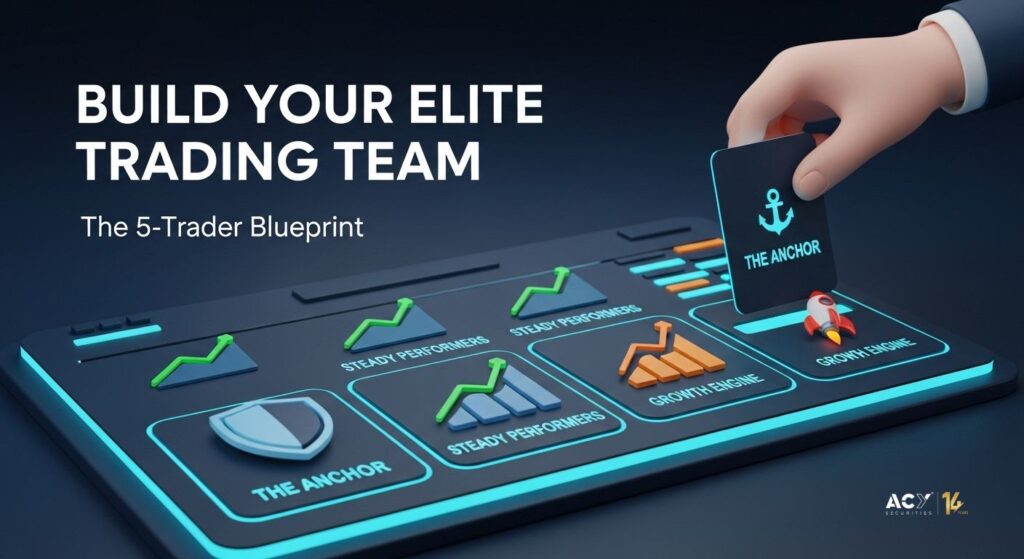
- Build a Balanced “Trading Team”: Do not simply select the top five traders from the MMR leaderboard. This is akin to building a basketball team with five centers. Instead, assemble a balanced team. Look for traders with different, non-correlated strategies. Your portfolio could include:
- The Anchor: A highly conservative, low-drawdown trader who provides stability.
- The Steady Performers: Two or three traders with solid, consistent track records and moderate risk profiles.
- The Growth Engine: Perhaps one trader with a higher-risk, higher-reward strategy, to whom you allocate a smaller portion of your capital.
- The Anchor: A highly conservative, low-drawdown trader who provides stability.
- Test Drive in a Demo Environment: Before risking a single dollar of real money, open a demo account. Use it to construct your chosen portfolio of five traders and let it run for several weeks or even months. This risk-free environment allows you to observe how the strategies interact, how frequently they trade, and how the combined equity curve behaves in live market conditions.
Is This Like Picking Stocks? How Diversifying Traders Builds a Resilient Portfolio
The analogy to stock picking is a powerful and accurate one. A prudent stock investor understands the folly of putting all their money into a single company. They build a diversified portfolio across different industries, technology, healthcare, consumer staples, energy, so that a downturn in one sector doesn’t cripple their entire investment.
The same logic applies directly to copy trading. Diversifying across traders is diversifying across trading philosophies. Each trader represents a unique “industry” of market approach. One might be in the “business” of short-term scalping, another in long-term trend-following, and a third in swing trading indices. By combining these different “businesses,” you create a portfolio that is resilient and can weather a variety of economic “seasons” or market conditions.
This strategic shift in thinking is profound. The greatest risk in copy trading is not necessarily a sudden market crash; it’s manager risk, the risk that the single individual you’ve chosen to follow fails. This can be due to a flawed strategy, psychological breakdown, or even outright fraud. Diversifying across multiple traders is the most direct and effective antidote to this primary risk. It reframes a platform’s multi-signal capability from a “nice-to-have” feature into the single most essential risk management tool at a copy trader’s disposal.
Part 3: The Unvarnished Truth – A Forensic Look at Risk and Reward
The marketing around copy trading often paints a picture of effortless profits, but a sustainable strategy can only be built on a foundation of clear-eyed realism. To succeed, one must move beyond the hype and conduct a forensic examination of the potential rewards and the very real risks involved. Acknowledging user concerns and skepticism head-on is not a sign of weakness; it’s the hallmark of an intelligent investor.
Beyond the Hype: What Are the Real Risks and Rewards?

The appeal of copy trading is powerful, but the dangers are equally potent and must be fully understood before allocating capital.
The Potential Rewards (The “Pull” Factors):
- Accessibility and Simplicity: Copy trading dramatically lowers the barrier to entry for participation in financial markets. It is especially attractive to beginners who lack technical knowledge and busy professionals who lack time for dedicated analysis.
- Time-Efficiency: The process is fully automated. Once the initial setup of selecting providers and allocating capital is complete, trades are executed without further manual intervention, freeing the copier from the need for constant screen time.
- Leveraging Expertise and Learning: It offers a unique “earn while you learn” opportunity. Copiers can potentially benefit from the returns of seasoned professionals while observing their decision-making in real-time. Research from MIT on the eToro platform found that traders who copied a suggested, vetted investor achieved returns 6-10% higher than those trading manually.
The Inherent Risks (The “Pushback” Factors):
- Market Risk: This is the fundamental, unavoidable risk that the value of the traded assets will decline due to broad market movements. This risk is present in all forms of investing and can be significantly amplified by leverage.
- Strategy and Performance Risk: The core risk in copy trading is that a chosen provider’s strategy is flawed, overly risky, or simply stops working in new market conditions. The axiom “past performance is not a guarantee of future results” is paramount here. As some users on forums like Reddit have experienced, a top trader’s performance can tank, leading to significant losses like one user’s reported 40% drop.
- Platform and Liquidity Risk: The copier’s results depend on the broker’s technology. Risks include platform downtime and, more commonly, slippage, the difference between the expected execution price and the actual fill price. During high volatility, slippage can erode profits or magnify losses.
- Over-Reliance and Psychological Risks: Ceding all decisions can inhibit the development of one’s own skills. Furthermore, signal providers are human and susceptible to psychological biases like greed and fear. There’s a dangerous paradox where risk-averse individuals are drawn to copy trading for safety, but the act of chasing high-return providers can lead them to take on far more risk than they would on their own. Community discussions often highlight this, warning that the system can be gamed by providers using risky strategies to attract followers with impressive but unsustainable short-term gains. Another major concern is survivorship bias, where platforms prominently display the few lucky winners, while the many who failed are never seen.
A Quantitative Deep Dive: How a $1,000 Investment Performs
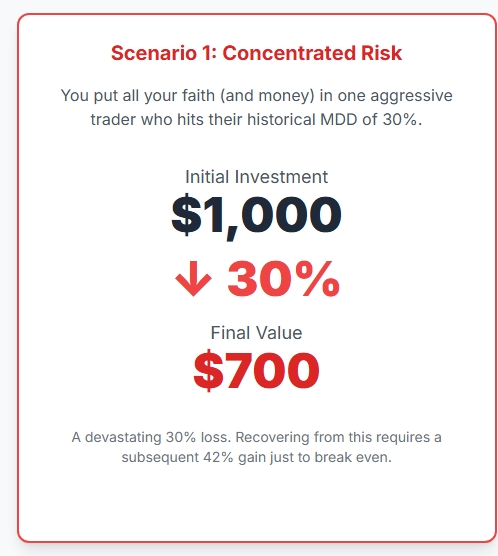
To move from abstract risks to concrete numbers, we must focus on the single most critical risk metric for any copy trader: Maximum Drawdown (MDD). MDD represents the largest single loss a strategy has incurred from a peak in account value to a subsequent trough, expressed as a percentage.
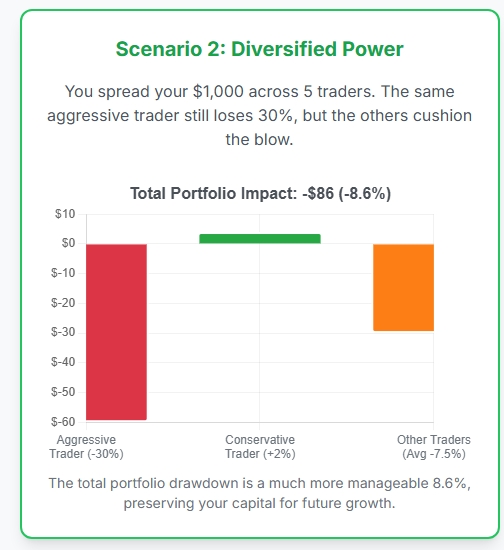
MDD is vital because it quantifies historical downside risk and helps align a provider’s strategy with your personal risk tolerance. If a trader’s profile shows a historical MDD of 30%, you must be prepared to see your allocated capital decrease by that amount. It is a backward-looking indicator, meaning the future could always be worse. Therefore, a prudent investor should view the historical MDD not as the maximum possible loss, but as the minimum worst-case loss they should be prepared to endure.
Let’s illustrate this with a hypothetical computation for a $1,000 initial investment, allocated evenly ($200 each) across five distinct signal providers with different risk profiles.
- Trader 1 (“Forexking”): MDD of -14.2%. Potential loss on $200:
$200 * 0.142 = $28.40. - Trader 2 (“Aggressive Growth”): MDD of -30%. Potential loss on $200:
$200 * 0.30 = $60.00. - Trader 3 (“Steady Income”): MDD of -8%. Potential loss on $200:
$200 * 0.08 = $16.00. - Trader 4 (“Index Follower”): MDD of -12%. Potential loss on $200:
$200 * 0.12 = $24.00. - Trader 5 (“Commodities Expert”): MDD of -20%. Potential loss on $200:
$200 * 0.20 = $40.00.
Each of these individual drawdowns represents a potential hit to a portion of the portfolio. The real power of diversification becomes clear when we simulate how the combined portfolio weathers a severe event.
What Does a Combined Drawdown of 5 Traders Actually Look Like?
The following table demonstrates the profound impact of diversification. We will simulate a scenario where the most aggressive trader (Trader 2) experiences their maximum historical drawdown of -30%, while the other traders are performing at various levels, some positive, some flat, and some in minor drawdowns. This comparison pits a concentrated, single-trader portfolio against our diversified, five-trader portfolio.
| Portfolio Scenario | Trader(s) | Allocation ($) | Performance during Scenario | Impact on Allocation ($) | Total Portfolio Value ($) | Total Portfolio Drawdown (%) |
| Concentrated | Trader 2 Only | $1,000 | Hits -30% MDD | -$300.00 | $700.00 | -30.0% |
| Diversified | Trader 1 | $200 | -5% Drawdown | -$10.00 | $190.00 | |
| Trader 2 | $200 | Hits -30% MDD | -$60.00 | $140.00 | ||
| Trader 3 | $200 | +2% Gain | +$4.00 | $204.00 | ||
| Trader 4 | $200 | Flat (0% change) | $0.00 | $200.00 | ||
| Trader 5 | $200 | -10% Drawdown | -$20.00 | $180.00 | ||
| Total | All 5 Traders | $1,000 | -$86.00 | $914.00 | -8.6% |
How Will This Volatility Impact Your Overall Profit and Loss?
The quantitative comparison in the table above provides the “aha!” moment for any aspiring copy trader. In the concentrated portfolio, the single trader’s -30% drawdown translates directly into a devastating 30% loss on the entire $1,000 investment, leaving the account at $700. To recover from this, the trader would need to make a subsequent gain of over 42% just to get back to break-even.
In the diversified portfolio, the story is dramatically different. Even though the same high-risk trader experiences the exact same severe drawdown, its impact is contained entirely within its $200 allocation, resulting in a $60 loss. The positive, flat, and smaller negative performances of the other four traders act as a powerful cushion. The total portfolio drawdown is a much more manageable 8.6%, with a total loss of only $86.
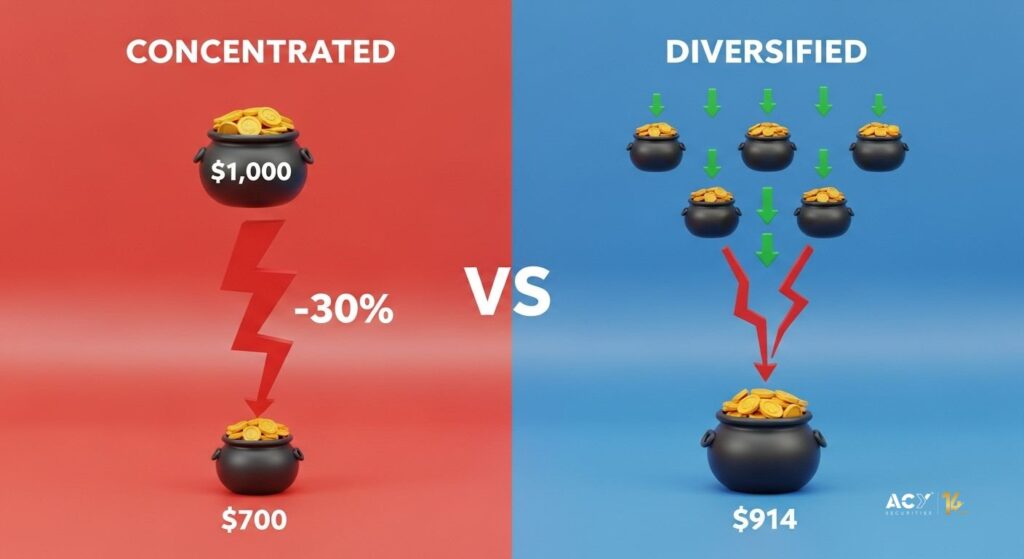
This demonstrates how diversification fundamentally alters the risk profile of copy trading. It doesn’t eliminate losses, but it significantly reduces portfolio volatility and protects the bulk of your capital from the failure of any single strategy or trader. A portfolio that drops 8.6% is in a far healthier position to recover and continue growing than one that has been slashed by 30%. This is how you manage volatility to protect your overall profit and loss statement over the long term.
Part 4: The New Frontier – Why AI is a Game-Changer for Top Traders
The image of a trader as a lone wolf, relying solely on gut instinct and experience, is rapidly becoming obsolete. The new frontier of elite trading performance is being forged in the crucible of data science, machine learning, and artificial intelligence (AI). For a copy trader, this technological shift is monumental. When you copy a top-tier trader in 2026, you are often no longer just mirroring a person; you are gaining access to the output of a sophisticated human-AI hybrid intelligence.
How Are Top Traders Using AI to Sharpen Their Edge in the Forex Market?
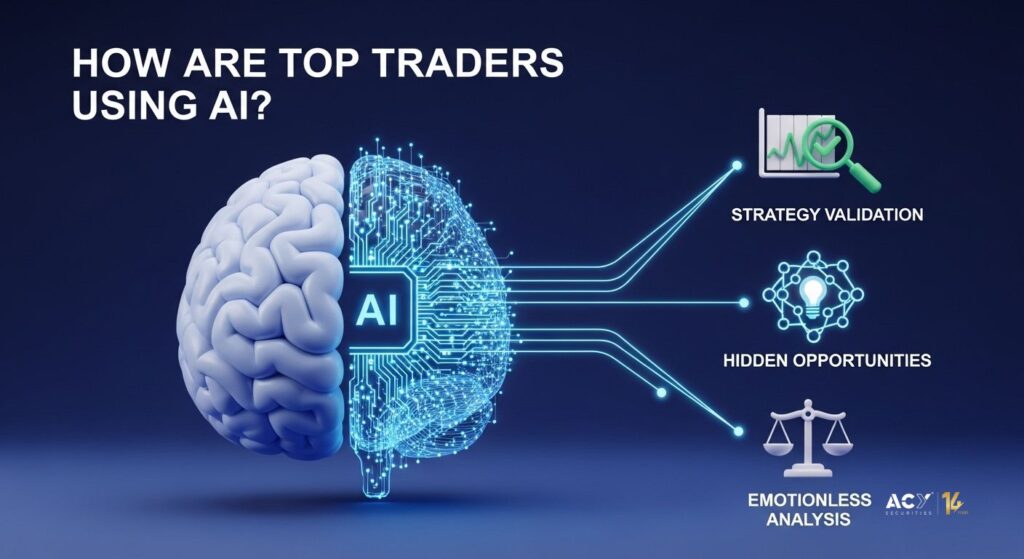
For the best signal providers, AI is not a replacement for their expertise but a powerful “force multiplier” that augments their abilities in ways previously unimaginable. They are using AI and machine learning to handle the heavy data lifting, allowing them to make sharper, more informed decisions.
Here’s how AI is revolutionizing the signal provider’s toolkit:
- Strategy Validation & Refinement: An AI model can backtest a trader’s strategy against decades of historical market data in mere minutes. This process can uncover hidden weaknesses, identify optimal parameters the trader hadn’t considered, and flag when changing market conditions no longer favor a previously successful strategy.
- Identifying Subtle Opportunities & Risks: The financial markets are a sea of data. AI algorithms can detect faint, complex patterns and inter-market correlations that are invisible to the human eye. This could mean identifying a leading indicator for currency volatility in the bond market or spotting a subtle shift in sentiment from news feeds, suggesting trades or warning of risks that fall outside the trader’s usual focus.
- Emotionless Analysis and Execution: One of the greatest advantages of AI is its objectivity. AI bots can analyze market conditions and execute trades based on a predefined set of rules, completely free from the emotional biases of fear, greed, or frustration that plague even experienced human traders.
Why Does This Matter to You? The Power of Copying an AI-Equipped Trader
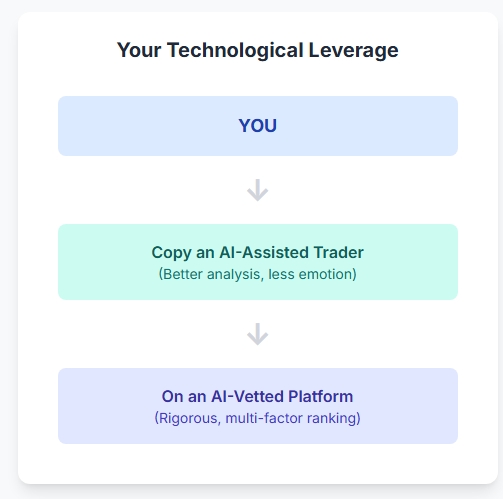
The implications for the copier are profound. This technological evolution transforms copy trading from a simple act of social imitation into a form of powerful technological leverage.
The old model was purely social: you followed a person you believed was smart. The new model involves AI at two critical levels:
- The Provider Level: The signal provider you are copying uses AI for deeper analysis, more robust strategy testing, and better risk identification.
- The Platform Level: The platform you are using, like TradingCup, employs its own AI to vet and rank those providers.
This means the copier is no longer just leveraging another person’s time and expertise. They are leveraging that person’s access to and application of advanced technology. In effect, you get the benefit of an institutional-grade, AI-powered analytical desk without needing to purchase the expensive software or learn the complex data science behind it. This is a fundamentally more powerful value proposition.
How TradingCup’s MMR Algorithm Ranks the Best AI-Powered Traders
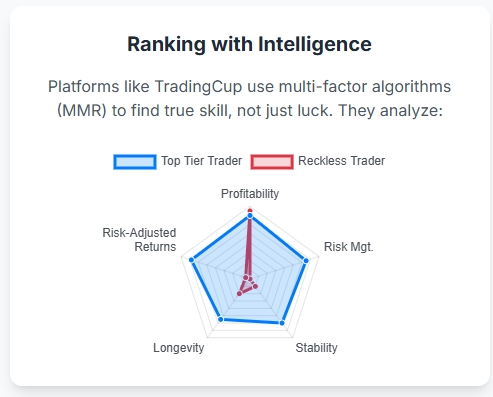
Recognizing that raw profit is a poor indicator of a trader’s quality, advanced platforms have moved beyond simple leaderboards. TradingCup, for example, utilizes its proprietary Money Management Ranking (MMR) algorithm, an AI-powered system designed to provide a holistic and rigorous evaluation of signal providers.
Unlike a basic leaderboard that might tempt you to copy a reckless but temporarily lucky trader, the MMR algorithm analyzes a sophisticated blend of critical factors to identify true, consistent skill :
- Profitability: The overall return generated.
- Risk Management: How well the trader controls downside risk.
- Stability: The consistency of returns over time.
- Risk-Adjusted Returns: Metrics that measure profit relative to the risk taken.
- Drawdown Levels: The severity of historical losses.
- Longevity: The length of the trader’s track record.
By using an AI-driven, multi-factor model, the platform does the initial heavy lifting of due diligence for you. It helps filter out the noise and highlight traders who demonstrate not just the ability to generate profit, but to do so in a stable, risk-aware, and repeatable manner. This means you aren’t just guessing; you are using a sophisticated tool to understand how the best traders are ranked on TradingCup.
Part 5: The Elon Musk Angle – Applying First Principles to Your Trading Strategy

To elevate your decision-making from amateur to professional, it helps to adopt the mental models of the world’s most effective problem-solvers. Elon Musk, the driving force behind SpaceX and Tesla, attributes much of his success to a powerful method of thinking that can be directly applied to how you select and evaluate copy traders: First Principles Thinking.
How Would Elon Musk Deconstruct the Problem of Copy Trading?
First Principles Thinking is the practice of breaking down complex problems into their most basic, fundamental truths and reasoning up from there. It is the opposite of reasoning by analogy, where we do things because they are like something else that was done before.
Musk’s famous rocket example perfectly illustrates this :
- Reasoning by Analogy: Musk was quoted prices of up to $65 million for a finished rocket. This was the “analogy” price, what rockets had always cost.
- Reasoning from First Principles: Musk asked a different question: “What are the fundamental materials a rocket is made of?” He discovered that the raw materials, aerospace-grade aluminum alloys, titanium, copper, and carbon fiber, cost only about 2% of the final price.
By deconstructing the problem to its essential truths, he realized he could build the rockets himself for a fraction of the cost. This is the core of his innovative approach.
From Rockets to Risk: Applying “First Principles Thinking” to Trader Selection
We can directly translate this mental model to the process of choosing a signal provider.
- Reasoning by Analogy (The Common, Flawed Approach): “This trader, ‘ForexKing,’ shows a +77.4% total gain on their profile. Other successful traders have high gains. Therefore, I should copy ForexKing.” This is reasoning by analogy. You are looking at the shiny, finished product (the high gain percentage) and accepting it at face value.
- Reasoning from First Principles (The Musk Approach): “What are the fundamental components of ForexKing’s +77.4% gain?
- What is the timeframe over which this gain was achieved?
- What is the Maximum Drawdown (-14.2%) they endured to get it?
- What is the volatility of their equity curve? Is it a smooth, steady climb or a wild, erratic ride?
- What is their core strategy? Does it rely on high-leverage, short-term bets, or a more conservative approach?
- What are the fundamental market conditions in which this strategy thrives or fails?”
- What is the timeframe over which this gain was achieved?
This is deconstructing the trader’s performance into its raw materials. It moves you from being a passive consumer of a headline number to an active analyst of the underlying process.
Are You Reasoning by Analogy or from First Principles? A New Way to Vet Traders
Use this checklist to apply first principles thinking to your own due diligence:
- Instead of: Looking only at “Total Gain.”
- Think from First Principles: Analyze the smoothness and consistency of the equity curve over the longest available timeframe. A volatile curve indicates a high-risk journey.
- Instead of: Being impressed by a high “Win Rate.”
- Think from First Principles: Scrutinize the average risk-to-reward ratio of their trades. A trader who wins 90% of the time but loses big on the other 10% can still wipe out an account.
- Instead of: Trusting a fancy strategy name like “Market Weaver Pro.”
- Think from First Principles: Examine their trade history to deduce the fundamental market conditions in which their strategy actually works. Are they a trend-follower? A range trader? Understanding this tells you when their strategy might be vulnerable.
This approach aligns perfectly with Musk’s broader philosophy. He sees AI as a fundamental, civilization-altering technology and is a proponent of taking large, but calculated, risks to achieve important outcomes. Adopting an AI-assisted, multi-trader copy trading strategy is not a blind gamble; it is a calculated bet on a future where technology systematically augments human financial capability. It is a decision made not by analogy, but from first principles.
Part 6: The Intelligent Copier – 10 Lessons from Benjamin Graham for the Digital Age
While Elon Musk provides a model for modern innovation, the timeless wisdom of Benjamin Graham, the mentor to Warren Buffett and the undisputed “father of value investing”, provides the psychological and strategic bedrock for long-term success. His masterwork, “The Intelligent Investor,” was written decades before the advent of copy trading, yet its principles for managing risk and mastering one’s own emotions are more relevant than ever.
Applying Graham’s wisdom transforms you from a mere “copier” into an “Intelligent Copier.” It directly counters the perception of copy trading as a form of reckless speculation and reframes it as a disciplined investment methodology.
Mr. Market is Now Mr. Signal Provider: Profiting from Volatility
Graham’s most famous allegory is that of “Mr. Market,” an emotional business partner who shows up every day offering to buy your shares or sell you his at wildly fluctuating prices. Some days he is euphoric and quotes ridiculously high prices; other days he is despondent and offers to sell at a huge discount. Graham’s point is that the intelligent investor should not be swayed by Mr. Market’s mood swings. They should ignore him most of the time, but be ready to take advantage of his extremes, selling to him when he is euphoric (overpriced) and buying from him when he is panicked (underpriced).
In the world of copy trading, your signal providers collectively act as “Mr. Signal Provider.” They will have periods of incredible performance (euphoria) and inevitable periods of drawdown (panic).
- The Unintelligent Copier: Chases performance. They see a trader on a hot streak and jump in at the peak of euphoria, only to ride the inevitable correction down. They see a solid trader in a temporary drawdown and panic-sell at the bottom, locking in losses.
- The Intelligent Copier: Understands that volatility is normal. They don’t chase hot streaks. When a fundamentally sound trader with a good long-term record and a low MDD hits a temporary drawdown, the Intelligent Copier sees it not as a disaster, but as a potential opportunity to start copying a great strategy at a more favorable point in its cycle.
Defining Your “Margin of Safety” in a Copy Trading World
Graham’s single most important principle is to always invest with a Margin of Safety. For a stock investor, this means buying a stock for significantly less than its calculated intrinsic value. It’s the cushion that protects you from bad luck, miscalculations, or unforeseen events.
For a copy trader, the Margin of Safety is not just about price; it’s a multi-layered concept built into your entire strategy:
- A Low Maximum Drawdown (MDD): Your first layer of safety is selecting traders who have a proven history of risking less. A trader with a 10% MDD offers a far greater margin of safety than one with a 50% MDD.
- Portfolio Diversification: Your portfolio of five uncorrelated traders is your ultimate margin of safety. It ensures that the failure or deep drawdown of any single trader does not catastrophically impact your entire capital.
- Platform-Specific Tools: Advanced platforms provide tools that allow you to actively create your own margin of safety. TradingCup’s Signal Multiplier feature, for example, allows you to copy a trader’s signals but at a reduced proportion (e.g., 0.5x), effectively halving your risk exposure to their strategy and building an extra layer of safety.
The following table translates ten of Benjamin Graham’s core principles into actionable rules for the Intelligent Copier in the digital age.
| Graham’s Principle | Traditional Application (Stock Investing) | The Intelligent Copier’s Application (Copy Trading) |
| 1. Invest, Don’t Speculate | Conduct thorough analysis of a business’s fundamentals before buying its stock. Avoid “hot” tips and chasing momentum. | Conduct thorough due diligence on a trader’s long-term performance, risk metrics (MDD), and strategy. Avoid copying based on short-term “hot streaks.” |
| 2. Know Mr. Market | Use market fluctuations as opportunities to buy low from pessimists and sell high to optimists, rather than letting the market’s mood dictate your actions. | View a signal provider’s performance fluctuations (equity curve) as normal. Avoid starting to copy at the peak of a performance spike or stopping during a temporary, manageable drawdown. |
| 3. Demand a Margin of Safety | Buy a stock only when its market price is significantly below its intrinsic value, creating a protective cushion against error or bad luck. | Create a margin of safety by (1) choosing traders with low historical MDD, (2) diversifying across 5+ uncorrelated traders, and (3) using tools like a signal multiplier to reduce risk. |
| 4. Control Your Behavior | Recognize that your own temperament and emotional reactions are a greater threat to your portfolio than market movements. | The entire purpose of a systematic copy trading plan is to remove your own emotional, impulsive decision-making from the trading process. Stick to your predefined rules. |
| 5. Price is What You Pay, Value is What You Get | The price of a stock is different from the value of the underlying business. The goal is to get more value than the price you pay. | The “price” of copying a trader includes their fees and their risk (MDD). The “value” is their long-term, risk-adjusted return. Ensure the value justifies the price. |
| 6. The Investor’s Chief Enemy is Himself | Most investment losses are caused by investors’ own psychological flaws: greed, fear, impatience, and overconfidence. | Copy trading is a tool to overcome this enemy. It outsources the moment-to-moment decision-making to a less emotional, more systematic process (either a disciplined human or an AI-assisted one). |
| 7. Never Overpay for Growth | Be wary of stocks with exciting growth stories that trade at extreme valuations, as the potential for future profit is already priced in. | Be wary of traders with astronomical recent gains. High performance often comes with high, hidden risk. Prioritize stable, consistent growth over explosive, unsustainable spikes. |
| 8. Focus on Real Returns After Inflation | Your true return is what’s left after accounting for inflation’s erosion of purchasing power. | Your true return is what’s left after accounting for platform fees, provider fees (subscriptions/performance), and trading costs (spreads). Factor these in when evaluating performance. |
| 9. Know Your Business | Never invest in a company whose business model you cannot understand and explain simply. | Never copy a trader whose fundamental strategy you do not understand. Is it trend-following, mean-reversion, scalping? Knowing this helps you understand their performance. |
| 10. Expect Volatility and Profit From It | Don’t fear market downturns. Greet them as opportunities to buy wonderful businesses at fair prices. | Don’t fear drawdowns in your copied portfolio. A well-diversified portfolio is designed to withstand them. Monitor them, but don’t panic. |
Part 7: Can This Really Surpass Your Job? A Realistic Assessment
With a robust strategy in place, diversifying across five AI-assisted traders, applying first principles thinking, and adhering to Graham’s timeless wisdom, we can now return to the central, provocative question: Can this truly generate an income stream that could replace your 9-to-5? The answer is a nuanced but qualified “yes.” It is ambitious, but it is not impossible. However, it requires a clear-eyed understanding of the capital, consistency, and discipline involved.
From Side Hustle to Main Income: What Does It Truly Take?
First and foremost, it is critical to dispel any notion that this is a “get rich quick” scheme. Social media is filled with stories of quick fortunes, but sustainable wealth is built on mathematical reality, not hype. The ability to replace your job is a direct function of two variables: your starting capital and the consistent rate of return you can achieve.
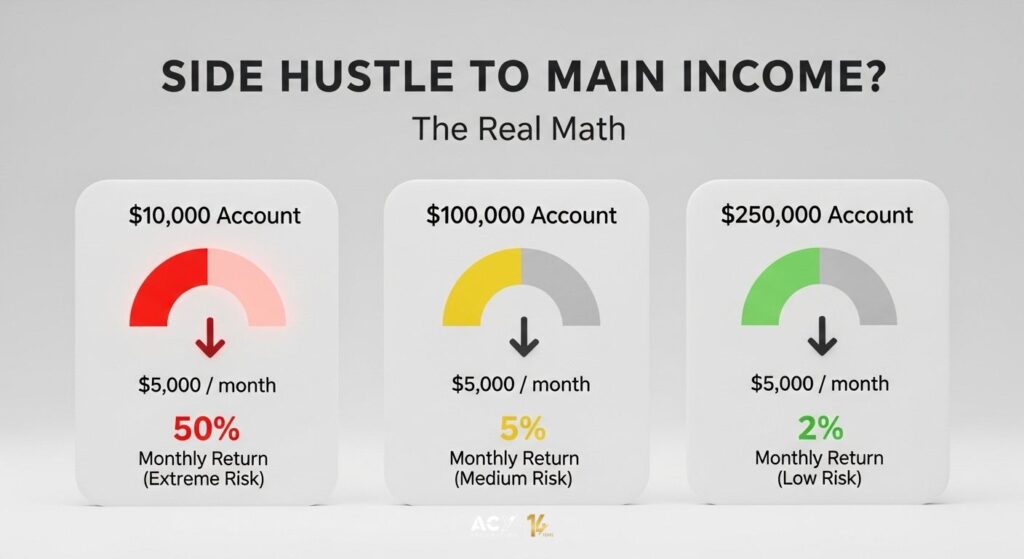
Let’s ground this in a simple calculation. Suppose your current job provides an after-tax income of $60,000 per year, or $5,000 per month.
- With a $100,000 copy trading account: To generate $5,000 per month, your portfolio of traders would need to achieve an average monthly return of 5%. This is a very strong performance, but it is within the realm of possibility for a well-selected portfolio of elite traders over a favorable period.
- With a $250,000 copy trading account: To generate that same $5,000 per month, your portfolio would need a more conservative and potentially more sustainable average monthly return of 2%.
- With a $10,000 copy trading account: To generate $5,000 per month, you would need a 50% monthly return. This level of performance is highly improbable, unsustainable, and would require taking on an extreme, account-destroying level of risk.
This simple math makes it clear: replacing a substantial salary requires substantial capital. The journey often begins with copy trading as a powerful side hustle, with the goal of growing the account to a size where the returns can become a primary income source.
The Compounding Effect: How Consistent Gains Could Outpace a Salary
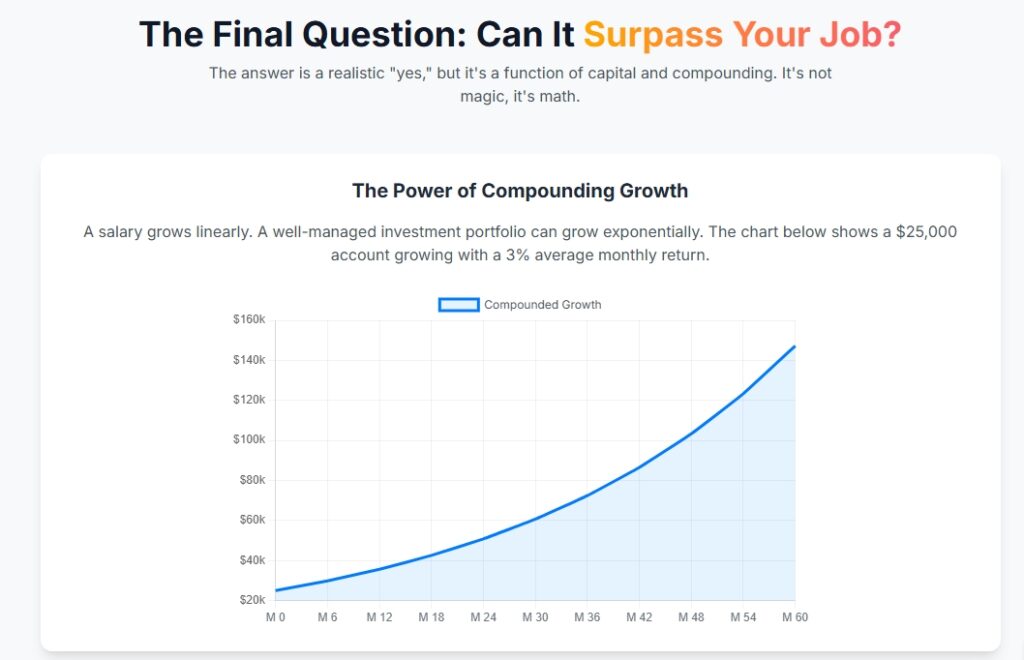
The true power of this endeavor lies not in a single month’s return, but in the magic of compounding. A salary typically grows in a linear fashion, you get a 3-5% raise each year. An investment portfolio, however, can grow exponentially.
Consider a $25,000 account that achieves a conservative average net return of 3% per month. If the profits are reinvested, that account could grow to over $125,000 in five years. At that point, the same 3% monthly return would generate $3,750 per month, a figure that begins to rival many salaries. The key is not hitting home runs, but consistently getting on base and letting the power of compounding do the heavy lifting over time.
A Reality Check: The Discipline and Monitoring Required
This is not a “set-and-forget” investment. While it is far more time-efficient than manual trading, it is not effort-free. The idea that copy trading is a “lazy-ass strategy,” as one Reddit user put it , is a dangerous misconception. A more accurate description is that it outsources the trade execution, not the portfolio management.
Achieving job-replacing income requires you to act as the manager of your own personal hedge fund. Your job is to:
- Continuously Monitor Performance: You must regularly review the performance of your overall portfolio and each of the five traders within it.
- Enforce Your Rules: Be prepared to stop copying a provider whose performance begins to degrade, whose strategy appears to change, or whose drawdown exceeds your predefined comfort level. You are the CEO of your capital, and you must be willing to fire an underperforming “manager.”
- Rebalance and Optimize: Periodically, you may need to adjust your portfolio, removing one trader and adding another to ensure your strategic mix remains optimal for current market conditions.
Elon Musk’s Vision of a Post-Work Future
On a grander scale, this entire endeavor can be seen as an early step toward the future of work envisioned by thinkers like Elon Musk. He has spoken about a future where AI and robotics will be able to do everything, leading to a state of “universal high income” where traditional jobs are no longer necessary for survival or prosperity. In this context, leveraging an AI-assisted, automated system like copy trading to generate income independent of traditional labor is not just a financial strategy; it’s a personal step into that new economic paradigm. It’s about using the tools of the future to build your financial freedom today.
Part 8: Your Toolkit for Success – Why TradingCup is the Ultimate Platform
Theory and strategy are essential, but their successful implementation depends entirely on the quality of the tools at your disposal. A successful copy trading journey requires a platform that is not only robust and reliable but also provides the specific features needed to manage risk, exercise control, and make intelligent decisions. This is where all the preceding arguments converge, highlighting why a platform like TradingCup, built on the institutional-grade infrastructure of ACY Securities, emerges as the superior choice for the serious beginner.
How TradingCup’s Signal Multiplier Gives You Granular Control Over Risk
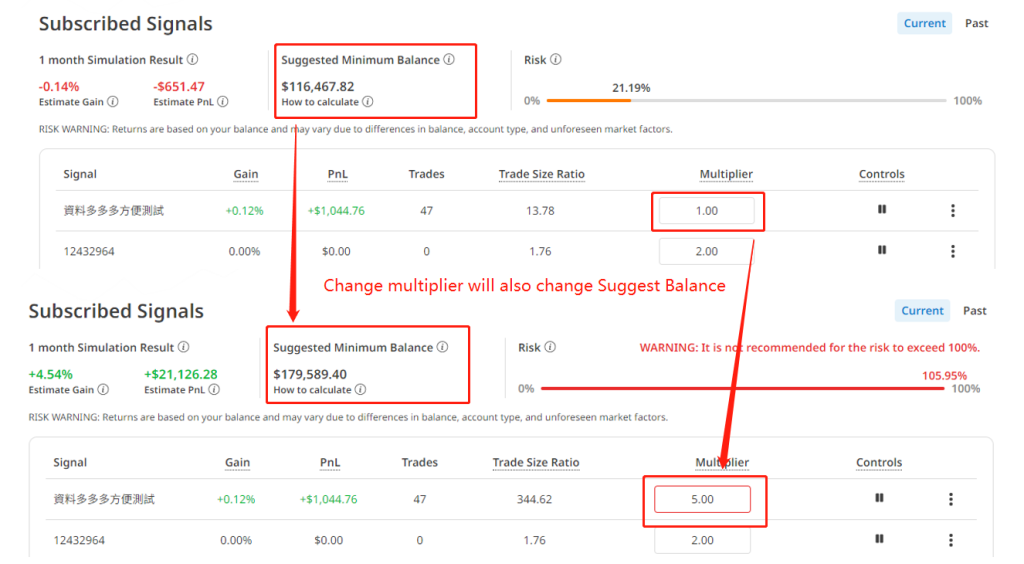
The ability to actively manage risk is the single most important factor separating successful copy traders from the rest. TradingCup’s Signal Multiplier feature is a powerful tool designed for precisely this purpose.
Here’s how it works: The platform automatically calculates a trade size ratio based on the proportion of your funds to the signal provider’s funds. The Signal Multiplier allows you to modify this ratio up or down based on your confidence and risk tolerance.
- Example: You are copying a trader who has a historical MDD of 20%, which is slightly higher than your comfort level. By setting the Signal Multiplier for that specific trader to 0.5, you instruct the platform to execute all of their trades in your account at half the proportional size. This effectively reduces your potential risk exposure to that strategy to just 10%.
- Conversely, if you have high confidence in a very conservative trader, you could set the multiplier to 2.0 to amplify their signals, though this proportionally increases your risk.
This feature is the practical application of Benjamin Graham’s “Margin of Safety.” It provides a crucial layer of control, enabling you to tailor the risk level of each individual strategy in your five-trader portfolio. This level of control is paramount, and a deep understanding of the signal multiplier is a key to tailoring your risk profile effectively.
What is the Right “Suggested Balance” to Start With?
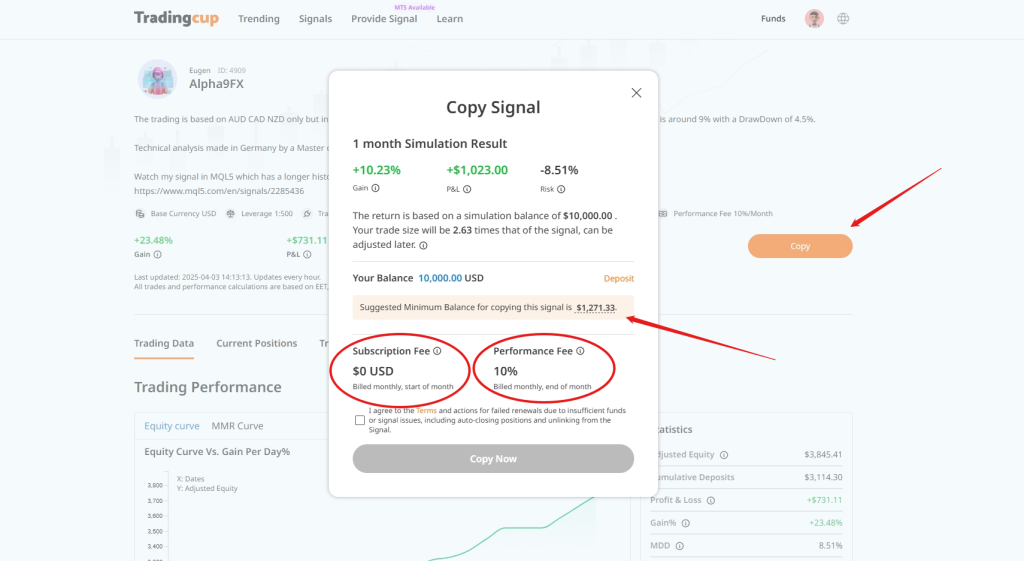
A common question for new copiers is how much capital is required. While the underlying broker for TradingCup, ACY Securities, offers account minimums as low as $50, a more strategic approach is recommended for effective copy trading. Most signal providers on TradingCup will list a “suggested balance” on their profile.
It is highly advisable to start with this recommended amount. This ensures that your account has sufficient capital to properly handle the provider’s trading style and risk management. Starting with a much smaller balance could mean that your account cannot properly replicate their trades proportionally, leading to skewed results. By following the suggested balance, you ensure your account is correctly aligned with the provider’s strategy from day one, setting you up for a more accurate and representative copying experience.
Why is TradingCup the Smartest eToro Alternative for Serious Beginners?
While platforms like eToro have done an excellent job of popularizing social trading, the choice of platform should align with your goals. For the investor who is serious about building a sustainable, risk-managed portfolio, the choice becomes clearer. The following table, based on a deep analysis of the competitive landscape, compares TradingCup against its key competitors.
| Feature | TradingCup | eToro | ZuluTrade | NAGA |
| Broker Model | Single-Broker (ACY Securities) | Single-Broker (Walled Garden) | Broker-Agnostic | Single-Broker (NAGA Markets) |
| Copy Trading Fee Structure | Subscription and/or Performance Fees + Broker Spreads/Commissions | No direct copy fees; revenue from spreads and other trading fees | Broker Spreads/Commissions (Profit-sharing model phased out) | Subscription and/or Performance Fees + Broker Spreads/Commissions |
| Key Differentiator / Strength | Curated pool of traders from its competition legacy; advanced MMR ranking; MT4/MT5 integration | Massive social community; extremely user-friendly interface; simple fee messaging | Flexibility to use your own broker; unique risk tools like ZuluGuard™ | Deeply integrated social network features (Feed, Messenger); tiered account benefits |
| Key Limitation / Weakness | Locked into ACY Securities; ambiguity on multi-signal feature; opaque total cost | Closed ecosystem; less rigorous vetting of traders; limited advanced tools | Can be more complex to set up; user experience can vary by chosen broker | Locked into NAGA broker; tiered system requires high deposits for best rates |
| Ideal User Profile | Trader who values a curated list of elite providers and the power of MT5, and is happy within the ACY ecosystem. | Beginner investor prioritizing ease-of-use, community interaction, and a simple fee structure. | Experienced trader who already has a preferred broker and wants to add copy trading capabilities. | Trader who seeks a “social media” style experience, with deep community interaction and tiered rewards. |
The analysis reveals a clear distinction. While eToro excels in simplicity and social interaction, making it great for casual exploration, TradingCup’s strengths lie in its focus on quality and performance. Its origins as a high-stakes trading competition mean its pool of signal providers is potentially of a higher, pre-vetted caliber. This, combined with the sophisticated MMR ranking algorithm, positions it as the platform for the intelligent beginner, one who values curated quality over sheer quantity. For those weighing their options, it becomes evident why many see TradingCup as the best eToro copy trading alternative for a serious start in forex.
Your Final Checklist: A Step-by-Step Guide to Getting Started on TradingCup
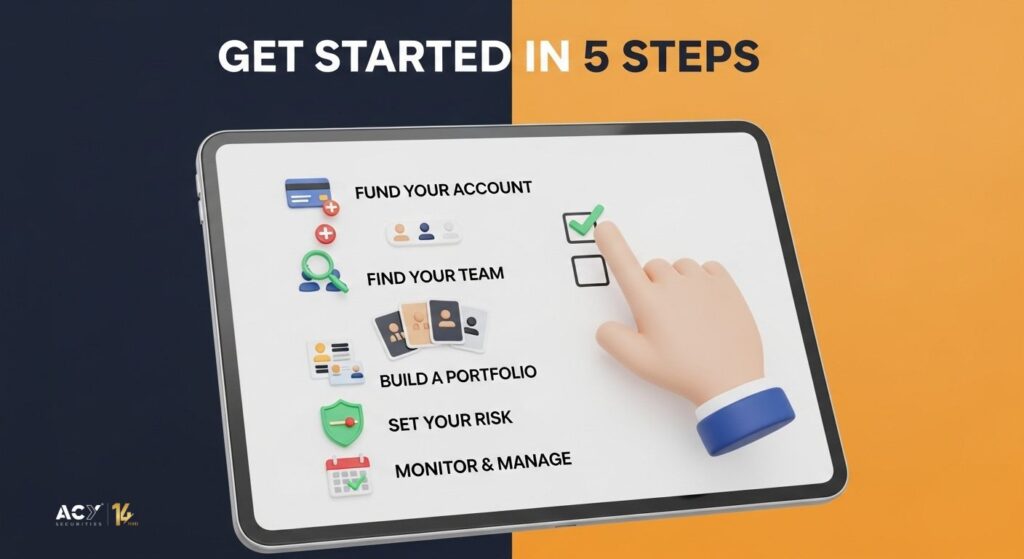
Ready to begin your journey? Here is a simple, actionable checklist to get you started on the right foot.
- Open and Fund Your Account: The first step is to sign up for a live MT4 or MT5 copy trading account with ACY Securities and deposit your initial funds.
- Find Your “Trading Team”: Navigate to the signals page and use the MMR ranking to begin your due diligence. Apply the “First Principles” thinking discussed earlier. Don’t just look at gains; scrutinize the equity curve, MDD, and strategy of potential traders.
- Build Your Diversified Portfolio: Once you have identified five traders who meet your criteria and offer strategic diversification, click ‘Copy’ on each one, allocating your desired capital.
- Set Your Risk Parameters: Go to your subscription settings and use the Signal Multiplier feature for each trader to align the risk of your portfolio with your personal tolerance.
- Monitor and Manage: Your journey has now begun. Schedule regular check-ins (e.g., weekly) to monitor the performance of your portfolio and ensure your chosen traders continue to meet your expectations.
For a more detailed walkthrough of the platform’s interface and features, a comprehensive guide on how TradingCup works can provide visual and practical assistance.
Conclusion: Making Smarter Decisions on Your Forex Journey
The prospect of replacing a traditional job with income from copy trading is undeniably compelling. It represents a shift from trading time for money to having capital work for you. As this deep dive has shown, this is not a far-fetched dream but an ambitious goal that is plausible with the right strategy. It is not a path for the gambler or the get-rich-quick artist, but for the intelligent, disciplined portfolio manager.
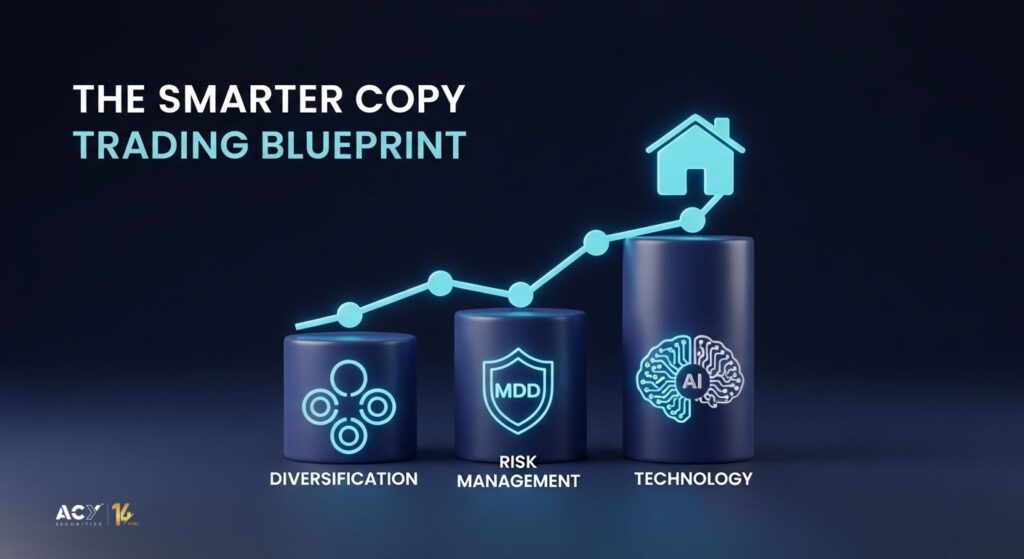
Success in this endeavor does not hinge on a single secret or a “holy grail” trader. Instead, it rests on three core pillars:
- Strategic Diversification: The understanding that spreading capital across a team of 5+ uncorrelated traders is the most powerful defense against the primary danger of manager risk.
- Rigorous Risk Management: The discipline to look past headline gains and focus on the metric that truly matters for capital preservation, Maximum Drawdown, and to use platform tools to align portfolio risk with personal tolerance.
- Leveraging Technology: The wisdom to choose a platform that uses AI and sophisticated algorithms like the MMR to vet and rank traders, ensuring you are copying not just a person, but a technologically-augmented, data-driven process.
The journey to potentially surpassing your job begins not with a blind leap of faith, but with an intelligent, informed first step. It begins with understanding the risks, embracing a proven strategy, and choosing the right tools for the task. By doing so, you can navigate your forex journey with greater confidence and make smarter decisions for your financial future.
Frequently Asked Questions (PAA-Focused)
What is copy trading and how does it work?
Copy trading is a portfolio management system where you automatically replicate the trades of an experienced investor (a signal provider) in your own brokerage account. You allocate a certain amount of capital, and every trade the provider makes is mirrored in your account in real-time, scaled proportionally to your investment.
Is copy trading profitable?
Copy trading can be profitable, but it is not guaranteed. Profitability depends heavily on choosing the right signal providers, managing risk effectively, and understanding that past performance does not guarantee future results. Success requires diligent research and continuous monitoring.
How much money do I need to start copy trading?
The minimum deposit to open an account with a broker like ACY Securities can be as low as $50. However, for effective copy trading, it is recommended to start with the “suggested balance” listed by the signal provider you choose to copy. This ensures your account is properly capitalized to mirror their strategy accurately.
Can you lose money in copy trading?
Yes, you can absolutely lose money in copy trading. The primary risks include market risk (the asset’s value falls), strategy risk (the provider’s strategy fails), and platform risk (slippage, fees). The most important risk metric to understand is a trader’s Maximum Drawdown (MDD), which indicates the largest loss their strategy has historically suffered.
Which is the best platform for copy trading?
The “best” platform depends on your goals. Platforms like eToro are known for their large social community and ease of use. TradingCup positions itself as a strong alternative for serious beginners by offering a curated pool of elite traders (from its competition history) and using an advanced, AI-powered Money Manager Ranking (MMR) algorithm to help users identify high-quality, risk-managed strategies.
How do I choose a trader to copy?
Avoid choosing based on high “Total Gain” alone. A better approach is to use a platform’s multi-factor ranking system, like TradingCup’s MMR, which analyzes profitability, risk, stability, and drawdown. Apply “First Principles Thinking”: deconstruct a trader’s performance by analyzing their long-term equity curve, their Maximum Drawdown, and their underlying strategy to ensure it aligns with your risk tolerance.
Is copy trading better than trading yourself?
For beginners or those with limited time, copy trading can be a better alternative. It saves the significant time required for market analysis and removes the emotional decision-making that often leads to losses for new traders. It provides access to expert strategies while you learn by observing. However, it also means relinquishing direct control over trades.
What are the risks of copy trading?
The main risks are:
1) Market Risk: The inherent risk of financial markets where asset prices can fall.
2) Strategy/Provider Risk: The risk that the trader you copy performs poorly, makes mistakes, or uses a flawed strategy.
3) Platform Risk: Technical issues like slippage (where your trade executes at a different price than the provider’s) and platform fees can impact returns. Diversifying across multiple traders is a key way to mitigate provider risk. Sources used in the report
(Disclaimer: This article is for informational and educational purposes only. It should not be considered financial advice. Always conduct your own research and consult with a qualified financial advisor before making any investment decisions.)
For more detailed insights on developing daily trading routines, risk management, and effective position sizing strategies, explore additional articles on Trading Cup. Our trading experts at ACY and FinLogix are also great resources to guide your journey towards trading excellence.

Discover Our Best Trading Signals
At Tradingcup, you can browse through a selection of signals and review past performance before you decide to copy.
Become A Signal Provider
Share your expertise and become a signal provider so other traders can copy your trades.
Stay tuned to our blog for more trader spotlights and leaderboard updates.
Trading involves risks.
Visit the Tradingcup blog through the link below for more updates: https://www.tradingcup.com/learn
Related Copy Trading blogs:
- Understanding Market Liquidations: Liquidity Sweeps and Runs Explained
- 7 Essential Daily Habits of Successful Traders to Outperform Their Peers
- 10 Strategies You Can Copy off Our Best Copy Traders
- 5 Strategies Every Trader Can Master To Trade Better In A Trading Contest
- 2025 Copy Trading Scams Exposed: How to Spot Fraud
- A Swing Trading Strategy with an 83 Percent Win Rate and Low Drawdowns
- Forex Martingale Strategies Explained, The Good, The Bad and The Ugly
- Pyramiding Trading Tutorial – Pros & Cons & How to Use It