Last Updated: April 29, 2025
This article is reviewed annually to reflect the latest market regulations and trends.

TL;DR (Too Long Didn’t Read):
- Context is King: Raw Forex signals are incomplete; market context (economic conditions, sentiment, market structure) is the missing dimension for effective trading.
- Beyond Blind Following: Relying solely on signals prevents skill development and increases vulnerability to market shifts and Forex signal scams.
- Soros & Reflexivity: George Soros’ success highlights reflexivity – how market perception shapes reality. Understanding this feedback loop is contextual analysis.
- Adapt Your Strategy: Signal interpretation and strategy must adapt to trending vs. ranging markets and prevailing economic cycles.
- Smarter Protection: Contextual analysis empowers traders to make educated decisions, manage risk effectively (especially in volatile markets like crypto), and protect capital.
“What is necessary to change a person is to change his awareness of himself.”– Abraham Maslow
Disclaimer: The information in this article is for educational purposes only and does not constitute financial, investment, or trading advice. Copy trading carries substantial risks, including the potential loss of your entire invested capital. Past performance of copied traders or strategies is not a reliable indicator of future results. You may be replicating high-risk trades, overleveraged positions, or strategies incompatible with your financial goals. Always conduct independent research into a trader’s historical performance, risk metrics, and strategy before copying them. Never invest funds you cannot afford to lose. Consult a licensed financial advisor to ensure copy trading aligns with your risk tolerance, financial objectives, and regulatory requirements in your jurisdiction. This article does not endorse specific traders, platforms, or strategies, and all trading decisions remain your sole responsibility.
Lessons from the Legends: George Soros

Few traders have navigated market context as masterfully as George Soros. His immense success wasn’t just luck; it was rooted in his Theory of Reflexivity, detailed in his complex book, “The Alchemy of Finance.”
Understanding Reflexivity:
Traditional economics often assumes market participants act rationally based on existing fundamentals, leading towards equilibrium. Soros disagreed profoundly. His core idea:
- Perception Shapes Reality: Investors don’t just react to reality; their perceptions and biases actively shape that reality (the fundamentals).
- Feedback Loops: A two-way connection exists. Investor perceptions influence market prices and actions (e.g., buying). These actions then impact the underlying fundamentals (e.g., increased investment boosts a company’s prospects or rising home prices encourage more lending). These changed fundamentals then reinforce or alter investor perceptions, creating a continuous loop.
- Disequilibrium, Not Equilibrium: These feedback loops are often positive (self-reinforcing), pushing prices far away from any theoretical “true value” or equilibrium. Think of asset bubbles (rising prices encourage more buying, pushing prices higher) and crashes (falling prices trigger panic selling, pushing prices lower).
- Boom-Bust Cycles: Reflexivity explains why markets are inherently unstable and prone to these cycles, driven by the internal dynamics of perception and fundamentals feeding off each other.
How Soros Picked Trades (Applying Reflexivity):
Soros excelled at identifying:
- Flawed Perceptions: Situations where the market’s prevailing view (the dominant bias) seemed disconnected from underlying reality or was becoming unsustainable.
- Developing Feedback Loops: Recognizing trends driven by self-reinforcing sentiment or credit expansion.
- Inflection Points: Identifying moments where the feedback loop was likely to break or reverse, often due to a growing awareness of the disconnect between perception and reality, or an external shock.
His famous “breaking the Bank of England” trade in 1992 involved recognizing the flawed perception that the UK could maintain the Pound Sterling within the European Exchange Rate Mechanism (ERM) despite weakening fundamentals. He bet heavily on the feedback loop breaking, and it did.
The Alchemy of Finance: 10 Lessons in Contextual Trading

While “The Alchemy of Finance” is more philosophical than a step-by-step guide, it offers profound lessons for contextual traders:
- Markets are Not Efficient: Forget the textbook models. Prices reflect bias and perception as much as (or more than) fundamentals. Contextual Implication: Don’t assume prices are “correct”; look for the biases driving them.
- Humans are Not Rational: We are driven by emotion, herd behaviour, and cognitive biases. Contextual Implication: Market sentiment (fear/greed) is a powerful force. Analyze it.
- Identify the Prevailing Bias: What is the dominant story or belief driving a market trend? Is it sustainable? Contextual Implication: Understanding the narrative is key to anticipating shifts.
- Recognize Feedback Loops: Are rising prices creating more optimism and buying (positive loop)? Or are falling prices triggering fear and selling? Contextual Implication: Identify the loop to understand the trend’s fuel.
- Fundamentals Can Follow Price: Reflexivity means strong price trends can create better fundamentals (e.g., a rising stock price allows a company easier access to capital). Contextual Implication: Don’t just analyze fundamentals in isolation; consider how the price trend might be influencing them.
- Trends Overshoot: Positive feedback loops push prices beyond rational valuations. Contextual Implication: Be wary of joining mature trends; look for signs of exhaustion or divergence.
- Timing Inflection Points is Key (But Hard): The biggest profits come from catching trend reversals, but this requires anticipating when the feedback loop will break. Contextual Implication: Develop tools and awareness to spot potential turning points (divergences, sentiment extremes, fundamental shifts).
- Test Your Hypothesis: Soros constantly formulated market hypotheses and tested them with trades, cutting losses quickly if wrong. Contextual Implication: Treat every trade as an experiment within the current context. Define your invalidation point.
- Pain Can Be Informative: Soros famously mentioned physical discomfort (like back pain) sometimes signaling something was wrong with his portfolio. Contextual Implication: While not literal advice, deep market immersion can develop intuition about contextual shifts (use cautiously, don’t trade purely on feelings!).
- Expect the Unexpected: Markets can change dramatically due to unforeseen events (geopolitics, policy shifts) that break existing loops. Contextual Implication: Always incorporate risk management; context can change rapidly.
Contextual Forex Signals: The Missing Dimension to Smarter Trading

The allure is undeniable. A simple notification flashes: BUY EUR/USD. SELL GBP/JPY. Stop Loss here, Take Profit there. Forex trading signals promise an easy path through the complex currency markets, a shortcut to profits without spending years mastering analysis. For busy individuals or newcomers overwhelmed by charts, it seems like the perfect solution.
But here’s the uncomfortable truth many signal providers won’t tell you: Raw signals, devoid of context, are like trying to assemble a complex puzzle with only a handful of random pieces. You might get lucky occasionally, fitting a piece here or there, but you’ll never see the full picture. That missing picture? It’s market context – the crucial, often overlooked dimension that separates informed speculation from blind gambling.
Many traders jump from signal service to signal service, chasing elusive profits, only to find their accounts dwindling. They blame the signals, the provider, or even the market itself. Yet, the real issue often lies in neglecting the broader environment in which these signals operate.
Easy Money or Dangerous Waters?
Let’s be clear: Forex trading signals can offer benefits. They are essentially trade suggestions, often generated by human analysts or algorithms, providing specific entry, exit, stop-loss, and take-profit levels.
Potential Advantages:
- Time-Saving: Reduces the need for constant, in-depth market analysis.
- Learning Tool: Can help beginners observe potential trade setups and market movements.
- Idea Generation: May highlight opportunities traders might otherwise miss.
- Discipline Aid: Can help remove emotional decision-making if followed strictly (though this is a double-edged sword).
However, the path paved with signals is fraught with peril. The internet, especially social media platforms like Telegram, Reddit, and Instagram, is teeming with “gurus” promising unbelievable returns. Reddit threads like those in r/PersonalFinanceZA and r/UKPersonalFinance are filled with warnings:
- Prevalence of Scams: Many providers fake results using demo accounts or rented luxury items to sell expensive subscriptions or courses. Their real income often comes from affiliate commissions with brokers, meaning they profit whether you win or lose.
- Lack of Transparency: Few explain the why behind their signals, leaving you clueless when market conditions change.
- Skill Stagnation: Relying solely on signals prevents you from developing your own analytical skills – essential for long-term success.
- Market Lag: By the time you receive and act on a signal, the market might have already moved, invalidating the setup.
- False Promises: Claims of 90%+ win rates are unrealistic. Professional traders understand losses are part of the game.
Blindly following signals is like navigating a minefield wearing a blindfold. You need to see the terrain. You need context.
What is Contextual Analysis? Unveiling the Missing Dimension

So, what exactly is this “context”? In Forex trading, context refers to the broader environment influencing currency price movements. It’s the backdrop against which individual signals must be evaluated. Think of a signal as a single musical note; context is the entire symphony.
Context encompasses several layers:
- Market Structure: Is the market trending strongly, consolidating in a range, or exhibiting volatile chop?
- Economic Fundamentals: What is the health of the underlying economies? Think GDP growth, inflation rates, and employment data.
- Monetary Policy: What are central banks doing? Are interest rates rising or falling? Is Quantitative Easing (QE) or Tightening (QT) in play?
- Market Sentiment: What is the overall mood of market participants? Are they risk-on (buying riskier assets) or risk-off (fleeing to safety)? Tools like the VIX index and Commitment of Traders (COT) reports help gauge this.
- Geopolitical Events: Elections, trade wars, political instability – these can significantly impact currency valuations.
- Intermarket Analysis: How are other markets (stocks, bonds, commodities) behaving? These can offer clues about risk appetite and capital flows.
- Timeframe: Context changes depending on whether you’re looking at a 5-minute chart or a daily chart.
Ignoring context is like a doctor prescribing medication based only on a single symptom, without understanding the patient’s overall health, history, or other medications. The prescription (the signal) might seem right in isolation, but disastrous in the broader context.
Why Context Matters: Beyond the Signal Blip

Understanding context transforms how you interpret and use signals. A simple “BUY” signal means vastly different things under different conditions.
1. Frameworks for Trending vs. Ranging Markets
The market spends significant time in two primary states: trending and ranging. Applying the same signal strategy in both is a recipe for failure.
- Trending Markets: Characterized by sustained directional moves (higher highs and higher lows for uptrends, lower lows and lower highs for downtrends).
- Contextual Signal Use: Trend-following indicators like Moving Averages (MAs), MACD, and ADX are valuable. Signals (e.g., pullback entries, breakout signals) are interpreted in the direction of the trend. A buy signal in a strong downtrend is highly suspect and likely a temporary bounce (a potential selling opportunity for counter-trend traders, but high risk). A buy signal during a pullback to a key moving average in an established uptrend has a higher probability.
- Framework: Identify the trend (e.g., price above 50 & 200 EMA). Look for signals confirming continuation (e.g., RSI bounce off 40-50 level, MACD crossover above zero). Ignore signals counter to the primary trend unless you have a specific, tested counter-trend strategy.
- Contextual Signal Use: Trend-following indicators like Moving Averages (MAs), MACD, and ADX are valuable. Signals (e.g., pullback entries, breakout signals) are interpreted in the direction of the trend. A buy signal in a strong downtrend is highly suspect and likely a temporary bounce (a potential selling opportunity for counter-trend traders, but high risk). A buy signal during a pullback to a key moving average in an established uptrend has a higher probability.
- Ranging Markets: Price action is contained between identifiable support and resistance levels. Momentum is often weak.
- Contextual Signal Use: Oscillators like RSI (Relative Strength Index) and Stochastics become more reliable for identifying overbought/oversold conditions near range boundaries. Trend-following signals often generate false positives (whipsaws). A buy signal near established range resistance is low probability; a buy signal near range support (perhaps confirmed by oscillator divergence) is higher probability.
- Framework: Identify clear support and resistance levels tested multiple times. Use oscillators to time entries near boundaries (sell near resistance, buy near support). Look for signals indicating a breakout from the range, which could signal the start of a new trend, but wait for confirmation (e.g., retest of the broken level).
- Contextual Signal Use: Oscillators like RSI (Relative Strength Index) and Stochastics become more reliable for identifying overbought/oversold conditions near range boundaries. Trend-following signals often generate false positives (whipsaws). A buy signal near established range resistance is low probability; a buy signal near range support (perhaps confirmed by oscillator divergence) is higher probability.
Before acting on any signal, ask: “Is this market primarily trending or ranging on my chosen timeframe?” Adjust your interpretation accordingly.
2. How Economic Cycles & Policy Affect Signal Reliability
Forex markets are heavily influenced by macroeconomic factors and central bank actions. A signal generated purely from technical analysis might be completely blindsided by a shift in economic policy.
- Interest Rate Cycles: Rising interest rates (hawkish policy) generally strengthen a currency as it attracts foreign capital seeking higher yields. Falling rates (dovish policy) tend to weaken it. A technical buy signal for a currency whose central bank is aggressively cutting rates faces strong headwinds. Conversely, a sell signal might be less reliable if the central bank is hiking rates.
- Inflation Data: High inflation often prompts central banks to raise rates, supporting the currency (initially). Unexpectedly low inflation might lead to rate cuts, weakening it. Signals need to be weighed against upcoming inflation reports and market expectations.
- QE/QT: Quantitative Easing (injecting liquidity) typically weakens a currency due to increased supply. Quantitative Tightening (withdrawing liquidity) tends to strengthen it. A signal must be considered within the context of these large-scale liquidity flows.
- GDP & Employment: Strong economic growth and low unemployment usually support a currency. Weak data can undermine it. A buy signal appearing just before a poor jobs report might quickly fail.
Stay informed about the economic calendar, central bank announcements, and the prevailing economic narrative for the currencies you trade. Ask: “Does the current economic context support or contradict this signal?”
3. Market Sentiment: Riding or Fading the Wave?
Sentiment reflects the collective mood and positioning of traders. Sometimes, sentiment alone can drive markets, even against fundamentals, especially in the short term.
- Risk-On/Risk-Off: In a “risk-on” environment, investors favour higher-yielding currencies (like AUD, NZD) and sell safe-havens (like JPY, CHF, USD). In “risk-off” (fearful) markets, the opposite occurs. A buy signal for AUD/JPY might be strong in a risk-on environment but weak during market turmoil.
- COT Report: Shows positioning of large speculators, commercial hedgers, and retail traders. Extreme positioning (e.g., speculators overwhelmingly long a currency) can sometimes signal an impending reversal (a contrarian indicator). A buy signal when large speculators are already extremely long might indicate the move is overcrowded and prone to reversal.
- VIX Index: Measures expected stock market volatility (often used as a proxy for broader risk sentiment). A high or rising VIX indicates fear (risk-off), while a low VIX suggests complacency (risk-on).
Gauge market sentiment through news flow, sentiment indicators (like broker ratios or COT data), and the VIX. Ask: “Is the prevailing market mood aligned with this signal?” Consider if extreme sentiment offers a contrarian opportunity.
The Modern Trader’s Contextual Toolkit

Developing contextual awareness requires more than just subscribing to a signal service.
1. The Underrated Power of Manual Tracking & Observation
In an age of automation, simply observing and manually tracking market developments is invaluable.
- Know Your Instruments: Deeply understand the currencies you trade – what drives them fundamentally? Who are the major players?
- Track Successful Traders (Conceptually): Don’t just copy trades, but understand why certain large players or respected analysts are taking positions. What is their reasoning? What context are they seeing? Read analyses, follow reputable sources (not hype merchants), and piece together the institutional view. This provides context on positioning and potential flows.
- Journaling: Record not just your trades, but your reasons for taking them, including your assessment of the market context at the time. Reviewing this helps identify flaws in your contextual analysis.
Why is this crucial? It forces you to engage with the market, build your own understanding, and develop intuition – something no signal provider can give you.
2. Using AI as a Contextual Assistant, Not a Crutch
Artificial Intelligence (AI) is increasingly used in trading. AI algorithms can process vast amounts of data (news feeds, economic reports, price patterns, social media sentiment) far faster than humans.
- Potential AI Benefits for Context:
- Data Aggregation: Quickly gathering relevant news and economic data.
- Sentiment Analysis: Processing social media and news for shifts in mood.
- Pattern Recognition: Identifying complex correlations invisible to the human eye.
- Backtesting: Testing signal validity under different historical contexts.
- Data Aggregation: Quickly gathering relevant news and economic data.
- Crucial Caveats:
- Garbage In, Garbage Out: AI relies on data quality. Biased or incomplete data leads to flawed analysis.
- Historical Limitations: AI learns from the past, which may not predict future, unprecedented events (black swans). Reflexivity itself implies the future isn’t just a repeat of the past.
- Lack of True Understanding: AI identifies correlations but doesn’t understand the underlying causal mechanisms or nuanced geopolitical contexts like a human can.
- Over-Optimization Risk: Models can be perfectly fitted to past data but fail miserably in live markets.
- Garbage In, Garbage Out: AI relies on data quality. Biased or incomplete data leads to flawed analysis.
Use AI tools to augment your contextual analysis – let it gather data, flag anomalies, or provide sentiment readings. But you must perform the critical thinking, synthesize the information, understand the why, and make the final decision. Don’t outsource your brain.
3. Building Immunity to Forex Signal Scams
Understanding context is your best defense against the proliferation of trading scams.
- Unrealistic Promises: “Guaranteed profits” or “95% win rates” ignore the inherent uncertainty and context-dependent nature of markets. If it sounds too good to be true, it invariably is.
- Lack of Contextual Reasoning: Legitimate analysis explains the why – the fundamental, technical, or sentimental reasons for a trade based on the current context. Scammers offer signals with no justification.
- Verification: Contextual knowledge allows you to sanity-check signals. Does this BUY signal make sense given the hawkish central bank and risk-off sentiment? If not, discard it.
By focusing on learning context, you shift from seeking easy answers (signals) to building genuine market understanding, making you far less susceptible to predatory schemes.
Context Beyond Forex: Crypto, Commodities, and Volatility

The principles of contextual analysis aren’t limited to Forex. They are perhaps even more critical in other markets:
- Cryptocurrencies: Highly volatile and driven heavily by sentiment, narratives, technological developments (e.g., upgrades, new protocols), regulatory news, and macroeconomic context (especially liquidity conditions and interest rate expectations). A Bitcoin signal without understanding the halving cycle, ETF flows, or regulatory crackdowns is dangerously incomplete.
- Commodities: Influenced by supply/demand dynamics, geopolitical events (especially for oil), weather patterns (for agricultural goods), and the strength of the US Dollar (as many are priced in USD).
- Stocks: Driven by company-specific news, sector trends, overall economic health, interest rates, and broad market sentiment.
In volatile markets, context shifts rapidly. Signals generated moments ago can become obsolete due to a sudden news event or sentiment swing. Constant contextual awareness is paramount.
The Trader’s Mindset: Context, Losses, and the Long Game
Trading is psychologically demanding. Contextual analysis helps manage this:
- Understanding Losses: Losses are inevitable. Even pro gamers grinding 12 hours a day have losing streaks. When a trade fails, contextual analysis helps you understand why. Was the initial context assessment wrong? Did the context shift unexpectedly? Was the signal simply low probability within that context? This turns losses into learning opportunities, not just frustrating setbacks. Without context, losses feel random and demoralizing.
- Embracing Uncertainty: Context helps define probabilities, but it doesn’t eliminate uncertainty. Reflexivity ensures markets are dynamic and unpredictable. A contextual approach accepts this, focusing on risk management and high-probability setups rather than seeking impossible certainty.
- Developing Intuition Through Immersion: Like Soros seemingly feeling market shifts, deep immersion in contextual analysis – constantly observing, learning, and testing – builds experience and pattern recognition that can feel like intuition over time. It’s not magic; it’s expertise born from diligent contextual work.
Conclusion: Trade Smarter, Not Harder
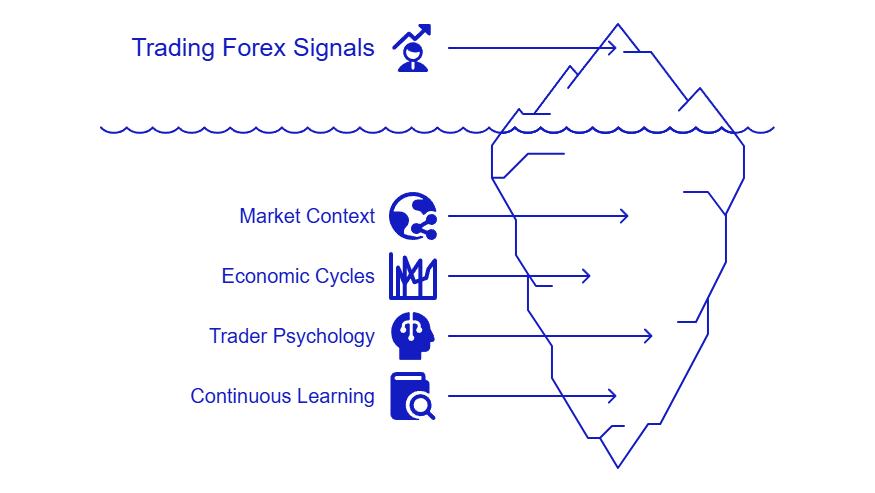
Forex signals offer a tempting shortcut, but true trading success lies in navigating the complexities of the market with understanding. Context is the missing dimension that elevates trading from a gamble to informed speculation.
By embracing contextual analysis:
- You move beyond blindly following alerts.
- You learn to interpret signals intelligently within the bigger picture.
- You draw valuable lessons from market masters like Soros.
- You adapt your strategies to different market conditions (trending vs. ranging).
- You understand the impact of economic cycles and sentiment.
- You build resilience against scams.
- You can leverage tools like AI effectively, without abdicating responsibility.
- You learn from losses and manage risk more effectively.
Ultimately, focusing on context is about protecting your capital and making smarter, more educated decisions. It requires effort, continuous learning, and critical thinking – there are no shortcuts. But the reward is a more robust, sustainable, and potentially profitable trading journey.
Frequently Asked Questions (FAQs)
Q1: Are Forex signals worth it?
A: Forex signals can be useful as a learning tool or for idea generation, but only if used within a broader contextual analysis framework. Relying on them blindly is risky, prevents skill development, and exposes you to numerous scams. Verify providers and never trade signals without understanding the underlying market context.
Q2: How does market context improve Forex trading?
A: Market context (economic conditions, sentiment, market structure, policy) provides the necessary background to interpret trade signals accurately. It helps traders understand why a signal might work or fail, adapt strategies to trending or ranging markets, manage risk effectively, and avoid taking trades that go against strong underlying forces.
Q3: What is George Soros’ reflexivity theory in simple terms?
A: Soros’ reflexivity theory states that market participants’ perceptions and biases don’t just reflect reality; they actively shape it through their actions. This creates feedback loops where rising prices can fuel more buying (and vice versa), pushing markets away from equilibrium into boom/bust cycles. Understanding these loops is key to contextual analysis.
Q4: How can I avoid Forex signal scams on Telegram or social media?
A: Be extremely skeptical of promises of high, guaranteed profits or unrealistic win rates. Look for transparency – does the provider explain their reasoning? Do they have a verified, long-term track record (not just flashy screenshots)? Focus on learning market analysis and context yourself, which makes you less reliant on signals and better able to spot scams. Avoid providers primarily earning through commissions or high subscription fees with no proof of performance.
Q5: Can AI replace the need for contextual analysis in trading?
A: No. While AI can be a powerful tool for gathering data, identifying patterns, and analyzing sentiment quickly, it has limitations. AI relies on historical data, struggles with unprecedented events, and lacks true human understanding of nuanced situations or reflexivity. Use AI as an assistant to augment your contextual analysis, but retain human oversight and critical thinking for final decisions.
Q6: Why is context especially important for crypto trading?
A: Cryptocurrency markets are highly volatile and heavily influenced by rapidly shifting narratives, sentiment, technological news, and regulatory developments, in addition to broader macroeconomic factors. Context changes quickly, making signals based purely on past price action potentially unreliable. A strong grasp of the current crypto context is vital for navigating its volatility and managing risk.
Q7: How do I apply signals differently in trending vs. ranging markets?
A: In trending markets, prioritize signals aligned with the trend direction (e.g., buy signals in an uptrend during pullbacks). Trend-following indicators (like Moving Averages) are more useful. In ranging markets, focus on signals near established support/resistance levels, often using oscillators (like RSI or Stochastics) to identify potential reversals at the boundaries. Avoid trend-following signals within a clear range.
For more detailed insights on developing daily trading routines, risk management, and effective position sizing strategies, explore additional articles on Trading Cup. Our trading experts at ACY and FinLogix are also great resources to guide your journey towards trading excellence.

Discover Our Best Trading Signals
At Tradingcup, you can browse through a selection of signals and review past performance before you decide to copy.
Become A Signal Provider
Share your expertise and become a signal provider so other traders can copy your trades.
Stay tuned to our blog for more trader spotlights and leaderboard updates.
Trading involves risks.
Visit the Tradingcup blog through the link below for more updates: https://www.tradingcup.com/learnBest blogs top 8 code to use if needed.
Related Copy Trading blogs:
- Understanding Market Liquidations: Liquidity Sweeps and Runs Explained
- 7 Essential Daily Habits of Successful Traders to Outperform Their Peers
- 10 Strategies You Can Copy off Our Best Copy Traders
- 5 Strategies Every Trader Can Master To Trade Better In A Trading Contest
- 2025 Copy Trading Scams Exposed: How to Spot Fraud
- A Swing Trading Strategy with an 83 Percent Win Rate and Low Drawdowns
- Forex Martingale Strategies Explained, The Good, The Bad and The Ugly
- Pyramiding Trading Tutorial – Pros & Cons & How to Use It