Last Updated: February 25, 2026
This article is reviewed annually to reflect the latest market regulations and trends.
Disclaimer: The information in this article is for educational purposes only and does not constitute financial, investment, or trading advice. Copy trading carries substantial risks, including the potential loss of your entire invested capital. Past performance of copied traders or strategies is not a reliable indicator of future results. You may be replicating high-risk trades, overleveraged positions, or strategies incompatible with your financial goals. Always conduct independent research into a trader’s historical performance, risk metrics, and strategy before copying them. Never invest funds you cannot afford to lose. Consult a licensed financial advisor to ensure copy trading aligns with your risk tolerance, financial objectives, and regulatory requirements in your jurisdiction. This article does not endorse specific traders, platforms, or strategies, and all trading decisions remain your sole responsibility.
TL;DR
- To start your trading with a guide, find worthy traders where risks don’t hide.
- Check drawdown stats, don’t just chase the gain, to save your capital from financial pain.
- Like Burry, look for value, deep and true, not just what’s popular and new.
- With five diverse traders, spread your bet, it’s the smartest trading practice yet.
- Monitor your progress, stay aware and keen, for the safest trading you have ever seen.
“The best hedge is buying an appropriately safe and cheap stock.” – Michael Burry
Best Copy Traders To Test Out for Beginners 2026
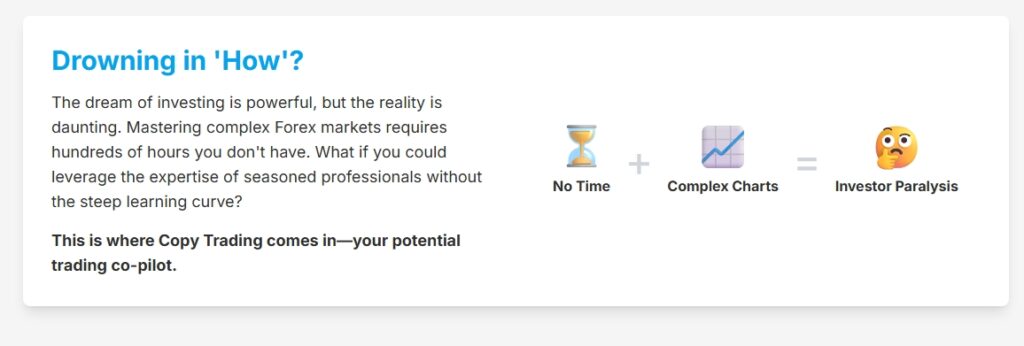
Many aspiring investors find themselves at a crossroads. The allure of financial markets, particularly the dynamic, 24-hour world of foreign exchange (Forex), promises opportunity. Yet, this promise is often overshadowed by a daunting reality: a steep learning curve, complex analytical tools, and the immense time commitment required to trade effectively. For individuals balancing a demanding career, family life, and other responsibilities, dedicating hundreds of hours to mastering chart patterns, economic indicators, and geopolitical analysis is simply not feasible.
This is the exact scenario where the concept of copy trading emerges as a potential lifeline. It presents itself as an elegant solution to a complex problem: what if one could participate in the markets without deep knowledge, leveraging the skills of seasoned professionals? The idea is compellingly simple. An individual finds a successful trader, allocates capital, and with a few clicks, automatically mirrors their every move. This approach appears to democratize trading, offering a shortcut to market exposure and the potential to profit from others’ hard-won expertise. However, as with any financial endeavor that seems too good to be true, a deeper, more critical examination is essential. The path of a copy trader is not one of passive income but of active management, and the difference between success and failure lies in understanding this distinction.
So, What Exactly is Forex Copy Trading?
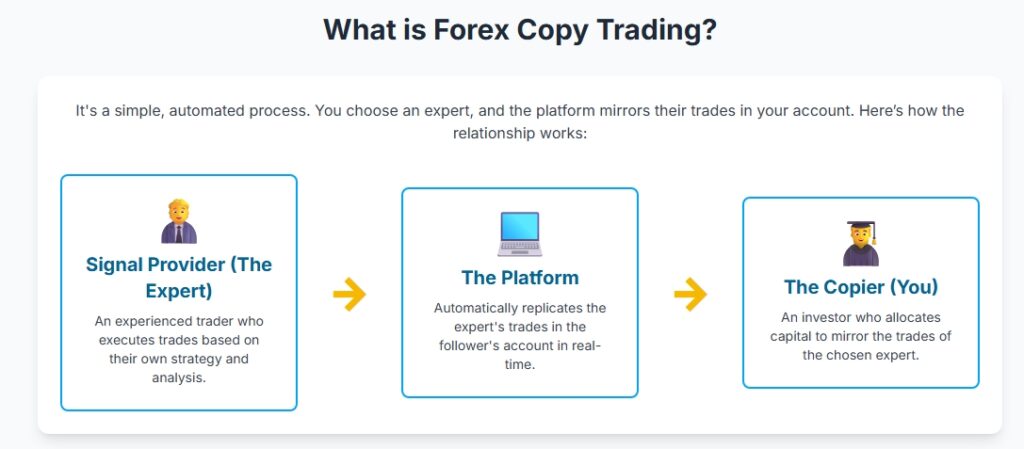
At its core, Forex copy trading is a portfolio management tool that links a portion of an investor’s funds to the account of a chosen expert trader, often called a “signal provider” or “master”. Think of it as having a personal trading co-pilot. The master trader is in the pilot’s seat, making all the navigational decisions, when to buy, when to sell, and how much to risk. The copy trader’s account, like a secondary cockpit, automatically replicates these maneuvers in real-time and in proportion to the allocated funds.
The process typically begins on a specialized platform where traders register and have their performance transparently displayed. A beginner can browse a leaderboard, filter traders based on various metrics, and select one whose strategy aligns with their goals. After linking their account, every trade executed by the master, whether it’s buying EUR/USD on a positive economic report or selling Gold (XAU/USD) based on technical signals, is instantly copied in the follower’s account.
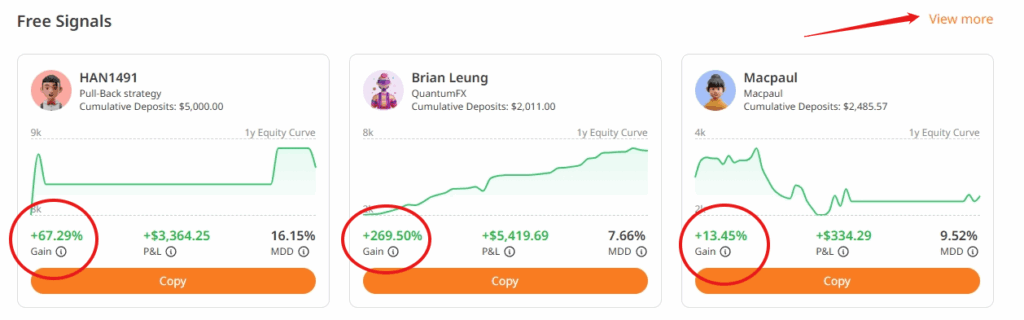
A common entry point for many beginners is the “free signal” model. This is something of a misnomer. While there is no upfront monthly subscription fee, the model operates on a performance-fee basis. The signal provider earns a percentage, typically between 10% and 30%, of the profits they generate for their copiers. This profit-sharing arrangement creates a powerful incentive for the master trader to perform well, as their income is directly tied to their followers’ success. However, it’s crucial to understand that this is not a risk-free partnership; the copier bears 100% of any losses incurred.
Is Copy Trading the Perfect Path for Beginners? A Brutally Honest Look
Copy trading isn’t for everyone. Before you jump in, consider this checklist (inspired by guidance from platforms like TradingCup):
- Are you comfortable with risk? All trading involves risk, and past performance is not indicative of future results. Even the best traders have losing streaks.
- Do you have capital you can afford to lose? Never invest money you can’t afford to part with.
- Are you looking for a passive investment? While copy trading is less hands-on, it still requires initial research and ongoing monitoring.
- Do you understand the fee structures? Subscription fees and performance fees can eat into profits.
- Are you patient? Quick riches are rare. Successful trading, even copying, often requires a long-term perspective.
- Are you willing to do your due diligence? Selecting a trader requires careful analysis of their history, strategy, and risk management.
- Do you have realistic expectations? Don’t expect to double your money overnight.
- Are you emotionally prepared for drawdowns? Seeing your account balance dip, even temporarily, can be stressful. Maximum Drawdown (MDD) is a key metric to understand.
If you’ve nodded along to these points with a clear understanding, then XAUUSD copy trading might be a suitable avenue for you to explore.
How to Analyze a Trader’s Full Performance
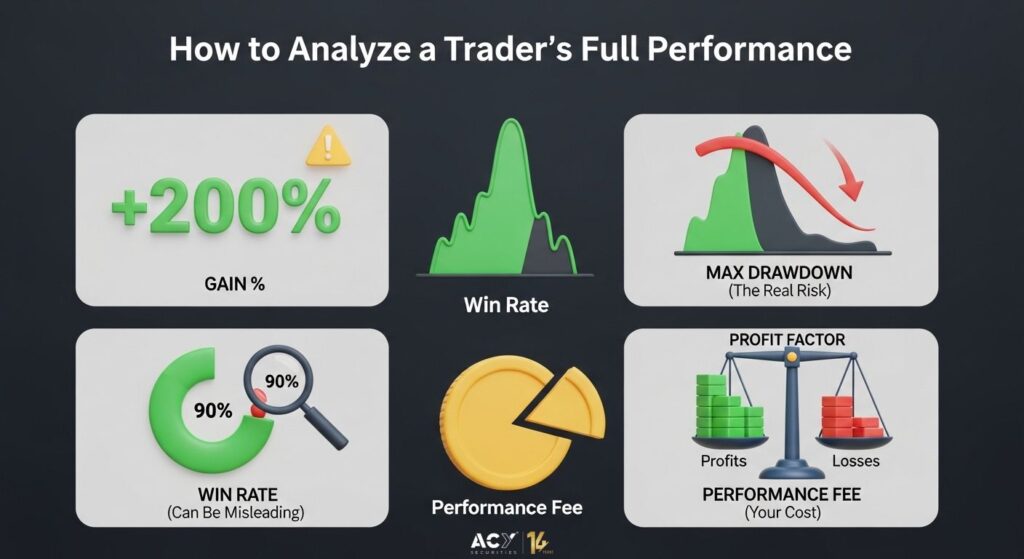
To apply the critical thinking of Burry and the lessons of “The Big Short,” a beginner needs a practical toolkit for analysis. Looking at a trader’s profile and seeing a large “Gain %” is like judging a book by its cover, it tells you nothing about the story’s substance, its risks, or its potential for a tragic ending. To truly understand a trader’s performance, one must learn to read the full story told by the data.
A comprehensive analysis requires looking beyond the headline number and scrutinizing the key metrics that reveal a trader’s skill, discipline, and, most importantly, their approach to risk. The following dashboard breaks down the essential metrics every beginner should master.
Table 1: Your Trader Analysis Dashboard
| Metric | What It Is | What It REALLY Tells You |
|---|---|---|
| Gain % | The total percentage return on the initial capital invested in the account. | This is the headline, the trader’s ability to generate profit. However, it is meaningless without the context of risk. A high gain often signals high risk. |
| Max Drawdown (MDD) % | The largest percentage drop the account has experienced from a peak value to a subsequent low point. | This is the single most important risk indicator. It quantifies the worst-case scenario and reveals the trader’s true risk management discipline. A high MDD is a major red flag for beginners. |
| Win Rate % | The percentage of all closed trades that were profitable. | This metric can be highly misleading on its own. A trader can have a 90% win rate with tiny profits but be wiped out by one or two catastrophic losses. It must be analyzed alongside the profit factor. |
| Profit Factor | The ratio of total profits from winning trades divided by the total losses from losing trades. | This provides crucial context for the win rate. A profit factor greater than 1.0 indicates profitability. A value above 2.0 is considered very strong, showing that profits are significantly outpacing losses. |
| Performance Fee % | The percentage of the copier’s net profit that is paid to the signal provider as compensation. | This is the cost of the service. It must be factored into any calculation of potential net returns. A high performance fee can significantly reduce a copier’s take-home profit. |
Mastering these five metrics allows a beginner to move from being a passive follower to an active analyst. It provides the framework needed to spot red flags, identify genuinely skilled traders, and make informed decisions based on a complete picture of risk and reward.
The Watchlist: A Deep Dive into Beginner-Friendly Traders
Now, let’s put theory into practice. By applying the analytical frameworks of Burry and “The Big Short” and using our Trader Analysis Dashboard, we can perform a rigorous due diligence process on a selection of traders. This exercise demonstrates how to move beyond surface-level impressions to make smarter, safer decisions.
Case Studies: Top Traders On TradingCup For Beginners
The following table and case studies analyze four distinct signal providers available on the TradingCup platform. Each one tells a different story and offers a valuable lesson for beginners. The data is drawn from the performance summaries you provided and platform leaderboards.
Case Study 1: QuantumFX
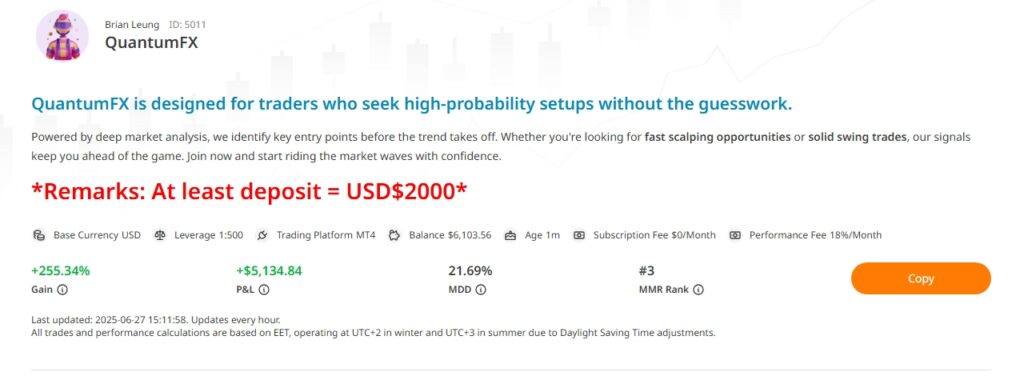
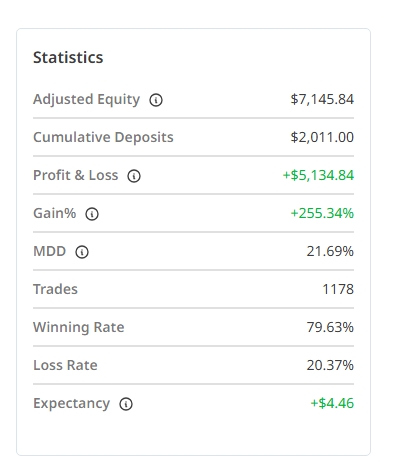
- Analysis: QuantumFX presents a compelling profile of high growth balanced with consistency. The gain of over 270% is excellent, but the standout metric is the 79.63% win rate. This indicates that the trader wins nearly 4 out of every 5 trades, a sign of a very consistent strategy. The Maximum Drawdown of 20.49% is on the higher side for a pure conservative, but it is a justifiable risk given the high returns and impressive win rate. The 18% performance fee is standard for this level of performance.
- Verdict: QuantumFX is a strong candidate for an aggressive growth portion of a beginner’s portfolio. The high win rate provides a degree of confidence that is often missing from other high-gain strategies. Close monitoring is still required due to the MDD.
Case Study 2: Pull-Back Strategy
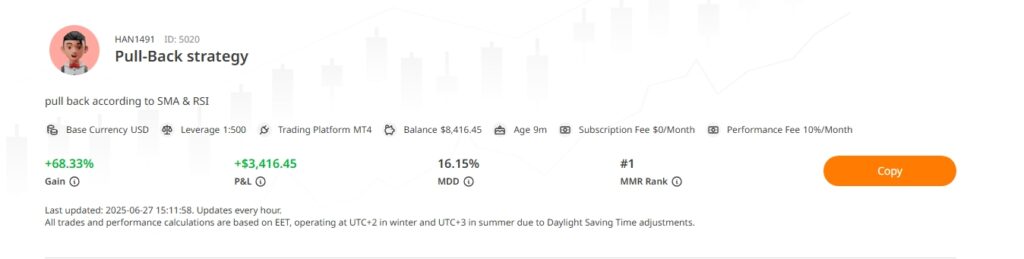
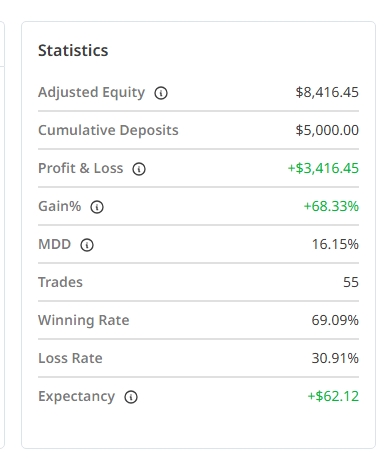
- Analysis: The Pull-Back Strategy remains a benchmark for a balanced, beginner-friendly profile. Its 68.33% gain is solid, but its strength lies in its risk management. The MDD is a contained 16.15%, and this is coupled with a strong win rate of 69.09% and a low 10% performance fee. This combination suggests a disciplined strategy that prioritizes capital preservation while achieving steady growth.
- Verdict: This remains an excellent example of a “value” signal provider. For a beginner looking to build the core of their portfolio, the balance of reasonable gain, controlled drawdown, and a solid win rate makes this a much safer starting point.
Case Study 3: EUR Specialist
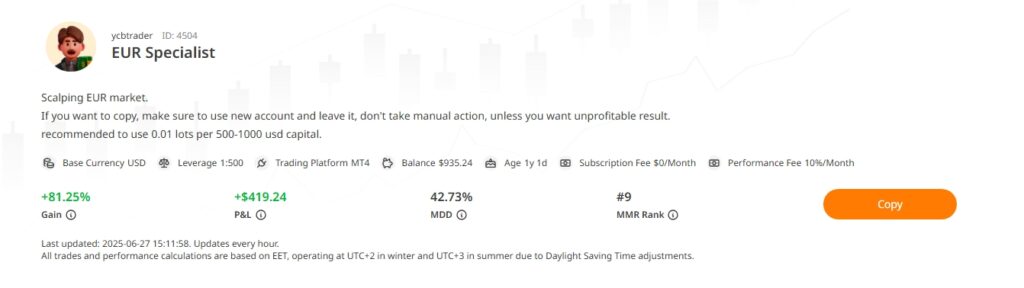
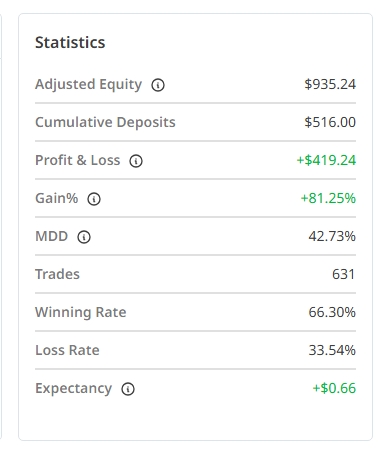
- Analysis: EUR Specialist continues to serve as a critical warning. While the 81.25% gain and 66.30% win rate might seem attractive in isolation, they are completely overshadowed by the MDD of 42.73%. This is a massive red flag. It indicates that at some point, copiers would have seen nearly half of their allocated capital disappear. This level of drawdown signals a severe lack of risk management and is unacceptable for any beginner.
- Verdict: Avoid. This profile is a textbook example of what Michael Burry would shun, a strategy where the potential downside is catastrophic. It highlights why MDD is a more important metric than gain for initial screening.
Case Study 4: Jason Huang
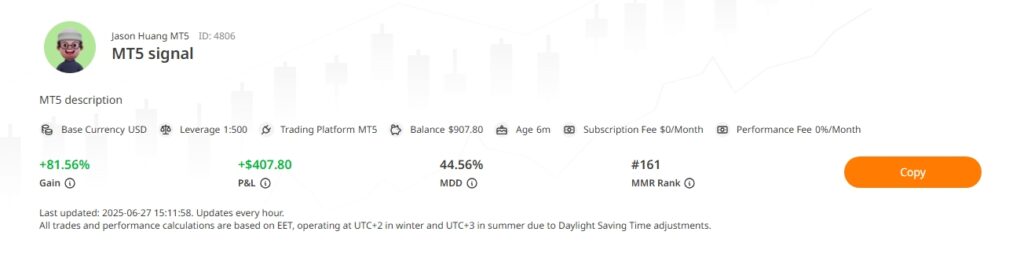
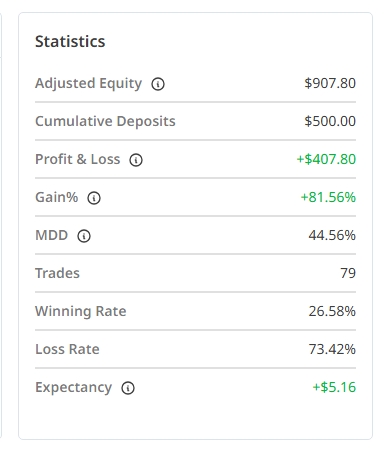
- Analysis: Jason Huang’s profile has transformed into a different, yet equally important, cautionary tale. The strategy is profitable, with a gain of +81.56% and a 0% performance fee. However, a deeper look reveals a highly dangerous methodology for a beginner. The MDD is a catastrophic 44.56%, nearly identical to EUR Specialist’s. Compounding this risk is the extremely low win rate of only 26.58%. This combination means the strategy loses three out of every four trades, relying on a few huge “home run” wins to offset the frequent losses. This is a classic gambler’s profile, unpredictable, stressful, and exposing capital to huge swings.
- Verdict: A powerful lesson in looking beyond the gain percentage. Despite being profitable and “free,” the extreme drawdown and low probability of success on any given trade make this strategy entirely unsuitable for beginners. This should be avoided.
How to Find Your Own Gems on TradingCup
The goal is not just to follow a list, but to learn how to fish. The TradingCup platform offers several powerful filters to help beginners find traders that match their specific risk tolerance and goals. Understanding these tools is key to becoming an effective manager of traders. Beyond Manual Search Below Are Filtered Lists From TradingCup
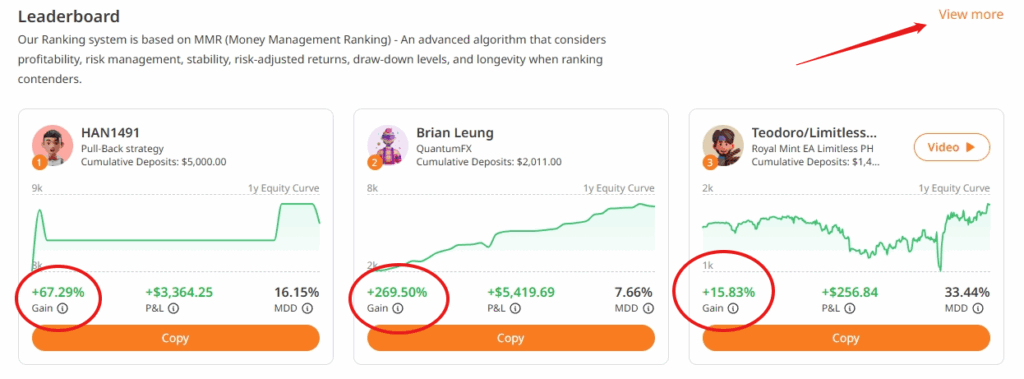
Leaderboard: Based on an MMR (Money Management Ranking) system or similar composite score, ranking traders holistically over their entire history.
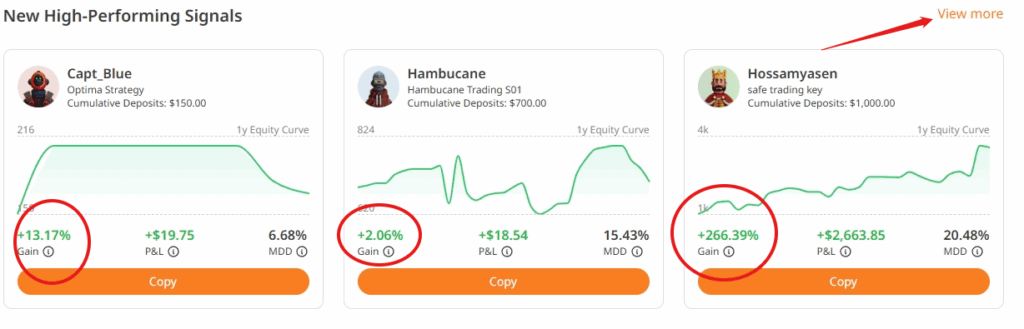
New High-performing Signals: Focuses on newer traders (e.g., < 1 year) showing positive Gain %. Good for finding emerging talent, but requires caution due to shorter track records.
Free Signals: Focuses on traders (e.g., > 1 year) showing positive Gain %. Good for finding Free Signal Providers. A great starting point for beginners to try copy trading without incurring huge costs.
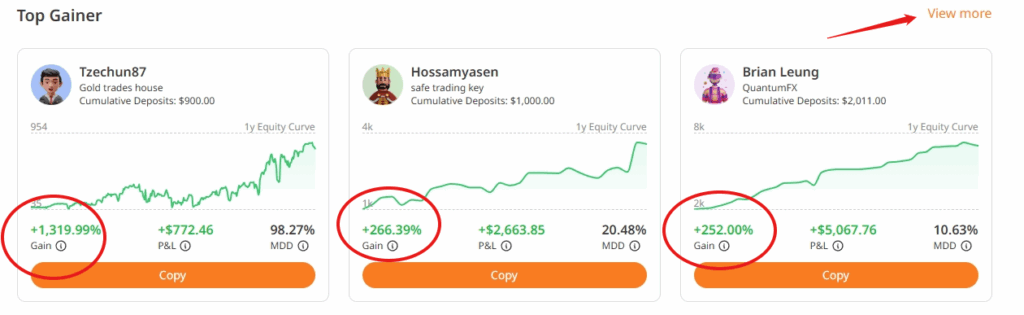
Top Gainer: Purely ranks by Gain % over a period (e.g., 1 year), often filtering for positive gain. Use with caution – high gain can mean high risk. Always check MDD and Sharpe Ratio here.
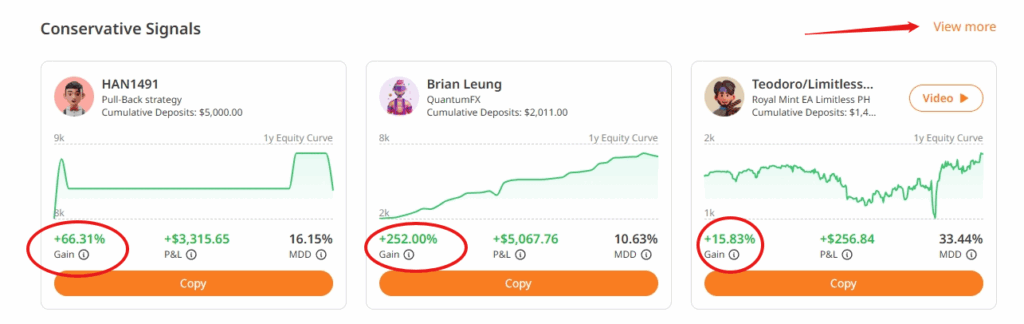
Conservative Signals: Filters for low risk, typically using a Maximum Drawdown threshold (e.g., <= 10% over 1 year) and often ranked by MMR within that subset. Ideal for risk-averse investors.
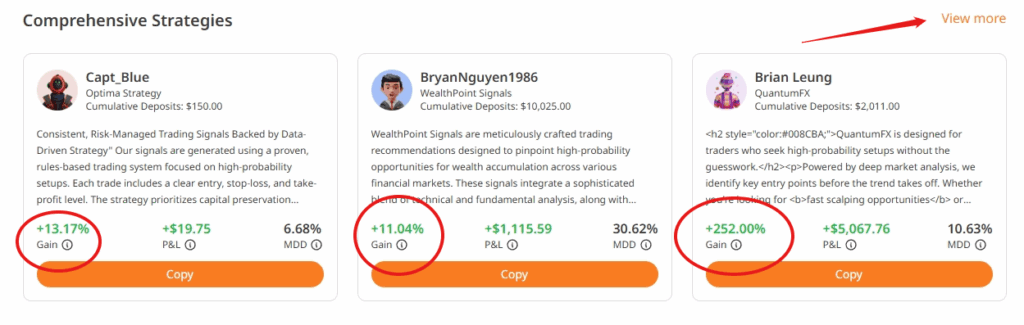
Comprehensive Strategies: Attempts to filter based on the quality and detail of the trader’s strategy description (looking for non-generic, non-volatile approaches like Martingale) combined with positive Gain %.
Building Your Fortress: Advanced Risk Management & Strategy
Selecting good traders is only half the battle. Long-term success in copy trading hinges on building a resilient portfolio structure and adhering to disciplined risk management principles. This means moving beyond copying a single trader and implementing strategies to protect capital from the inevitable volatility of the markets.
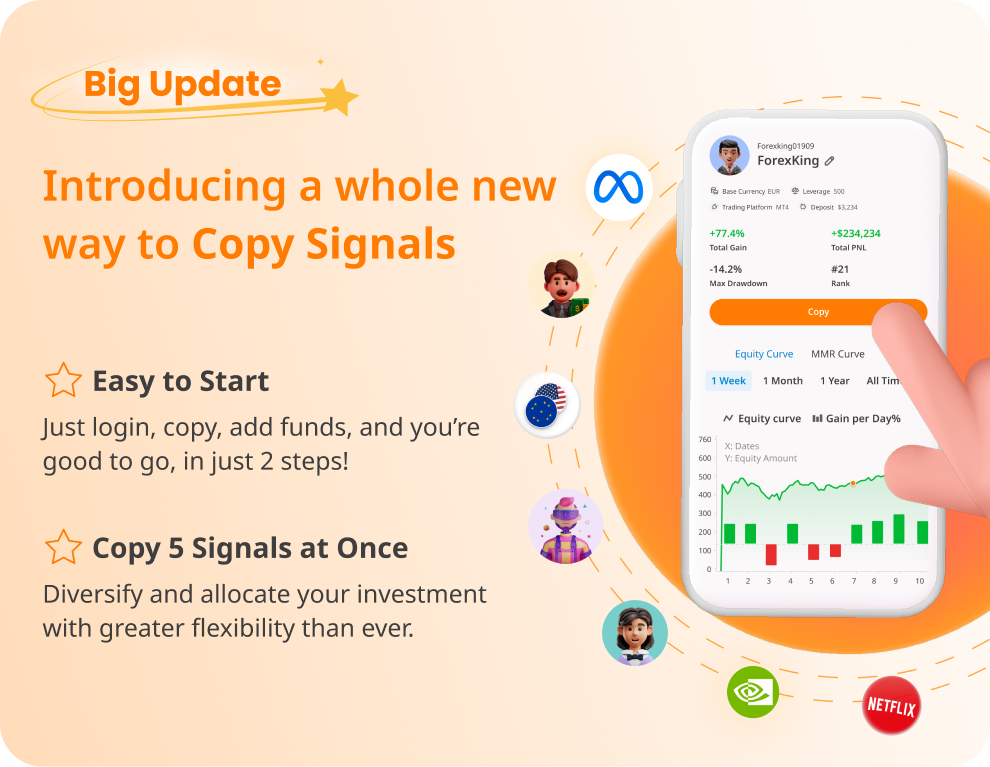
Should You Put All Your Eggs in One Basket? The 5-Trader Diversification Rule
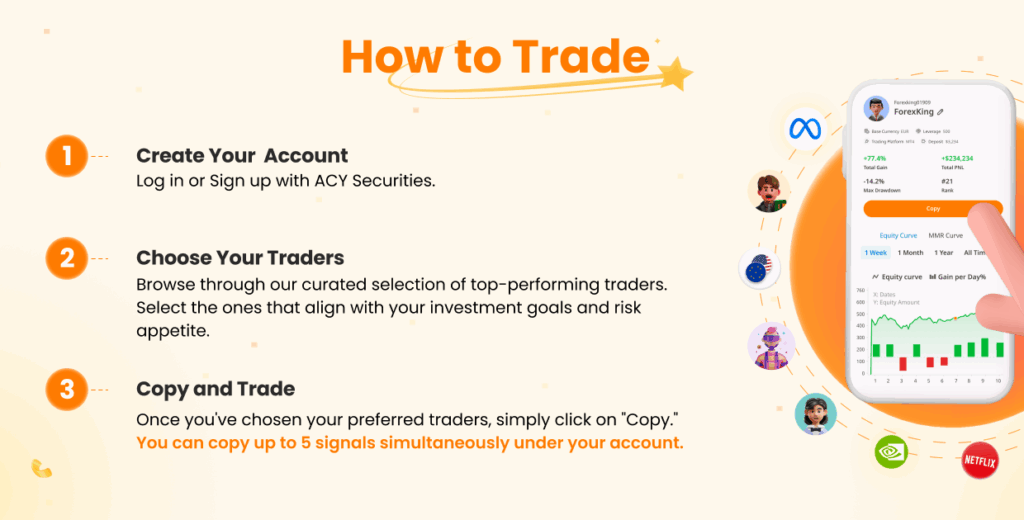
Concentrating all of your capital on a single trader is one of the most common and dangerous mistakes a beginner can make. No matter how impressive their track record, any single trader can experience a losing streak, change their strategy, or simply make a mistake. If all your funds are tied to them, your entire portfolio suffers.
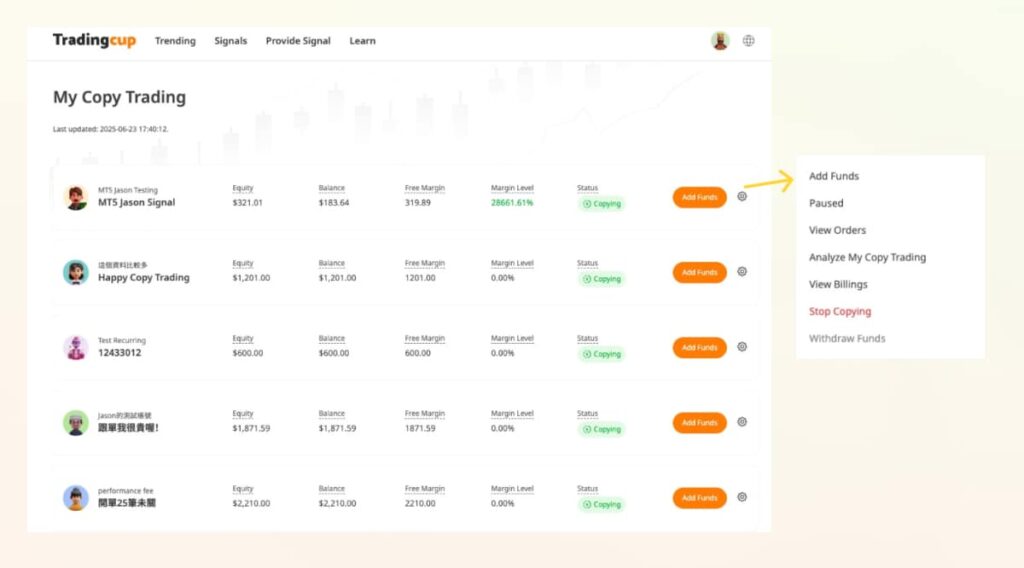
The solution is diversification. This is a fundamental principle of risk management in all forms of investing, and it is especially critical in copy trading. By spreading capital across multiple signal providers, the impact of any single trader’s poor performance is mitigated. A robust diversification strategy involves more than just picking several names; it involves selecting traders with different characteristics:
- Varying Strategies: Combine traders who use different approaches, such as short-term scalping, medium-term swing trading, and long-term position trading.
- Different Asset Classes: Allocate capital to traders who specialize in different markets. For example, one might focus on major Forex pairs (like EUR/USD), another on commodities (like Gold or Oil), and a third on stock indices.
- Uncorrelated Risk Profiles: Balance your portfolio by combining aggressive, higher-risk traders with more conservative, low-drawdown traders. A common allocation model for beginners might be to copy 3-5 traders, creating a blended portfolio that smooths out returns and reduces overall volatility. Some platforms even encourage this by limiting the maximum allocation to any single trader to 20% of a copier’s funds.
The easiest and most effective strategy for a beginner is to start by copying up to 5 different traders, ensuring they have varied styles and risk levels. This approach, detailed in resources like “Easiest Copy Trading Strategy For Forex: Copying 5 Traders,” provides a foundational layer of safety against the failure of any one strategy.
How Often Should You Check on Your Copy Traders? A Guide to Mindful Monitoring
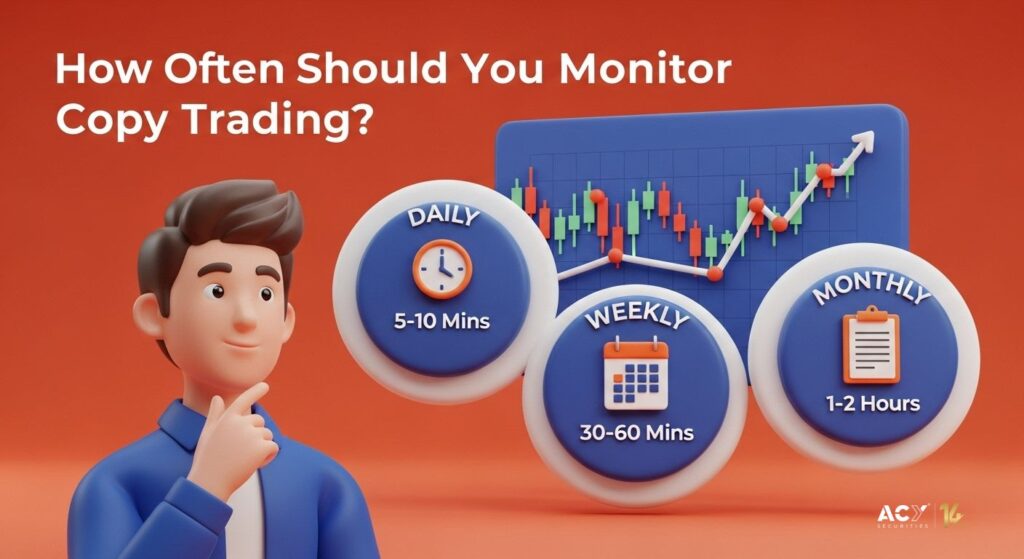
Once a portfolio of traders is established, the question of monitoring frequency arises. The optimal approach lies between two extremes: the obsessive, constant checker who reacts to every minor fluctuation, and the completely hands-off investor who might miss critical warning signs.
Successful copy trading requires regular monitoring, but not constant intervention. Overreacting to a single losing day or week is an emotional mistake that can lead to abandoning a sound long-term strategy prematurely. Conversely, complete neglect means you might fail to notice if a trader’s performance fundamentally deteriorates or if their risk profile changes dramatically.
A disciplined and effective monitoring routine for a beginner could look like this:
- Daily Check-in (5 Minutes): A quick glance at the portfolio’s overall performance. The goal is not to react, but simply to stay informed and become desensitized to normal market volatility. This prevents the shock of logging in after a week to see a major swing.
- Weekly Deep Review (30-60 Minutes): A more thorough review of each trader’s performance for the week. Check their closed trades, current open positions, and any changes in their key metrics (like drawdown). This is the time to ask critical questions: Is the trader sticking to their stated strategy? Has their risk-taking increased?
- Monthly Reassessment: At the end of each month, evaluate the performance of the entire portfolio. Is it meeting expectations? Is it time to reallocate funds, reduce exposure to an underperforming trader, or replace them with a new one?
This structured approach fosters informed decision-making while mitigating the risk of emotional, knee-jerk reactions. The goal is to be an engaged manager, not a nervous spectator.
The 7 Deadly Sins: Are You Making These Beginner Copy Trading Mistakes?
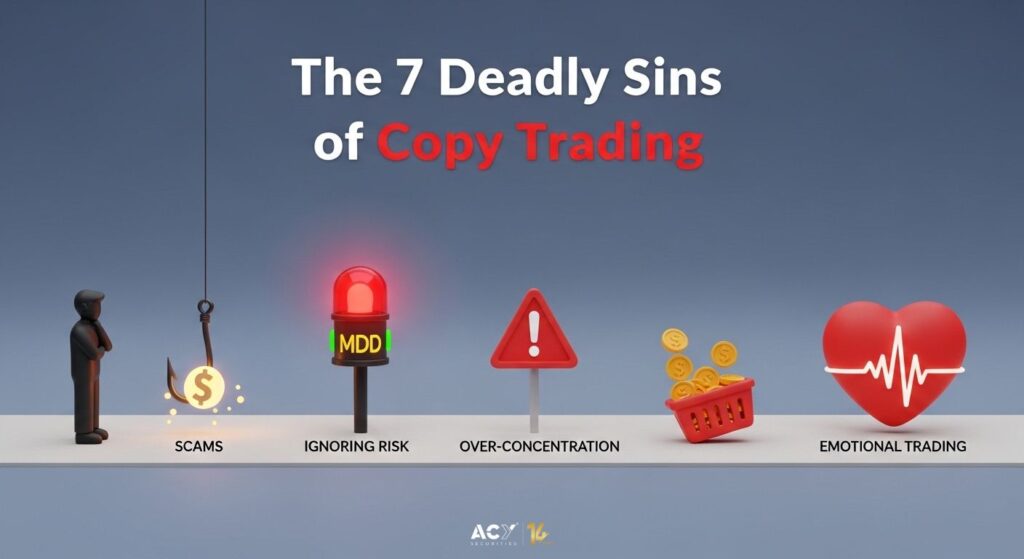
Even with the best tools and strategies, beginners are prone to a set of common, often unconscious, mistakes that can derail their efforts. Being aware of these “seven deadly sins” is the final step in building a defensive trading mindset.
- Falling for a Scam. Before any trading mistake, the most catastrophic error is falling victim to fraud. The online world is rife with forex scams, from fake brokers to signal sellers promising guaranteed, unrealistic returns. Red flags include: unsolicited contact, pressure to deposit funds quickly, promises of zero-risk profits, and dealing with unregulated entities. Always use a reputable, regulated platform and remember: if it sounds too good to be true, it is.
- Blind Faith: This is the mistake of copying a trader based on their rank or a single impressive metric without conducting any personal due diligence. It’s outsourcing thinking entirely, which is a recipe for failure.
- Ignoring Risk Management: Becoming fixated on potential gains while completely ignoring the Maximum Drawdown (MDD) and other risk metrics. This is the fastest way to lose capital.
- Over-Concentration: Putting all your investment capital into a single trader, no matter how good they seem. This violates the core principle of diversification and exposes the portfolio to catastrophic risk.
- Impatience: Chasing quick, unrealistic profits and abandoning traders or strategies at the first sign of a drawdown. Successful investing is a long-term endeavor, and patience is required.
- Ignoring Costs: Forgetting to factor in performance fees, spreads, and other commissions. These costs eat into net profits and must be part of the initial analysis.
- Emotional Decision-Making: Panicking and closing positions during a downturn or getting greedy and overallocating during a winning streak. A trading plan should be executed with discipline, not emotion.
- Misunderstanding Leverage: Using excessive leverage without understanding that it amplifies losses just as much as gains. This is a frequent and costly mistake for new forex traders.
Avoiding these pitfalls, as detailed in guides like “Copy Trading Tips Beginners Ignore Unconsciously,” is fundamental to surviving and thriving in the copy trading ecosystem.
How Would Michael Burry Pick a Copy Trader? A Guide to Contrarian Selection

To excel as a manager of traders, one can draw powerful lessons from some of Wall Street’s most legendary contrarians. Dr. Michael Burry, famed for his billion-dollar bet against the subprime mortgage market depicted in “The Big Short,” built his career on a philosophy of rigorous, independent thought that is directly applicable to selecting a copy trader. Adopting a “Burry-esque” mindset means ignoring the hype and focusing on what truly matters: value and safety.
Burry’s investment approach is grounded in a deep-value, contrarian framework that prioritizes risk management above all else. Applying his principles creates a powerful checklist for evaluating signal providers:
- Obsess Over the Downside First: Burry’s primary question was never “How much can I make?” but “How much can I lose?”. He believed that preserving capital was paramount, as “lost dollars are simply harder to replace than gained dollars are to lose”. For a copy trader, this means the first metric to scrutinize is not the impressive Gain %, but the terrifying Maximum Drawdown (MDD). The MDD reveals the largest single loss from a peak to a trough an account has suffered, offering a stark picture of the trader’s worst-case performance and risk management discipline. A trader with a 300% gain but a 60% MDD is a gambler; one with a 50% gain and a 10% MDD is a professional.
- Find “Roadkill” Value: Burry famously sought out “shares of unpopular companies when they look like roadkill”. He looked for value where no one else was looking, in assets the market had discarded out of fear or misunderstanding. In the world of copy trading, this translates to resisting the allure of the “Top Gainer” leaderboard, which is often populated by high-risk, high-volatility traders. The Burry approach would be to use a platform’s “Conservative Signals” filter, seeking out traders with consistent, stable, and perhaps “boring” track records. The goal is to find durable value, not fleeting hype.
- Do the Research No One Else Will: A pivotal moment in “The Big Short” comes when Burry reveals he knew the mortgage bonds were filled with bad loans because he did what no one else would: he read them. He sifted through thousands of pages of tedious prospectuses to find the truth. The parallel for a copy trader is clear: don’t just look at the summary statistics on a trader’s profile. Dive deep into their entire trading history. Understand the markets they trade, the frequency of their trades, their average win and loss size, and the logic of their strategy. True diligence is the only path to real conviction.
- Distrust the Herd and Think Independently: Burry’s natural state was that of an “outsider” analyzing the group. He made his fortune by betting against the entire financial establishment’s consensus. This is a potent warning against blindly following the most-copied trader on a platform. Popularity is not a proxy for quality. The herd can be, and often is, wrong. An investor’s analysis must be their own.
The Big Short: 10 Commandments for Surviving the Copy Trading Trenches
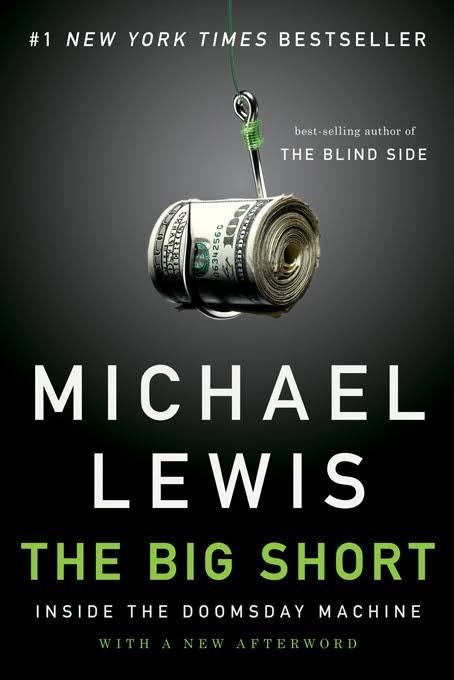
The story of “The Big Short” is more than just a tale of financial clairvoyance; it’s a masterclass in risk, incentive, and human psychology. The lessons from Michael Lewis’s book and the subsequent film serve as a set of commandments for any beginner navigating the treacherous waters of copy trading.
- Thou Shalt Do Thy Own Research: The protagonists of “The Big Short” didn’t trust the official AAA ratings from agencies like Moody’s and S&P. Instead, Mark Baum’s team conducted on-the-ground due diligence, visiting Florida to see the housing bubble firsthand. For a copy trader, this means you are the rating agency. You must analyze a trader’s performance data yourself and not blindly trust their “Top Trader” status.
- Thou Shalt Question Authority: The entire premise of the book is that the experts, the banks, the rating agencies, the Federal Reserve, were catastrophically wrong. Similarly, a trader’s high ranking on a platform is a starting point for investigation, not a conclusion.
- Thou Shalt Understand the Incentives: The 2008 crisis was fueled by misaligned incentives. Mortgage brokers were paid to issue loans, regardless of quality, and rating agencies were paid by the banks whose products they were rating. A copy trader must understand the signal provider’s incentives. A performance fee encourages profit, but it can also encourage excessive risk-taking to chase that fee.
- Thou Shalt Not Be Blinded by Greed: The pursuit of quick, easy profits drove the financial system off a cliff. For a copy trader, chasing a signal with a 1,500% gain without scrutinizing its 98% maximum drawdown is a modern form of the same greed.
- Thou Shalt Be Wary of Complexity: The risk of the housing market was hidden within complex, opaque instruments like Collateralized Debt Obligations (CDOs) that few understood. The lesson is simple: if you cannot understand a trader’s strategy in simple terms, do not copy it. Complexity often hides risk.
- Thou Shalt Prepare for the Cycle to Turn: A key lesson from the crisis is that economic booms do not last forever. A trader who performs exceptionally well in a stable, trending market may collapse when volatility spikes or the market reverses. Look for traders who have demonstrated consistency across different market conditions.
- Thou Shalt Be Patient (with a Caveat): Michael Burry held his position for nearly two years, enduring investor revolts and massive short-term losses before being proven right. This teaches the virtue of patience. However, this lesson comes with a critical caveat. Burry’s conviction was born from thousands of hours of meticulous research. A beginner’s “patience” with a losing trader can easily become foolish stubbornness. The key is to have a data-driven thesis for why a trader was chosen. If that data fundamentally changes, one must be willing to cut losses, not hold on out of hope.
- Thou Shalt Hedge Thy Bets: While the characters in the film took a single, concentrated bet, the lesson for a retail investor is the opposite. The prudent approach is to diversify. Never go all-in on a single trader, no matter how promising they seem.
- Thou Shalt Be Cautious with Leverage: The 2008 crash was amplified by extreme leverage, with investment banks holding debt ratios of 30-to-1. In Forex trading, leverage is a double-edged sword that can magnify both gains and losses. A beginner must understand how it works and use it with extreme caution.
- Thou Shalt Demand Honesty & Transparency: At its heart, the crisis was a failure of honesty. The system was opaque. A copy trader should only operate on platforms that provide transparent, verifiable, and comprehensive performance data. Without transparency, due diligence is impossible.
Conclusion: From Novice to Knowledgeable, Starting Your Forex Journey with Confidence
The journey into Forex copy trading is often born from a desire for a simpler path to investment success. While it offers a powerful tool to leverage professional expertise, the notion that it is a “set it and forget it” solution is a dangerous illusion. True success does not lie in finding a single, infallible trader to follow blindly. It lies in an investor’s transformation from a passive novice into a knowledgeable, diligent, and disciplined manager of trading talent.
By adopting the contrarian, risk-first mindset of an investor like Michael Burry, internalizing the cautionary lessons from “The Big Short,” and mastering the practical skills of performance analysis, a beginner can navigate this complex environment with confidence. The path forward is clear: prioritize safety over hype by focusing on drawdown, not just gain. Build a resilient portfolio through the strategic diversification of 3-5 traders with varied styles. Implement a mindful monitoring routine to stay informed without being emotional. And, most importantly, conduct rigorous due diligence on every decision.
Copy trading is not a shortcut around the principles of sound investing; it is an application of them. By approaching it with caution, strategy, and a commitment to continuous learning, beginners can turn this innovative tool into a valuable component of their long-term financial journey.
Frequently Asked Questions (FAQ)
What is the best copy trading platform for beginners?
The best platforms for beginners are those that are easy to use, are well-regulated, and provide transparent, comprehensive performance data for each trader. Platforms like TradingCup are designed to help users find and copy traders in real-time, featuring exclusive ranking systems like the Money Manager Ranking (MMR) to help assess traders based on risk and performance, not just profit.
How much money do I need to start copy trading?
This varies by platform and trader. Some platforms have minimum deposit requirements. More importantly, some signal providers recommend a minimum investment amount to ensure your account can properly replicate their strategy’s position sizing and risk management. It is always advisable to start with a modest balance that you can afford to lose, especially while learning.
Is forex copy trading profitable for beginners?
Copy trading can be profitable for beginners, but it is not guaranteed. Profitability depends heavily on careful trader selection, robust risk management, diversification, and continuous monitoring. Many beginners lose money because they neglect these principles. Success is possible, but it requires strategy and diligence, not just luck.
Can you lose all your money in copy trading?
es. All trading involves substantial risk, including the potential loss of your entire invested capital. If the trader you copy incurs major losses, your account will incur those same losses. This is why understanding Maximum Drawdown (MDD), using stop-loss tools, and diversifying across multiple traders are critical risk management practices.
How do I choose a good trader to copy?
Choosing a good trader requires a multi-faceted analysis. Look for:
- Consistent Performance: A solid track record over a significant period (at least 6-12 months) is more reliable than short-term gains.
- Low Maximum Drawdown (MDD): This is a key indicator of risk management. A lower MDD is generally safer.
- A Clear Strategy: You should be able to understand the trader’s style (e.g., scalping, swing trading) and the markets they focus on.
- Good Risk-Adjusted Returns: Use metrics like the Sharpe Ratio or a platform’s proprietary ranking (like MMR) to see if the returns justify the risk taken.
- Transparency: Only copy traders on platforms that provide full, verifiable performance histories.
What is a good drawdown for copy trading?
There is no single “good” number, as it depends on your personal risk tolerance. However, for a beginner or conservative investor, a Maximum Drawdown (MDD) below 15-20% is often considered manageable. An MDD above 30-40% should be seen as a significant red flag, indicating a very high-risk strategy that could lead to substantial losses.
(Disclaimer: This article is for informational and educational purposes only. It should not be considered financial advice. Always conduct your own research and consult with a qualified financial advisor before making any investment decisions.
For more detailed insights on developing daily trading routines, risk management, and effective position sizing strategies, explore additional articles on Trading Cup. Our trading experts at ACY and FinLogix are also great resources to guide your journey towards trading excellence.

Discover Our Best Trading Signals
At Tradingcup, you can browse through a selection of signals and review past performance before you decide to copy.
Become A Signal Provider
Share your expertise and become a signal provider so other traders can copy your trades.
Stay tuned to our blog for more trader spotlights and leaderboard updates.
Trading involves risks.
Visit the Tradingcup blog through the link below for more updates: https://www.tradingcup.com/learn
Related Copy Trading blogs:
- Understanding Market Liquidations: Liquidity Sweeps and Runs Explained
- 7 Essential Daily Habits of Successful Traders to Outperform Their Peers
- 10 Strategies You Can Copy off Our Best Copy Traders
- 5 Strategies Every Trader Can Master To Trade Better In A Trading Contest
- 2025 Copy Trading Scams Exposed: How to Spot Fraud
- A Swing Trading Strategy with an 83 Percent Win Rate and Low Drawdowns
- Forex Martingale Strategies Explained, The Good, The Bad and The Ugly
- Pyramiding Trading Tutorial – Pros & Cons & How to Use It