Last Updated: February 25, 2026
This article is reviewed annually to reflect the latest market regulations and trends.
Disclaimer: The information in this article is for educational purposes only and does not constitute financial, investment, or trading advice. Copy trading carries substantial risks, including the potential loss of your entire invested capital. Past performance of copied traders or strategies is not a reliable indicator of future results. You may be replicating high-risk trades, overleveraged positions, or strategies incompatible with your financial goals. Always conduct independent research into a trader’s historical performance, risk metrics, and strategy before copying them. Never invest funds you cannot afford to lose. Consult a licensed financial advisor to ensure copy trading aligns with your risk tolerance, financial objectives, and regulatory requirements in your jurisdiction. This article does not endorse specific traders, platforms, or strategies, and all trading decisions remain your sole responsibility.
TL;DR
- If you want to trade but feel the grind, Copy trading helps you unwind.
- ZuluTrade is vast, a choice you can make, But hidden risks could cause a mistake.
- TradingCup is new, with a contest-born crew, And a risk-focused ranking (MMR) that’s safer for you.
- Don’t just chase high returns with glee, A trader with low, managed risk is the key.
- For a smarter start and peace of mind, TradingCup’s supportive ecosystem is what you’ll find.
“We should not, like sheep, follow the herd of creatures in front of us, making our way where others go, not where we ought to go.”
— Seneca
ZuluTrade vs. TradingCup: Which Forex Copy Trading Platform is the Smart Choice for Beginners in 2026?
In today’s fast-paced world, the ambition to grow personal wealth often collides with the reality of a demanding schedule. Many are drawn to the immense potential of the foreign exchange (forex) market, the largest and most liquid financial market in the world, yet are understandably deterred by its perceived complexity. The intricate charts, the endless stream of economic data, and the steep learning curve can feel like taking on a second full-time job. This creates a frustrating paradox: the desire to invest is strong, but the time and specialized knowledge required for active trading are scarce commodities.
This is where the concept of copy trading emerges as a compelling solution. It presents a seductive promise: what if you could participate in the markets by leveraging the expertise of seasoned professionals, automatically replicating their trading decisions in your own account? This approach aims to democratize trading, offering a pathway for those who lack the time for extensive market analysis to still pursue their financial goals.
However, this solution introduces a new, even more critical question. If you are entrusting your capital to the decisions of another, the choice of who to follow and which platform to use becomes paramount. The initial barrier to entry isn’t just a lack of time or knowledge; it’s a profound psychological hurdle built on the fear of the unknown, the complexity of the markets, and the risk of making costly mistakes. Copy trading offers to outsource not just the technical analysis but the very psychological burden of pulling the trigger on a trade. Therefore, selecting a platform is not merely a technical choice; it is the foundational decision in managing one’s investment psychology and risk from the very first step.
What Exactly is Forex Copy Trading, and How Does It Work?
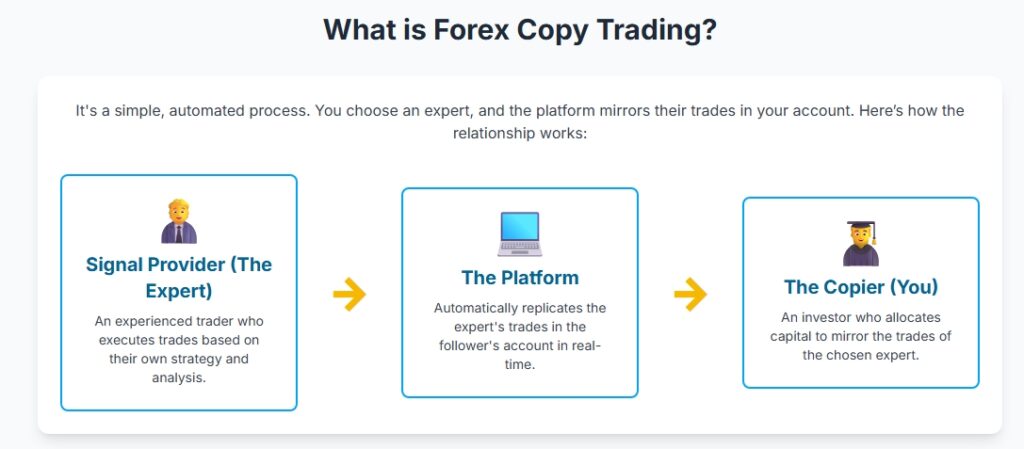
At its core, forex copy trading is an innovative form of portfolio management that bridges the gap between novice investors and expert traders. Imagine hiring a team of world-class chefs to cook for you. You don’t need to know their complex recipes or cooking techniques; you simply choose the chefs whose cuisine you trust, and their creations appear on your table. Copy trading operates on a similar principle.
In this ecosystem, there are two main participants:
- Signal Providers (or Leaders): These are experienced traders who allow others to view and replicate their trading activity. They execute trades in their own accounts based on their strategies and analysis.
- Copiers (or Followers): These are investors who allocate a portion of their capital to automatically mirror the trades of one or more Signal Providers. When the Signal Provider opens or closes a position, the same action is executed in the Copier’s account in real-time.
The process is largely automated by the platform. A copier browses a leaderboard of Signal Providers, reviews their performance statistics, and selects one to follow. The platform then handles the trade replication, typically on a proportional basis. For instance, if a Copier with a $1,000 account copies a Signal Provider with a $10,000 account, the trades in the Copier’s account will be executed at 10% of the size of the Provider’s trades, maintaining the same risk exposure relative to the account size. This system, also known as mirror trading or social trading, allows beginners to gain exposure to the forex market without needing to perform their own in-depth analysis.
Is Copy Trading a Golden Ticket for Beginners? A Reality Check

Copy trading isn’t for everyone. Before you jump in, consider this checklist (inspired by guidance from platforms like TradingCup):
- Are you comfortable with risk? All trading involves risk, and past performance is not indicative of future results. Even the best traders have losing streaks.
- Do you have capital you can afford to lose? Never invest money you can’t afford to part with.
- Are you looking for a passive investment? While copy trading is less hands-on, it still requires initial research and ongoing monitoring.
- Do you understand the fee structures? Subscription fees and performance fees can eat into profits.
- Are you patient? Quick riches are rare. Successful trading, even copying, often requires a long-term perspective.
- Are you willing to do your due diligence? Selecting a trader requires careful analysis of their history, strategy, and risk management.
- Do you have realistic expectations? Don’t expect to double your money overnight.
- Are you emotionally prepared for drawdowns? Seeing your account balance dip, even temporarily, can be stressful. Maximum Drawdown (MDD) is a key metric to understand.
If you’ve nodded along to these points with a clear understanding, then XAUUSD copy trading might be a suitable avenue for you to explore.
What Makes ZuluTrade a Titan of Social Trading?

As one of the pioneers in the space, ZuluTrade has built a formidable reputation since its founding in 2007. It stands as a titan of social trading, boasting a massive user base of over two million and a history of innovation that has shaped the industry.
The Strengths of a Veteran
ZuluTrade’s primary value proposition is choice. It operates as a broker-agnostic network, connecting to over 70 different brokerage firms. This gives users incredible flexibility to work with their preferred broker or shop around for the best conditions. This open-network philosophy has made it a go-to platform for traders around the globe.
A cornerstone of its offering is the proprietary ZuluGuard™ feature. This risk-management tool is designed to protect a copier’s capital by monitoring the behavior of a Signal Provider. If a provider dramatically changes their strategy or executes trades that deviate from their historical pattern, ZuluGuard can automatically sever the connection, preventing further exposure to erratic behavior. For beginners, this acts as a crucial safety net against a trader going rogue. The platform is also praised for its mobile-first interface and a suite of analytical tools to help users evaluate traders.
The Baggage of a Long History
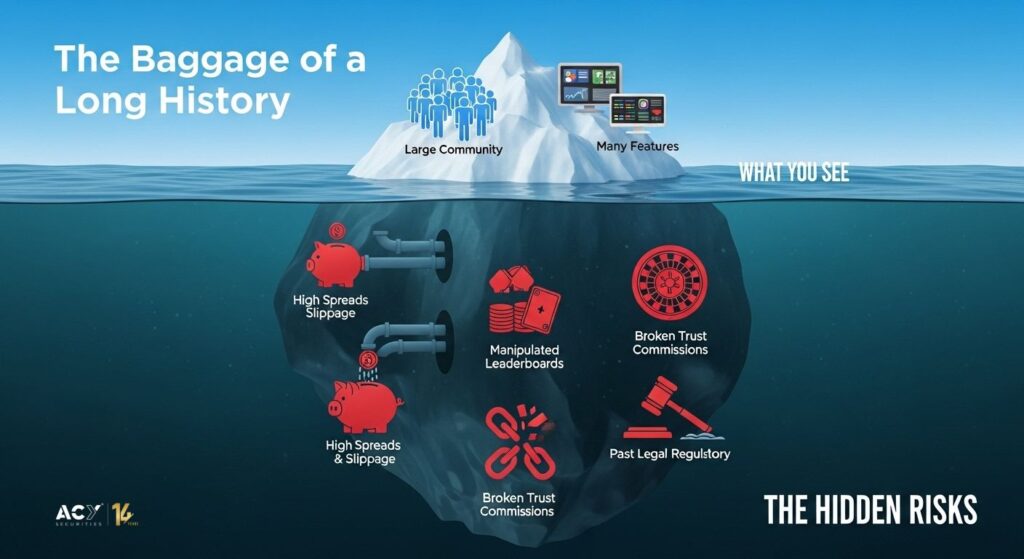
However, ZuluTrade’s long history is not without its controversies, and the platform carries significant reputational baggage that potential users must consider. A deep dive into user sentiment across forums, reviews, and social media reveals a polarized community. While many are ardent fans, a vocal and persistent contingent raises serious concerns.
- Execution and Cost Issues: A common thread among user complaints is the experience of high spreads, costly slippage, and execution lag. These “hidden costs” can significantly erode the profitability of a strategy, turning a winning signal into a losing trade for the copier.
- Signal Provider Disputes: More troubling are the long-running allegations from Signal Providers themselves. Threads on respected industry forums like Forex PeaceArmy detail claims of unpaid commissions and even trade manipulation, with some providers accusing the platform of being a “scam”. Such disputes can damage trust and potentially impact the quality and motivation of the very traders that copiers rely on.
- Ranking Algorithm Concerns: Multiple sources, including Reddit threads, suggest that ZuluTrade’s ranking algorithm can be “gamed.” The system can allegedly be manipulated to favor traders who employ high-risk strategies like Martingale (doubling down on losing trades), which produce impressive-looking short-term gains but carry an extremely high risk of total account failure. For a beginner who relies on the leaderboard to identify “top traders,” this is a particularly dangerous trap.
- Regulatory Scrutiny: The platform’s history also includes a 2016 enforcement action from the National Futures Association (NFA) in the U.S., a point that is still referenced in critical reviews today.
While ZuluTrade’s scale and features are impressive, these persistent issues suggest a platform where the onus is heavily on the user to perform exceptionally deep due diligence to avoid potential pitfalls.
Could TradingCup’s Modern Approach Be Better?
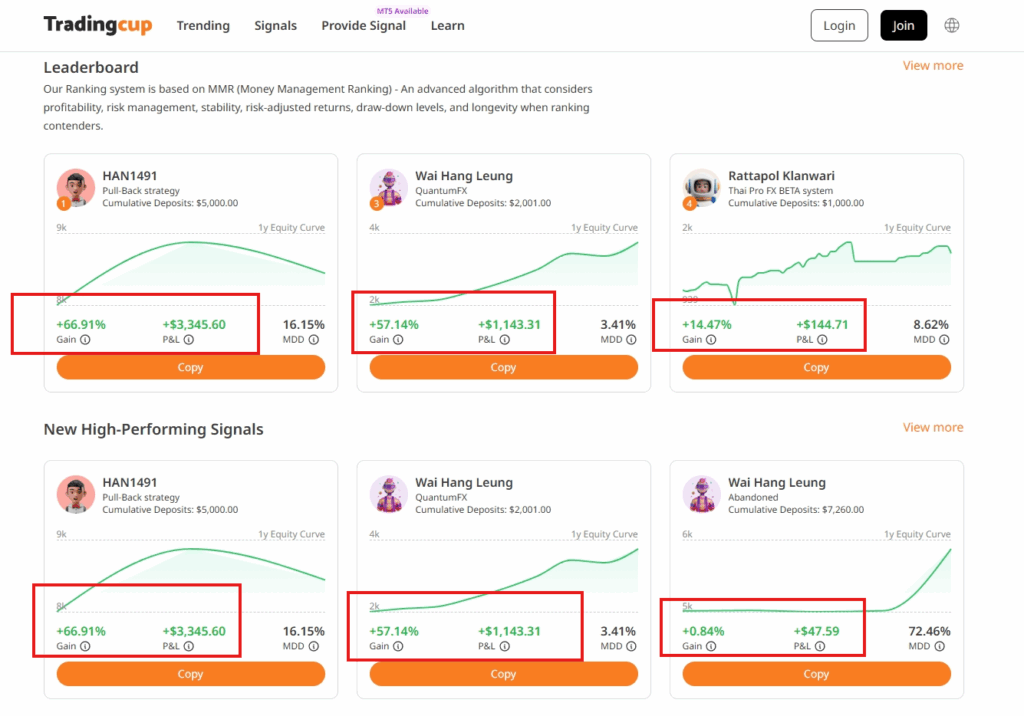
Emerging from the competitive world of global trading contests, TradingCup presents itself not merely as another platform, but as an evolution in the copy trading model. Launched by the well-established broker ACY Securities, its entire philosophy is built around a meritocracy of verifiable performance, aiming to solve many of the legacy issues that plague older platforms.
Forged in the Arena of Competition
TradingCup’s origin story is its key differentiator. It grew out of ACY Securities’ highly successful trading competitions, like the “Pip Hunter Trading Contest”. This background fosters a culture where traders are vetted not by marketing claims, but by their audited performance under real-market pressure. This contest pedigree means that many of the Signal Providers available for copying are already proven winners on a public stage, providing a level of pre-vetted credibility that is rare in the industry.
Core Technology Designed for Today’s Trader
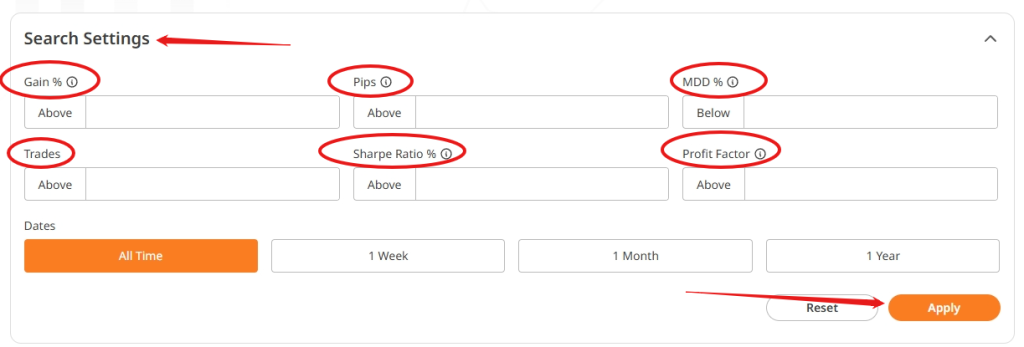
TradingCup’s architecture is designed to address the specific pain points identified in older systems. Its core features include:
- The Money Management Ranking (MMR) Algorithm: This is the heart of the platform. Unlike simplistic rankings that can be gamed by high profits alone, the MMR is a sophisticated, holistic algorithm. It evaluates traders based on a balanced set of metrics, including profitability, risk management, long-term stability, risk-adjusted returns, and maximum drawdown levels. The explicit goal is to filter out high-risk “gamblers” and promote traders who demonstrate consistent, responsible strategies, a crucial safeguard for beginners.
- Low-Latency Execution and Platform Integration: By integrating directly with ACY Securities’ infrastructure, TradingCup offers ultra-low-latency execution through ACY Pro Zero accounts, aiming to minimize the costly slippage and delays that frustrate users on other platforms. It supports both the industry-standard MetaTrader 4 (MT4) and the more advanced MetaTrader 5 (MT5), giving traders access to a wide range of instruments and powerful tools.
- Commitment to Transparency: The platform emphasizes clear and transparent leaderboards. Users have access to detailed performance statistics for every trader, including their full trading history, risk scores, and current drawdown, allowing for informed decision-making.
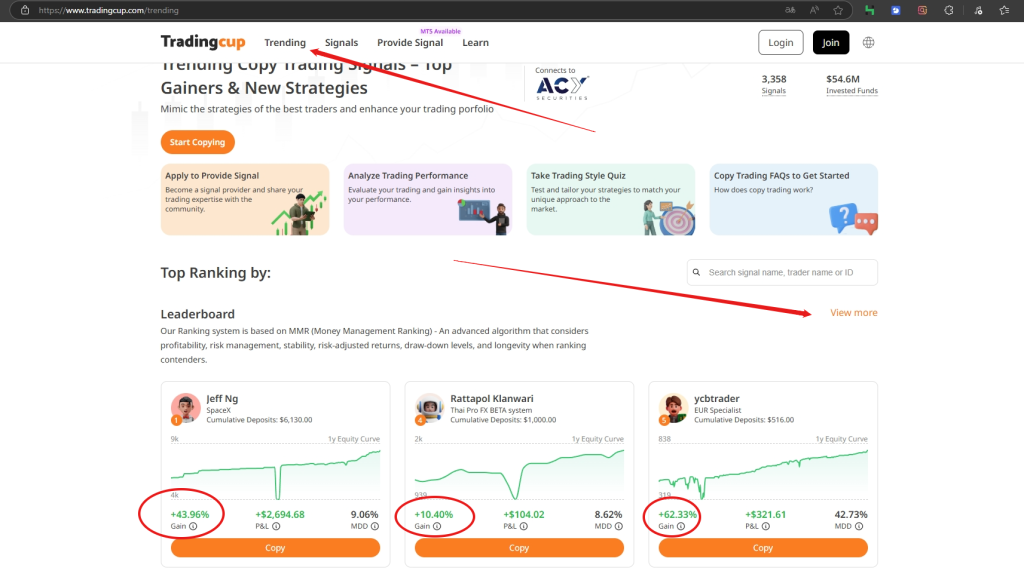
TradingCup’s approach is a direct response to the market’s need for a more transparent, secure, and merit-based copy trading environment.
The Ultimate Showdown: ZuluTrade vs. TradingCup Side-by-Side
For a beginner, the sheer volume of information can be overwhelming. To cut through the noise, a direct comparison of the factors that matter most, safety, cost, ease of finding talent, and support, is essential. The following decision matrix distills the key differences between the veteran network and the modern arena.
The Beginner’s Decision Matrix: ZuluTrade vs. TradingCup
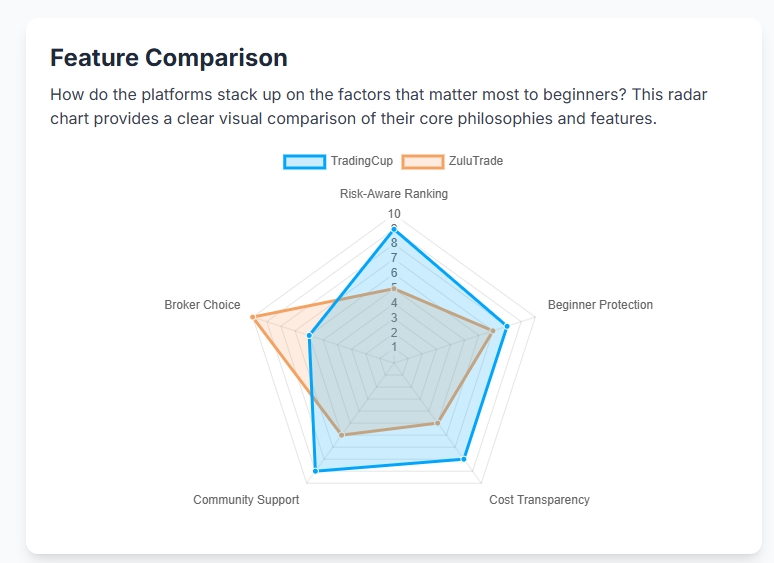
| Decision Factor for Beginners | ZuluTrade (The Veteran Network) | TradingCup (The Modern Arena) | Why This Matters to You |
| Core Philosophy | Open Social Network: Maximum choice of brokers and traders. | Curated Meritocracy: Performance-vetted traders from a competitive ecosystem. | Are you comfortable sifting through thousands for a gem, or do you prefer a pre-vetted list of champions? |
| How Traders are Ranked | Proprietary algorithm based on performance metrics. (Criticized for favoring high-risk styles ). | Money Manager Ranking (MMR): Holistic score including profitability, risk, drawdown, and stability. | MMR is designed to filter out “get rich quick” gamblers, giving you a safer starting pool of traders to choose from. |
| Key Risk Management Tool | ZuluGuard™: Automatically disconnects from traders who deviate from their strategy. | The MMR Itself: The ranking system is the primary risk filter, promoting low-drawdown traders from the start. Plus risk controls like the signal multiplier. | ZuluGuard is a reactive tool (stops the bleeding). MMR is a proactive tool (helps you avoid the risky trader in the first place). |
| Typical Costs & Fees | Spreads + Broker Commissions. Potential for higher spreads/slippage cited in user complaints. | Spreads (low-latency via ACY Pro Zero ) + Signal Provider Fees (Subscription/Performance ). | TradingCup’s direct integration with ACY aims to control costs like slippage, a common hidden “fee” for beginners. |
| Regulatory Oversight | Directly regulated by HCMC (EU), JIAA (JP), FSC (MU). | Platform itself is unlicensed; leverages the licenses of its parent, ACY Securities. | ZuluTrade has broader direct regulation. With TradingCup, your trust is placed in the well-established regulatory standing of ACY Securities. |
| Community Vibe & Support | Polarized: Ardent fans vs. vocal complaints about support and payments. | Embryonic but supportive: Free webinars, Telegram/Discord channels for direct help. | TradingCup offers a structured, hands-on support system crucial for beginners, moving beyond just a platform to a learning ecosystem. |
| Biggest Beginner Trap | Blindly copying a top-ranked trader who uses a high-risk martingale strategy and blowing your account. | Platform is new, so there’s less long-term, independent data. You are an early adopter of a promising system. | With ZuluTrade, the risk is hidden in the data. With TradingCup, the risk is the platform’s relative youth. |
Why Do Cost and Ease of Use Matter Most When You’re Starting Out?
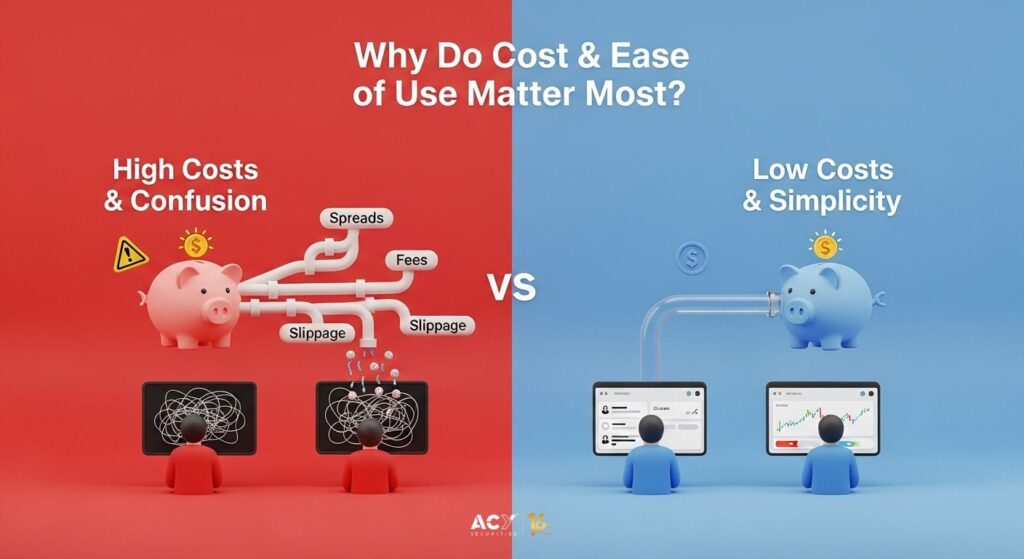
When embarking on an investment journey, financial capital is obviously important. However, for a beginner, psychological capital, the confidence, discipline, and emotional resilience to stick with a strategy, is arguably even more critical. High costs and a difficult-to-use platform can erode this psychological capital long before market movements do.
The True Cost of Trading
The costs associated with copy trading go beyond a simple subscription fee. A complete analysis includes :
- Spreads: The difference between the buy and sell price of an asset.
- Commissions: A fee charged by the broker per trade.
- Provider Fees: Subscription or performance-based fees paid to the Signal Provider.
- Slippage: The hidden cost incurred when a trade executes at a less favorable price than anticipated, often during volatile markets.
For a beginner, unpredictable or high costs create anxiety and doubt. Every pip lost to slippage or wide spreads feels like a personal failure, making it harder to trust the process. This is where platform architecture becomes critical. ZuluTrade’s broker-agnostic model offers choice, but it can also lead to inconsistent execution quality and costs, as evidenced by user complaints. TradingCup’s direct integration with ACY Securities’ low-latency infrastructure is specifically designed to control these variables, offering a more predictable and transparent cost structure.
The Value of a Seamless Experience
A clunky, confusing, or buggy interface is more than just an annoyance; it is a major source of friction that undermines a beginner’s confidence. When a new user has to fight with the platform to find information, execute a command, or understand a report, it creates stress and uncertainty. The goal for a novice should be to focus on learning from the experts they are copying, not battling the user interface. An intuitive, clean, and responsive platform, as TradingCup aims to provide, allows the technology to fade into the background, empowering the user to focus on what truly matters: making smart investment decisions.
Thinking Like a Market Wizard: How Would Michael Marcus View This Choice?

Michael Marcus, one of the legendary traders featured in Jack Schwager’s Market Wizards, turned an initial stake of $30,000 into $80 million. His success was not built on luck, but on a rigid, philosophical approach to trading. Applying his core principles to the choice between ZuluTrade and TradingCup offers a powerful framework for any serious investor.
Marcus’s trading philosophy rests on several key pillars :
- Follow a System with a Definable Edge: Marcus, mentored by the great Ed Seykota, learned to rely on predefined, mechanical rules for entering and exiting trades, minimizing the destructive influence of emotion.
- Practice Fanatical Risk Management: He was famous for his discipline, never risking more than 5% of his capital on a single idea. Capital preservation was always his primary concern.
- Align the Three Pillars: He believed the best trades occurred when fundamentals, technicals, and overall market tone were all in agreement.
- Diversify Intelligently: He spread his risk across various markets and strategies to ensure no single adverse event could cripple his portfolio.
When viewing the choice of a copy trading platform through this lens, a clear preference emerges. For a copy trader, the “trade” is not just on a currency pair; the primary investment is in the skill and discipline of the Signal Provider. The platform’s data and ranking algorithm, therefore, become the “technical and fundamental analysis” used to evaluate that provider.
Michael Marcus would not simply pick a platform; he would dissect its methodology. He would see the ranking algorithm as the core “system.” He would immediately be skeptical of a system like ZuluTrade’s, where user reports suggest it can be gamed by high-risk strategies. Such a system lacks a consistent, defensible “edge.” Conversely, he would be drawn to TradingCup’s Money Manager Ranking (MMR). The MMR’s focus on risk-adjusted returns, low drawdowns, and stability is a system designed to identify a true trading edge, not just a lucky streak. It aligns perfectly with his principle of rigorous, data-driven analysis. He would use the transparent risk metrics on TradingCup to ensure that his portfolio of copied traders adhered to his strict diversification and risk-limitation rules.
Ultimately, Marcus would conclude that vetting the platform is vetting the trade. A platform with a flawed or easily manipulated ranking system is equivalent to a bad chart setup, a signal to stay away. A platform with a robust, transparent, and risk-aware system like the MMR provides the solid foundation upon which a sound, diversified copy trading strategy can be built.
10 Lessons from Market Wizards to Guide Your First Copy Trade

Jack Schwager’s Market Wizards books are a masterclass in trading psychology and discipline. The timeless wisdom of the legendary traders interviewed within provides an essential roadmap for anyone starting their copy trading journey. Here are ten key lessons, adapted for the modern copy trader.
- “Cut Losses, Cut Losses, and Cut Losses”: This famous quote from Ed Seykota is the cornerstone of survival. In copy trading, this means you must not be afraid to stop copying a trader whose performance is faltering or whose strategy no longer aligns with your risk tolerance. Use the platform’s tools to set your own risk limits and be prepared to act on them.
- Find a Style That Fits Your Personality: The book shows there is no single “right” way to trade. Don’t just chase the highest returns on a leaderboard. Use the platform’s detailed stats to find a trader whose style, be it short-term scalping or long-term trend following, and risk profile genuinely resonate with your own comfort level.
- Good Trading Should Be Effortless (Because the Hard Work is in Preparation): The wizards stressed that the actual execution of a trade should be easy because the real work was done beforehand. For a copy trader, your “preparation” is the deep dive you perform on a Signal Provider’s statistics. Scrutinize their MMR score, their drawdown history, and their consistency before you ever click “copy.”
- Risk Management is Job #1: The wizards focused on protecting their capital first and foremost. Before you even think about potential profits, decide the maximum amount you are willing to lose on any single copied trader. This decision will dictate your allocation size.
- Don’t Get Cocky After a Win: Many wizards confessed their biggest losses came right after their biggest wins. A winning streak can breed overconfidence. Resist the urge to increase your risk allocation or abandon your rules just because you’ve had a few good weeks.
- Patience is a Profitable Virtue: The best traders wait patiently for the perfect setup. As a copy trader, you should not feel compelled to be copying someone at all times. It is better to do nothing than to copy a mediocre trader out of impatience.
- Be an Independent Thinker: Don’t blindly follow the crowd and copy the most popular trader on the platform. The “herd” is often wrong. The most-copied trader is not necessarily the best or the most suitable for your specific goals. Do your own analysis of the data provided.
- Have No Loyalty to a Position (or a Trader): The wizards were masters of flexibility, admitting when they were wrong and reversing their positions without ego. If the data shows that a trader you are copying is no longer performing or has changed their strategy for the worse, you must be disciplined enough to cut them loose.
- Losing is an Inevitable Part of the Game: Every single Market Wizard had losing trades and periods of drawdown. A good trader is not one who never loses, but one who manages their losses effectively. Pay close attention to a provider’s “maximum drawdown” statistic, it tells you how much they have lost from a peak in the past and is a good indicator of their risk control.
- Start Small to Pay for Your “Education”: Many of the greats blew up their first accounts. They advised starting with small amounts of money to minimize the cost of learning. This aligns perfectly with TradingCup’s own advice to begin with a modest balance to ensure your account aligns with the provider’s strategy.
Why TradingCup’s Ecosystem Offers a Smarter Start for Beginners
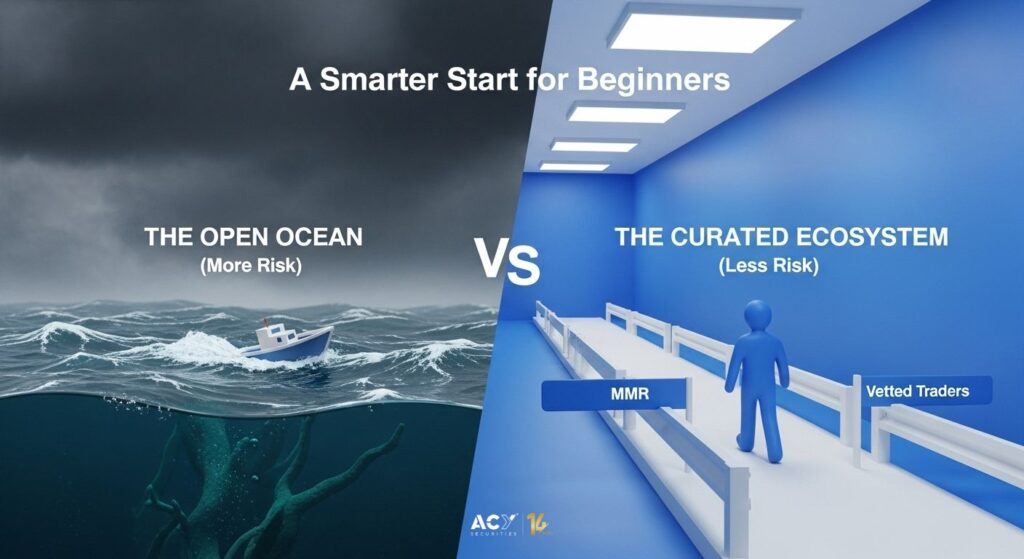
The choice between ZuluTrade and TradingCup is a choice between two fundamentally different philosophies. ZuluTrade offers a vast, open ocean of possibilities. For an experienced navigator with a sturdy vessel and advanced tools, this ocean is full of opportunity. However, for a beginner setting sail for the first time, this same ocean can be treacherous, filled with hidden reefs (high-risk traders), unpredictable currents (slippage and high costs), and conflicting signals (polarized community feedback). The burden of navigating these dangers falls almost entirely on the user.
TradingCup, in contrast, offers a curated, modern, and supportive ecosystem. It’s less of an open ocean and more of a state-of-the-art training facility with world-class coaches. By building its platform on a foundation of competitive, verifiable performance and filtering its talent through the risk-aware MMR algorithm, it drastically reduces the noise and lowers the probability of a catastrophic beginner mistake.
For a beginner, the smarter choice is not the one with the most options, but the one with the best-quality options and the strongest safety nets. TradingCup’s focus on transparency, risk-adjusted rankings, and a supportive community provides a structured environment where a novice can learn and grow with confidence. It is a platform designed not just for copying, but for cultivating smarter traders.
TradingCup’s Edge: Beyond the Platform, A Community of Support

A critical factor for any beginner is the availability of help and guidance. This is where TradingCup leverages its connection with ACY Securities to provide an edge that goes far beyond the platform’s code. It offers a comprehensive support system designed to educate and empower its users, transforming a solitary activity into a community-driven experience.
This ecosystem of support includes:
- Live Educational Webinars: ACY Securities hosts regular live webinars featuring their top market analysts. These sessions cover everything from weekly market outlooks and technical analysis of key currency pairs to deep dives on trading psychology and risk management. For a beginner, this free access to professional-grade education is an invaluable resource for building their own knowledge base while they copy others.
- Direct Communication via Telegram and Discord: Many Signal Providers on TradingCup maintain dedicated channels on platforms like Telegram and Discord for their copiers. This creates a direct line of communication, allowing followers to ask questions, understand the rationale behind a strategy, and discuss market conditions. This dialogue transforms passive copying into a collaborative venture, building trust and providing immense psychological support, especially during volatile periods.
This commitment to education and community support is a powerful differentiator. It signals that the platform’s goal is not just to facilitate transactions, but to foster the long-term success of its users. You can explore these free educational resources, like their upcoming webinars, to see the level of support for yourself.
How Does TradingCup Separate the Pros from the Pretenders?
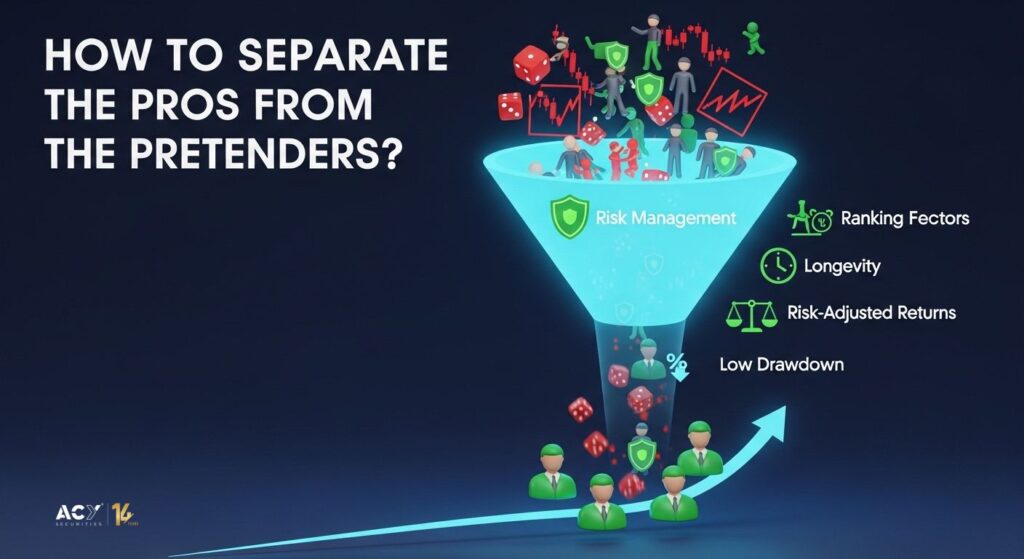
The integrity of any copy trading platform rests on its ability to accurately identify and rank skilled traders. TradingCup’s Money Manager Ranking (MMR) is the engine that drives this integrity. It is purposefully designed to look beyond superficial metrics and reward the qualities that define professional, sustainable trading.
The MMR algorithm is a multi-faceted system that holistically evaluates a trader’s performance by incorporating several key factors :
- Profitability: While important, this is just one piece of the puzzle.
- Risk Management: The system analyzes how well a trader controls their risk, rewarding those who use sensible position sizing and avoid excessive leverage.
- Long-Term Stability: The MMR favors traders who demonstrate consistent performance over time, filtering out those who have one lucky week but cannot sustain their results.
- Risk-Adjusted Returns: It measures the amount of return generated for each unit of risk taken. A trader who makes 10% with low volatility is ranked higher than one who makes 15% with extreme, high-risk swings.
- Drawdown Levels: This is a critical metric for beginners. The MMR heavily penalizes traders with large drawdowns (significant losses from a portfolio’s peak), as this is a classic sign of a high-risk or undisciplined approach.
By weighing these factors, the MMR ensures that the traders who rise to the top of the leaderboard are not just profitable, but are also skilled risk managers. Understanding how the best traders are ranked is the first step to becoming a smart copier.
Your First Move: The Easiest Copy Trading Strategy for Day One
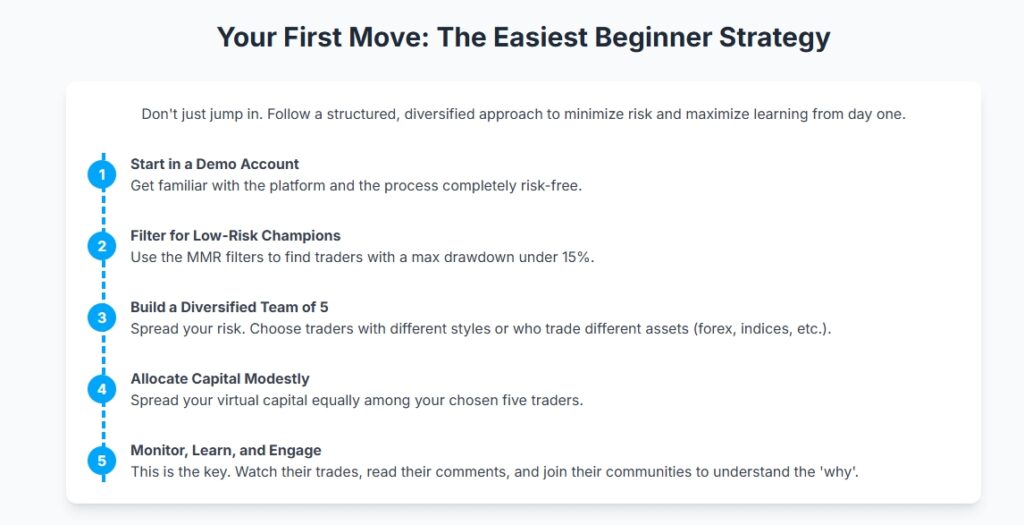
Jumping into the market can feel daunting. The key is to start with a simple, low-risk, and structured approach. Based on the principles of diversification championed by market legends and the features offered by modern platforms, here is an easy-to-follow strategy for your first day.
The strategy leverages the idea of diversifying across a small portfolio of traders, a concept supported by the ability to copy up to five signals simultaneously in TradingCup’s demo environment.
- Start in the Safety of a Demo Account: Before risking any real capital, open a demo account. This allows you to familiarize yourself with the platform, the process of copying, and the behavior of the traders you select, all in a risk-free environment.
- Filter by MMR for Low-Risk Champions: Use the TradingCup leaderboard and its powerful filters. Your primary goal is to find traders with a proven track record of capital preservation. Specifically, filter for traders with a maximum drawdown of less than 15%.
- Build a Diversified Team of 5: Select five different traders who meet your low-risk criteria. To enhance diversification, try to choose traders with slightly different styles. For example, you might select:
- Two who focus on major forex pairs (e.g., EUR/USD, GBP/USD).
- One who specializes in indices (e.g., S&P 500).
- One who trades commodities (e.g., Gold).
- One with a different time horizon (e.g., a short-term day trader vs. a longer-term swing trader).
- Two who focus on major forex pairs (e.g., EUR/USD, GBP/USD).
- Allocate Capital Modestly and Equally: In your demo account, allocate an equal, small portion of your virtual capital to each of the five traders. This spreads your risk evenly.
- Monitor, Learn, and Engage: This is the most important step. Don’t just “set and forget.” Watch the trades that are executed. Read the Signal Provider’s commentary. If they have a Telegram or Discord channel, join it and observe the discussion. Your goal is to understand why they are making the decisions they are making.
This structured approach minimizes risk, maximizes learning, and builds the disciplined habits necessary for long-term success.
Conclusion: Your Forex Journey Begins with a Smarter Decision

The path to successful investing is paved with smart decisions. For a beginner venturing into the world of forex copy trading, the most critical decision is the choice of the platform that will serve as their guide, their filter, and their safety net.
While the established presence of ZuluTrade offers a vast universe of choice, it comes with the significant burden of navigating a complex environment with documented risks better suited for a seasoned trader. The smarter path for a beginner is one that prioritizes safety, transparency, and support from the outset.
TradingCup, with its modern architecture, risk-aware ranking system, and integrated support community, provides precisely this environment. It is engineered to help new traders avoid the most common and devastating mistakes, allowing them to build their capital and their confidence in tandem. By choosing a platform that aligns with the principles of disciplined risk management and transparent performance, a new investor is not just choosing a piece of software; they are laying the foundation for a sustainable and successful forex journey.
Frequently Asked Questions (FAQs)
Is copy trading legit and can you make money?
Yes, copy trading is a legitimate investment method. However, it is not a risk-free or guaranteed way to make money. Profitability is entirely dependent on the performance of the traders you choose to copy, market conditions, and the fees and execution quality of the platform you use. Success requires careful selection of traders on a reliable platform and active risk management.
What is the best copy trading platform for beginners?
The best copy trading platforms for beginners are those that are transparent, easy to use, have low and predictable costs, and offer strong educational and community support. Platforms like TradingCup are specifically designed for this audience, featuring a risk-focused ranking system (MMR) and access to educational resources that help beginners make more informed decisions.
How much money do I need to start copy trading?
The minimum deposit varies significantly between platforms, with some allowing users to start with as little as $100. TradingCup advises new users to begin with the “Suggested Minimum Balance” recommended by the Signal Provider they choose to copy. This helps ensure the copier’s account has sufficient capital to properly replicate the provider’s strategy without issues.
Is ZuluTrade a good platform?
ZuluTrade is one of the oldest and largest copy trading platforms, offering an unparalleled selection of brokers and traders. This makes it a powerful tool for experienced investors. However, beginners should be aware of persistent user complaints regarding high-risk traders gaming the ranking system, as well as potential issues with spreads and trade execution speed.
What makes TradingCup’s MMR ranking different?
Unlike rankings that focus solely on raw profit, TradingCup’s Money Manager Ranking (MMR) is a holistic algorithm. It incorporates crucial risk-management metrics like maximum drawdown, long-term stability, and risk-adjusted returns. This design helps beginners avoid overly aggressive or “gambler” style traders, promoting a safer and more stable pool of talent to choose from.
Can I lose all my money copy trading?
Yes, it is possible to lose your entire investment. All trading involves substantial risk, especially when using leverage. Past performance of a trader is not a guarantee of future results. This is why it is critical to never invest more than you can afford to lose and to choose a platform that provides robust tools and transparent data to help you manage that risk effectively.
(Disclaimer: This article is for informational and educational purposes only. It should not be considered financial advice. Always conduct your own research and consult with a qualified financial advisor before making any investment decisions.)
For more detailed insights on developing daily trading routines, risk management, and effective position sizing strategies, explore additional articles on Trading Cup. Our trading experts at ACY and FinLogix are also great resources to guide your journey towards trading excellence.

Discover Our Best Trading Signals
At Tradingcup, you can browse through a selection of signals and review past performance before you decide to copy.
Become A Signal Provider
Share your expertise and become a signal provider so other traders can copy your trades.
Stay tuned to our blog for more trader spotlights and leaderboard updates.
Trading involves risks.
Visit the Tradingcup blog through the link below for more updates: https://www.tradingcup.com/learn
Related Copy Trading blogs:
- Understanding Market Liquidations: Liquidity Sweeps and Runs Explained
- 7 Essential Daily Habits of Successful Traders to Outperform Their Peers
- 10 Strategies You Can Copy off Our Best Copy Traders
- 5 Strategies Every Trader Can Master To Trade Better In A Trading Contest
- 2025 Copy Trading Scams Exposed: How to Spot Fraud
- A Swing Trading Strategy with an 83 Percent Win Rate and Low Drawdowns
- Forex Martingale Strategies Explained, The Good, The Bad and The Ugly
- Pyramiding Trading Tutorial – Pros & Cons & How to Use It