
Last Updated: May 21, 2025
This article is reviewed annually to reflect the latest market regulations and trends.

TL; DR
- Decade Performance (2015-2025): Bitcoin showed a significantly higher CAGR (~115%) than Gold (~6%), but with extreme volatility; Gold offered stability and consistent returns, especially during crises.
- Risk & Investor Profile: Gold (XAUUSD) suits conservative investors seeking capital preservation and an inflation hedge; Bitcoin attracts high-risk speculators with its growth potential but requires careful risk management due to volatility.
- Stress Testing & Reliability: Gold has proven resilient in economic downturns and geopolitical crises; Bitcoin’s reaction is more mixed, often correlating with risk assets during sharp sell-offs but showing recovery potential.
- Copy Trading for Risk Management: Copy trading can provide a structured approach to trading both XAUUSD and Bitcoin, potentially mitigating individual stress and aiding in risk management by leveraging experienced traders’ strategies.
- Strategic Outlook & Discipline: Future projections see significant upside for both (Gold potentially >$5,000, Bitcoin >$1M by 2030 ), but successful investing requires discipline, understanding market dynamics, and aligning choices with personal risk tolerance for smarter wealth protection.
Disclaimer: The information in this article is for educational purposes only and does not constitute financial, investment, or trading advice. Copy trading carries substantial risks, including the potential loss of your entire invested capital. Past performance of copied traders or strategies is not a reliable indicator of future results. You may be replicating high-risk trades, overleveraged positions, or strategies incompatible with your financial goals. Always conduct independent research into a trader’s historical performance, risk metrics, and strategy before copying them. Never invest funds you cannot afford to lose. Consult a licensed financial advisor to ensure copy trading aligns with your risk tolerance, financial objectives, and regulatory requirements in your jurisdiction. This article does not endorse specific traders, platforms, or strategies, and all trading decisions remain your sole responsibility.

“The four most expensive words in the English language are, ‘This time it’s different.’” – Sir John Templeton
Gold (XAUUSD) vs. Bitcoin (BTC): The 10-Year Showdown (2015-2025) – Which Asset Builds & Protects Your Wealth Better?
Two assets that consistently capture investor attention, albeit for different reasons, are Gold (XAUUSD) and Bitcoin (BTC). One is humanity’s oldest store of value, a tangible symbol of stability; the other, a digital pioneer, promising a decentralized future but characterized by breathtaking volatility. This comprehensive comparison, drawing on a decade of data from 2015 to May 2025, dissects their historical performance, risk profiles, investor suitability, and future potential. Crucially, we’ll explore how copy trading can be a strategic tool for navigating these markets and if insights from financial titans like Stanley Druckenmiller and the cautionary tales from “The Big Short” can guide us toward smarter investment decisions.
What Are We Truly Comparing? Defining Gold (XAUUSD) and Bitcoin
Before diving into the granular data, clarity on these assets is essential.
What is Gold (XAUUSD)? Is It Still the Ultimate Safe Haven?
- XAUUSD Explained: XAU is the internationally recognized currency code for one troy ounce of gold. USD represents the U.S. dollar. Therefore, XAUUSD signifies the exchange rate between gold and the U.S. dollar – essentially, the price of gold in U.S. dollars.
- Why Investors Choose Gold:
- Historical Store of Value: For millennia, gold has been a trusted means of preserving wealth.
- Safe Haven Asset: During times of economic uncertainty, geopolitical instability, or market turmoil, gold often sees increased demand, acting as a “safe haven”.
- Inflation Hedge: Gold has traditionally been considered a hedge against inflation, aiming to protect purchasing power when currencies devalue.
- Portfolio Diversification: Gold’s price movements often have a low or negative correlation with other financial assets like stocks and bonds, making it a valuable tool for diversification.
- Central Bank Demand: Central banks globally continue to hold and acquire gold as part of their reserves, signaling trust in its long-term value.
- Historical Store of Value: For millennia, gold has been a trusted means of preserving wealth.
- Trading Gold: Beyond physical bullion, gold can be accessed through Gold ETFs, futures contracts, options, Contracts for Difference (CFDs), and increasingly, through copy trading platforms where you can mirror the trades of seasoned gold traders. (Looking to trade XAUUSD? Explore options for how to trade XAUUSD and find the best gold traders to copy or learn about day trading gold XAUUSD and copy trading top gold traders.)
What is Bitcoin (BTC)? The “Digital Gold” Phenomenon?
- Bitcoin Explained: Bitcoin is a decentralized digital currency, introduced in 2009 by the pseudonymous Satoshi Nakamoto. It operates on a peer-to-peer network using blockchain technology – a transparent and immutable public ledger.
- Why Investors are Attracted to Bitcoin:
- High Growth Potential: Bitcoin has delivered extraordinary returns over its lifetime, attracting those seeking significant capital appreciation.
- Decentralization: It is not controlled by any single entity like a central bank or government, offering an alternative to traditional financial systems.
- Limited Supply: Bitcoin’s supply is capped at 21 million coins, a characteristic that proponents argue gives it scarcity value, similar to precious metals.
- Growing Adoption: Increasing institutional investment and broader mainstream acceptance are seen as key drivers for its future.
- Technological Innovation: Bitcoin represents a novel technology with potential applications beyond just a currency, including its role in the developing Web3 ecosystem.
- High Growth Potential: Bitcoin has delivered extraordinary returns over its lifetime, attracting those seeking significant capital appreciation.
- Trading Bitcoin: Bitcoin can be traded on numerous cryptocurrency exchanges, through brokers, Bitcoin ATMs, peer-to-peer platforms, and recently, through regulated products like Spot Bitcoin ETFs in the U.S.. Copy trading Bitcoin is also a popular option for those looking to follow experienced crypto traders.
A Decade in Review (2015-2025): XAUUSD vs. Bitcoin Performance Milestones

The period between 2015 and May 2025 has been transformative for both assets.
What Does the Historical Data Reveal for Gold and Bitcoin?
- XAUUSD (Gold): Throughout the decade, gold experienced steady appreciation, punctuated by significant rallies during periods of heightened risk. For instance, it reached new highs above $3,499 in April 2025, driven by geopolitical instability, inflationary risks, and demand from central banks. Technical analysis in May 2025 showed XAUUSD reversing a short-term downtrend after piercing key resistance, indicating buying pressure. Its minimum price around 2015 was approximately $1,000/oz.
- Bitcoin (BTC): Bitcoin’s journey was far more dramatic. The dataset highlights an all-time high of $68,789.63 recorded up to May 2025 in one dataset, while other sources indicate it surpassed $100,000 in 2025, driven by institutional adoption via spot ETFs and the post-2024 halving event. A surge past $93,000 occurred in November 2024, catalyzed by Federal Reserve interest rate cuts and favorable regulatory news. The PDF also references a maximum price in 2025 of $145,871.41, with a minimum around 2015 of approximately $200. As of May 2025, Bitcoin was cited as trading around $106,000-$107,955.88.
What Were the Key Performance Milestones and Price Events?
- XAUUSD Milestones:
- Consistent performer during global uncertainty (e.g., trade wars, Brexit).
- Strong rally post-COVID-19 pandemic outbreak.
- New nominal highs in 2025 above $3,499 (April 2025) and later trading around $3,310.03 in May 2025, with projections for a maximum of $3,720.38 in 2025.
- Sustained demand from central banks, with record purchases in Q1 2024 (290 tonnes).
- Consistent performer during global uncertainty (e.g., trade wars, Brexit).
- Bitcoin Milestones:
- Major bull runs in 2017, 2020-2021, and into 2024-2025.
- Approval and successful launch of Spot Bitcoin ETFs in the U.S., attracting significant inflows.
- Bitcoin halving events (e.g., 2020, 2024) historically correlating with price increases.
- Surpassing $100,000 in 2025, with projections for a maximum of $145,871.41 in 2025.
- Major bull runs in 2017, 2020-2021, and into 2024-2025.
How Do XAUUSD and Bitcoin Compare on Key Financial Metrics?
Investment decisions demand a look beyond headline price movements.
What Are Their Average Annualized Returns and CAGR (2015-2025)?
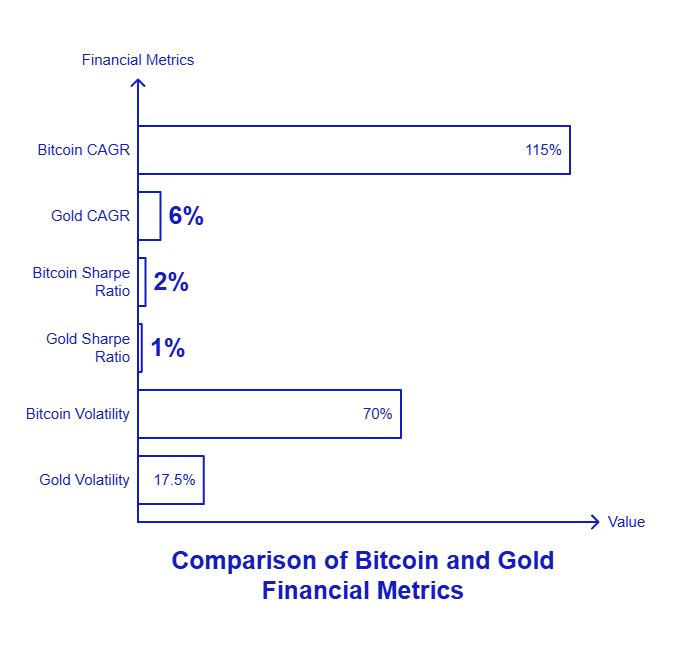
- Bitcoin (BTC): Exhibited an extraordinary Compound Annual Growth Rate (CAGR) of approximately 115% over 13 years (a period extending slightly beyond the 2015-2025 focus but indicative). The table in the PDF also lists an average annual return of ~115%.
- XAUUSD (Gold): Delivered more modest returns, with a CAGR and average annual return of around 6%.
Risk-Adjusted Returns: Is Bitcoin’s Higher Return Worth the Volatility?
- Sharpe Ratio: Despite its volatility, Bitcoin’s Sharpe ratio has consistently exceeded 2 across multi-year holding periods, suggesting superior risk-adjusted returns compared to gold (Sharpe ratio ~1 over 5 years) and equities during those specific periods.
- Volatility: Gold historically demonstrates lower price fluctuations compared to Bitcoin, which experiences significantly higher variance. Bitcoin’s annualized volatility averages 60-80%, while gold’s is around 15-20%.
- Maximum Drawdowns: Bitcoin has seen severe drawdowns (e.g., a 50% drop during the COVID-19 meltdown, and a 36.59% plummet during the March 2020 oil price war ). Gold’s drawdowns are typically less severe.
How Do XAUUSD and Bitcoin Perform Under Economic Stress?
An asset’s true mettle is often tested during economic downturns.
Stress Testing XAUUSD and Bitcoin: Resilience vs. Volatility?
- Economic Downturns/Recessions:
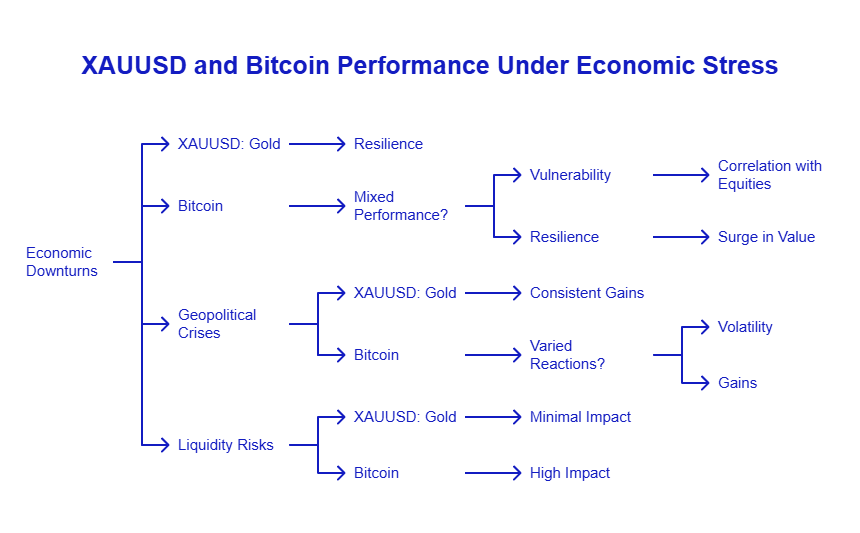
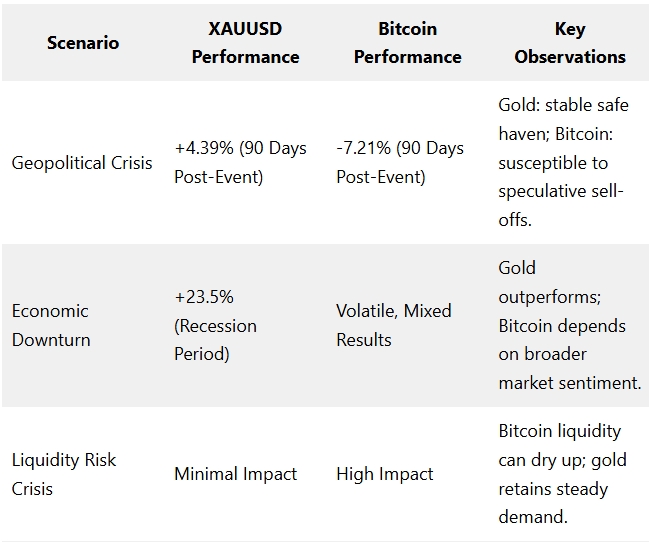
- XAUUSD: Gold historically outperforms during recessions, achieving average absolute returns of 23.5% in past downturns. During the 2008 financial crisis, gold prices increased significantly, showcasing its ability to preserve value. It is considered indispensable for wealth preservation during turbulent times.
- Bitcoin: Its performance is more mixed and can depend on broader market sentiment. It can be vulnerable in risk-averse environments due to its correlation with equities like tech stocks. However, it has also shown resilience; for example, it surged 60.15% within 90 days after the Hamas attack on Israel in October 2023.
- XAUUSD: Gold historically outperforms during recessions, achieving average absolute returns of 23.5% in past downturns. During the 2008 financial crisis, gold prices increased significantly, showcasing its ability to preserve value. It is considered indispensable for wealth preservation during turbulent times.
- Geopolitical Crises:
- XAUUSD: Gold consistently demonstrates resilience and serves as a stable safe-haven asset. A study of 38 major geopolitical events (2016-Jan 2025) found gold outperformed Bitcoin in 61.8% of medium-term evaluations (90 days). For example, after the assassination of Qasem Soleimani, gold showed consistent gains (+4.39% at 90 days).
- Bitcoin: Reactions are varied. While it gained after the 2022 Russia-Ukraine conflict initially, it experienced volatility (-7.21% at 90 days) after the Soleimani event. Post-geopolitical events, Bitcoin showed an average return of +10.94% over 90 days, higher than gold’s +1.64%, but with more risk.
- XAUUSD: Gold consistently demonstrates resilience and serves as a stable safe-haven asset. A study of 38 major geopolitical events (2016-Jan 2025) found gold outperformed Bitcoin in 61.8% of medium-term evaluations (90 days). For example, after the assassination of Qasem Soleimani, gold showed consistent gains (+4.39% at 90 days).
- Liquidity Risks:
- XAUUSD: Liquidity can contract during economic downturns, with potential for sharp intraday swings. However, it generally remains relatively liquid due to its established role. Minimal impact on liquidity during crises compared to Bitcoin.
- Bitcoin: Exhibits greater susceptibility to market sentiment. Its liquidity can dry up quickly under extreme volatility, posing a high impact risk during crises.
- XAUUSD: Liquidity can contract during economic downturns, with potential for sharp intraday swings. However, it generally remains relatively liquid due to its established role. Minimal impact on liquidity during crises compared to Bitcoin.
Matching XAUUSD and Bitcoin to Your Risk Appetite
Understanding your own risk tolerance is fundamental.
Are You a Conservative Investor or a High-Risk Speculator?
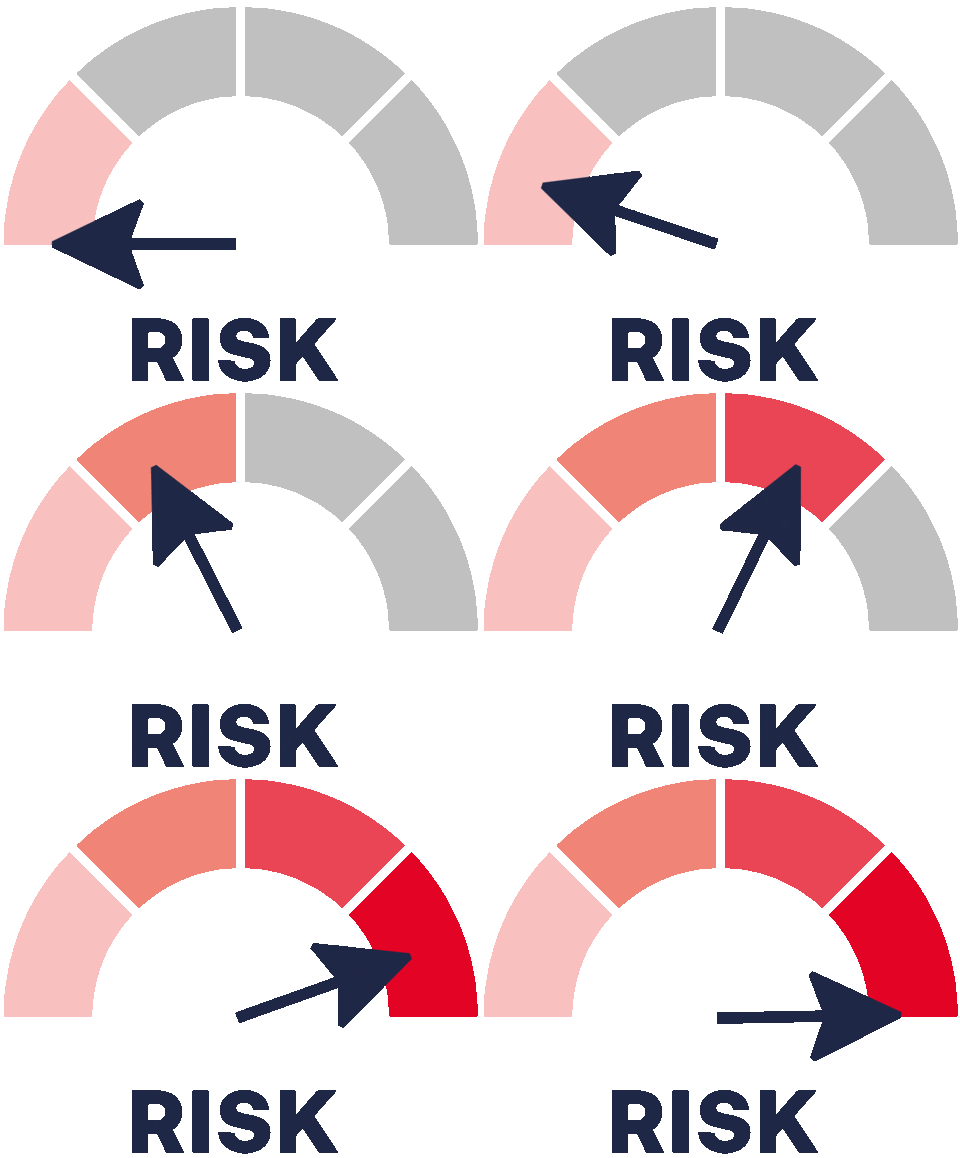
- Conservative Investors: Typically favor XAUUSD. They prioritize capital preservation and stability. Gold’s intrinsic value, historical resilience during crises, inflation-hedging properties, and low correlation with equities make it suitable. Older generations often prefer gold for wealth preservation.
- High-Risk Speculators: Often drawn to Bitcoin. They seek aggressive growth and are willing to embrace uncertainty and volatility. Bitcoin’s decentralization, finite supply, and potential for exponential growth appeal to this group, particularly younger, tech-savvy investors.
- The Balanced Approach: Many investors might opt for a diversified portfolio containing both, using gold for stability and a smaller Bitcoin allocation for growth potential.
Behavioral Patterns: Why Do We Choose Gold or Bitcoin?
- Psychological Biases in Bitcoin: Cryptocurrency investments are significantly influenced by fear of loss, herd mentality, envy, and speculative instincts. Cognitive errors like heuristic simplification can lead to incorrect analysis. Social media heavily influences sentiment.
- Emotional vs. Rational: Bitcoin markets see more emotional decision-making, driven by retail investor sentiment and short-term price movements. Gold purchases tend to be guided by more rational approaches focused on long-term wealth preservation and inflation hedging.
- Generational Divide: Younger investors show a clear affinity for Bitcoin, aligning with technological advancements and decentralization. Older generations often lean towards gold-backed securities for wealth preservation.
Lessons from Market Masters: Druckenmiller & “The Big Short” on Trading XAUUSD, Bitcoin, and Copy Trading
Can the wisdom of Wall Street legends inform our approach?
How Might Stanley Druckenmiller View Copy Trading, Gold, and Bitcoin?

Stanley Druckenmiller, renowned for his macro-economic acumen and flexible investment style, offers valuable perspectives:
- On Gold (XAUUSD): Druckenmiller has historically viewed gold as a key component of a portfolio, especially when concerned about currency debasement or inflationary pressures from central bank policies. He’d likely see its strategic value in the current environment.
- On Bitcoin (BTC): He has acknowledged Bitcoin’s potential, referring to it as “digital gold” and a store of value, especially for younger generations. He has owned Bitcoin, but his allocation would be dynamic, based on his macro outlook and its evolving narrative versus other assets like gold.
- On Copy Trading (Interpreted):
- Druckenmiller emphasizes deep, independent research. He would likely be wary of blindly copying any single trader without rigorous due diligence on their strategy, risk management, and long-term, verifiable track record.
- However, for individuals lacking the time or expertise for extensive market analysis, he might concede that copy trading a transparent and proven manager could be a more structured approach than making uninformed decisions. The emphasis would be on who is being copied and understanding why they are making their trades. He’d likely advocate for using it as a learning tool rather than a passive income button.
- Druckenmiller emphasizes deep, independent research. He would likely be wary of blindly copying any single trader without rigorous due diligence on their strategy, risk management, and long-term, verifiable track record.
What Are 10 “Big Short” Lessons for Today’s XAUUSD & Bitcoin Investor?
Michael Lewis’s “The Big Short” provides enduring lessons relevant to any speculative market:
- Question Everything: Don’t blindly accept prevailing narratives for gold or Bitcoin.
- Understand the Instrument: Complexity (like CDOs then, or certain DeFi protocols now) can obscure risk.
- Beware the Herd: FOMO can drive bubbles. We’ve seen this in both crypto and, at times, commodity rushes.
- Asymmetric Opportunities: Look for bets where the potential upside far outweighs the downside (though these are rare and hard to identify).
- Due Diligence is King: The ‘Big Short’ investors dug deep. Do the same for assets or any copy trading service.
- Experts Aren’t Infallible: Ratings agencies failed. “Gurus” can be wrong or biased.
- Conviction & Patience Pay: Holding contrarian views or long-term positions requires resolve through volatility.
- Risk Management is Paramount: Even with a winning thesis, poor risk management can be fatal.
- Transparency (or Lack Thereof) Matters: Opaque markets hide dangers. Blockchain offers transparency, but market manipulation can still exist.
- Understand Incentives: Know how brokers, exchanges, influencers, and even copy trade providers are compensated.
A Day in the Life: The Reality of Trading Bitcoin vs. Copy Trading
What’s the practical experience like?
What’s It Like Trading Bitcoin? Beyond the Hype, What’s a Trader’s Day?

- 24/7/365 Market: Bitcoin never closes. This means constant monitoring, potential for overnight gapping, and global news impacting prices at any hour.
- Information Barrage: Traders sift through technical charts, on-chain data, crypto news sites, social media (Twitter, Reddit, Telegram), and macroeconomic releases.
- Extreme Volatility: Rapid price swings are the norm. This demands robust risk management – stop-losses, position sizing, and emotional control.
- Security Focus: Protecting private keys, choosing secure exchanges, and vigilance against scams are critical.
- Psychological Fortitude: Dealing with FOMO during rallies and FUD (Fear, Uncertainty, Doubt) during crashes is a significant mental challenge. The “regret factor” of missing a pump or selling too early/late is high.
How Does a Day in the Life of a Copy Trader Differ?

- Initial Due Diligence (The Heavy Lifting): The primary work is upfront – researching and selecting traders or strategies to copy. This involves analyzing historical performance (returns, drawdown, risk score), understanding their trading style, reading reviews, and assessing the transparency of the platform.
- Setting Parameters: Allocating capital, setting risk limits per trader (e.g., copy stop-loss levels), and deciding whether to copy open trades or only new ones.
- Monitoring (Less Intensive): Regularly reviewing the performance of copied traders, but not necessarily making minute-by-minute decisions. Adjustments are made based on longer-term performance or changes in the trader’s strategy.
- Diversification Management: Often copy trading involves diversifying across multiple traders with different styles or asset focuses (e.g., some on XAUUSD, some on BTC, some on traditional forex).
- Reduced Direct Stress: While market movements still impact the investment, the stress of individual trade execution and constant analysis is outsourced to the chosen trader. However, the risk of the chosen trader underperforming is still present.
Navigating Key Trading Considerations for XAUUSD and Bitcoin

Practical aspects to weigh for smarter investing.
Volatility Comparison: How Wild is the Ride?
As established, Bitcoin’s volatility (average 60-80% annually ) significantly eclipses that of gold (average 15-20% annually ). This means Bitcoin can offer quicker, larger gains but also inflict faster, deeper losses. Gold offers a more stable, predictable path.
What’s the Effect on Your Stress as an Investor? (The Regret Factor)
- Bitcoin: High regret factor. The “what if I’d bought more?” during parabolic runs or “what if I hadn’t sold?” after a recovery can be intense. The fear of catastrophic loss during crashes is also significant.
- XAUUSD: Lower regret factor. Price movements are typically more measured. While one might regret not allocating more during a steady climb, the fear of sudden, massive drawdowns is less pronounced.
- Copy Trading: Can mitigate some stress by deferring decisions, but choosing the wrong trader can lead to a different kind of regret. The key is trust in the selection process.
Potential Gains and Losses Over Time Horizons: Investing $1000
Based on data and projections for 2025:
- Investing $1000 in XAUUSD:
- Potential Value at Minimum Price (2025): ~$752
- Potential Value at Maximum Price (2025): ~$1,134
- Probability of Loss (>10%): Low (<5%). Gold’s stable nature reduces the likelihood of significant losses.
- Potential Value at Minimum Price (2025): ~$752
- Investing $1000 in Bitcoin:
- Potential Value at Minimum Price (2025): ~$909
- Potential Value at Maximum Price (2025): ~$1,459
- Probability of Loss (>10%): Moderate (15-20%). Bitcoin’s volatility increases risk but also offers higher upside potential.
- Potential Value at Minimum Price (2025): ~$909
Over longer horizons (e.g., 5 years), assuming historical CAGR of ~115% for Bitcoin, a $1000 investment could theoretically see exponential growth, but this is highly speculative and not guaranteed. Gold, with a ~6% CAGR, would see more modest but steadier growth.
Counterarguments: Is Bitcoin Purely Speculative? Is Gold Outdated?
- Bitcoin: Speculative Nature vs. Evolving Asset: Critics argue Bitcoin is largely a speculative asset, sensitive to macro risk-on/risk-off sentiment, much like tech stocks. However, growing institutional adoption, its use as an inflation hedge by some, and technological advancements (Layer-2 solutions) suggest it’s maturing.
- Gold: Proven Reliability vs. Lower Returns: Gold’s centuries-long history as a store of value and its performance during recessions (average absolute return of 23.5% ) underscore its reliability. While its returns are lower than Bitcoin’s peak phases, its role in capital preservation is well-established.
What About Probabilistic Forecasts and Optimal Entry Points?
- XAUUSD: Better suited for conservative portfolios seeking steady appreciation. A $1000 investment offers a high probability (>80%) of modest, consistent returns over five years. Optimal entry points might be dips below key support levels (e.g., $3,200-$3,250 as per May 2025 data).
- Bitcoin: Appeals to aggressive investors comfortable with volatility for potentially outsized rewards. Probability of exponential gains over five years might exceed 50%, but significant drawdowns are equally likely. Entry during pullbacks to established support zones (e.g., $80,000-$85,000 as per May 2025 data) could be considered.
Granular Data & Profit Potential (Insights from May 2025)
Let’s look at some specific comparative figures based on the provided analysis.
How Does Their Profit Potential Compare Directly?
Based on data around May 2025:
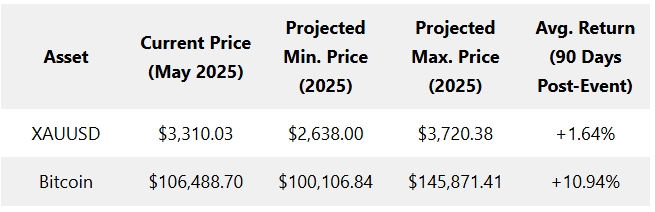
Bitcoin exhibits higher volatility and greater short-to-medium term profit potential (+10.94% avg. 90-day post-event return vs. gold’s +1.64%) but with elevated risks.
Stress Calculations: A Quick Recap
The Long Game: Discipline, Risk Management, and Future Projections
Successful investing is rarely a sprint.
Why is Discipline More Crucial Than “One Big Win” in Forex, Gold, and Even Bitcoin?
Unlike the lottery-like wins in some memecoins (which often end in tears for most), sustained success in established markets like Forex (and by extension, XAUUSD which is traded similarly) and even in the maturing Bitcoin market requires discipline. One successful trade won’t make you rich. Consistent application of a sound strategy, risk management, continuous learning, and emotional control are vital. Bitcoin, despite its growth, is still prone to severe bear markets that can wipe out undisciplined traders. Trading, in general, is not a one-time event that guarantees success; even Bitcoin took years to achieve its peak valuations.
How Can Copy Trading Help with Risk Management in Volatile Markets?
Copy trading can be a tool for risk management if used wisely:
- Access to Experience: Leverages the expertise of traders who have navigated various market conditions.
- Pre-defined Risk Settings: Many platforms allow copiers to set their own risk limits (e.g., stop-loss on the entire copy amount).
- Diversification: Ability to copy multiple traders with different strategies, potentially smoothing out returns.
- Reduced Emotional Trading: Helps avoid impulsive decisions driven by fear or greed. However, the risk always remains that the copied trader themselves may underperform or make errors. Due diligence is paramount.
What Are the Future Price Projections (Post-2025) and Strategic Implications?
- XAUUSD: Forecasts suggest gold could exceed $5,000 per ounce by 2030. Factors include central bank acceptance of higher inflation targets (3-4%) eroding real yields, and its role as a hedge against systemic risks.
- Bitcoin: Projections are ambitious, with some predicting $1 million within the same timeframe (by 2030). ARK Invest estimates a range between $300,000 and $1.5 million by 2030 depending on adoption scenarios. Drivers include finite supply, institutional adoption, technological advancements like Layer-2 solutions maturing by 2030, and potential for quantum-resistant cryptography.
- Strategic Implications: Both assets appear to have robust long-term outlooks, supported by structural shifts in global finance. Investors need to balance short-term volatility with long-term potential, considering diversification and adaptive strategies.
Conclusion: Crafting Your Strategy for XAUUSD vs. Bitcoin
The 2015-2025 decade clearly illustrates the divergent paths of XAUUSD and Bitcoin. Bitcoin offered phenomenal growth alongside heart-stopping volatility, while gold provided stability and resilience, especially during crises.
Choosing between them or deciding on an allocation to both hinges on your individual risk tolerance, financial goals, and investment timeline. Conservative investors will likely continue to favor gold’s proven reliability. Growth-seeking, risk-tolerant investors may be drawn to Bitcoin’s potential, acknowledging its speculative nature.
Copy trading can offer a pathway to engage with these assets, potentially simplifying strategy execution and risk management, but it demands careful selection of traders. Ultimately, smarter wealth protection isn’t about finding the “perfect” asset, but about understanding the characteristics of each, recognizing behavioral pitfalls, and building a diversified, disciplined approach tailored to your unique circumstances.
FAQs
Q1: Over the last 10 years (2015-2025), which was more profitable, Gold (XAUUSD) or Bitcoin?
A: Bitcoin demonstrated a significantly higher average annual return (around 115%) compared to Gold (around 6%) between 2015 and 2025. However, this came with substantially higher volatility and risk for Bitcoin.
Q2: How does Gold (XAUUSD) perform during economic recessions compared to Bitcoin?
A: Gold has historically performed well during recessions, with average absolute returns of 23.5% in past downturns, acting as a safe-haven asset. Bitcoin’s performance during recessions is more varied and can be influenced by broader market sentiment, sometimes correlating with risk assets.
Q3: Is Bitcoin a good investment for conservative investors?
A: No, Bitcoin is generally not considered suitable for conservative investors due to its high volatility and risk of significant drawdowns. Conservative investors typically prefer more stable assets like Gold (XAUUSD) which prioritize capital preservation.
Q4: What are the future price predictions for Gold and Bitcoin by 2030?
A: Some expert forecasts suggest Gold (XAUUSD) could exceed $5,000 per ounce by 2030. For Bitcoin, projections are even more ambitious, with some analysts predicting it could reach $1 million within the same timeframe, and ARK Invest estimating a range between $300,000 and $1.5 million. These are speculative and depend on various factors.
Q5: Can copy trading help manage risks when investing in volatile assets like Bitcoin?
A: Copy trading can potentially help manage risk by allowing you to follow experienced traders’ strategies and by offering tools to set risk parameters. However, it doesn’t eliminate risk, as the chosen trader can also incur losses. Thorough due diligence on traders is crucial.
Q6: What did the analysis say about investing $1000 in Gold vs. Bitcoin in 2025?
A: According to the PDF’s projections for 2025, a $1000 investment in Gold had a low probability (<5%) of >10% loss, with potential values between roughly $752 and $1,134. For Bitcoin, a $1000 investment had a moderate (15-20%) probability of >10% loss, with potential values between roughly $909 and $1,459, offering higher upside but greater risk.
Q7: How do psychological biases affect Bitcoin investors more than Gold investors?
A: Bitcoin investors are often more susceptible to psychological biases like herd mentality, fear of loss, and speculative instincts, fueled by social media and rapid price movements. Gold investment decisions tend to be more rational, focusing on long-term wealth preservation and inflation hedging.
For more detailed insights on developing daily trading routines, risk management, and effective position sizing strategies, explore additional articles on Trading Cup. Our trading experts at ACY and FinLogix are also great resources to guide your journey towards trading excellence.

Discover Our Best Trading Signals
At Tradingcup, you can browse through a selection of signals and review past performance before you decide to copy.
Become A Signal Provider
Share your expertise and become a signal provider so other traders can copy your trades.
Stay tuned to our blog for more trader spotlights and leaderboard updates.
Trading involves risks.
Visit the Tradingcup blog through the link below for more updates: https://www.tradingcup.com/learn
Related Copy Trading blogs:
- Understanding Market Liquidations: Liquidity Sweeps and Runs Explained
- 7 Essential Daily Habits of Successful Traders to Outperform Their Peers
- 10 Strategies You Can Copy off Our Best Copy Traders
- 5 Strategies Every Trader Can Master To Trade Better In A Trading Contest
- 2025 Copy Trading Scams Exposed: How to Spot Fraud
- A Swing Trading Strategy with an 83 Percent Win Rate and Low Drawdowns
- Forex Martingale Strategies Explained, The Good, The Bad and The Ugly
- Pyramiding Trading Tutorial – Pros & Cons & How to Use It