Last Updated: May 19, 2025
This article is reviewed annually to reflect the latest market regulations and trends.
TL;DR: Key Takeaways for Understanding ROI in Copy Trading
- Beyond Basic ROI: True understanding of copy trading ROI involves analyzing risk-adjusted returns, not just profit percentages. Key metrics include Sharpe Ratio, Calmar Ratio, Maximum Drawdown, and Win Rate.
- Trader Evaluation is Crucial: Don’t just chase high ROI figures. Evaluate traders based on long-term consistency, risk management strategies, transparency, and performance across various market conditions.
- Psychology Matters: Emotional discipline is as important as strategy. Understanding trading psychology, like principles from Brett Steenbarger’s work, helps avoid common pitfalls such as fear and greed.
- Vetting Platforms Enhance Safety: Reputable copy trading platforms provide essential vetting, transparent data, and risk management tools, aiding in informed decision-making and education.
- Continuous Adaptation is Key: Financial markets are dynamic. Regularly review and adjust your copied traders and strategies to align with evolving market conditions and personal risk tolerance.
Disclaimer: The information in this article is for educational purposes only and does not constitute financial, investment, or trading advice. Copy trading carries substantial risks, including the potential loss of your entire invested capital. Past performance of copied traders or strategies is not a reliable indicator of future results. You may be replicating high-risk trades, overleveraged positions, or strategies incompatible with your financial goals. Always conduct independent research into a trader’s historical performance, risk metrics, and strategy before copying them. Never invest funds you cannot afford to lose. Consult a licensed financial advisor to ensure copy trading aligns with your risk tolerance, financial objectives, and regulatory requirements in your jurisdiction. This article does not endorse specific traders, platforms, or strategies, and all trading decisions remain your sole responsibility.
“The stock market is a device to transfer money from the impatient to the patient.” – Warren Buffett.
Introduction: Decoding ROI in the Evolving World of Copy Trading

Copy trading has democratized access to financial markets, offering an appealing avenue for both novice and experienced individuals to potentially profit from the expertise of seasoned traders. However, the allure of quick returns can often overshadow a critical component: a genuine Understanding of ROI in Copy Trading. What does that percentage truly signify? Is a high ROI the only beacon to follow, or are there deeper currents to navigate for smarter protection of your money?
This comprehensive article, updated for today’s dynamic markets, aims to be your expert guide. We’ll dissect ROI, explore its relationship with established stock investment metrics, and delve into the multifaceted approach required for sustainable success. From leveraging vetting platforms to understanding the intricate psychology of trading, we’re here to equip you with the knowledge to make informed decisions and optimize your copy trading journey.
The True Meaning of ROI in Copy Trading – Beyond the Surface
Return on Investment (ROI) in copy trading, at its most basic, measures the profitability of copying a particular trader relative to the capital invested. While a high ROI is attractive, it rarely tells the whole story. A truly informed investor looks deeper.
Key Performance Metrics to Scrutinize:
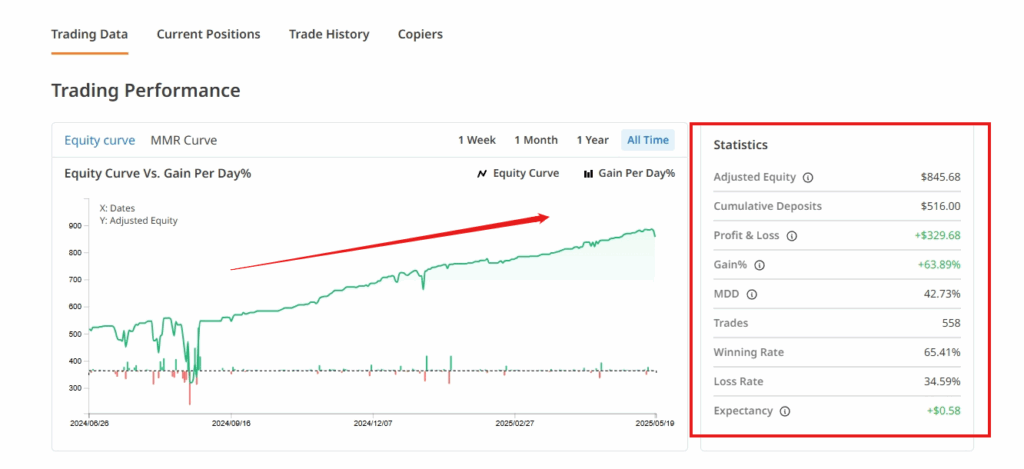
Evaluating signal providers requires a comprehensive look at several metrics. These metrics, often available on reputable copy trading platforms, paint a much clearer picture than standalone ROI:
- Gain %: The percentage increase in account balance over a specific period. While important, it must be viewed in conjunction with risk. A trader with a +30% gain but massive drawdowns might be a riskier bet than one with a steady +15% and minimal drawdowns.
- Pips (For Forex): Measures price movement in Forex trading, useful for assessing Forex-specific strategies.
- Maximum Drawdown (MDD): This is a critical risk indicator. It represents the largest peak-to-trough decline in portfolio value before a new peak is achieved. A high MDD (e.g., over 20-30%) indicates significant potential losses, even if past ROI was high. TradingCup, for example, penalizes maximum drawdowns exceeding 20%.
- Sharpe Ratio: Measures risk-adjusted return. It calculates the average return earned in excess of the risk-free rate per unit of volatility or total risk. A Sharpe Ratio above 1.0 is generally considered good, indicating that returns are compensating for the risk taken.
- Calmar Ratio: Evaluates return relative to the maximum drawdown. A higher Calmar Ratio (e.g., above 3.0) is preferred as it suggests better returns for the risk endured, especially during downturns.
- Profit Factor: Gross Profit divided by Gross Loss. A value above 1.75 can suggest sustainable profitability. This is akin to profitability ratios in fundamental stock analysis.
- Win Rate vs. Loss Rate: The percentage of winning trades versus losing trades. While a high win rate is appealing, it’s crucial to also consider the average size of wins versus losses (Risk/Reward Ratio).
- Expectancy: Represents the average amount you can expect to win (or lose) per trade. It’s calculated as (Average Win x Win Rate) – (Average Loss x Loss Rate). A positive expectancy is crucial for long-term profitability.
Focusing solely on ROI without considering these risk metrics is like admiring a car’s top speed without checking its brakes.
Market Sentiment and Social Media Chatter:

A quick scan of Reddit discussions and trading blogs often reveals a common pitfall: beginners chasing sky-high, short-term ROI figures without scrutinizing the underlying strategy or risk. Forum users frequently share stories of being lured by impressive recent returns, only to experience substantial losses when market conditions shift or the copied trader’s high-risk strategy falters. This highlights the importance of due diligence beyond advertised ROI. Experienced voices in these communities often emphasize the value of consistency, drawdown management, and understanding the trader’s methodology.
The David Tepper Angle – A Billionaire Investor’s Perspective (Hypothetical)
While David Tepper, the renowned hedge fund manager, hasn’t publicly detailed his views on copy trading specifically, we can extrapolate his general investment philosophy to this domain. Tepper is known for his expertise in distressed debt investing, a field that demands rigorous analysis, risk assessment, and an eye for undervalued assets.
How Might David Tepper Approach ROI in Copy Trading?
- Deep Due Diligence: Tepper wouldn’t just glance at an ROI figure. He’d likely delve into a trader’s history, strategy, risk management protocols (like their Maximum Drawdown), and how they perform under stress (market volatility). He’d want to understand the why behind the numbers.
- Focus on Risk-Adjusted Returns: His career is built on managing risk effectively. He’d likely prioritize traders who demonstrate consistent, positive risk-adjusted returns (e.g., a good Sharpe Ratio) over those with volatile, high-ROI-but-high-drawdown profiles.
- Understanding the ‘Edge’: Tepper seeks an edge in his investments. In copy trading, this would translate to understanding a signal provider’s unique strategy and why it’s likely to be profitable over the long term. Is it a niche market expertise? A sophisticated algorithm?
- Patience and Contrarian Thinking: Tepper has made bold moves during market turmoil. While copy trading often involves following trends, a Tepper-like approach might involve identifying skilled traders who might be temporarily out of favor but whose long-term metrics and strategy remain sound – essentially finding “value” in the trader pool. He’s quoted saying, “The key is to wait. Sometimes the hardest thing to do is to do nothing.” This patience would apply to selecting and sticking with well-vetted traders.
- Not Afraid to Cut Losses (or Switch Traders): While patient, Tepper is also pragmatic. If a trader’s performance consistently deteriorates, or if the underlying market conditions fundamentally change their strategy’s viability, he wouldn’t hesitate to re-evaluate and make a change.
Applying a Tepper-like mindset to copy trading means being analytical, risk-aware, patient yet decisive, and always looking beyond superficial numbers.
Section 3: Lessons from “The Psychology of Trading” by Brett Steenbarger
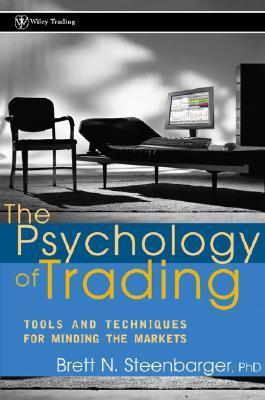
Dr. Brett Steenbarger’s work, particularly “The Psychology of Trading” and “The Daily Trading Coach,” offers invaluable insights directly applicable to copy trading, even though you are not executing the trades yourself. Your psychological state significantly impacts your decisions in selecting, monitoring, and sticking with (or abandoning) copied traders.
10 Key Lessons for Copy Traders:
- Behavior is Patterned: Recognize your own patterns in selecting traders. Are you drawn to overly aggressive strategies after a period of low returns? Do you panic and switch traders too frequently? Identifying these patterns is the first step to change
- Emotions as Market Data (for yourself): Your emotional reactions to a copied trader’s performance (e.g., anxiety during a drawdown, euphoria during a winning streak) are data points. Use them to understand your risk tolerance and adjust your selections or allocations accordingly
- The Importance of a Psychological Journal: Keep notes on why you chose a trader, your expectations, and your emotional responses during their trading. This helps in identifying biases and improving decision-making over time
- Combatting Performance Anxiety (even as a copier): Worrying excessively about a copied trader’s every move can lead to impulsive decisions. Trust your vetting process and focus on long-term performance rather than short-term fluctuations
- Building Emotional Resilience: Trading (and by extension, copy trading) involves ups and downs. Cultivate resilience to withstand drawdowns without deviating from your overall strategy
- The Pitfall of “Trying Too Hard” (Over-Optimization): Constantly switching traders or tweaking settings at the slightest dip can be counterproductive. Sometimes, patience and allowing a strategy to play out is key
- Recognizing Your Patterns: Understand your decision-making habits. Do you tend to follow the crowd or make independent, well-researched choices?
- Setting Effective Goals: What are your realistic goals for copy trading? Vague goals like “make a lot of money” are less effective than specific, measurable, achievable, relevant, and time-bound (SMART) goals
- Building on Your Best (Solution Focus): When you find a trader or strategy that works well for your risk profile, understand why. Replicate successful selection processes, not just returns
- Understanding Stress and Distress: Copy trading can be stressful, especially during losing periods. Recognize the sources of your stress and develop coping mechanisms to avoid emotional decision-making
By integrating these psychological insights, copy traders can build a more disciplined, patient, and ultimately successful approach.
Understanding Search Filters & Trader Rankings:
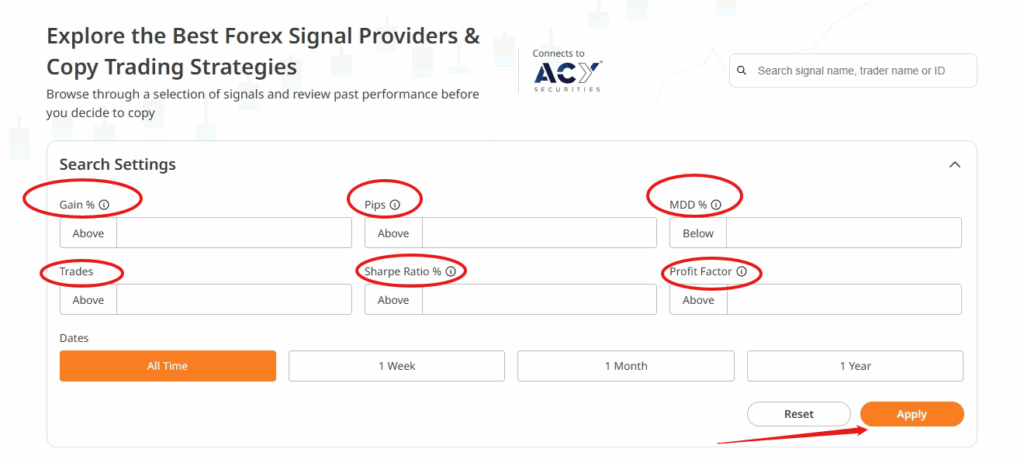
A platform like TradingCup likely allows users to filter and rank traders based on a variety of these crucial metrics:
- Performance Over Time: Not just the last month’s ROI, but performance over 6 months, 1 year, or even longer to show consistency
- Risk Score/MDD Limits: Allowing users to filter out traders whose Maximum Drawdown exceeds their personal comfort level (e.g., filtering for traders with MDD < 20%).
- Sharpe/Calmar Ratios: Highlighting traders who deliver better risk-adjusted returns.
- Number of Copiers & Assets Under Management: Can indicate a degree of trust and success, though not a sole determinant.
- Trading Frequency & Style: Matching a trader’s style (e.g., scalping, swing trading, long-term) with your own preferences.
- Markets Traded: Focusing on traders who operate in markets you understand or wish to gain exposure to.
TradingCup’s MMR system is designed to prioritize capital preservation while generating stable returns, penalizing excessive drawdowns and rewarding resilience. This aligns with a prudent investment approach.
Why Copy Trading is Akin to Picking Stocks
Choosing a trader to copy shares many similarities with the rigorous process of selecting individual stocks for an investment portfolio:
- Fundamental Analysis (of the Trader):
- Stock: You’d analyze a company’s financials, management, competitive advantages, and industry trends.
- Trader: You analyze their track record (like company performance history), trading strategy (business model), risk management (company’s financial health/debt), and consistency across market conditions (industry cycles). You’re looking at their Gain%, MDD, Sharpe Ratio, etc., much like P/E ratios or debt-to-equity ratios for stocks.
- Stock: You’d analyze a company’s financials, management, competitive advantages, and industry trends.
- Technical Analysis (of Trader’s Performance Charts):
- Stock: You might look at price charts, volume, and indicators to predict future movements.
- Trader: You examine their equity curve. Is it a smooth upward trend, or volatile with sharp peaks and valleys? A choppy equity curve, even with high overall ROI, can indicate a risky strategy.
- Stock: You might look at price charts, volume, and indicators to predict future movements.
- Risk Assessment:
- Stock: You assess the company’s specific risks, market risks, and your own risk tolerance.
- Trader: You assess the trader’s Maximum Drawdown, the volatility of their returns, and whether their risk profile aligns with yours.
- Stock: You assess the company’s specific risks, market risks, and your own risk tolerance.
- Diversification:
- Stock: You typically don’t put all your money into one stock.
- Trader: Similarly, it’s often advised to diversify by copying multiple traders with different strategies or across different asset classes to mitigate risk. (Though some platforms like the one mentioned by TradingCup might suggest sticking to one trusted trader at a time initially
- Stock: You typically don’t put all your money into one stock.
- Long-Term vs. Short-Term Outlook:
- Stock: Are you investing for long-term growth or short-term gains?
- Trader: Are you looking for a trader with a strategy that’s proven sustainable over years, or are you tempted by someone with recent, explosive (but potentially unsustainable) returns?
- Stock: Are you investing for long-term growth or short-term gains?
- Management Quality (Trader’s Discipline & Skill):
- Stock: The quality of a company’s management is crucial.
- Trader: The trader’s discipline, adherence to their strategy, and ability to manage risk and emotions are paramount.
- Stock: The quality of a company’s management is crucial.
Just as you wouldn’t invest in a stock based solely on a hot tip or one quarter’s earnings, you shouldn’t choose a copy trader based solely on a high advertised ROI. A deeper, more analytical approach is required for both.
The “Best Forex Signal Provider” – Myth or Reality?

The search for the single “best” Forex signal provider is often a futile one. The article rightly points out that this notion overlooks the dynamic nature of financial markets and varying trader needs. What works for one person’s risk appetite and capital might not work for another. Furthermore, a strategy that excels in one market condition (e.g., low volatility) may falter in another (e.g., high volatility).
Why a Single “Best” is Elusive:
- Market Dynamics: Forex markets are influenced by countless factors – economic data, geopolitical events, central bank policies. No single strategy is foolproof across all scenarios.
- Varying Risk Appetites: A provider employing aggressive, high-reward strategies might appeal to some, while others prefer conservative, capital-preservation approaches.
- Different Trading Styles: Some providers might specialize in short-term scalping, others in long-term trend following. “Best” depends on what aligns with your objectives.
- Temporary Win Streaks vs. Long-Term Consistency: Many novice traders are lured by providers with recent spectacular gains, mistaking short-term luck for sustainable skill. True quality lies in consistent performance over extended periods and varying market cycles.
What to Look For Instead:
Instead of searching for a mythical “best,” focus on finding providers who are:
- Transparent: Clear about their strategy, risk management, and provide verified track records.
- Consistent: Demonstrate steady performance over time, not just isolated bursts of high profit. Their equity curve should ideally be a gradual upward slope.
- Risk-Aware: Employ sound risk management techniques (e.g., reasonable stop-losses, appropriate position sizing, manageable drawdowns).
- Adaptable (or Specialised and You Diversify): Either the trader shows an ability to adapt, or you diversify across traders who specialize in different conditions/assets.
- A Good Fit for YOU: Their strategy, risk level, and communication should align with your individual needs and comfort zone.
Platforms like TradingCup aim to help by providing comprehensive data and rankings (like their MMR) to allow for more informed choices based on a variety of factors, not just raw ROI.
Evaluating Top Traders – A Multi-Dimensional Approach
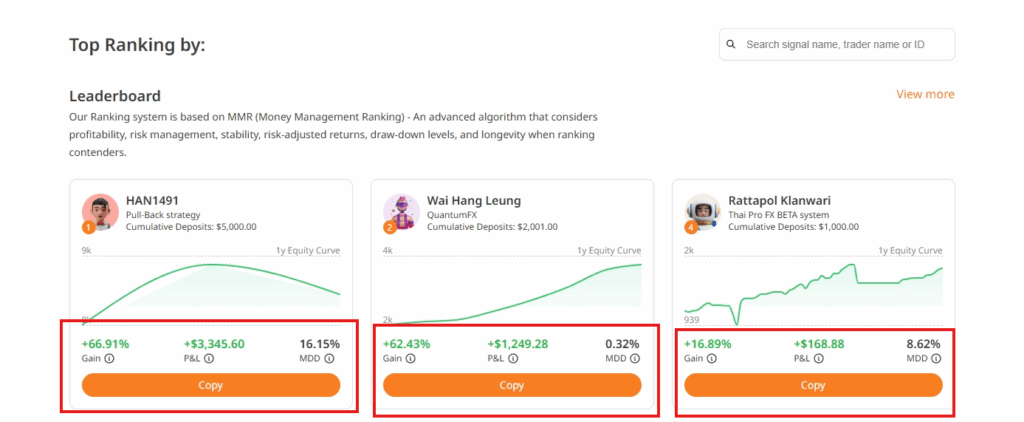
Building on the previous section, how do you effectively evaluate traders who appear at the top of leaderboards? TradingCup’s philosophy suggest, it’s about looking beyond the headline ROI figure.
Key Evaluation Criteria (as per TradingCup’s approach and best practices):
- Long-Term Verified Performance:
- TradingCup Mention: Prioritize reviewing long-term performance, not just recent gains.
- Details: Look for at least 12-24 months of trading history. This helps filter out those who got lucky in the short term.
- TradingCup Mention: Prioritize reviewing long-term performance, not just recent gains.
- Risk Management Metrics (The Core of TradingCup’s MMR):
- Maximum Drawdown (MDD): This is crucial. A trader consistently keeping MDD below 20-25% is generally managing risk well.
- Sharpe Ratio & Calmar Ratio: These show if the returns justify the risk taken. Higher is generally better.
- Average Win vs. Average Loss (Risk/Reward Ratio): A trader might have a 50% win rate, but if their average win is 2R and average loss is 1R, they are profitable.
- Maximum Drawdown (MDD): This is crucial. A trader consistently keeping MDD below 20-25% is generally managing risk well.
- Consistency of Returns:
- Look at month-by-month returns. Are they steady, or are there wild swings with huge winning months followed by devastating losing ones? Smooth equity curves are preferable.
- Look at month-by-month returns. Are they steady, or are there wild swings with huge winning months followed by devastating losing ones? Smooth equity curves are preferable.
- Trading Strategy & Transparency:
- Does the trader explain their methodology? Understanding their approach helps you gauge if it’s sustainable and if you’re comfortable with it. Is it based on technical analysis, fundamentals, algorithms?
- Does the trader explain their methodology? Understanding their approach helps you gauge if it’s sustainable and if you’re comfortable with it. Is it based on technical analysis, fundamentals, algorithms?
- Number of Trades & Trading Frequency:
- A very high number of trades (over-trading) can rack up commission costs and may indicate a less thoughtful approach. Too few trades might mean missed opportunities or a strategy that is too passive for your liking.
- A very high number of trades (over-trading) can rack up commission costs and may indicate a less thoughtful approach. Too few trades might mean missed opportunities or a strategy that is too passive for your liking.
- Copier Base & Reviews (with caution):
- A large number of copiers can be a positive sign, but don’t rely on this alone (herd mentality). Look for genuine reviews if available, but be aware of fake testimonials.
- A large number of copiers can be a positive sign, but don’t rely on this alone (herd mentality). Look for genuine reviews if available, but be aware of fake testimonials.
- Alignment with Your Goals:
- Does their typical return, risk level, and trading style align with your financial objectives and risk tolerance?
- Does their typical return, risk level, and trading style align with your financial objectives and risk tolerance?
TradingCup’s MMR system, by incorporating many of these factors, aims to rank traders based on their ability to deliver sustainable outcomes and preserve capital. This is a far more robust way to evaluate than simply sorting by “highest ROI this month.”
When to Switch Traders – The Art of Timely Reassessment
Sticking with a chosen trader through minor drawdowns is important for long-term success, but blindly holding on when red flags appear is detrimental. Knowing when to switch requires a balance of patience and vigilance.
Indicators It Might Be Time to Switch:
- Significant Deviation from Historical Performance:
- Increased Maximum Drawdown: If a trader who historically maintained a 15% MDD suddenly experiences a 30-40% drawdown without a clear market-wide cataclysm, it’s a major concern.
- Consistently Lower Returns: A few bad months can happen. But if performance consistently lags well below their historical average or benchmarks for an extended period (e.g., 3-6 months), investigation is needed.
- Change in Win Rate/Risk-Reward: A sudden, sustained drop in win rate or a worsening risk-reward profile.
- Increased Maximum Drawdown: If a trader who historically maintained a 15% MDD suddenly experiences a 30-40% drawdown without a clear market-wide cataclysm, it’s a major concern.
- Change in Trading Strategy or Behavior:
- If the trader abandons their stated strategy or starts taking on uncharacteristically large risks (“revenge trading,” over-leveraging).
- A sudden significant increase or decrease in trading frequency without explanation.
- Breach of Your Personal Risk Limits:
- Even if the trader hasn’t “failed” by their own standards, if their current drawdown or risk profile now exceeds what you are comfortable with, it’s valid to switch.
- Even if the trader hasn’t “failed” by their own standards, if their current drawdown or risk profile now exceeds what you are comfortable with, it’s valid to switch.
- Loss of Confidence:
- If you no longer trust the trader’s judgment or ability to navigate the markets, the psychological stress might make it better to move on, even if objective metrics are borderline.
- If you no longer trust the trader’s judgment or ability to navigate the markets, the psychological stress might make it better to move on, even if objective metrics are borderline.
- Better Alternatives Emerge:
- As you continue to learn and research, you might find other traders whose strategies, risk profiles, and performance better align with your evolving goals. Dynamic provider selection is key.
- As you continue to learn and research, you might find other traders whose strategies, risk profiles, and performance better align with your evolving goals. Dynamic provider selection is key.
- Changes in Market Regime:
- A strategy that excelled in a trending market might suffer in a ranging market. If the trader doesn’t adapt or if you believe the market regime has fundamentally shifted against their strategy, a switch might be prudent. Nick Battista, highlights that market volatility and shifting trends can impact even successful traders.
- A strategy that excelled in a trending market might suffer in a ranging market. If the trader doesn’t adapt or if you believe the market regime has fundamentally shifted against their strategy, a switch might be prudent. Nick Battista, highlights that market volatility and shifting trends can impact even successful traders.
The Process of Switching:
- Don’t Act Impulsively: Avoid rage-quitting after one bad trade or day. Base your decision on a pattern of underperformance or clear red flags.
- Review Your Criteria: Revisit why you chose the trader initially and assess against those benchmarks.
- Have Alternatives Researched: Ideally, you should continuously (passively) monitor other potential traders so you have vetted options ready.
- Consider Phased Approach: You might reduce allocation to the underperforming trader rather than cutting them off completely, while increasing allocation to a new one.
Comprehensive Analysis of ROI in Copy Trading and Its Relation to Stock Investment Metrics
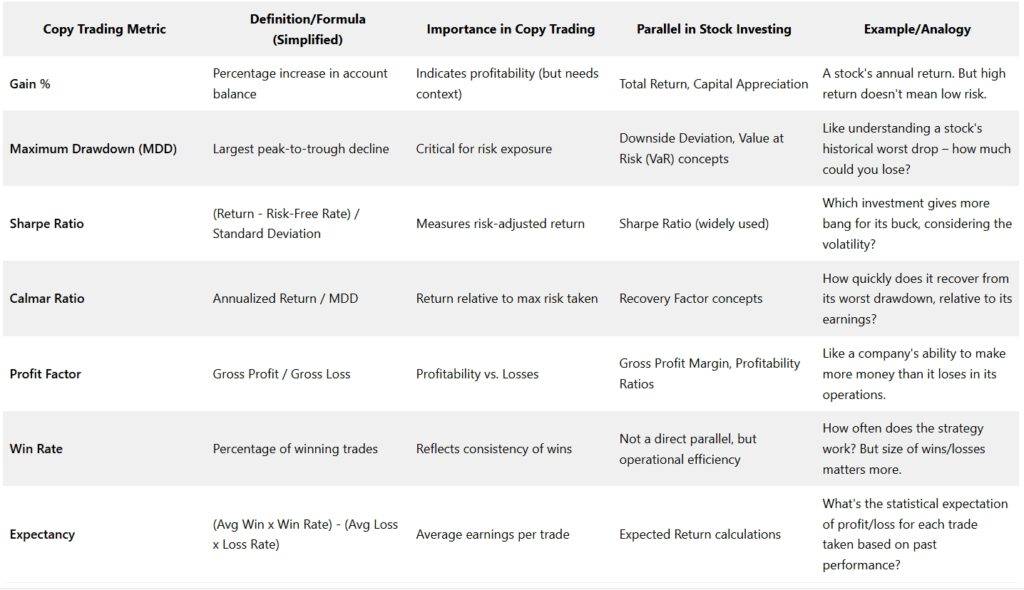
Why This Matters:
- Familiar Framework: For stock investors, these parallels make copy trading analysis less alien.
- Risk Emphasis: Just as you wouldn’t solely use Price-to-Earnings (P/E) to pick a stock, you shouldn’t use only Gain % for a trader. Risk metrics (MDD, Sharpe) are like the balance sheet and cash flow statement – revealing underlying health and stability.
- Holistic View: Combining these metrics gives a more complete picture, similar to how fundamental analysts use a suite of ratios to evaluate a stock. TradingCup’s MMR system does this by design.
Ultimately, whether evaluating a stock or a copy trader, the goal is the smarter protection of money through informed, analytical decisions, not just chasing the highest advertised number.
Conclusion: Investing Smarter in the Copy Trading Arena
Understanding ROI in copy trading is a journey that extends far beyond a single percentage point. It demands a holistic approach that integrates meticulous analysis of risk-adjusted returns, a keen eye for evaluating trader psychology and discipline, and the agility to adapt to ever-shifting market landscapes. The principles of sound investment, due diligence, risk management, continuous learning, and emotional fortitude, are just as critical here as they are in traditional stock picking.
By leveraging the analytical tools and transparent data provided by reputable vetting platforms, and by cultivating an understanding of both the numbers and the human element of trading, you can navigate the world of copy trading with greater confidence and work towards smarter protection and growth of your capital. Remember, the goal is not just to find traders with high ROI, but to find traders whose strategies and risk management align with your own path to sustainable financial success.
Frequently Asked Questions (FAQs) About ROI in Copy Trading
Q1: What is a good ROI in copy trading?
A “good” ROI is subjective and depends on risk tolerance, investment duration, and market conditions. More importantly, focus on risk-adjusted ROI. An annual ROI of 15-30% with a Maximum Drawdown below 20% might be considered good by many, but this varies. Consistency is more valuable than a single high ROI figure.
Q2: Can I lose money even if I copy a trader with high ROI?
Yes, absolutely. Past performance is not indicative of future results. A trader with a high historical ROI might have achieved it through high-risk strategies that could lead to significant losses. Market conditions can change, or the trader might make poor decisions. This is why understanding metrics like Maximum Drawdown is crucial.
Q3: How much money do I need to start copy trading?
This varies by platform and the trader you choose to copy. Some platforms have very low minimums. However, it’s essential to only invest what you can afford to lose, especially when starting. The PDF suggests diversifying investments and capping exposure per trader (e.g., limiting portfolio exposure to 5% per trader).
Q4: How are traders ranked on copy trading platforms?
Platforms use various ranking methodologies. Some may heavily weigh recent ROI. However, more sophisticated platforms, like the system described for TradingCup, use a Money Management Ranking (MMR) that considers multiple factors including Gain %, Maximum Drawdown, Sharpe Ratio, Calmar Ratio, and Profit Factor to provide a more holistic view of a trader’s risk management and consistency.
Q5: Can I trade myself while also copy trading?
Generally, yes, but often in separate accounts. Some platforms may restrict manual trading in the specific account designated for copying a strategy to avoid conflicts or interference with the copied trades.
Q6: What happens if a strategy provider I am copying stops their service?
If a provider stops, your copied open positions will typically be closed. The platform should have procedures for this. It underscores the need for ongoing monitoring and having alternative traders in mind.
Q7: Are stop-loss and take-profit levels from the strategy provider copied to my account?
This can vary by platform. Some platforms may copy these protective orders, while others might only copy the entry and exit signals, meaning your actual fill prices and the execution of SL/TP could differ slightly. It’s crucial to understand how your specific platform handles this. The cTrader FAQ, for example, states protections are not copied, but the closing signal is.
For more detailed insights on developing daily trading routines, risk management, and effective position sizing strategies, explore additional articles on Trading Cup. Our trading experts at ACY and FinLogix are also great resources to guide your journey towards trading excellence.

Discover Our Best Trading Signals
At Tradingcup, you can browse through a selection of signals and review past performance before you decide to copy.
Become A Signal Provider
Share your expertise and become a signal provider so other traders can copy your trades.
Stay tuned to our blog for more trader spotlights and leaderboard updates.
Trading involves risks.
Visit the Tradingcup blog through the link below for more updates: https://www.tradingcup.com/learn
Related Copy Trading blogs:
- Understanding Market Liquidations: Liquidity Sweeps and Runs Explained
- 7 Essential Daily Habits of Successful Traders to Outperform Their Peers
- 10 Strategies You Can Copy off Our Best Copy Traders
- 5 Strategies Every Trader Can Master To Trade Better In A Trading Contest
- 2025 Copy Trading Scams Exposed: How to Spot Fraud
- A Swing Trading Strategy with an 83 Percent Win Rate and Low Drawdowns
- Forex Martingale Strategies Explained, The Good, The Bad and The Ugly
- Pyramiding Trading Tutorial – Pros & Cons & How to Use It