Last Updated: May 19, 2025
This article is reviewed annually to reflect the latest market regulations and trends.
TL;DR: Key Insights for Aspiring Traders
- Understand the Core Difference: Copy trading mirrors expert human traders, while algorithmic trading uses pre-set computer programs for execution.
- Accessibility vs. Expertise: Copy trading is beginner-friendly with a lower learning curve; algorithmic trading demands significant technical skill and programming knowledge.
- Risk Landscape Varies: Copy trading risks include over-reliance on others and potential for blind replication of poor strategies; algorithmic trading faces system failures, coding errors, and market volatility impacts.
- Cost Considerations: Copy trading often involves subscription, performance, or volume fees. Algorithmic trading can have high initial development and infrastructure costs, but potentially lower per-trade costs later.
- Protect Your Capital: Both methods require robust risk management; success hinges on due diligence, continuous learning, and aligning your strategy with your financial goals and risk tolerance.
Disclaimer: The information in this article is for educational purposes only and does not constitute financial, investment, or trading advice. Copy trading carries substantial risks, including the potential loss of your entire invested capital. Past performance of copied traders or strategies is not a reliable indicator of future results. You may be replicating high-risk trades, overleveraged positions, or strategies incompatible with your financial goals. Always conduct independent research into a trader’s historical performance, risk metrics, and strategy before copying them. Never invest funds you cannot afford to lose. Consult a licensed financial advisor to ensure copy trading aligns with your risk tolerance, financial objectives, and regulatory requirements in your jurisdiction. This article does not endorse specific traders, platforms, or strategies, and all trading decisions remain your sole responsibility.

“The individual investor should act consistently as an investor and not as a speculator.” – Benjamin Graham
Copy Trading vs. Algorithmic Trading: Your Ultimate Beginner’s Guide to Smarter Investing

Navigating the world of financial trading can feel like charting a course through a complex galaxy, especially for beginners. Two bright stars that have captured the attention of many are copy trading and algorithmic trading. Both promise to revolutionize how we approach the markets, but they orbit different principles and demand different things from you, the trader. Are you looking to leverage the wisdom of crowds, or do you prefer the cold, hard logic of machines? More importantly, how can you engage with these methods to ensure smarter protection of your hard-earned money?
This guide will dissect copy trading and algorithmic trading, illuminating their paths from historical emergence to their current impact on a trader’s daily life. We’ll explore their benefits, untangle their limitations, confront their risks, and compare their costs and potential profitability. By the end, you’ll have a clearer map to help you decide which, if either, aligns with your journey towards smarter investing.
Copy Trading vs. Algorithmic Trading
At their core, both copy trading and algorithmic trading aim to optimize trading outcomes, but their operational mechanics and target audiences differ significantly.
What is Copy Trading?
Imagine being able to peek over the shoulder of a seasoned trading professional and replicate their trades in real-time, without needing decades of market experience yourself. That’s the essence of copy trading. It’s a portfolio management strategy where traders can automatically copy the positions opened and managed by another selected trader. Platforms like TradingCup, eToro, ZuluTrade, and those offered by brokers like Zerodha and Dhan facilitate this by allowing users to link a portion of their funds to a chosen expert. When the expert makes a trade, the same trade is executed in the copier’s account proportionally.
This approach democratizes access to financial markets, making sophisticated strategies seemingly available to even inexperienced traders. Think of it as having a trading mentor whose actions you can directly mirror. But is it always wise to follow without question?
What is Algorithmic Trading?
Algorithmic trading, often called “algo trading” or “black-box trading,” takes human emotion out of the equation. It relies on computer programs to execute trades based on a predefined set of rules and instructions. These rules can be based on various factors like timing, price, volume, or complex mathematical models. Once programmed, these systems can operate autonomously, identifying trading opportunities and executing orders at speeds and frequencies impossible for a human trader.
From simple order routing systems to complex high-frequency trading (HFT) strategies and AI-driven predictive models, algorithmic trading spans a wide spectrum of technological sophistication. It’s the realm of quantitative analysts (“quants”), programmers, and institutions, though increasingly accessible to retail traders with the right tools and knowledge. Could this be your path to disciplined, emotionless trading?
Copy Trading vs Algo Trading: History and Recent Developments

Understanding where these trading methods come from can shed light on their current forms and future trajectories.
The History and Recent Developments of Copy Trading
Copy trading is a relatively newer phenomenon, emerging primarily in the early 2010s with the rise of social trading platforms. Its development was fueled by:
- Technological Advancements: The integration of APIs into brokerage systems allowed for seamless real-time replication of trades.
- Demand for Passive Solutions: Many retail investors sought ways to participate in markets without dedicating extensive time to research and analysis.
- Social Connectivity: Platforms began incorporating social media-like features, allowing traders to interact, share insights, and build communities.
Recent Developments (2024-2025):
- Increased Accessibility and Transparency: Platforms are striving for greater transparency in showcasing trader performance, risk profiles, and fee structures.
- Enhanced Risk Management Tools: More sophisticated tools are being offered to copiers, allowing for better control over fund allocation and risk per trade.
- Regulatory Scrutiny: As its popularity grows, regulatory bodies like ASIC are paying closer attention, aiming to implement measures for consumer protection and address risks associated with imitative practices, particularly concerning “finfluencers”.
- Focus on Education: Platforms are increasingly offering educational resources to help users make more informed decisions rather than blindly copying.
- Diversification of Strategies: Popular copied strategies include trend following, long-term value investing (especially in stocks), and even “HODLing” in the crypto space.
The History and Recent Developments of Algorithmic Trading
Algorithmic trading has a much longer lineage, with its roots traceable to the computerization of financial markets:
- Early Days: The concept began with NASDAQ’s introduction in 1971 as the first electronic stock market. Initially, it was used by institutional investors for efficiently executing large orders.
- The Rise of HFT: The late 1990s and early 2000s saw breakthroughs in computational power and data analytics, leading to the emergence of High-Frequency Trading (HFT), which revolutionized market liquidity and price discovery.
- Technological Sophistication: The use of machine learning, AI, and big data by firms like Renaissance Technologies marked a new era of complex algorithmic strategies.
Recent Developments (2024-2025):
- AI and Machine Learning Integration: AI is no longer just a buzzword. Advanced machine learning models are being used for more sophisticated pattern recognition, predictive analytics, and even real-time strategy adaptation. Tools like Octa’s OctaVision aim to provide personalized AI-driven trade analysis.
- Quantum Computing Exploration: While still in its nascent stages, the potential of quantum computing to solve complex optimization problems and enhance predictive modeling is a significant area of research and could offer unparalleled computational capabilities.
- Cloud-Based Solutions: There’s a strong shift towards cloud-based deployment for algorithmic trading systems, offering scalability, cost-effectiveness, and real-time data processing capabilities.
- Retail Algo Trading Growth: Algorithmic trading tools and platforms are becoming more accessible to retail traders, not just institutional giants. This includes user-friendly apps and API access provided by brokers.
- Continued Market Growth: The algorithmic trading market is projected for significant growth, driven by the demand for efficiency, speed, and data-driven decision-making.
Global Footprints: Adoption Rates and Regional Whys

The uptake of copy and algorithmic trading varies across the globe, influenced by regulatory environments, technological infrastructure, and investor demographics.
Copy Trading Adoption:
- Europe and the UK: These regions have shown significant interest in copy trading, with high search traffic noted. A developed retail investment culture and regulatory frameworks that (while evolving) have allowed for its growth contribute to this.
- Asia-Pacific: While specific copy trading adoption rates are harder to pinpoint, the general rise of retail investing and mobile trading in countries like India, Vietnam, and parts of Southeast Asia suggests a fertile ground. Factors include a young, tech-savvy population, increasing mobile internet penetration, and a search for alternative investment vehicles.
- Challenges: Regulatory uncertainty in some jurisdictions and the need for investor education remain key factors influencing broader adoption.
Algorithmic Trading Adoption:
- North America (USA Dominant): This region is the heavyweight champion, accounting for the largest share of the global algorithmic trading market (around 40-41%). The US boasts sophisticated financial markets, advanced technological infrastructure, and a regulatory environment that, while stringent, supports automated trading. Algorithmic trading reportedly accounts for 60-73% of all US stock trading.
- Asia-Pacific (Rapid Growth): Countries like China and India are witnessing rapid adoption driven by technological advancements, increased institutional investment, and a growing pool of tech talent. However, retail participation in algorithmic trading in India, for instance, is still catching up to institutional levels seen in more mature markets.
- Europe: Standardized regulations under MiFID II have helped ensure transparency and accountability, fostering a stable environment for algorithmic trading.
- Key Drivers: The global adoption of algorithmic trading is pushed by the demand for efficient order execution, lower transaction costs, and the ability to deploy complex strategies across multiple markets. Cloud deployment is a major enabler, holding a significant global market share.
Why the differences? Regulatory clarity, market maturity, technological readiness, and the prevalence of retail versus institutional investors all play crucial roles.
Copy Trading vs Algorithmic Trading: Benefits and Limitations
No trading method is a silver bullet. Let’s break down the pros and cons.
Copy Trading: Benefits and Limitations
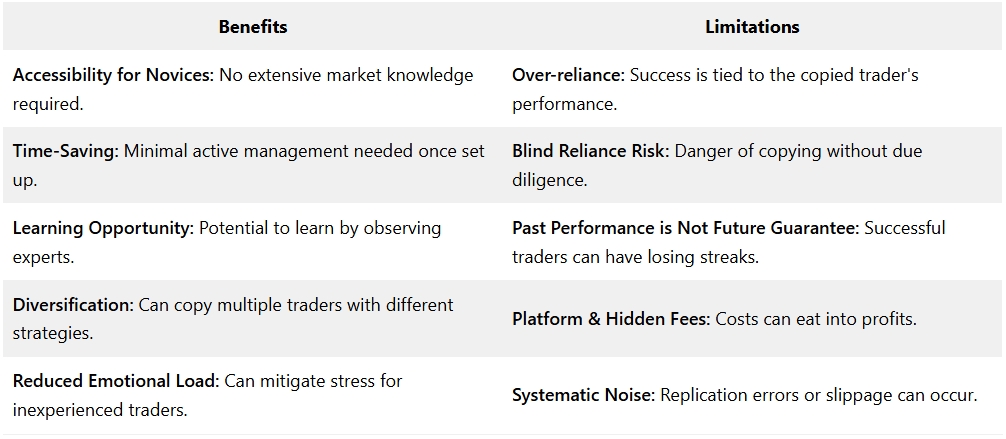
Are you truly diversifying, or just diversifying your reliance on others?
Algorithmic Trading: Benefits and Limitations
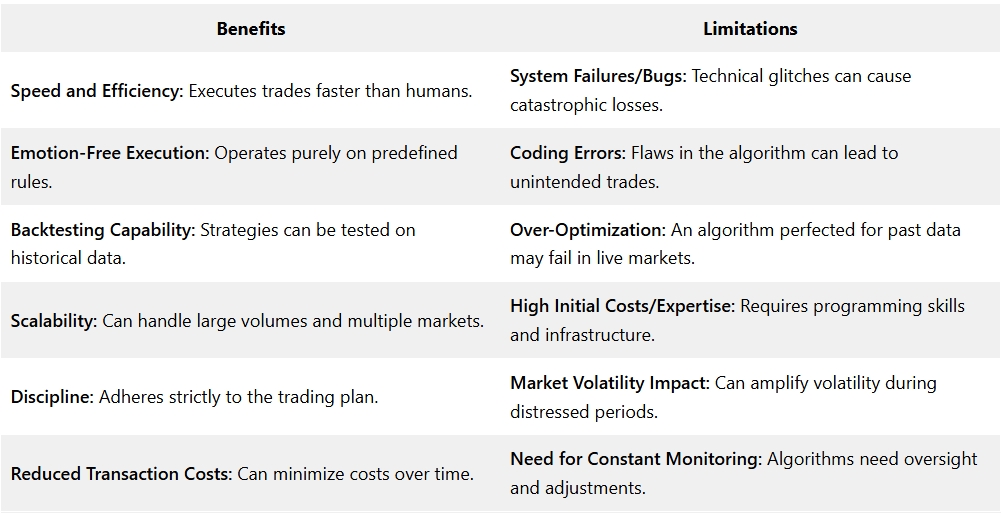
Can a machine truly understand the art of the market, or only its science?
Copy Trading vs Algo Trading: Understanding the Risks
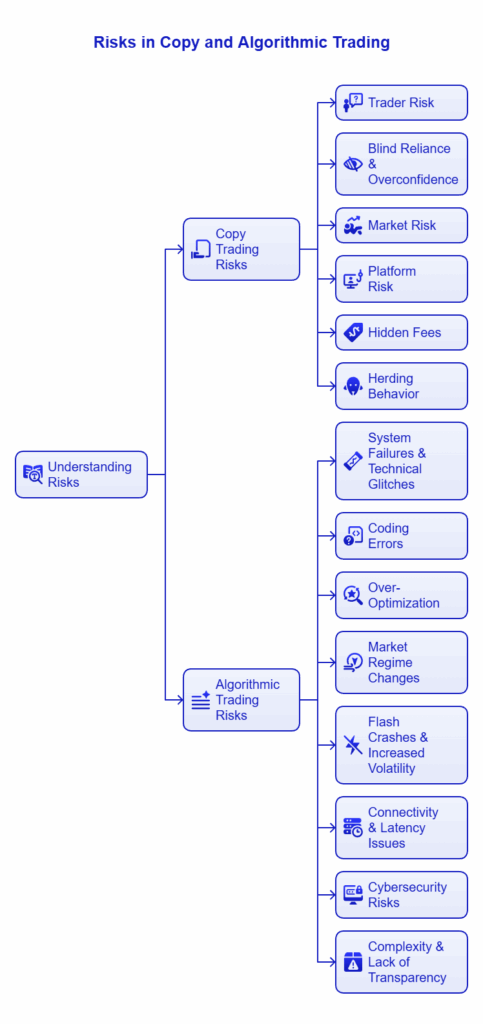
Both copy trading and algorithmic trading come with their own set of storms to navigate. Protecting your capital means understanding these risks intimately.
Risks in Copy Trading:
- Trader Risk: The primary risk is that the trader you’re copying makes poor decisions, leading to losses for you. As Jason Worrell’s experience with Bitget showed, even seemingly impeccable track records can mask high-leverage strategies that result in significant losses.
- Blind Reliance & Overconfidence: Novices may place undue trust in top performers without critical evaluation, leading to overexposure or copying strategies misaligned with their own risk tolerance. This overconfidence can lead to excessive trading and reduced long-term returns.
- Market Risk: The copied strategies are still subject to market volatility. If the market moves against the trader’s position, copiers will also suffer losses.
- Platform Risk: Issues like slippage (difference between expected and execution price), execution delays, or platform outages can impact trades.
- Hidden Fees: Subscription fees, profit-sharing arrangements (often 5-20%), spreads, and transaction fees can erode profitability if not carefully managed.
- Herding Behavior: If many users copy the same few popular traders, it can amplify market movements and potentially exacerbate mispricing, especially if those traders make correlated errors.
Risks in Algorithmic Trading:
- System Failures & Technical Glitches: This is a major concern. The Knight Capital Group incident in 2012, where a software bug led to a $440 million loss in minutes, is a stark reminder of this risk.
- Coding Errors: Flaws in the algorithm’s logic or implementation can lead to unintended and potentially disastrous trading behavior.
- Over-Optimization (Curve Fitting): An algorithm might be perfectly tuned to historical data but fail to perform in live, dynamic market conditions because it learned noise rather than true signals.
- Market Regime Changes: An algorithm designed for a specific market condition (e.g., trending) may perform poorly if the market shifts (e.g., to ranging).
- Flash Crashes & Increased Volatility: HFT, a subset of algorithmic trading, has been implicated in contributing to market volatility and sudden, sharp price movements.
- Connectivity & Latency Issues: For strategies dependent on speed, any delays in receiving data or sending orders can be detrimental.
- Cybersecurity Risks: Algorithmic trading systems can be targets for cyberattacks. Inadequate firewalls or outdated software can expose systems and sensitive data.
- Complexity & Lack of Transparency (Black Box): Some complex algorithms, especially those using AI, can be difficult to understand, making it hard to predict their behavior or diagnose issues.
How Nick Leeson Might View These Methods

Nick Leeson, infamous for bringing down Barings Bank through unauthorized, high-risk trades hidden in error accounts, offers a cautionary tale relevant to any discussion of trading, risk, and control. While he hasn’t directly commented extensively on copy or algorithmic trading in the provided search snippets, we can infer his potential perspective based on his past actions:
- On Copy Trading:
- Potential for Misuse: Leeson’s own downfall involved a lack of oversight and the ability to conceal mounting losses. He might see copy trading as a system where, if the “leader” trader is reckless or fraudulent (akin to his own hidden activities), many followers could suffer. The “blind faith” aspect could be a red flag for him.
- Leverage Amplification: His aggressive use of leverage to chase losses could make him wary of copy trading platforms that allow or encourage high leverage, as this can quickly amplify losses for copiers.
- Lack of Personal Control: Having experienced the consequences of his own unchecked decisions, he might be critical of handing over trading decisions entirely to another individual whose risk appetite and true strategy might not be fully transparent.
- Potential for Misuse: Leeson’s own downfall involved a lack of oversight and the ability to conceal mounting losses. He might see copy trading as a system where, if the “leader” trader is reckless or fraudulent (akin to his own hidden activities), many followers could suffer. The “blind faith” aspect could be a red flag for him.
- On Algorithmic Trading:
- Speed and Concealment: The speed of algorithmic trading could, in a rogue context, potentially allow for rapid accumulation of positions or losses before detection, similar to how his losses spiraled quickly.
- Complexity as a Shield: Highly complex algorithms could be used to obscure true trading intentions or risk levels, much like his use of the 88888-error account.
- The “Black Box” Risk: If an algorithm malfunctions or behaves unexpectedly (like the Knight Capital incident), the lack of immediate human intervention or understanding could lead to massive, uncontrolled losses, a scenario Leeson himself ultimately created manually.
- Over-reliance on Systems: Leeson’s story is one of human fallibility and emotional decision-making (loss aversion, ego). He might caution that even with algorithms, human oversight and the potential for human error in designing or monitoring them remain critical risks. His martingale-like strategy (doubling down on losses) is a behavioral flaw that even an algorithm could be programmed to follow if not designed with strict risk controls.
- Speed and Concealment: The speed of algorithmic trading could, in a rogue context, potentially allow for rapid accumulation of positions or losses before detection, similar to how his losses spiraled quickly.
Leeson’s experience underscores the paramount importance of transparency, robust risk management, independent oversight, and questioning any system that seems “too good to be true” or operates without clear accountability, principles vital for both copy and algorithmic traders.
Lessons from a Master: “Disciplined Trading” by Van Tharp Applied
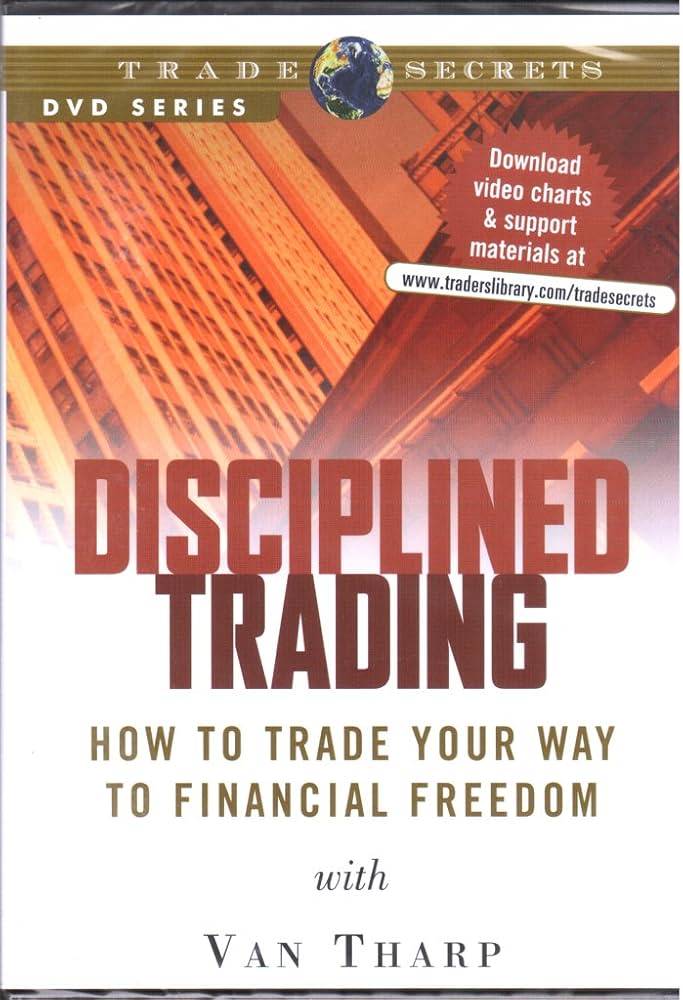
Mark Douglas’s “Trading in the Zone” is often cited, but Van Tharp’s “Disciplined Trader” also offers profound insights. While specific “10 lessons” weren’t directly retrieved for copy/algorithmic contexts, here are key principles from trading psychology and risk management (often discussed by authors like Tharp and evident in search snippets about disciplined trading) applied to our topic:
- Know Thyself (Psychology is Key):
- Copy Trading: Understand your risk tolerance before copying. Are you comfortable with the chosen trader’s drawdown potential? Don’t let greed or fear dictate who you copy or when you stop.
- Algo Trading: Your biases can creep into algorithm design. Objectively assess your strategy’s logic. Can you handle the algorithm’s expected drawdown without emotional interference?
- Copy Trading: Understand your risk tolerance before copying. Are you comfortable with the chosen trader’s drawdown potential? Don’t let greed or fear dictate who you copy or when you stop.
- Expectancy and Edge:
- Copy Trading: Does the trader you copy have a proven, positive expectancy (long-term profitability after costs)? Don’t just look at recent hot streaks.
- Algo Trading: Your algorithm must have a positive expectancy, rigorously backtested and forward-tested. What is your statistical edge?
- Copy Trading: Does the trader you copy have a proven, positive expectancy (long-term profitability after costs)? Don’t just look at recent hot streaks.
- Position Sizing (Money Management is Paramount):
- Copy Trading: Don’t allocate too much capital to a single trader. Diversify your “copierships” if possible, and determine position size based on your account, not just proportionally to the leader.
- Algo Trading: This is critical. How much do you risk per trade? This rule can make or break even a winning algorithm.
- Copy Trading: Don’t allocate too much capital to a single trader. Diversify your “copierships” if possible, and determine position size based on your account, not just proportionally to the leader.
- The Importance of a Trading Plan:
- Copy Trading: Your plan should include criteria for selecting traders, how much to allocate, when to stop copying (e.g., predefined drawdown limits), and how often to review.
- Algo Trading: The algorithm is the plan. But you also need a plan for when to turn it off, when to re-optimize, and how to monitor its performance.
- Copy Trading: Your plan should include criteria for selecting traders, how much to allocate, when to stop copying (e.g., predefined drawdown limits), and how often to review.
- Risk Control (Cut Losses Short):
- Copy Trading: Many platforms allow you to set your own stop-losses on copied trades, overriding the leader if necessary. Use them!
- Algo Trading: Build robust stop-loss mechanisms and maximum risk parameters into your algorithm.
- Copy Trading: Many platforms allow you to set your own stop-losses on copied trades, overriding the leader if necessary. Use them!
- Focus on the Process, Not Just Outcomes:
- Copy Trading: Don’t get fixated on every winning or losing trade. Focus on whether you followed your plan for selecting and managing copied traders.
- Algo Trading: Monitor if the algorithm is executing as designed. Short-term losses are part of a positive expectancy system.
- Copy Trading: Don’t get fixated on every winning or losing trade. Focus on whether you followed your plan for selecting and managing copied traders.
- Continuous Learning and Adaptation:
- Copy Trading: Markets change, and so does trader performance. Continuously review who you are copying and why.
- Algo Trading: Markets evolve. Your algorithm may need adjustments or even complete overhauls over time. Stay updated on new techniques and market dynamics.
- Copy Trading: Markets change, and so does trader performance. Continuously review who you are copying and why.
- Discipline is Your Superpower:
- Copy Trading: Stick to your allocation and risk rules. Avoid impulsively switching traders based on short-term noise.
- Algo Trading: Let the algorithm do its job. Avoid manually overriding it based on emotion, unless it’s a pre-planned intervention for specific circumstances.
- Copy Trading: Stick to your allocation and risk rules. Avoid impulsively switching traders based on short-term noise.
- Understand the Probabilistic Nature of Trading:
- Copy Trading: Even the best traders have losing streaks. Understand that losses are inevitable.
- Algo Trading: No algorithm is 100% accurate. Focus on the long-term probability of success.
- Copy Trading: Even the best traders have losing streaks. Understand that losses are inevitable.
- Low-Risk Ideas:
- Copy Trading: Start with small allocations when testing new traders. Understand their strategy before committing significant capital.
- Algo Trading: Paper trade and forward-test thoroughly before risking real money. Start with smaller position sizes in live trading.
- Copy Trading: Start with small allocations when testing new traders. Understand their strategy before committing significant capital.
Which of these disciplines do you find most challenging, and how can you strengthen it?
Copy Trading vs Algo Trading Costs: What You Need to Know

Understanding the financial outlay is crucial before diving in.
Copy Trading Costs:
The cost of copy trading can vary significantly between platforms and the traders you choose to copy. Common fee structures include:
- Subscription Fees: Some platforms or specific traders might charge a flat monthly or annual fee for access to their signals.
- Performance Fees (Profit Sharing): This is very common. You pay a percentage of the profits generated by the copied trades, often calculated using a High-Water Mark (HWM) model. This means you only pay on new profits, ensuring the trader is incentivized to recover any previous losses before earning a fee on that capital again. Percentages can range from 5% to 30% or more.
- Management Fees: Some strategies might charge a small percentage of your allocated equity, often calculated and accrued daily (e.g., Deriv’s cTrader allows up to 10% annually).
- Volume Fees (Commission-based): A fee charged per million of copied volume, applied on both opening and closing trades (e.g., Deriv’s cTrader allows up to $10 per million).
- Spreads and Slippage: These aren’t direct fees from the platform for copying but are trading costs. The spread is the difference between the buy and sell price. Slippage can occur during volatile markets when your trade executes at a slightly different price than intended.
- Withdrawal/Deposit Fees: Check the platform’s policy on funding and withdrawing from your account.
Be sure to click “Start Copying” or a similar button on any platform to view all applicable fees before committing. Check transaction logs and history regularly to understand what you’re being charged.
Algorithmic Trading Costs:
The costs here can be more front-loaded and depend on your approach:
- DIY Algorithm Development:
- Time Investment: Significant time is needed for research, strategy development, coding, and testing. This is an opportunity cost.
- Data Feeds: Reliable, real-time, and historical market data can be expensive, especially for granular or specialized data.
- Software & Programming Tools: While some languages (Python, R) are open-source, you might need specialized backtesting software or IDEs.
- Infrastructure: For low-latency strategies, you might need powerful computers, dedicated servers (VPS), or co-location services near exchange servers.
- Time Investment: Significant time is needed for research, strategy development, coding, and testing. This is an opportunity cost.
- Using Off-the-Shelf Algo Platforms/Software:
- Subscription/Licensing Fees: Many platforms that offer tools for building or running algos charge monthly or annual fees.
- Brokerage APIs: Some brokers offer free API access, while others might charge or require minimum balances/activity.
- Subscription/Licensing Fees: Many platforms that offer tools for building or running algos charge monthly or annual fees.
- Hiring a Developer: If you’re not a programmer, custom algorithm development can be very expensive.
- Brokerage Commissions & Fees: Standard trading costs still apply.
- Maintenance & Upgrades: Algorithms aren’t “set and forget.” They require ongoing monitoring, tweaking, and potential overhauls as market conditions change, which incurs further time or financial cost.
- Regulatory & Compliance Costs (Institutional): For larger operations, ensuring compliance with regulations can add to expenses. For retail traders, SEBI in India, for example, has guidelines for algorithm approval and tagging.
Retail traders face challenges like high initial costs and the need for technical expertise when adopting algorithmic trading. However, the rise of low-cost platforms and open-source resources is gradually lowering these barriers.
When considering costs, are you factoring in your own time as a valuable resource?
Hypothetical Profitability Analysis Over 10 Years
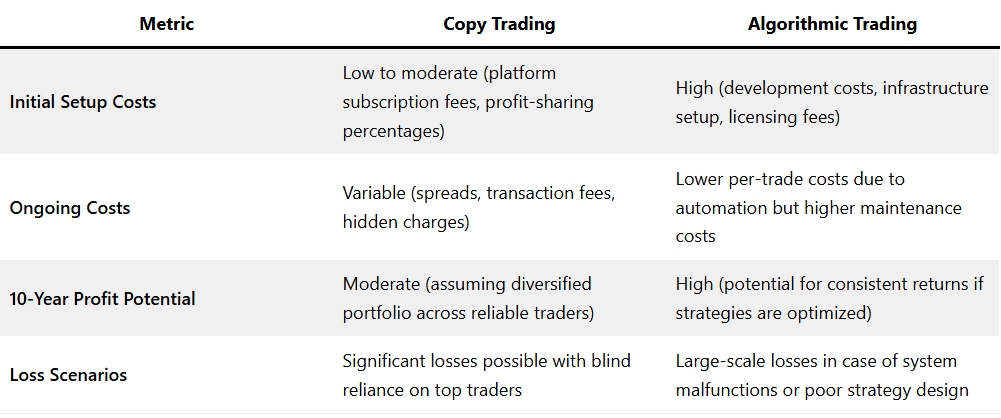
For example, an initial $10,000 investment in index funds could grow to approximately $25,937 at a 10% annual return rate. Aggressive monthly returns via copy trading may seem appealing but often prove unsustainable due to high leverage and volatile conditions. Similarly, algorithmic trading shows potential for steady gains when paired with robust risk management frameworks.
Predicting profitability over a decade for either method is fraught with difficulty and depends heavily on individual skill, strategy choice, risk management, market conditions, and sheer luck.
Copy Trading Profitability:
- Hypothetical High Returns vs. Reality: While some traders showcase impressive monthly gains, these are often achieved with high leverage and risk, making them unsustainable long-term. Many users face substantial losses due to poor risk management or blindly copying aggressive strategies, especially in volatile markets like Forex and Crypto.
- Dependence on Trader Skill: Your long-term profitability is directly tied to the sustained skill and discipline of the traders you copy. Finding consistently profitable traders over 10 years is a significant challenge.
- Impact of Fees: Over a long period, performance fees, management fees, and spreads can significantly eat into gross profits.
- Potential for Moderate Growth: With careful selection of multiple, consistently performing (but perhaps less spectacular) traders, diversification, and diligent risk management, moderate growth is possible. However, outperforming a simple index fund over 10 years via copy trading would require exceptional selection and luck.
Algorithmic Trading Profitability:
- Potential for Consistent Returns (if well-designed): A robust, well-tested algorithm with a genuine edge, coupled with disciplined risk management, has the potential for more stable and consistent returns over the long term compared to discretionary or emotionally driven trading.
- Compounding Power: Even moderate, consistent percentage gains can lead to significant wealth accumulation over a decade due to the power of compounding.
- Scalability: For institutional players or those with significant capital, algorithms can deploy strategies across various markets and sizes without a degradation in decision quality, potentially leading to higher absolute profits.
- High Failure Rate of Algorithms: It’s important to note that many, if not most, self-developed retail algorithms fail to achieve sustained profitability. The “edge” might be illusory, over-optimized, or quickly arbitraged away by more sophisticated players.
- Benchmark Comparison: As a general benchmark, an initial $10,000 investment in an S&P 500 index fund could grow to roughly $25,937 over 10 years, assuming an average annual return of 10%. Any active trading strategy, including algorithmic, should aim to consistently outperform such passive benchmarks after costs and taxes to be considered truly successful.
Overall: Algorithmic trading frameworks built on disciplined backtesting and rule-based designs tend to exhibit more stable performance trajectories, albeit potentially with slower initial compounding rates compared to the allure of quick copy trading gains (which often prove unsustainable). For long-term wealth accumulation, a structured, emotionless approach (which algorithmic trading strives for) is generally favored over reliance on individual trader performance, which can be unpredictable.
What does “profitability” truly mean to you – quick windfalls or steady, sustainable growth?
Copy Trading vs Algo Trading: Learning Curve
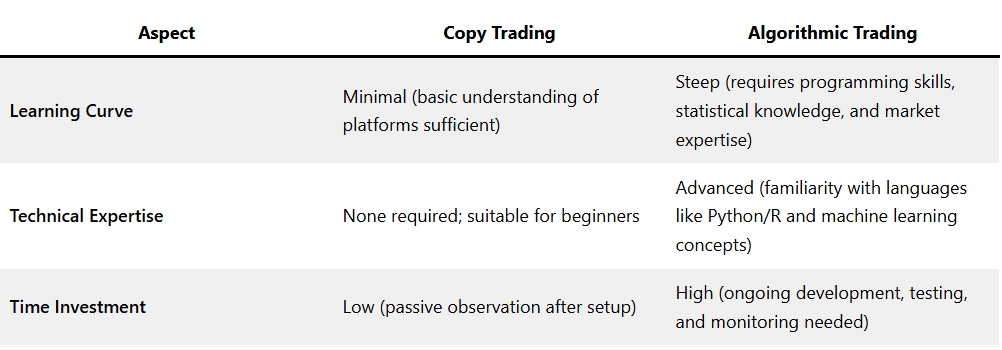
In summary, while copy trading offers accessibility and simplicity, it has inherent risks tied to trader dependency and market fluctuations. Algorithmic trading provides precision and scalability but demands technical proficiency and rigorous oversight. Both methodologies cater to distinct audiences, copy trading suits novices seeking ease of use, whereas algorithmic trading appeals to tech-savvy individuals or institutions aiming for systematic approaches.
Copy Trading Learning Curve:
- Relatively Flat Initial Curve: Getting started is often straightforward: choose a platform, find a trader, allocate funds, and click “copy”. Basic understanding of platform functionalities is usually sufficient.
- No Technical Expertise Required (Initially): You don’t need to know how to trade or analyze markets yourself to begin.
- The Real Learning: The steeper part of the curve involves learning how to effectively select and manage traders, understand risk metrics, interpret performance data correctly, and avoid common pitfalls like chasing past performance or over-allocating. This requires critical thinking and ongoing education.
- Time Investment: Low initial time investment for setup and passive observation, but more time is needed for diligent research and ongoing monitoring if you want to be successful.
Algorithmic Trading Learning Curve and Technical Expertise Needed:
- Steep and Demanding Curve: This path requires significant upfront investment in learning and development.
- Essential Technical Expertise:
- Programming Skills: Proficiency in languages like Python (with libraries like NumPy, Pandas, scikit-learn), R, or C++ is often necessary for developing, backtesting, and implementing strategies.
- Statistical Knowledge & Quantitative Analysis: Understanding statistical concepts, data analysis, and how to build and interpret mathematical models is crucial.
- Market Structure & Dynamics: Deep knowledge of how markets operate, order types, and liquidity is essential.
- Software & Platforms: Familiarity with backtesting platforms (e.g., QuantConnect, Quantopian in the past, or broker-specific tools), trading APIs, and potentially database management.
- Hardware (for HFT): For high-frequency strategies, understanding low-latency network setups, GPUs, or FPGAs might be needed, though this is more for advanced/institutional levels.
- Programming Skills: Proficiency in languages like Python (with libraries like NumPy, Pandas, scikit-learn), R, or C++ is often necessary for developing, backtesting, and implementing strategies.
- Resources: Online courses (Coursera, edX), communities (QuantConnect), and specialized books can aid the learning process, but mastery takes considerable time and intellectual rigor.
- Time Investment: High, involving ongoing development, rigorous testing, continuous monitoring, and refinement of strategies.
Are you prepared for a leisurely stroll or a challenging climb?
A Day In The Life Of A Trader: Copy Trading vs Algorithmic Trading

How do these methods weave into the fabric of a trader’s day?
Impact of Copy Trading:
- Potentially Passive: Once set up, copy trading can allow for minimal active monitoring, freeing up time for other pursuits. This is a major appeal for those with busy schedules.
- Risk of Complacency or Anxiety: While passive, some traders might still anxiously check performance frequently. Others might become too complacent and neglect necessary reviews.
- Emotional Rollercoaster (Indirect): You might experience the emotional highs and lows of the market indirectly through the performance of the traders you copy.
- Information Overload (Selection Phase): The initial phase of selecting traders can be time-consuming, involving sifting through many profiles and statistics.
- Community Engagement: Many platforms have social features, which can add a layer of interaction and shared learning (or shared anxiety).
Impact of Algorithmic Trading:
- Intensive Development & Testing Phase: Traders often dedicate substantial portions of their day (and night) to coding, backtesting, debugging, and refining strategies. This fosters analytical thinking but can risk burnout.
- Monitoring & Intervention: Even automated systems require monitoring for performance deviations, technical issues, or unexpected market events that might necessitate manual intervention or algorithm adjustments.
- Potential for Freedom (Once Stable): A well-functioning, stable algorithm could theoretically offer more hands-off time after the intensive development and testing phases, but vigilance is always needed.
- Stress of Responsibility: The trader bears full responsibility for the algorithm’s design and performance. Losses due to a flawed algorithm can be particularly stressful.
- Intellectual Stimulation: For those who enjoy problem-solving, coding, and quantitative analysis, algorithmic trading can be highly engaging and intellectually rewarding.
The Choice Between Copy Trading and Algorithmic Trading Hinges on Individual Objectives, Risk Tolerance, and Resource Availability
The choice between copy trading and algorithmic trading is not about which is definitively “better,” but which is better for you and your goals, particularly when the aim is the smarter protection of your money.
Copy trading offers a seemingly easier entry point into the world of trading, democratizing access to the strategies of experienced individuals. It can save time and reduce the initial learning curve. However, this convenience comes with the significant risk of over-reliance, the potential for blindly following unsuitable strategies, and the impact of various fees. For it to be a path to smarter investing, it demands rigorous due diligence in selecting traders, active risk management on your part, and an understanding that past performance is no crystal ball.
Algorithmic trading, on the other hand, champions a systematic, emotionless approach, leveraging technology for speed, precision, and the ability to backtest strategies. When designed and managed correctly, it can offer a more disciplined route to potentially consistent returns. Yet, this path is paved with significant challenges: a steep learning curve, the need for substantial technical expertise, high initial costs, and the ever-present risk of system failures or coding errors that can lead to substantial losses if not managed with extreme care.
Ultimately, smarter protection of your money in investing, regardless of the method, boils down to:
- Education: Understand the tools and markets you’re engaging with.
- Risk Management: Never invest more than you can afford to lose and always have clear risk parameters.
- Due Diligence: Whether researching a trader to copy or designing an algorithm, thorough investigation is paramount.
- Realistic Expectations: There are no get-rich-quick schemes in sustainable investing.
- Alignment with Your Profile: Choose a path that matches your risk tolerance, time availability, technical skills, and financial goals.
Perhaps the future lies in hybrid approaches, combining the intuitive simplicity of some copy trading aspects with the computational prowess of algorithmic systems. Or maybe it’s about using these tools not as standalone solutions, but as components within a broader, well-diversified investment strategy.
The journey into trading is yours to make. Question everything, learn continuously, and prioritize the protection of your capital above all else.
Frequently Asked Questions (FAQs)
Q1: Is copy trading suitable for absolute beginners?
A: Yes, copy trading is often marketed as an excellent option for beginners because it allows them to participate in the market without extensive prior knowledge by replicating the trades of experienced individuals. However, beginners must still conduct thorough research on the traders they choose to copy and understand the platform’s risks and fees.
Q2: How much money do I need to start copy trading?
A: This varies by platform. Some allow you to start with relatively small amounts, while others might have higher minimums. It’s crucial to only invest what you can afford to lose, regardless of the minimum requirement.
Q3: Can you actually make money with copy trading?
A: It’s possible to make money, but it’s not guaranteed. Profitability depends on the skill of the traders you copy, market conditions, the fees you pay, and your own risk management. Many people also lose money, especially if they choose traders unwisely or don’t manage risk.
Q4: What’s the difference between copy trading and social trading?
A: Copy trading is a specific function where trades are automatically replicated. Social trading is a broader concept that includes copy trading but also encompasses sharing trading ideas, strategies, and market insights within a community, allowing users to make their own informed decisions.
Q5: What are the main costs associated with algorithmic trading for a retail trader?
A: For retail traders developing their own algorithms, costs can include data feeds, programming software (though many tools are open-source), powerful hardware (less critical for non-HFT), and the significant investment of their own time for development and testing. If using third-party platforms or pre-built algos, there might be subscription or licensing fees. Standard brokerage commissions also apply.
Q6: Do I need to be a programmer to use algorithmic trading?
A: To develop custom algorithms from scratch, yes, programming skills (e.g., Python, R, C++) are generally essential. However, some platforms offer user-friendly interfaces or “drag-and-drop” tools that allow non-programmers to build simpler algorithms or use pre-built ones. The level of technical expertise needed varies widely.
Q7: Is algorithmic trading less risky than manual trading?
A: Not necessarily. Algorithmic trading can eliminate emotional decision-making and execute trades with speed and precision, which can reduce certain types of risk. However, it introduces other risks like system failures, coding errors, over-optimization, and the potential for rapid losses if an algorithm malfunctions or market conditions drastically change.
Q8: What is “backtesting” in algorithmic trading?
A: Backtesting is the process of applying a trading algorithm to historical market data to see how it would have performed in the past. It’s a crucial step in algorithm development to assess potential viability, but good past performance doesn’t guarantee future success.
Q9: How often do I need to monitor my trades if I’m copy trading or using an algorithm?
A: Copy Trading: While it can be passive, regular monitoring (e.g., weekly or monthly reviews of trader performance and your overall portfolio) is wise. Don’t “set and forget.” Algorithmic Trading: This requires more active monitoring, especially initially. You need to ensure the algorithm is running correctly, check for unexpected behavior, and assess its performance against benchmarks and changing market conditions. The level of monitoring might decrease if an algorithm proves stable over time, but it should never be entirely neglected.
Q10: Which is better for protecting my money: copy trading or algorithmic trading?
A: Neither method inherently guarantees better protection. Smarter money protection comes from your approach: thorough research, robust risk management (like setting appropriate stop-losses and position sizes), diversification, continuous learning, and choosing a method that aligns with your understanding and ability to manage its specific risks. The article suggests that structured, rule-based algorithmic approaches may offer more stable long-term trajectories if well-designed, compared to the reliance on individual (and potentially volatile) human trader performance in copy trading.
For more detailed insights on developing daily trading routines, risk management, and effective position sizing strategies, explore additional articles on Trading Cup. Our trading experts at ACY and FinLogix are also great resources to guide your journey towards trading excellence.

Discover Our Best Trading Signals
At Tradingcup, you can browse through a selection of signals and review past performance before you decide to copy.
Become A Signal Provider
Share your expertise and become a signal provider so other traders can copy your trades.
Stay tuned to our blog for more trader spotlights and leaderboard updates.
Trading involves risks.
Visit the Tradingcup blog through the link below for more updates: https://www.tradingcup.com/learn
Related Copy Trading blogs:
- Understanding Market Liquidations: Liquidity Sweeps and Runs Explained
- 7 Essential Daily Habits of Successful Traders to Outperform Their Peers
- 10 Strategies You Can Copy off Our Best Copy Traders
- 5 Strategies Every Trader Can Master To Trade Better In A Trading Contest
- 2025 Copy Trading Scams Exposed: How to Spot Fraud
- A Swing Trading Strategy with an 83 Percent Win Rate and Low Drawdowns
- Forex Martingale Strategies Explained, The Good, The Bad and The Ugly
- Pyramiding Trading Tutorial – Pros & Cons & How to Use It