Last Updated: May 02, 2025
This article is reviewed annually to reflect the latest market regulations and trends.
TL;DR:
- True Consistency is Rare: Focus on traders with proven long-term track records, disciplined strategies, and robust risk management, not just short-term high gains.
- Risk-Reward is King: Understand and apply the risk-reward ratio and position sizing; many traders fail by ignoring these fundamentals due to psychological biases.
- Learn from Masters: Apply principles from “Think and Grow Rich” (Desire, Faith, Planning, Persistence) and understand Elon Musk’s approach to calculated, innovation-driven risk.
- Due Diligence is Crucial: Analyze copy traders beyond headline gains; scrutinize Maximum Drawdown (MDD), strategy, win rate, fees, and long-term performance (like the Tradingcup examples provided).
- Protect Your Capital: Copy trading isn’t passive income; track performance, understand fees, manage emotions, and never risk more than you can afford to lose – smarter money protection is paramount.
Disclaimer: The information in this article is for educational purposes only and does not constitute financial, investment, or trading advice. Copy trading carries substantial risks, including the potential loss of your entire invested capital. Past performance of copied traders or strategies is not a reliable indicator of future results. You may be replicating high-risk trades, overleveraged positions, or strategies incompatible with your financial goals. Always conduct independent research into a trader’s historical performance, risk metrics, and strategy before copying them. Never invest funds you cannot afford to lose. Consult a licensed financial advisor to ensure copy trading aligns with your risk tolerance, financial objectives, and regulatory requirements in your jurisdiction. This article does not endorse specific traders, platforms, or strategies, and all trading decisions remain your sole responsibility.

“The key to trading success is emotional discipline. If intelligence were the key, there would be a lot more people making money trading.” – Victor Sperandeo
Elon Musk’s Playbook: Calculated Risk for Massive Rewards

While not a traditional market trader, Elon Musk’s approach to business embodies a fascinating perspective on risk and reward, relevant to anyone managing capital. He doesn’t avoid risk; he embraces calculated, asymmetric risk for potentially world-changing (and financially enormous) rewards.
- Vision-Driven Risk: Musk takes risks others deem impossible (reusable rockets, mass-market EVs) because they align with a larger vision. This conviction fuels persistence through failures. Trader Takeaway: Have conviction in your well-researched strategy, but don’t confuse conviction with stubbornness.
- Innovation as Risk Mitigation: Musk tackles high-risk ventures but mitigates risk through relentless innovation, engineering excellence, and problem-solving. SpaceX faced multiple failures before succeeding. Trader Takeaway: Continuously refine your strategy and risk management techniques. Learn from losses to improve.
- High Tolerance for Failure: Musk famously stated, “If things are not failing, you are not innovating enough.” Failure is seen as a data point on the path to success. Trader Takeaway: Accept that losses are part of trading. Analyse them objectively, don’t let them derail your discipline.
- Focus on Asymmetry: The potential upside of success for SpaceX or Tesla far outweighed the (significant) capital risked. Trader Takeaway: Seek trades with a favourable risk-reward ratio, where potential gains significantly exceed potential losses.
Musk isn’t gambling; he’s making highly informed, calculated bets on transformative outcomes, backed by rigorous execution. Traders can adopt a similar mindset: take calculated risks based on a solid plan, not reckless chances.
10 Trading Lessons from “Think and Grow Rich”
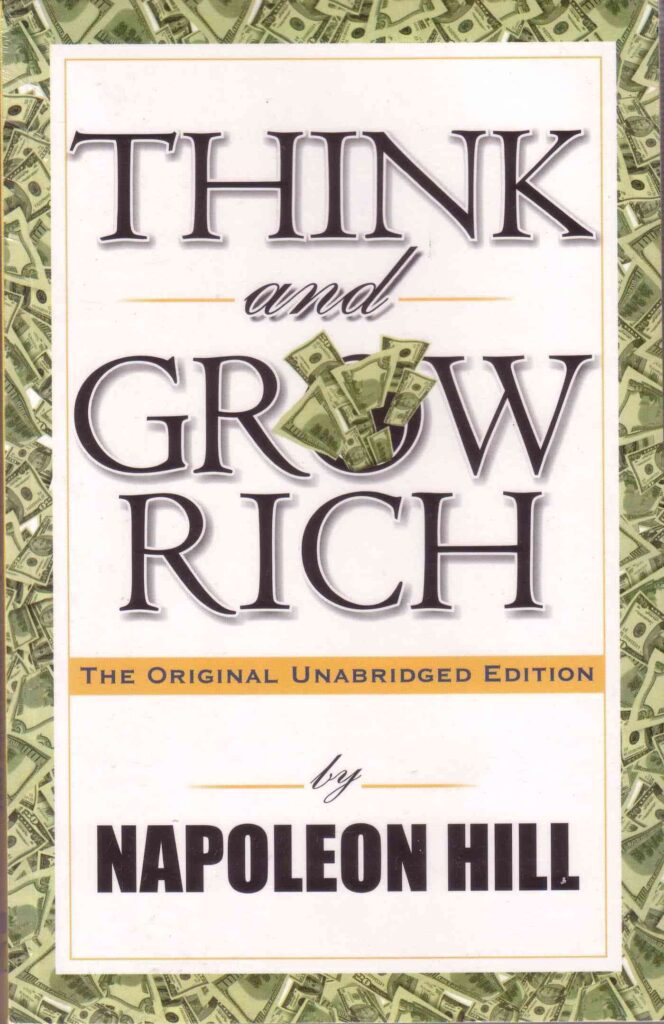
Napoleon Hill’s classic, while focused on general success, offers powerful principles directly applicable to the mindset of a profitable trader:
- Burning Desire: You need an intense, unwavering desire to succeed in trading, not just a casual wish. This fuels the necessary effort and persistence.
- Faith: Believe in your ability to learn, adapt, and execute your strategy successfully. Visualize positive outcomes to reinforce this belief, especially during drawdowns.
- Auto-Suggestion: Use positive affirmations (“I am a disciplined trader,” “I follow my risk management rules”) to program your subconscious for success and counteract fear/greed.
- Specialized Knowledge: Trading requires specific skills. Continuously learn about markets, technical/fundamental analysis, risk management, and your chosen strategy. Don’t be a jack-of-all-trades, master-of-none.
- Imagination: Develop and test new strategies or variations. Market conditions change, and stagnant approaches eventually fail. Keep innovating (like Musk).
- Organized Planning: Create a detailed trading plan: your strategy, entry/exit rules, risk parameters, position sizing rules, and performance review process. “Wishing” for profits isn’t a plan.
- Decision: Make trading decisions based on your plan promptly and decisively. Avoid procrastination or second-guessing once criteria are met. Equally, decide quickly to cut losses when a trade goes wrong.
- Persistence: Trading is challenging. You will face setbacks and losses. Persist through difficulties, learn from mistakes, and stick to your plan. Most quit too early.
- Power of the Master Mind: Engage with other serious traders (responsibly), mentors, or communities to share knowledge, challenge ideas, and maintain motivation (but beware of herd mentality).
- The Subconscious Mind & Managing Fear: Understand how emotions like fear and greed impact decisions. Use discipline, planning, and auto-suggestion to manage them and make rational choices.
Analysing Top Traders: A Tradingcup Case Study (April 2025 Data)
Let’s apply these principles by analyzing the provided Risk vs. Reward data for Tradingcup’s top traders (using the illustrative data from April 2025). This helps understand how to evaluate potential traders to copy.
Trader Comparison Table:
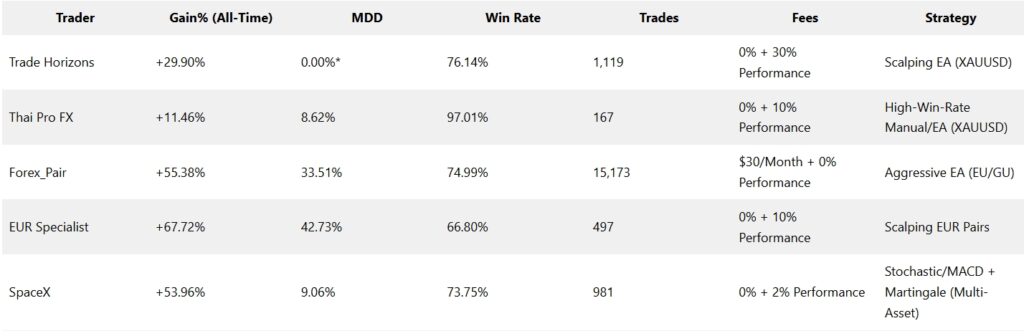
Note: 0.00% MDD is highly unusual, especially for scalping, and warrants further investigation into the reporting period or methodology.
Individual Trader Breakdown:
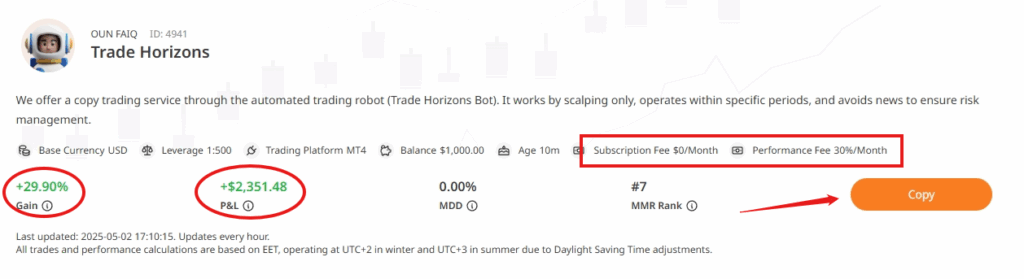
Trade Horizons:
- Reward: Good gain (+29.90%). High trade frequency suggests active scalping.
- Risk: The 0.00% MDD is a major red flag. Scalping is inherently risky; this figure might be misleading (short timeframe, specific reporting?). High leverage (1:500) adds significant risk. Strategy depends heavily on execution speed and low spreads.
- Fees: High 30% performance fee.
- Ideal For: Very experienced traders comfortable with automated, high-frequency strategies who can verify the MDD claim over a longer, reliable period. High caution advised.
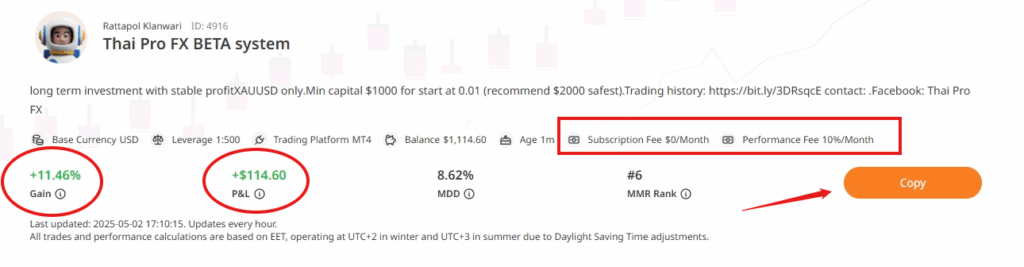
Thai Pro FX BETA System:
- Reward: Modest gain (+11.46%) but exceptionally high win rate (97.01%). Fewer trades suggest a selective approach. Focus on Gold (XAUUSD).
- Risk: Moderate MDD (8.62%), aligning with a more conservative approach despite the high win rate. Suggests losses, when they occur, are managed.
- Fees: Low 10% performance fee.
- Ideal For: Risk-averse investors seeking stability and capital preservation. The high win rate is attractive, but ensure average win size justifies the RRR against the infrequent losses.
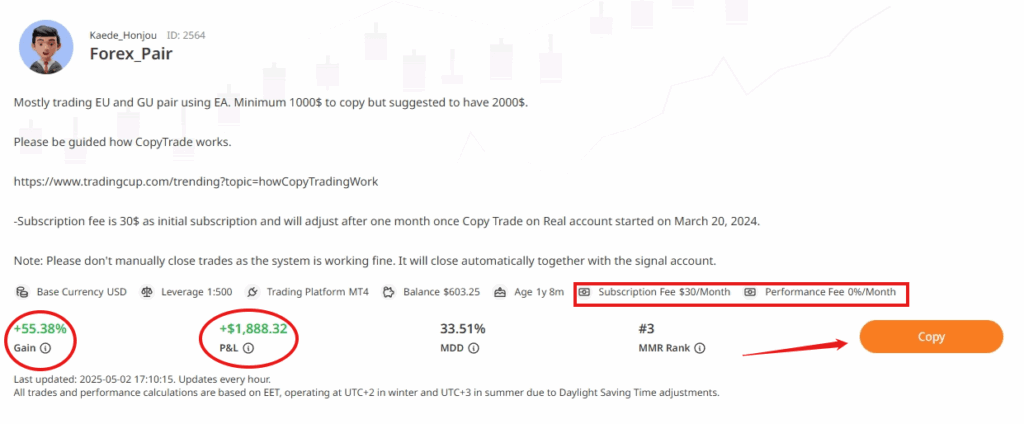
Forex_Pair:
- Reward: High gain (+55.38%). Extremely high trade frequency (15,173) with an aggressive EA on major pairs.
- Risk: Extremely high MDD (33.51%). This level of drawdown indicates significant risk and potential for large capital loss, overshadowing the gains. High leverage adds to the risk.
- Fees: $30/month subscription, no performance fee.
- Ideal For: Not recommended for most investors due to the unsustainable risk profile. Only potentially suitable for highly risk-tolerant, experienced traders using minimal capital allocation.
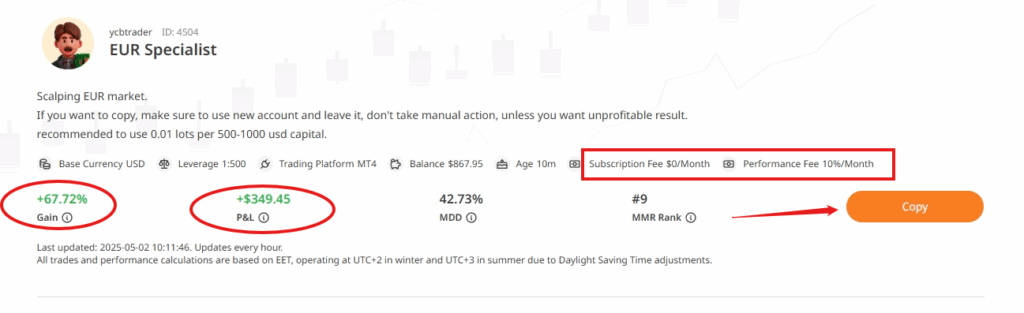
EUR Specialist:
- Reward: Highest gain shown (+67.72%). Scalping EUR pairs.
- Risk: Very high MDD (42.73%). Similar to Forex_Pair, the potential for severe drawdowns makes this very risky. Scalping requires precision; large drawdowns suggest vulnerability.
- Fees: Low 10% performance fee.
- Ideal For: Aggressive traders prepared for significant volatility and potential large losses. Requires strict personal risk controls if copying.
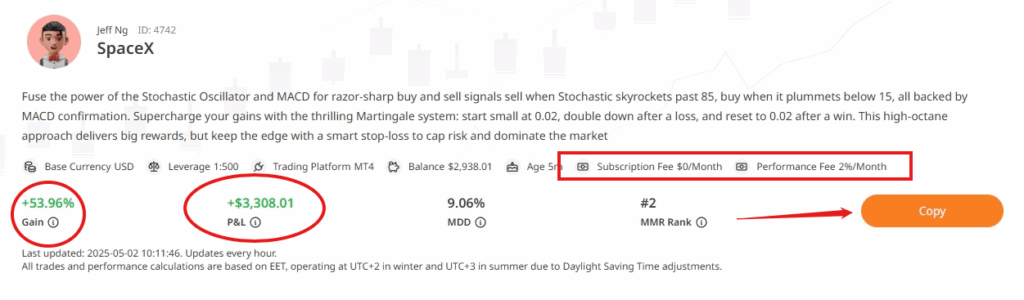
SpaceX:
- Reward: Strong gain (+53.96%) with diversification across Gold and Silver pairs. Combines technical indicators with Martingale.
- Risk: Surprisingly low-moderate MDD (9.06%) despite using a Martingale component (which typically increases risk significantly). This suggests disciplined application or favourable market conditions during the reporting period. Martingale still carries inherent risk of rapid loss magnification if a losing streak extends.
- Fees: Very low 2% performance fee.
- Ideal For: Balanced investors seeking strong returns with demonstrated (historical) risk control. The low MDD is appealing, but the Martingale element requires understanding and caution. Excellent MMR ranking (#2) adds confidence.
Recommendations Based on Risk Tolerance:
- Aggressive Investors:
- SpaceX: Offers the best blend of high returns and historically controlled risk (low MDD, low fees). Monitor carefully due to Martingale.
- Trade Horizons: Potentially high returns, but only if the 0% MDD can be verified over a significant period. The high performance fee is a drag. Proceed with extreme caution.
- SpaceX: Offers the best blend of high returns and historically controlled risk (low MDD, low fees). Monitor carefully due to Martingale.
- Balanced Investors:
- Thai Pro FX: Excellent choice for stability. High win rate and moderate MDD suggest capital preservation focus. Low fees are a plus. Good MMR ranking (#6).
- Thai Pro FX: Excellent choice for stability. High win rate and moderate MDD suggest capital preservation focus. Low fees are a plus. Good MMR ranking (#6).
- Avoid:
- Forex_Pair & EUR Specialist: The massive MDDs make these unsuitable for most investors. The risk of catastrophic loss outweighs the potential gains unless managed with extreme expertise and minimal capital.
- Forex_Pair & EUR Specialist: The massive MDDs make these unsuitable for most investors. The risk of catastrophic loss outweighs the potential gains unless managed with extreme expertise and minimal capital.
Diversification Strategy:
Consider combining Thai Pro FX (stable, low-risk, Gold focus) with SpaceX (higher return potential, diversified, historically controlled risk) to potentially balance returns and mitigate overall portfolio risk.
Final Notes on Copying:
- MMR Ranking Matters: Platforms like Tradingcup often have ranking systems (like MMR). Prioritize traders with consistently high rankings, suggesting a better risk-adjusted performance.
- Set Personal Stop-Losses: Don’t rely solely on the trader’s risk management. Define your own maximum acceptable loss for any copy trading relationship.
- Educate Yourself: Use platform resources (seminars, community) to understand the strategies you’re copying. Don’t copy blindly.
Always remember that past performance data (especially potentially anomalous figures like 0% MDD) needs critical evaluation. Align your choices with your personal financial goals and risk tolerance.
Who Are The Most Consistent Traders & Can You Copy Their Success?
The potential for significant financial gains, the thrill of navigating market dynamics, the dream of financial freedom. This leads many aspiring traders to seek out the “holy grail”—the consistently profitable trader whose success seems almost effortless. The rise of copy trading platforms like Tradingcup has amplified this quest, offering the tantalizing prospect of simply mirroring the trades of seasoned professionals.
But is it truly that simple? Who are these consistently profitable traders? What secrets do they hold? And more importantly, can you realistically – and safely – leverage their strategies through copy trading?
This updated article dives deep into the realities of trading consistency, the essential traits of successful traders, the mechanics and risks of copy trading, and crucial risk management principles. We’ll explore insights from unconventional thinkers like Elon Musk, timeless wisdom from “Think and Grow Rich,” and analyse real-world trader data to help you navigate this complex landscape with a focus on smarter money protection.
The Myth of Perfect Consistency in Trading
First, let’s address a common misconception. In trading, “consistent” doesn’t mean winning every single trade or generating identical profits month after month. Markets are inherently volatile and unpredictable. Even the best traders experience losing streaks and drawdowns.
True consistency lies in:
- Adherence to a Strategy: Consistently applying a well-defined and tested trading plan, regardless of emotional impulses.
- Rigorous Risk Management: Consistently protecting capital by defining risk per trade, using stop-losses, and managing position sizes.
- Long-Term Profitability: Demonstrating positive returns over extended periods (months, years), weathering different market conditions.
- Adaptability & Learning: Consistently reviewing performance, learning from mistakes, and adapting strategies as market dynamics evolve.
Searching for a trader who never loses is a fool’s errand. The focus should be on finding traders who manage losses effectively and maintain profitability over the long haul.
Secrets of Genuinely Profitable Traders
While strategies vary wildly, consistently profitable traders often share core psychological and behavioural traits:
- Discipline: The bedrock of success. They stick to their trading plan, entry/exit rules, and risk parameters, avoiding impulsive decisions driven by fear or greed.
- Patience: They wait for high-probability setups that fit their strategy, rather than forcing trades out of boredom or a desire for constant action. They understand that sitting on the sidelines is a valid position.
- Robust Risk Management: This isn’t an afterthought; it’s integral. They know exactly how much they’re willing to risk per trade and overall. They prioritize capital preservation above all else.
- Emotional Control: They treat trading as a business, not a casino. They manage fear during drawdowns and avoid euphoria after wins, maintaining objectivity. As the quote above suggests, psychology often trumps raw intelligence.
- Continuous Learning: Markets change. Profitable traders are perpetual students, constantly refining their strategies, studying market behaviour, and learning from both wins and losses.
- Accountability: They take full responsibility for their results, never blaming the market, their broker, or external factors for losses. They analyse mistakes objectively to improve.
- Realistic Expectations: They understand that trading involves probabilities, not certainties. They don’t expect to get rich overnight and focus on steady, sustainable growth.
Copy Trading: The Promise and the Peril
Copy trading platforms allow you to automatically replicate the trades of selected traders in your own account. It sounds like the perfect shortcut – leveraging expertise without years of learning.
Benefits:
- Access to expertise for beginners.
- Time-saving for those unable to actively trade.
- Potential diversification by copying multiple traders with different strategies.
- Learning opportunity by observing experienced traders.
Risks & Considerations:
- Past Performance is Not Guarantee: A trader’s hot streak might end right after you start copying them.
- Hidden Risks: Strategies like scalping or Martingale (seen in some examples below) can have risks not immediately apparent from headline figures (e.g., sensitivity to slippage, potential for catastrophic losses).
- Survivorship Bias: Platforms often highlight top performers, many of whom might have achieved high returns through unsustainable risks. Many who failed are no longer visible.
- Lack of Control: You are reliant on the trader’s decisions. If they go off-plan or make errors, your capital is affected.
- Differing Capital/Leverage: The copied trader’s results might not be perfectly replicated if your account size, leverage, or broker execution differs.
- Fees: Performance fees and subscription costs eat into your returns.
Due diligence is non-negotiable. Don’t just look at the percentage gain. Dig deeper into historical performance, Maximum Drawdown (MDD) (the largest peak-to-trough decline), strategy description, trade frequency, and community reviews.
The Unbreakable Rule: Risk vs. Reward
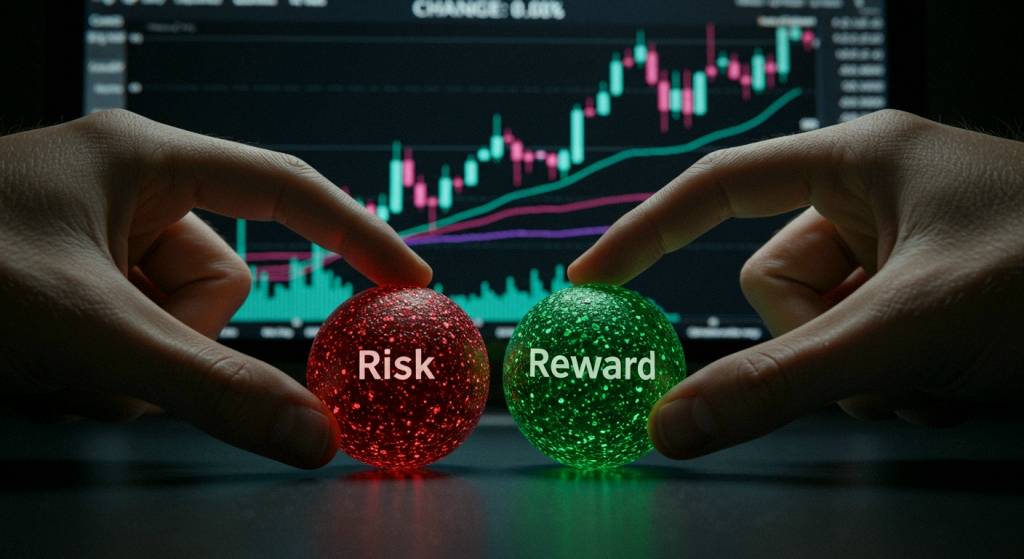
At the heart of profitable trading and smart investing lies the Risk-Reward Ratio (RRR). It quantifies the potential profit of a trade relative to its potential loss.
- Calculation: RRR = (Potential Reward) / (Potential Risk)
- Potential Reward = Target Price – Entry Price
- Potential Risk = Entry Price – Stop-Loss Price
- Potential Reward = Target Price – Entry Price
- Example: If you buy a stock at $50, set a target at $65 (potential reward $15), and a stop-loss at $45 (potential risk $5), your RRR is $15 / $5 = 3. This is often expressed as 1:3 (risking 1 unit to potentially gain 3).
Why is RRR Crucial?
A favourable RRR (typically recommended > 1:2 or 1:3) means your winners are significantly larger than your losers. This allows you to be profitable even if you win less than 50% of your trades.
Best Use Cases & Strategy:
- Filtering Trades: Only take trades offering a favourable RRR according to your plan.
- Setting Targets/Stops: Use it to determine logical profit targets and stop-loss levels based on market structure (support/resistance, volatility).
- System Development: Build trading strategies where the average winning trade is consistently larger than the average losing trade.
Why Do Many Traders Ignore Basic RRR?
- Psychology: Greed focuses on potential gains, while fear minimizes the perception of risk. Hope keeps losing trades open too long.
- Desire for High Win Rate: Some prioritize winning frequently over winning big, accepting poor RRR for a higher probability of a small win (which is often unsustainable).
- Lack of Education/Planning: Many jump into trading without understanding or implementing fundamental risk management principles.
- Overconfidence: Believing they can “feel” the market or that this trade is different, leading them to ignore predefined rules.
Ignoring the RRR is like building a skyscraper on sand – eventually, it collapses.
The Universal Truth: Risking Money to Make Money

Whether it’s launching a startup, investing in stocks, or even navigating relationships (which often involve financial entanglements), generating returns almost always involves taking some form of risk. Trading is simply a more direct application of this principle: you must risk capital to potentially earn a profit.
The key isn’t to avoid risk entirely (which means avoiding potential returns) but to manage it intelligently. Understand the risks you are taking, ensure they are calculated, and align them with the potential reward. This applies whether you’re risking startup capital like an entrepreneur or trading capital in the markets.
Timing the Market vs. Adapting to the Market
Many traders chase the elusive skill of “market timing.” While understanding market cycles (accumulation, mark-up, distribution, mark-down) is helpful, perfectly predicting tops and bottoms consistently is nearly impossible.
Furthermore, a strategy that yields huge profits in a strong uptrend might perform poorly in a sideways or declining market. Some traders mentioned below excel in specific conditions (e.g., scalping low-volatility pairs) but might struggle during high-impact news events.
Key Insight: Profitability often comes not from predicting the market, but from having a strategy with an edge and adapting its application (or sitting out) based on current market conditions. Recognize when the environment is favourable for your strategy and when it’s prudent to reduce exposure or wait. Some traders earn now simply because the market suits their style; the real test is long-term adaptability.
Position Sizing: Don’t Bet the Farm
Alongside RRR, position sizing is a critical pillar of risk management. It determines how much capital to allocate to a single trade. Trading the same number of shares/lots for every trade, regardless of the setup’s risk, is a recipe for disaster.
A common method is the Percentage Risk Model:
- Determine Account Risk: Decide the maximum percentage of your total trading capital you’ll risk on any single trade (e.g., 1% or 2% is common).
- Determine Trade Risk: Calculate the distance between your entry price and your stop-loss price in points/pips/dollars per share.
- Calculate Position Size: Position Size = (Account Capital * Risk %) / (Stop-Loss Distance * Value per Point/Pip/Dollar)
Example using Tradingcup’s suggested balance concept: Let’s say Tradingcup suggests a minimum balance of $1,000 for copying a certain trader, and you decide to risk 2% of this per trade ($20). If the trader’s next signal has a stop-loss 50 pips away on EUR/USD (where 1 standard lot pip = $10), you need to calculate the appropriate lot size. Risk per standard lot = 50 pips * $10/pip = $500. Your allowed risk = $20. Position Size (in lots) = $20 / $500 = 0.04 lots (or 4 micro lots).
Proper position sizing ensures that a single loss doesn’t cripple your account, allowing you to withstand inevitable losing streaks and stay in the game.
Don’t Forget the Fees!
When evaluating copy trading profitability, fees are a crucial factor often underestimated.
- Subscription Fees: Some platforms or traders charge a flat monthly fee.
- Performance Fees (Profit Sharing): Many traders take a percentage of the profits generated in your copied account (e.g., 10%, 20%, 30%).
- Broker Spreads/Commissions: Standard trading costs apply to copied trades. High-frequency strategies (like scalping) are particularly sensitive to these.
A trader might show a 50% gross gain, but after a 30% performance fee and trading costs, your net return could be significantly lower. Always factor fees into your profitability calculations and comparisons.
Track, Monitor, Verify
Copy trading is not a “set it and forget it” strategy. You need to actively monitor the performance of the traders you copy.
- Regular Reviews: Check performance weekly or monthly. Is it aligning with their stated strategy and historical results?
- Drawdown Watch: Pay close attention to drawdowns. Are they within expected limits for the strategy, or is something potentially wrong? Set your own maximum drawdown tolerance for any copied trader.
- Strategy Drift: Is the trader sticking to their advertised strategy, or are they suddenly taking different types of trades or excessive risks?
- Platform Metrics: Utilize the tools provided by platforms like Tradingcup (e.g., MMR ranking, detailed stats) but verify with your own observations.
Trust, but verify. Your capital is your responsibility.
Conclusion: Trade Smart, Protect Your Capital
Finding consistently profitable traders is less about discovering magicians and more about identifying disciplined professionals with robust risk management and adaptable strategies proven over time. Copy trading offers a tempting path, but it’s fraught with potential pitfalls if approached carelessly.
Success isn’t just about maximizing gains; it’s fundamentally about smarter money protection. By understanding and applying principles of risk-reward, position sizing, conducting thorough due diligence on traders (looking beyond headline gains to MDD and fees), learning from diverse thinkers like Musk and Hill, and actively monitoring your investments, you can navigate the world of trading and copy trading more intelligently. Treat it like a business, prioritize learning, manage your emotions, and always protect your capital.
Frequently Asked Questions (FAQ)
Q1: What is the most important factor when choosing a trader to copy?
A: While high returns are attractive, Maximum Drawdown (MDD) is arguably the most critical factor. It indicates the largest loss the trader has historically experienced from a peak. A low MDD suggests better risk control. Also consider consistency over time, strategy alignment with your risk tolerance, and fees.
Q2: Is copy trading truly passive income?
A: No. While it requires less active trading time from you, it demands active monitoring, due diligence in selecting traders, understanding the strategies and risks involved, and managing your overall investment. It’s not a “set and forget” solution.
Q3: Can I lose more money than I invest in copy trading?
A: If using leverage, yes. Leverage magnifies both profits and losses. If a copied trader experiences a significant loss on a leveraged position, your losses could potentially exceed your initial investment in that specific copy relationship, depending on your broker’s negative balance protection policy. Always understand the leverage being used.
Q4: How reliable is a high win rate (like Thai Pro FX’s 97%)?
A: A high win rate is appealing but needs context. Ensure the average profit per winning trade significantly outweighs the average loss per losing trade (favourable Risk-Reward Ratio). Sometimes strategies achieve high win rates by taking very small profits and risking larger losses, which can be unsustainable or lead to large drawdowns eventually.
Q5: What does the “Martingale” component in SpaceX’s strategy mean?
A: A Martingale strategy typically involves increasing the trade size after a loss, intending to recoup previous losses plus a small profit on the next winning trade. While it can look good in certain conditions, it’s very risky because a prolonged losing streak can lead to exponentially increasing position sizes and potentially catastrophic losses. SpaceX’s low historical MDD suggests disciplined use or favourable conditions, but the underlying risk remains.
Q6: Why is a 0% Maximum Drawdown (like Trade Horizons) suspicious?
A: Achieving 0% MDD over a significant period, especially with an active strategy like scalping, is highly improbable. It could mean the data covers a very short timeframe, excludes certain periods, uses a specific calculation method, or is simply inaccurate. It requires thorough investigation before trusting. Sources and related content
For more detailed insights on developing daily trading routines, risk management, and effective position sizing strategies, explore additional articles on Trading Cup. Our trading experts at ACY and FinLogix are also great resources to guide your journey towards trading excellence.

Discover Our Best Trading Signals
At Tradingcup, you can browse through a selection of signals and review past performance before you decide to copy.
Become A Signal Provider
Share your expertise and become a signal provider so other traders can copy your trades.
Stay tuned to our blog for more trader spotlights and leaderboard updates.
Trading involves risks.
Visit the Tradingcup blog through the link below for more updates: https://www.tradingcup.com/learn
Related Copy Trading blogs:
- Understanding Market Liquidations: Liquidity Sweeps and Runs Explained
- 7 Essential Daily Habits of Successful Traders to Outperform Their Peers
- 10 Strategies You Can Copy off Our Best Copy Traders
- 5 Strategies Every Trader Can Master To Trade Better In A Trading Contest
- 2025 Copy Trading Scams Exposed: How to Spot Fraud
- A Swing Trading Strategy with an 83 Percent Win Rate and Low Drawdowns
- Forex Martingale Strategies Explained, The Good, The Bad and The Ugly
- Pyramiding Trading Tutorial – Pros & Cons & How to Use It