Last Updated: May 02, 2025
This article is reviewed annually to reflect the latest market regulations and trends.

TL;DR:
- Consistency Over Luck: True trading success comes from repeatable strategies and discipline, not short-term wins; ~90% of retail traders lose long-term.
- Copy Trading Requires Diligence: Finding consistent profitable traders isn’t passive; treat copy trading like a business with thorough research, planning, and monitoring.
- Learn from Legends: Emulate the discipline and risk management tactics of market wizards like Martin Schwartz (“Pit Bull”).
- Informed Trader Selection is Key: Analyze potential copy trade targets (e.g., ycbtrader vs. Jeff Ng) based on strategy, performance metrics (win rate, drawdown), psychology, and risk tolerance.
- Strategic Portfolio Allocation: Consider copy trading an aggressive, small part of a diversified investment portfolio, focusing on capital protection and informed risk-taking.
Disclaimer: The information in this article is for educational purposes only and does not constitute financial, investment, or trading advice. Copy trading carries substantial risks, including the potential loss of your entire invested capital. Past performance of copied traders or strategies is not a reliable indicator of future results. You may be replicating high-risk trades, overleveraged positions, or strategies incompatible with your financial goals. Always conduct independent research into a trader’s historical performance, risk metrics, and strategy before copying them. Never invest funds you cannot afford to lose. Consult a licensed financial advisor to ensure copy trading aligns with your risk tolerance, financial objectives, and regulatory requirements in your jurisdiction. This article does not endorse specific traders, platforms, or strategies, and all trading decisions remain your sole responsibility.

“We are what we repeatedly do. Excellence, then, is not an act, but a habit.” – Often attributed to Aristotle
How Martin Schwartz Picked Trades

Martin Schwartz, famously detailed in Jack Schwager’s “Market Wizards” and his own book “Pit Bull,” was a champion trader renowned for his short-term prowess. While copy trading wasn’t prevalent then, his principles for picking trades and managing risk are timeless and directly applicable to evaluating traders you might copy:
- Technical Analysis Focus: Schwartz was a master chartist. He relied heavily on technical indicators (like moving averages) and chart patterns to identify potential entry and exit points. He believed price action often preceded news. When evaluating copy traders, understand their reliance on technical vs. fundamental analysis.
- Listen to the Market: He emphasized adapting to what the market was actually doing, not what he thought it should do. He wasn’t rigidly attached to a bias if price action contradicted it. Look for copy traders who demonstrate flexibility.
- Risk Management First: Schwartz was obsessive about cutting losses quickly. He knew that preserving capital was key to staying in the game. His famous quote: “My biggest losses have always followed my biggest wins.” highlights the danger of overconfidence. Prioritize copy traders with demonstrably strong risk controls and reasonable drawdowns.
- Preparation & Routine: He did his homework before the market opened, identifying key support/resistance levels and potential scenarios. Discipline and routine were crucial. Does the trader you’re considering have a consistent approach?
- Volume Matters: He often looked for volume confirmation to validate breakouts or trend strength. Check if the trader’s platform provides insights into trade rationale or if their strategy inherently incorporates volume.
Schwartz’s success wasn’t magic; it was built on hard work, discipline, and a deep respect for market risk – qualities to seek in any trader you copy.
10 Lessons from “Pit Bull: Lessons from Wall Street’s Champion Day Trader”
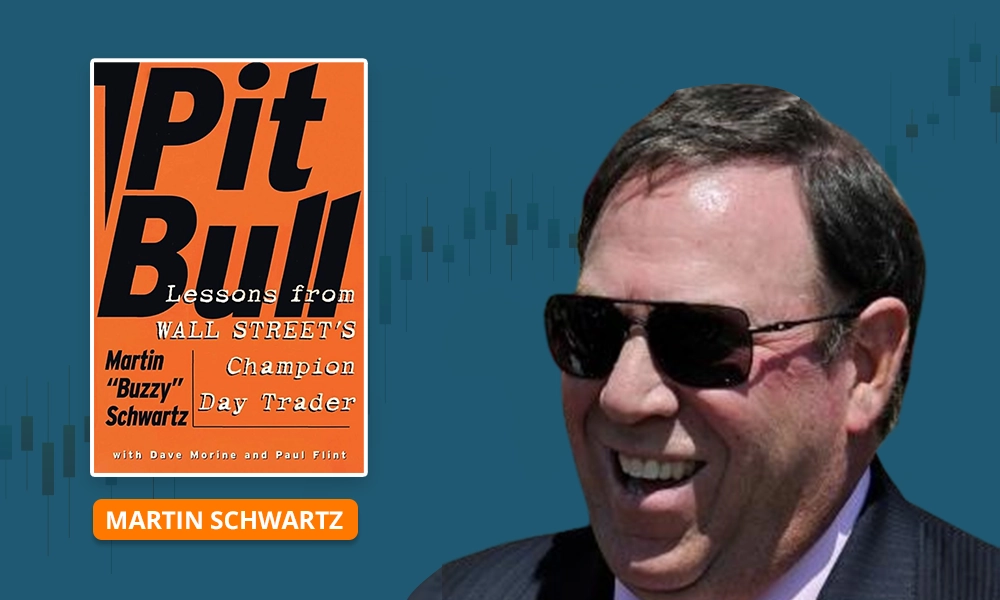
Martin Schwartz’s autobiography, “Pit Bull,” offers invaluable insights for anyone serious about trading, including those evaluating copy traders:
- Find Your Niche: Schwartz excelled at short-term S&P futures trading. Find traders who specialize and have mastered their specific market or strategy.
- Separate Ego from Trading: Don’t let ego drive decisions. Be willing to admit when you’re wrong and cut losses swiftly.
- Importance of Capital Preservation: Before seeking great riches, ensure you don’t lose your stake. Risk management is paramount.
- Hard Work and Preparation: Success requires effort. Schwartz meticulously prepared for each trading day. Look for traders who demonstrate professionalism.
- Adaptability is Key: Markets change. Strategies that work today might not work tomorrow. Seek traders who show evidence of adapting over time.
- Control Your Emotions: Fear and greed are destructive. Discipline and emotional detachment are vital for consistent execution.
- Learn from Losses: Every loss is a lesson. Analyze mistakes to avoid repeating them. A good trader learns and improves.
- Develop a Methodology: Have a clear, repeatable process for entering and exiting trades. Avoid random or impulsive actions.
- Focus on the Process, Not Just Profits: Consistent execution of a sound strategy leads to profits over time. Don’t chase every dollar.
- Know When to Step Away: Recognize when you’re not trading well (due to stress, fatigue, or market conditions) and take a break. Discipline includes knowing when not to trade.
These lessons underscore the importance of discipline, risk management, and a professional approach – hallmarks of potentially reliable copy trade candidates.
Secrets Of Profitable Traders You Can Copy Trade

Stories of quick fortunes fuel dreams of financial freedom. Yet, the stark reality is that consistent profitability in trading is less like a lottery win and more like mastering a demanding craft. Many enter the arena, especially in markets like Forex, treating it like a casino, only to join the sobering statistic: data suggests upwards of 90% of retail traders lose money over time. Why? Often, it’s a lack of strategy, discipline, and crucially, consistency.
But what if you could bypass the grueling years of learning curves, emotional rollercoasters, and costly mistakes? What if you could leverage the hard-won expertise of those who have achieved consistent profitability? This is the promise of copy trading – replicating the trades of seasoned professionals.
Comparing Most Consistent Profitable Traders – Ycbtrader vs. Jeff Ng (SpaceX)
Let’s analyze two hypothetical (but based on common profiles) traders to illustrate the evaluation process. You need this kind of detailed breakdown before committing capital.
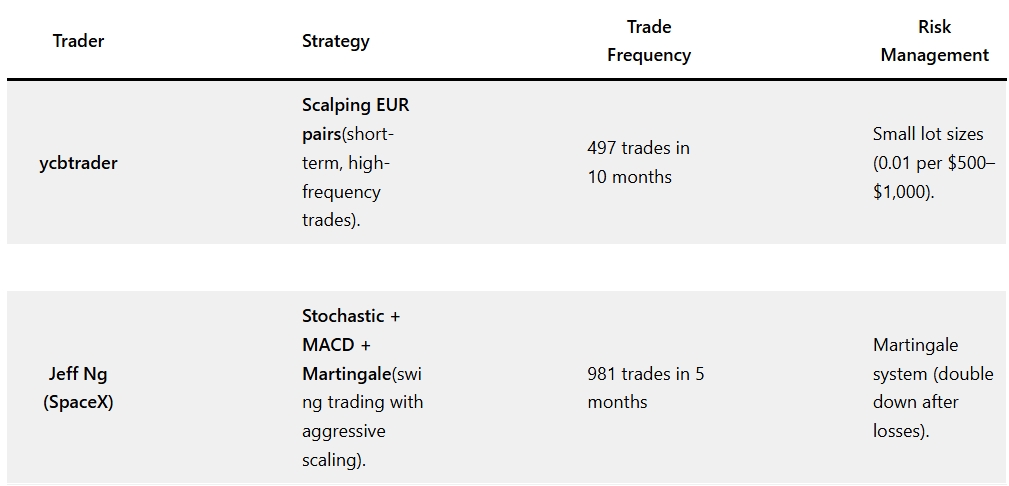
1. Trading Strategy & Style
2. Performance Metrics
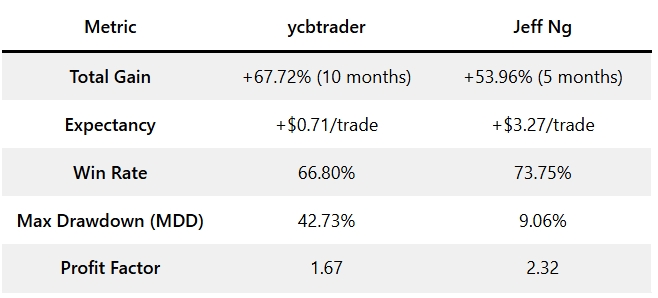
Key Insight: Jeff Ng’s higher expectancy and lower MDD suggest better risk-adjusted returns, but ycbtrader’s longer track record adds stability.
3. Fundamentals Impact
- ycbtrader (EUR Focus):
- Jeff Ng (Gold-Related Pairs):
- Relevant Events: Fed rate cuts, U.S.-China trade tensions, global recession fears.
- Missed Opportunities : If gold surged due to geopolitical crises but Jeff Ng lagged, his indicator-based strategy might struggle during trendless markets.
- Relevant Events: Fed rate cuts, U.S.-China trade tensions, global recession fears.
4. Secret Sauce & Psychology
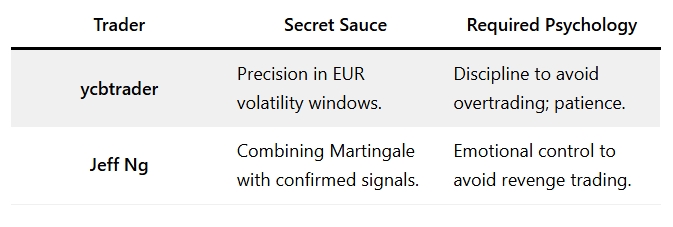
Philosophy:
- ycbtrader : “Capture small, frequent gains through speed and precision.”
- Jeff Ng : “Leverage trends with calculated aggression to maximize profits.”
5. Rules & Trade Plans
- ycbtrader :
- Jeff Ng :
- Entry : Buy when Stochastic <15 + MACD bullish crossover; sell when Stochastic >85 + MACD bearish divergence.
- Martingale : Double position size after a loss; reset to 0.02 lots after a win.
- Rule : Never exceed 2% risk per trade.
- Entry : Buy when Stochastic <15 + MACD bullish crossover; sell when Stochastic >85 + MACD bearish divergence.
6. Long-Term Profitability Factors
- ycbtrader :
- Strength : Consistent win rate and low individual trade risk.
- Weakness : High MDD (42.73%) may erode capital during prolonged EUR weakness.
- Strength : Consistent win rate and low individual trade risk.
- Jeff Ng :
- Strength : High expectancy and diversified portfolio (gold, EUR).
- Weakness : Martingale risks catastrophic loss if losing streak exceeds account equity.
- Strength : High expectancy and diversified portfolio (gold, EUR).
Analysis & Key Insights:
- Risk vs. Reward: Jeff Ng shows significantly better risk-adjusted metrics on the surface: much higher expectancy per trade, higher profit factor, and drastically lower Max Drawdown (MDD). However, this comes with the huge caveat of the Martingale system. Martingale strategies double position size after each loss, aiming to recover losses quickly with a single win. While effective in certain conditions, a prolonged losing streak can wipe out an entire account. The low MDD might be because such a streak hasn’t occurred yet in his shorter track record.
- Consistency & Stability: ycbtrader has a longer track record (10 months vs. 5), suggesting more time-tested consistency. Their scalping strategy with tight stops aims for smaller, more frequent wins. However, the high MDD of 42.73% is a major red flag. It means at some point, their account value dropped by over 42% from its peak. This could indicate periods of struggle or perhaps looser risk management than the stated rules imply.
- Strategy Fit: ycbtrader suits those seeking steady, small gains and who can tolerate (or mitigate via capital allocation) the high historical MDD. Jeff Ng appeals to those seeking higher potential returns and comfortable with the inherent risks of Martingale, trusting his specific implementation and the lower observed MDD so far.
Final Evaluation:
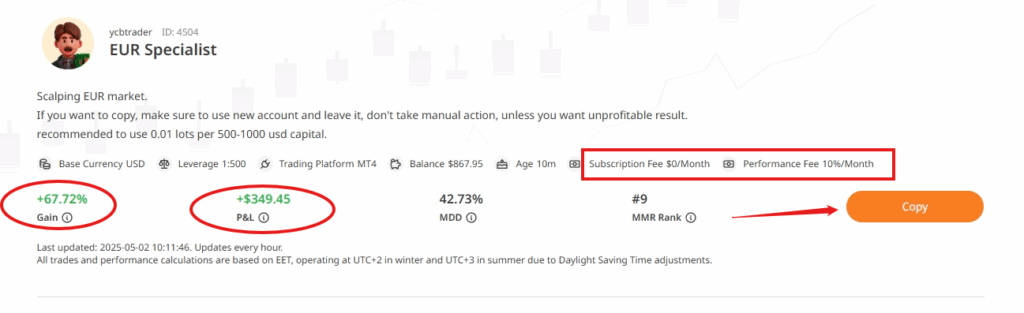
Choose ycbtrader if: You prioritize a longer (though not ideal) track record and a non-Martingale strategy, but you must be comfortable with the high historical drawdown and potentially allocate less capital due to it.
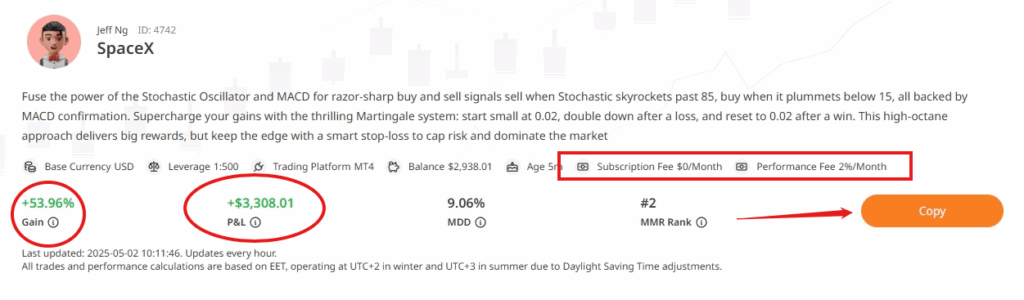
Choose Jeff Ng if: You seek higher potential expectancy and are impressed by the low MDD but fully understand and accept the catastrophic risk potential of the Martingale system. His shorter track record requires extra scrutiny and perhaps a smaller initial allocation.
Crucial Caveat: This is a simplified comparison. Real-world due diligence involves deeper analysis, checking reviews, understanding platform fees, and ideally, backtesting similar strategies if possible. Never copy trade with money you cannot afford to lose.
What Defines a Consistently Profitable Trader?

Identifying these elusive traders requires looking beyond flashy percentage gains. Here are the core pillars:
- Proven Strategy: They have a well-defined trading methodology (e.g., scalping, swing trading, trend following) with clear entry, exit, and risk management rules. They understand why their strategy works and its limitations.
- Iron Discipline: They stick to their plan, even when emotions run high. They avoid impulsive trades, revenge trading (trying to win back losses quickly), and over-leveraging. Discipline is the bedrock of long-term success.
- Robust Risk Management: This is paramount. They know exactly how much they’re willing to risk per trade (often a small percentage of capital, like 1-2%), use stop-loss orders diligently, and understand position sizing. Their focus is on capital preservation first, profits second.
- Psychological Fortitude: They manage fear, greed, hope, and regret. They accept losses as part of the game, learn from mistakes, and maintain confidence without becoming overconfident. They understand market psychology and their own biases. (Investopedia highlights biases like overconfidence and herd behavior).
- Continuous Learning & Adaptation: Markets evolve. A consistently profitable trader never stops learning. They review trades, analyze performance, stay informed about market conditions, and adapt their strategy when necessary.
- Track Record: They have a history of performance, ideally over various market conditions, demonstrating their strategy’s resilience. Look for steady, gradual equity curve growth rather than volatile spikes and crashes.
Why Seek Consistent Profitable Traders for Copy Trading?

Copy trading platforms allow you to automatically replicate the trades of selected “signal providers” or “master traders.” Choosing the right traders – the consistently profitable ones – is crucial. Here’s why it’s appealing:
- Leverage Expertise: Gain access to strategies and market insights that may have taken years to develop. Benefit from the trader’s experience without needing the same level of market knowledge yourself.
- Save Time: Trading requires significant time for research, analysis, and execution. Copy trading automates this, potentially offering a more passive approach (though monitoring is still essential).
- Potential for Returns: By replicating successful strategies, you aim to achieve similar profitability (proportionate to your investment, minus fees).
- Diversification: Copying multiple traders with different strategies and market focuses can diversify your risk, similar to diversifying a traditional investment portfolio.
- Learning Opportunity: Observing a professional trader’s decisions, even passively, can be highly educational. You see real-time application of strategy and risk management.
- Informed Decision-Making: The goal isn’t blind faith. It’s about using transparency (performance stats, trade history) to make informed decisions about who to entrust with replicating trades on your behalf.
It generally takes months, even years, of dedicated effort to master trading. Copy trading offers a potential shortcut, if you approach it correctly by focusing on consistent profitable traders.
Treat Copy Trading Like a Business, Not a Lottery Ticket

The biggest mistake beginners make is viewing copy trading as a “set and forget” path to riches. Success requires a professional mindset:
- Develop a Detailed Plan: Define your goals (realistic return expectations), risk tolerance (how much are you willing to lose?), capital allocation (how much to invest in copy trading?), and trader selection criteria.
- Thorough Due Diligence: Research platforms and potential traders rigorously. Don’t just look at headline returns. Analyze their full track record, maximum drawdown (MDD), risk score, strategy details, trade frequency, and asset focus.
- Take Your Time: Don’t rush into copying the first trader you see with high returns. Patience in selection is vital.
- Pick a Few & Track: Start small, perhaps diversifying across 2-3 traders with different styles. Monitor their performance closely, comparing it against their history and your expectations. Check leaderboards and analytics regularly.
- Ongoing Management: Copy trading isn’t entirely passive. Periodically review performance, adjust allocations, and be prepared to stop copying a trader if their strategy falters or no longer aligns with your goals.
The Mirage of Easy Money: Beginner’s Luck vs. True Consistency
Anyone can get lucky. A few winning trades fueled by market hype or a random tip-off might create a brief, exhilarating sense of mastery. This is beginner’s luck – exciting, but ultimately unsustainable. Like catching a wave perfectly by accident, it’s unlikely to be repeated without understanding the ocean’s currents.
Consistency in trading is not the same as short-term profitability. A trader might have a fantastic week or even a month, riding a specific market trend. But can they replicate that success when market conditions change? Can they navigate choppy waters, manage losing streaks, and stick to their plan when fear or greed creeps in?
- Consistency: Relies on a tested strategy, disciplined execution, rigorous risk management, and adaptability. It’s about the process, not just the outcome of a single trade.
- Beginner’s Luck: Often lacks a solid foundation. Decisions might be impulsive, risk management non-existent, and success heavily dependent on favourable, but temporary, market conditions.
Treating trading like gambling – chasing wins without a plan – is a fast track to depleting capital. Consistent profitable traders understand it’s a game of probabilities, discipline, and long-term edge, not a slot machine.
Copy Trading: An Aggressive Slice of Your Investment Portfolio
It’s vital to position copy trading correctly within your overall financial strategy. It is not a safe alternative to traditional investing like index funds or bonds. Due to the leverage often involved, the potential for rapid strategy failure, and platform risks, copy trading sits firmly on the higher-risk, potentially higher-reward end of the spectrum.
Consider it an aggressive component, allocated only a small percentage of your total investable assets – an amount you are entirely prepared to lose without impacting your core financial security. Think of it like venture capital or speculative stock picks, not your retirement nest egg.
The focus should always be on smarter protection of money. This means:
- Allocating only risk capital.
- Diversifying across multiple well-researched traders (if possible and practical).
- Setting platform-level risk controls if available (e.g., overall stop-loss for copy trading).
- Regularly reviewing and being ready to cut ties with underperforming or unexpectedly risky traders.
Conclusion: Trade Smarter, Not Harder (But Still Smartly)
Finding consistent profitable traders to copy trade offers a compelling potential shortcut in the challenging world of trading. However, it’s not a guaranteed path to profit. Success hinges on shifting from a gambling mindset to a business owner’s perspective.
It requires diligent research, understanding the difference between fleeting luck and genuine consistency, learning from the discipline of masters like Martin Schwartz, carefully analyzing potential traders (like our ycbtrader vs. Jeff Ng example), managing risk rigorously, and treating it as a high-risk component of a diversified investment portfolio.
By focusing on consistent profitable traders with proven strategies, sound risk management, and transparent track records, and by actively monitoring your choices, you can harness the power of copy trading while striving for smarter protection of your hard-earned capital.
Frequently Asked Questions (FAQ)
Q1: Is copy trading really profitable?
A: Copy trading can be profitable if you successfully identify and copy consistent profitable traders and manage risk effectively. However, it’s not guaranteed. Profits depend heavily on the chosen trader’s performance, market conditions, and fees. Significant losses are also possible, especially if copying high-risk strategies or poorly performing traders. Statistics show most retail traders lose money, highlighting the importance of diligence.
Q2: How do I find genuinely consistent profitable traders to copy?
A: Look beyond short-term high returns. Analyze long-term performance (ideally 1 year+), check for a steady equity curve, review the maximum drawdown (MDD – lower is generally better, but understand the context), understand their trading strategy and risk management rules, read user reviews (if available), and consider their consistency across different market conditions. Platforms often provide risk scores and detailed statistics – use them!
Q3: What are the main risks of copy trading?
A: Key risks include:
- Market Risk: The trader you copy can still lose money due to market volatility.
- Strategy Risk: The trader’s strategy might fail or underperform.
- Trader Risk: The trader might deviate from their stated strategy, become emotional, or stop trading.
- Platform Risk: Technical issues or broker insolvency (choose regulated platforms).
- Over-reliance: Blindly copying without understanding can lead to poor decisions.
- High-Risk Strategies: Some traders use risky methods like Martingale, which can lead to large, rapid losses.
Q4: How much money do I need to start copy trading?
A: This varies significantly by platform and the trader you copy. Some platforms allow starting with a few hundred dollars, while others require more. Crucially, only invest risk capital – money you can afford to lose entirely without affecting your financial well-being. Treat it as a high-risk part of your investment portfolio.
Q5: Can I lose more than I invest in copy trading?
A: If using leverage (common in Forex/CFD copy trading), it is technically possible to lose more than your initial deposit, resulting in a negative balance. However, reputable brokers in many jurisdictions offer negative balance protection, preventing this. Always confirm your broker’s policy and understand the risks associated with leverage before starting. Focus on traders and platforms that emphasize strong risk management.
Q6: Should I copy multiple traders?
A: Yes, diversifying by copying 2-4 different traders with varied, uncorrelated strategies (e.g., one scalper, one swing trader, different asset classes) is generally recommended. This spreads risk, so if one trader has a bad period, it might be offset by others. Ensure you still thoroughly research each trader.
For more detailed insights on developing daily trading routines, risk management, and effective position sizing strategies, explore additional articles on Trading Cup. Our trading experts at ACY and FinLogix are also great resources to guide your journey towards trading excellence.

Discover Our Best Trading Signals
At Tradingcup, you can browse through a selection of signals and review past performance before you decide to copy.
Become A Signal Provider
Share your expertise and become a signal provider so other traders can copy your trades.
Stay tuned to our blog for more trader spotlights and leaderboard updates.
Trading involves risks.
Visit the Tradingcup blog through the link below for more updates: https://www.tradingcup.com/learn
Related Copy Trading blogs:
- Understanding Market Liquidations: Liquidity Sweeps and Runs Explained
- 7 Essential Daily Habits of Successful Traders to Outperform Their Peers
- 10 Strategies You Can Copy off Our Best Copy Traders
- 5 Strategies Every Trader Can Master To Trade Better In A Trading Contest
- 2025 Copy Trading Scams Exposed: How to Spot Fraud
- A Swing Trading Strategy with an 83 Percent Win Rate and Low Drawdowns
- Forex Martingale Strategies Explained, The Good, The Bad and The Ugly
- Pyramiding Trading Tutorial – Pros & Cons & How to Use It