Last Updated: February 25, 2026
This article is reviewed annually to reflect the latest market regulations and trends.

Master Copy Trading: Decode Search Filters to Find Winning Traders & Protect Your Capital
Stop gambling, start strategizing. Learn how to use Gain %, MDD, Sharpe Ratio, MMR, and more like a pro analyst to navigate copy trading platforms like TradingCup, eToro, ZuluTrade, and Binance.
Introduction
Copy trading – the siren song of the financial markets. It promises the expertise of seasoned traders delivered directly to your account, potentially generating passive income with minimal effort. Platforms showcase leaderboards brimming with impressive gains, making it seem deceptively simple. But dive beneath the surface, and a complex reality emerges. How do you separate the consistent performers from the flash-in-the-pan gamblers? How do you avoid replicating disastrous losses?
The answer lies in mastering the art and science of search filters. These aren’t just checkboxes on a platform; they are your analytical toolkit, your first line of defense, and your key to unlocking the true potential of copy trading while diligently managing risk. Ignoring them is like navigating a minefield blindfolded. Understanding them empowers you to make informed decisions, much like a savvy investor scrutinizes a company’s financials before buying its stock.
This comprehensive guide, updated for 2026, will equip you with the knowledge to decode copy trading search filters effectively. We’ll break down critical metrics, explain advanced ranking systems like MMR, compare popular platforms, and ultimately show you how to use these tools for smarter investing and better money protection.
“Risk comes from not knowing what you’re doing.”
– Warren Buffett
TL;DR:
- Filters are Non-Negotiable: Don’t blindly copy! Use copy trading search filters (Gain %, MDD, Sharpe Ratio, etc.) to perform due diligence on potential traders.
- Combine Metrics for Clarity: No single filter tells the whole story. Like stock analysis, combine metrics (Profit Factor, Win Rate, Volatility) for a holistic view of a trader’s performance and risk profile.
- Risk Management is Paramount: Prioritize Maximum Drawdown (MDD) and risk-adjusted returns (Sharpe Ratio, Calmar Ratio) over pure profit percentage to protect your capital.
- Platform Filters Differ: Understand the specific search filters and ranking systems (like MMR) used by platforms like TradingCup, eToro, ZuluTrade, and Binance as they vary.
- Diligence is Ongoing: Copy trading isn’t “set and forget.” Continuously monitor performance, review strategy alignment, and don’t hesitate to stop copying if risks increase or goals diverge.
Why Search Filters Are Your Most Valuable Ally in Copy Trading
Imagine walking into a library containing millions of books, looking for one specific piece of information without a catalog system. That’s akin to navigating a copy trading platform without using its search filters. You’re inundated with trader profiles, flashy gain percentages, and enticing promises. Filters are your catalog, your sorting mechanism, your way to:

- Cut Through the Noise: Isolate traders who meet your specific criteria.
- Identify Potential: Sift through thousands to find traders with consistent, risk-managed performance.
- Manage Risk: Screen out traders whose strategies are too volatile or aggressive for your comfort level.
- Save Time: Efficiently narrow down your options instead of manually analyzing hundreds of profiles.
Think of it as sieving for gold. The raw riverbed contains gravel, sand, and maybe, just maybe, some precious metal. Filters are your sieve, helping you wash away the debris and isolate the potential nuggets of consistent profitability.
Decoding the Core Search Filters: Your Trader Analysis Screener
Platforms offer various metrics, but some are fundamental to understanding a trader’s performance and risk profile. Let’s break down the key filters you provided, which represent critical data points:
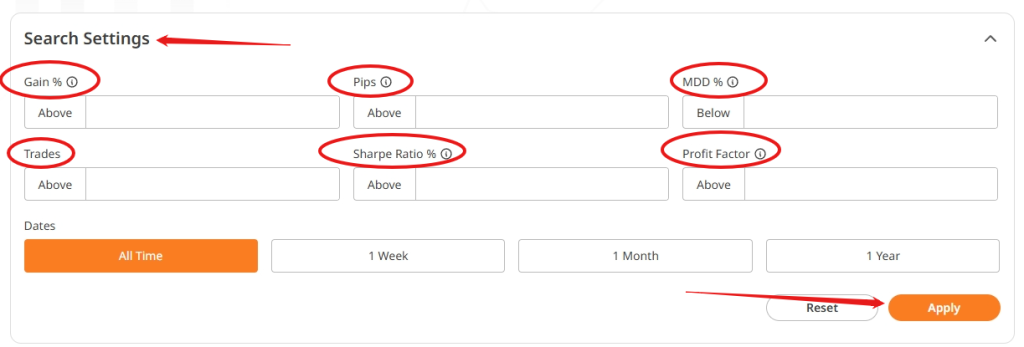
Gain % (Profit/Loss Percentage):
- What it is: Measures the trader’s profitability over a specific period (e.g., 30 days, 90 days, 1 year, all-time). Often calculated as
(Total Profit - Total Loss) / Total Initial Depositsor similar variations reflecting net growth. - Why it matters: The most obvious indicator of profitability.
- Interpretation: Look for consistency over longer periods (1 year+). Astronomical short-term gains (e.g., 500% in a month) can be red flags for extreme risk-taking or luck (survivor bias, as often mentioned in Reddit forums). A steady, positive gain over 12 months or more is generally more reliable.
Pips (Price Interest Points):
- What it is: Pips represent the smallest unit of price movement in forex trading (often used more broadly on some platforms). The filter might show the sum of absolute pips gained or lost across all trades.
- Why it matters: Indicates the volatility and activity level of the trader’s strategy, not direct profitability in account currency terms. A high absolute pip count suggests many trades or trades targeting larger price movements, potentially indicating higher volatility.
- Interpretation: This metric needs context. A high pip count isn’t inherently good or bad. A scalper might accumulate many small pips, while a swing trader targets fewer, larger pip movements. Compare it with Gain % and MDD. High pips with low gain might suggest inefficient trading.
MDD % (Maximum Drawdown):
- What it is: The largest peak-to-trough decline (percentage loss) experienced in the trader’s account equity since inception or over a defined period.
- Why it matters: This is arguably one of the most crucial risk indicators. It shows the worst historical loss streak a trader endured. How much could you have lost if you copied them during their worst period?
- Interpretation: Lower is generally better, indicating effective risk management. An MDD below 15-20% is often considered reasonable, while conservative investors might look for <10%. An extremely high MDD (e.g., >40-50%), even with high gains, signals a very risky strategy prone to significant losses.
Trades:
- What it is: Simply the total number of trades executed over a period.
- Why it matters: Indicates the trader’s frequency and style.
- Interpretation: High trade counts often point to scalpers or day traders, while lower counts suggest swing or position traders. Consider this alongside average trade duration (if available). High frequency isn’t necessarily better; it can incur higher transaction costs (spreads/commissions) for the copier. Ensure the style aligns with your expectations.
Sharpe Ratio %:
- What it is: A measure of risk-adjusted return. It calculates the average return earned in excess of the risk-free rate per unit of volatility (standard deviation). Essentially, how much return did the trader generate for the level of risk taken?
- Why it matters: Helps compare traders who might have similar returns but different risk levels. A higher Sharpe Ratio indicates better performance for the amount of risk assumed.
- Interpretation: Higher is better. A Sharpe Ratio above 1 is generally considered good, above 2 is very good, and above 3 is excellent. Negative ratios indicate the trader underperformed the risk-free rate.
Profit Factor:
- What it is: Measures the gross profit generated relative to the gross loss. Calculated as
Total Winnings / Total Losses. - Why it matters: Shows the overall profitability efficiency of the trading system.
- Interpretation: A Profit Factor greater than 1 indicates profitability. Higher values are better. A Profit Factor of 2 means the trader made twice as much on winning trades as they lost on losing trades. A value below 1 means the strategy is losing money overall. Look for values comfortably above 1 (e.g., >1.5).
The Power of Layering: Thinking Like a Stock Analyst
Looking at any single filter in isolation is dangerous. A trader might boast a 300% Gain, but if their MDD is 70%, are you comfortable with that level of risk? Another might have a 90% win rate, but if their Profit Factor is 1.1, it means their few losses are almost wiping out their many small wins.

This is where combining filters becomes crucial. It’s directly analogous to fundamental analysis when choosing stocks. You wouldn’t invest in a company based only on its revenue growth. You’d also examine:
- Net Profit Margins: (Similar to Profit Factor – efficiency)
- CAGR (Compound Annual Growth Rate): (Similar to consistent Gain % over time)
- Debt-to-Equity Ratio: (Similar to MDD – risk level)
- Operational Costs: (Related to trading costs/frequency)
- Management Quality & Strategy: (Trader’s stated strategy, transparency)
By layering filters, you compound your chances of a favorable outcome:
- High Gain % + Low MDD % + High Sharpe Ratio: Suggests strong, risk-managed returns.
- Consistent Win Rate (>60%) + Profit Factor (>1.5): Indicates efficient profitability.
- Reasonable Trade Frequency + Clear Strategy Description: Helps ensure alignment with your expectations and avoids overly costly high-frequency strategies.
Beyond Manual Search: Pre-Filtered Lists & The MMR System
Many platforms offer pre-filtered lists to simplify discovery. Understanding their logic is key:
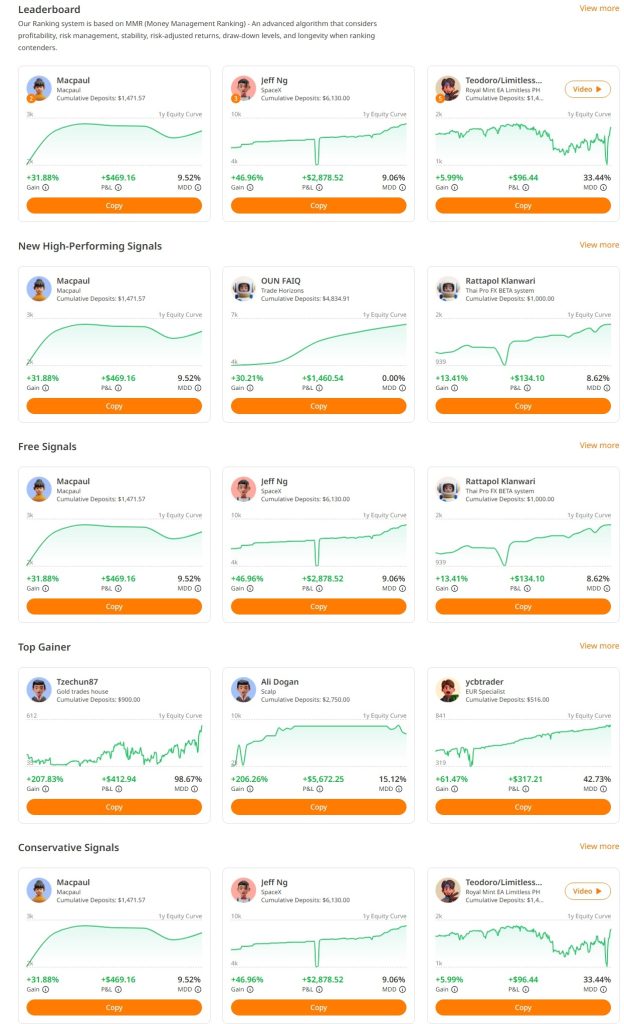
- Leaderboard: Often based on an MMR (Money Management Ranking) system or similar composite score, ranking traders holistically over their entire history.
- New High-performing Signals: Focuses on newer traders (e.g., < 1 year) showing positive Gain %. Good for finding emerging talent, but requires caution due to shorter track records.
- Top Gainer: Purely ranks by Gain % over a period (e.g., 1 year), often filtering for positive gain. Use with caution – high gain can mean high risk. Always check MDD and Sharpe Ratio here.
- Conservative Signals: Filters for low risk, typically using a Maximum Drawdown threshold (e.g., <= 10% over 1 year) and often ranked by MMR within that subset. Ideal for risk-averse investors.
- Comprehensive Strategies: Attempts to filter based on the quality and detail of the trader’s strategy description (looking for non-generic, non-volatile approaches like Martingale) combined with positive Gain %.
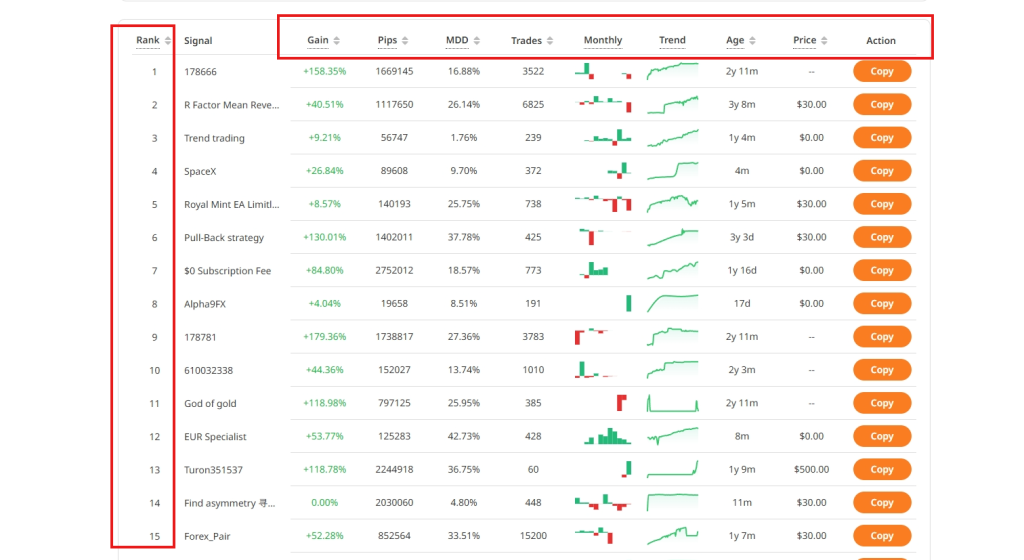
Decoding the MMR System: A Holistic View TradingCup’s Logic
TradingCup use sophisticated MMR systems to rank traders based on multiple factors, aiming for consistency and risk awareness. Let’s break down the logic provided, illustrating how a multi-faceted approach works:
Winning Percentage:
- Measures: % of profitable trades.
- Weighting: Moderate (avoids rewarding pure luck).
- Target: Aim for >60% combined with low volatility.
Profit vs. Loss Ratio (or Profit Factor):
- Measures: Risk efficiency (how much gained per unit risked/lost).
- Weighting: High (critical for long-term profitability).
- Target: Prioritize traders with ratios >1.5.
Total Return:
- Measures: Overall profitability.
- Benchmark: Compared against platform average to contextualize performance.
Maximum Drawdown:
- Measures: Worst historical loss.
- Red Flag: Penalizes traders exceeding a threshold (e.g., 20%).
- Target: Seek lower MDD (<15-20%).
Sharpe Ratio:
- Measures: Risk-adjusted returns.
- Sweet Spot: Top traders often maintain >1.5.
Calmar Ratio:
- Measures: Return relative to Max Drawdown (
Annualized Return / Max Drawdown). Favors strategies resilient to crashes. - Significance: A ratio >3 signals strong recovery ability relative to risk taken.
Standard Deviation:
- Measures: Performance consistency/volatility.
- Priority: Lower volatility (e.g., <10-15%) often gets higher rankings, indicating stability.
An MMR system synthesizes these metrics, providing a more balanced view than any single filter alone. Understanding its components helps you interpret rankings effectively.
Platform Comparison: Filters Across TradingCup, eToro, ZuluTrade, and Binance
While core concepts apply universally, the specific filters, presentation, and emphasis can differ across platforms:

- eToro:
- Strengths: Pioneer in social/copy trading, very user-friendly interface, large user base, strong social interaction features (feeds, comments), CopyPortfolios (thematic investments). Regulated in multiple jurisdictions. Offers stocks, ETFs, crypto, forex, commodities.
- Filters: Performance (various timeframes), Risk Score (proprietary 1-10 rating), number of copiers, allocation, active weeks, average trade size, preferred assets. Filters for location and verification status.
- Considerations: Minimum copy amount ($200), minimum per trade ($1). Fees include spreads, overnight fees, and potential inactivity fees. Some Reddit users question the transparency/impact of fees on copier returns vs. Popular Investor returns and the vetting process for traders.
- ZuluTrade:
- Strengths: Focuses heavily on connecting signal providers (Leaders) with investors across various brokers. High transparency with detailed performance statistics. Offers a simulation tool to test a Leader’s strategy against your account settings. Strong community features and rankings.
- Filters: ROI, Drawdown, Win Rate, average pips, weeks trading, number of followers, max open trades, assets traded (Forex focus but others available). Proprietary ZuluRank algorithm.
- Considerations: Primarily a platform connecting brokers and traders; requires linking to a compatible brokerage account. Focus is often on Forex CFDs.
- Binance Copy Trading:
- Strengths: Leverages Binance’s massive cryptocurrency exchange infrastructure, high liquidity, vast selection of crypto futures contracts. Potentially lower fees for crypto trading compared to non-specialist platforms.
- Filters: PNL (Profit and Loss), ROI, MDD, AUM (Assets Under Management), Sharpe Ratio, number of copiers, trading days. Filters for futures contracts (e.g., USDT-M, COIN-M).
- Considerations: Primarily focused on crypto derivatives (futures), which are inherently high-risk due to leverage. Regulatory landscape for Binance varies by region. UI might be complex for beginners compared to eToro. Vetting of lead traders might be less rigorous than platforms with longer track records in curated copy trading.
Key Differences Summary:
- Asset Focus: Binance (Crypto Futures) vs. eToro (Multi-Asset) vs. ZuluTrade (Forex Strong, others via CFDs).
- User Experience: eToro (Very beginner-friendly) vs. ZuluTrade (Data-rich, analytical) vs. Binance (Exchange-integrated, potentially complex).
- Unique Features: eToro (Social Feed, CopyPortfolios) vs. ZuluTrade (Simulation, ZuluRank) vs. Binance (Deep crypto liquidity).
- Risk Emphasis: All show MDD, but eToro’s Risk Score is prominent, ZuluTrade offers deep analytics, Binance operates in the high-risk crypto futures space.
Always explore the specific filters and data available on your chosen platform before committing capital.
Beyond Filters: Smarter Money Protection Strategies
Filters are powerful, but they aren’t a magic bullet. True success in copy trading requires a broader risk management framework:

- Diversification: Don’t put all your eggs in one basket. Copy multiple traders, ideally with different, uncorrelated strategies and risk profiles. Copying five high-risk crypto scalpers isn’t true diversification.
- Capital Allocation: Start small. Only allocate a portion of your investment capital you can afford to lose, especially when starting. Decide how much to allocate per trader.
- Stop-Loss on Copying: Many platforms allow you to set a “copy stop-loss” – an overall loss level on your copied investment for a specific trader, at which point the platform automatically stops copying them and closes open positions.
- Regular Monitoring & Review: Copy trading is not passive income you can completely ignore. Schedule regular check-ins (e.g., weekly or monthly) to:
- Review the trader’s recent performance and risk metrics (have they changed?).
- Assess if their strategy still aligns with your goals and risk tolerance.
- Read any updates or communications from the trader.
- Check platform fees and their impact.
- Understand the Costs: Factor in spreads, commissions, overnight fees, and any platform-specific copy trading fees. These erode profits, especially for high-frequency strategies. Reddit discussions often highlight how fees impact copiers more than lead traders benefiting from rebates.
- Beware of Survivor Bias: Platforms naturally highlight top performers. Remember that past performance is not indicative of future results. Many “star” traders disappear after a bad run. Focus on long-term consistency and risk management over short-term explosive gains.
- Manage Emotions: Avoid FOMO (Fear Of Missing Out) chasing traders with recent huge gains. Stick to your predefined criteria and risk tolerance. Don’t panic-stop copying during minor drawdowns if the trader’s overall stats still meet your criteria.
Conclusion: Taking Control of Your Copy Trading Journey
Copy trading offers a compelling proposition, but success hinges on informed decision-making, not blind faith. Search filters are your essential tools for conducting due diligence, assessing risk, and identifying traders whose strategies align with your financial goals.
By understanding metrics like Gain %, MDD, Sharpe Ratio, and Profit Factor, appreciating the nuances of composite rankings like MMR, comparing filter availability across platforms like eToro, ZuluTrade, and Binance, and implementing robust risk management practices like diversification and copy stop-losses, you transform copy trading from a gamble into a calculated strategy.
Mastering these filters empowers you to navigate the complexities of the market, protect your hard-earned capital, and increase your probability of achieving sustainable results. Start exploring the filters on your chosen platform, perhaps with a demo account first, and commit to continuous learning and vigilant monitoring. Your financial future is worth the effort.
Frequently Asked Questions (FAQ)
Q1: What is the single most important filter in copy trading?
A: While all filters provide context, Maximum Drawdown (MDD) is arguably the most critical for risk assessment. It quantifies the worst potential loss based on history, directly impacting capital preservation. However, it should always be considered alongside performance metrics like Sharpe Ratio and consistent Gain %.
Q2: Can I lose money even if I use search filters carefully?
A: Yes. Copy trading involves significant risk. Past performance does not guarantee future results. Even well-filtered, historically successful traders can experience losing periods due to market volatility, strategy drift, or unforeseen events. Filters improve your selection process but don’t eliminate risk.
Q3: How much money do I need to start copy trading?
A: This varies significantly by platform. Some, like eToro, have minimums around $200 to start copying. Others might require linking to broker accounts with their own minimums. Crucially, only invest capital you can afford to lose. Start small to understand the process.
Q4: Is a higher Gain % always better when choosing a trader?
A: No. Extremely high gains often correlate with extremely high risk (high MDD, low Sharpe Ratio). Prioritize consistent, risk-adjusted returns over short-term explosive gains. Look for steady growth combined with acceptable risk levels.
Q5: How often should I review the traders I am copying?
A: Don’t “set and forget.” Review performance and risk metrics at least weekly or bi-weekly, and conduct a more thorough review monthly. Check if the trader’s risk profile or strategy has changed significantly and if it still aligns with your goals.
Q6: What is a good win rate for a copy trader?
A: While higher is generally better, context matters. A win rate above 60% is often considered good, but it needs to be paired with a strong Profit Factor (>1.5). A trader winning 90% of trades but losing big on the remaining 10% might still be unprofitable or very risky.
For more detailed insights on developing daily trading routines, risk management, and effective position sizing strategies, explore additional articles on Trading Cup. Our trading experts at ACY and FinLogix are also great resources to guide your journey towards trading excellence.

Discover Our Best Trading Signals
At Tradingcup, you can browse through a selection of signals and review past performance before you decide to copy.
Become A Signal Provider
Share your expertise and become a signal provider so other traders can copy your trades.
Stay tuned to our blog for more trader spotlights and leaderboard updates.
Trading involves risks.
Visit the Tradingcup blog through the link below for more updates: https://www.tradingcup.com/learnBest blogs top 8 code to use if needed.
Related Copy Trading blogs:
- Understanding Market Liquidations: Liquidity Sweeps and Runs Explained
- 7 Essential Daily Habits of Successful Traders to Outperform Their Peers
- 10 Strategies You Can Copy off Our Best Copy Traders
- 5 Strategies Every Trader Can Master To Trade Better In A Trading Contest
- 2025 Copy Trading Scams Exposed: How to Spot Fraud
- A Swing Trading Strategy with an 83 Percent Win Rate and Low Drawdowns
- Forex Martingale Strategies Explained, The Good, The Bad and The Ugly
- Pyramiding Trading Tutorial – Pros & Cons & How to Use It