Last Updated: February 25, 2026
This article is reviewed annually to reflect the latest market regulations and trends.
TL;DR: AI Revolutionizing Copy Trading in 2026
- Smarter Trader Selection & Risk Management: Machine Learning (ML) elevates AI Copy Trading by deeply analyzing trader performance and risk profiles, enabling superior selection and dynamic risk management crucial for navigating 2026’s markets.
- Predictive Power Beyond Copying: Copy Trading in 2026 leverages AI for predictive analysis, anticipating market reactions to news and trends, shifting from simple replication to proactive, smarter investing.
- Enhanced Capital Protection: A major AI advantage is strengthened capital protection via automated scam detection, filtering manipulation, and objective pattern recognition, promoting rational decisions over emotional trading.
- Personalized AI Guidance: AI Copy Trading platforms now offer personalized insights based on user goals and risk tolerance, plus AI tools that accelerate understanding of complex trading strategies for more informed choices.
- Accessible Advanced Tools: The competitive AI landscape makes sophisticated Machine Learning tools (better analytics, faster processing) increasingly available on copy trading platforms, empowering both signal providers and copiers for safer, more efficient trading in 2026.
Disclaimer: The information in this article is for educational purposes only and does not constitute financial, investment, or trading advice. Copy trading carries substantial risks, including the potential loss of your entire invested capital. Past performance of copied traders or strategies is not a reliable indicator of future results. You may be replicating high-risk trades, overleveraged positions, or strategies incompatible with your financial goals. Always conduct independent research into a trader’s historical performance, risk metrics, and strategy before copying them. Never invest funds you cannot afford to lose. Consult a licensed financial advisor to ensure copy trading aligns with your risk tolerance, financial objectives, and regulatory requirements in your jurisdiction. This article does not endorse specific traders, platforms, or strategies, and all trading decisions remain your sole responsibility.

“Risk comes from not knowing what you’re doing.” – Warren Buffett
AI’s Revolutionizing Copy Trading in 2026: Trading Smarter, Protecting Capital
The financial markets are a relentless ocean of data, constantly shifting with economic tides, geopolitical currents, and waves of human sentiment. Navigating these waters has always been challenging, especially for individual investors. Copy trading emerged as a popular lifeboat, allowing novices and time-strapped traders to mirror the strategies of seasoned professionals. But in 2026, a powerful new engine is being fitted to this lifeboat: Machine Learning (ML).
Forget simple automation. We’re entering an era where AI isn’t just executing trades; it’s enhancing intuition, uncovering hidden patterns, predicting market squalls, and fundamentally revolutionizing copy trading into a smarter, safer endeavor. This isn’t science fiction; it’s the cutting edge of fintech, transforming how we approach market participation and, crucially, how we protect our hard-earned capital.
This deep dive explores how Machine Learning is reshaping the copy trading landscape in 2026, moving beyond basic replication to offer predictive insights, enhanced risk management, personalized guidance, and robust defense against scams. Get ready to discover how AI is empowering traders, from the seasoned expert to the curious beginner, to navigate the markets with unprecedented intelligence and security.
First, A Quick Refresher: What is Copy Trading?
Before diving into the ML revolution, let’s briefly revisit the concept. Copy trading allows users on specific platforms (like TradingCup, eToro, Binance Copy Trading, AvaTrade, ZuluTrade, and many others emerging in 2026) to automatically replicate the trades executed by selected, experienced traders (often called signal providers or lead traders).

Traditional Copy Trading:
- Mechanism: Link your account to a chosen trader. Their trades are automatically copied in your account in real-time, often proportionally to your allocated funds.
- Appeal: Lowers the barrier to entry for beginners, saves time on research, provides learning opportunities by observing experts, and allows for diversification across different strategies.
- Challenges: Success heavily relies on picking the right trader. Past performance isn’t a guarantee. You inherit the trader’s risks and potential biases. Market volatility can impact even good strategies. Over-reliance on a single trader is a significant risk.
Copy trading democratized access to trading strategies, but its effectiveness was often limited by human factors and the sheer complexity of market analysis. This is precisely where Machine Learning steps in.
The Algorithm Awakens: Machine Learning in the Financial Arena
Machine Learning, a subset of Artificial Intelligence (AI), isn’t about creating sentient robots; it’s about building systems that can learn from data, identify patterns, and make decisions or predictions with minimal human intervention. Think of it as training a computer to develop its own expertise by feeding it vast amounts of information.

In finance, AI algorithms sift through mountains of data – historical prices, trading volumes, economic reports, news articles, social media chatter, even regulatory filings – orders of magnitude faster and more comprehensively than any human analyst.
Key AI Approaches Used:
- Supervised Learning: Training models on labeled data (e.g., historical trades labeled as ‘profitable’ or ‘loss-making’) to predict future outcomes.
- Unsupervised Learning: Finding hidden patterns and structures in unlabeled data (e.g., clustering traders with similar risk profiles or identifying previously unknown market correlations).
- Reinforcement Learning: Training models to make sequences of decisions by rewarding actions that lead to desired outcomes (e.g., optimizing a trading strategy over time).
Finance is the perfect playground for AI due to its data-rich environment and the constant search for predictive edges. In 2026, AI is no longer experimental; it’s a core component of sophisticated trading operations.
The AI Revolution in Copy Trading: More Than Just Mirroring
Machine Learning injects intelligence into every stage of the copy trading process, transforming it from passive mirroring into an actively optimized strategy.

- Smarter Trader Selection: Forget relying solely on simple return percentages. AI algorithms analyze potential signal providers on a much deeper level:
- Consistency Analysis: Identifying traders who perform well across various market conditions, not just during specific trends.
- Risk-Adjusted Returns: Evaluating performance relative to the risks taken (e.g., Sharpe ratio, Calmar ratio analysis over time).
- Behavioral Pattern Recognition: Detecting subtle signs of high-risk behavior, over-leveraging, or strategy drift before significant losses occur.
- Predictive Performance Modeling: Using past data to forecast the likelihood of future success under current market projections.
- Dynamic Risk Management: AI doesn’t just copy stop-losses; it anticipates risk.
- Volatility Adaptation: Automatically adjusting copied trade sizes or leverage based on real-time market volatility predictions.
- Correlation Monitoring: Warning copiers if multiple traders they follow suddenly exhibit highly correlated (and thus, risky) behavior.
- Predictive Stop-Losses: Suggesting optimal stop-loss levels based on predicted price movements and volatility, not just arbitrary percentages.
- Optimized Portfolio Allocation: AI helps copiers build a more resilient portfolio of traders.
- Diversification Analysis: Recommending a mix of traders with different, non-correlated strategies to smooth out equity curves.
- Capital Allocation Suggestions: Advising how much capital to allocate to each trader based on their risk profile, predicted performance, and the copier’s overall goals.
Essentially, AI acts as an intelligent layer between the signal provider and the copier, filtering, analyzing, and optimizing the process for better potential outcomes and stronger capital protection.
Empowering the Elite: AI as the Top Trader’s Co-Pilot
While often discussed in the context of helping beginners, AI is also a powerful tool for the very traders being copied. The best signal providers in 2026 are increasingly leveraging AI as an analytical co-pilot to augment their own expertise.

- Information Overload Solved: Human traders can only process so much. AI systems scan and synthesize global news, economic data releases, earnings reports, social media sentiment, and technical indicators simultaneously, highlighting information the trader might have missed.
- Strategy Validation & Refinement: An AI model can backtest a trader’s strategy across decades of historical data in minutes, identifying weaknesses or optimal parameters the trader hadn’t considered. It can flag when market conditions no longer favor a previously successful strategy.
- Identifying Subtle Opportunities/Risks: AI can detect faint market signals or inter-market correlations that are not immediately obvious, suggesting trades or warning of impending risks that fall outside the trader’s usual focus.
For top traders, AI isn’t a replacement; it’s a force multiplier, handling the heavy data lifting and providing insights that sharpen their edge, leading to potentially more robust and reliable signals for copiers.
Seeing Beyond the Noise: AI Uncovers Real Patterns, Not Wishful Thinking
Humans are prone to biases: confirmation bias (seeing patterns that confirm existing beliefs), recency bias (overweighting recent events), and finding patterns in randomness (pareidolia). We often engage in “wishful thinking” trading, hoping a pattern will play out.
Machine Learning operates differently. It approaches data objectively, identifying statistically significant patterns, correlations, and anomalies that the human eye (or biased mind) would miss.
- Complex Non-Linear Relationships: Markets aren’t always linear. AI excels at modeling complex relationships between variables (e.g., how oil price changes affect specific airline stocks under certain VIX levels).
- Microstructure Analysis: Analyzing order book flow, bid-ask spread dynamics, and high-frequency trading patterns to predict short-term price movements – patterns invisible in standard charts.
- Cross-Asset Correlation Discovery: Identifying leading/lagging relationships between seemingly unrelated assets (e.g., a specific commodity price change preceding movement in an emerging market currency).
AI acts like a financial microscope, revealing intricate market structures hidden beneath the surface noise. This allows for strategies based on quantifiable probabilities rather than gut feelings, forming a cornerstone of smarter investment protection.
Predicting the Unpredictable? AI, News, and Geopolitical Tremors
Can AI predict the future? No. Can it analyze vast amounts of information to predict the probable market reaction to events? Increasingly, yes. This is particularly relevant in 2025, navigating a complex global landscape.
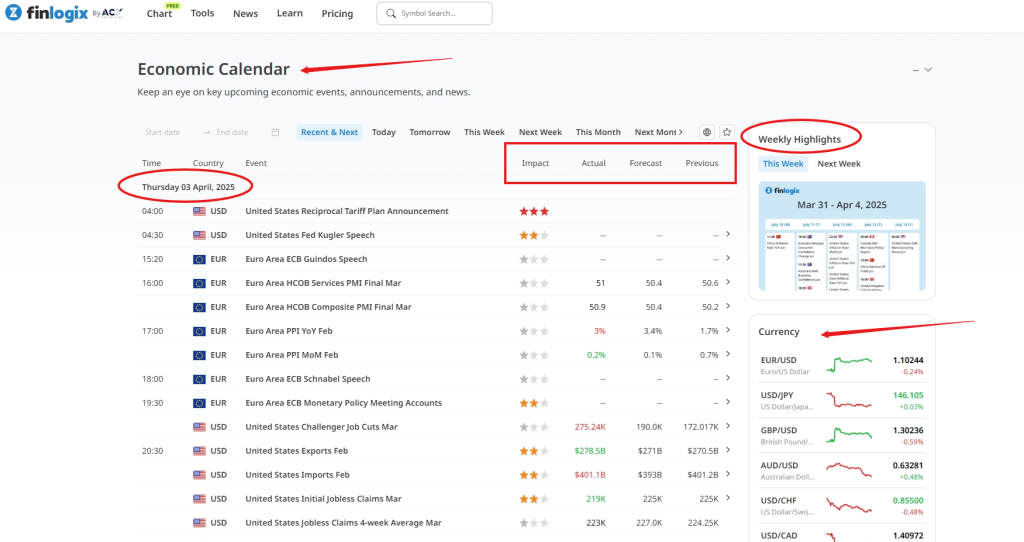
- News & Sentiment Analysis: Natural Language Processing (NLP), a branch of AI, allows machines to understand the sentiment (positive, negative, neutral) and key topics within news articles, social media posts, and financial reports in real-time. Platforms can analyze headlines and social media chatter to gauge market mood shifts often before they fully reflect in prices.
- Event Impact Modeling: AI models can be trained on historical data to predict how specific types of news (e.g., interest rate decisions, inflation reports, election results, geopolitical flare-ups) typically impact different asset classes.
- Navigating Political Volatility (e.g., Trump Administration): The current political climate, including policies from the Trump administration focusing on deregulation, tariffs, and significant AI infrastructure spending (“Stargate” initiative), creates both opportunities and risks. AI helps traders navigate this by:
- Analyzing policy documents, official statements, and even tweets for sentiment and potential market impact.
- Identifying sectors likely to benefit (e.g., tech involved in AI projects, domestic industries shielded by tariffs) or suffer (e.g., companies reliant on disrupted supply chains).
- Modeling the potential impact of deregulation (or re-regulation) on specific industries.
- Assessing the risk associated with leveraged positions in stocks or ETFs highly sensitive to political news flow or trade tensions.
AI provides a data-driven framework for assessing the probable impact of news and political shifts, helping traders (and by extension, copiers) make more informed decisions, especially critical when using leverage. It’s about anticipating reactions, not predicting events themselves, adding another layer of intelligent risk management.
The AI Arms Race: A Sharper Sword for Copiers
The field of Artificial Intelligence is fiercely competitive. Tech giants, fintech startups, and academic institutions are constantly pushing the boundaries, leading to an “AI arms race.” This relentless innovation directly benefits copy traders.
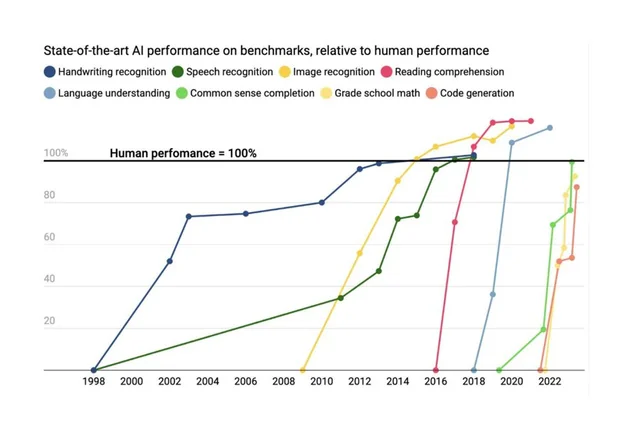
AI performance on benchmarks relative to human performance
- Better, Faster Algorithms: Competition drives the development of more accurate predictive models, faster data processing, and more sophisticated analysis techniques.
- Cheaper Access: As AI technology matures, the cost of implementing AI solutions decreases, making powerful tools accessible on more copy trading platforms, not just institutional hedge funds.
- Increased Computing Power: Cloud computing and specialized hardware make the immense computational power needed for complex AI models more readily available.
- Democratization of Tools: Features that were once exclusive to high-end quantitative funds, like advanced risk modeling and sentiment analysis, are becoming standard offerings on leading copy trading platforms in 2026.
This competitive landscape ensures that the AI tools available to copy traders will only get better, faster, and more integrated, continuously enhancing the potential for smarter trading and better money protection.
Your Digital Shield: AI for Scam and Fake News Detection
The digital age has amplified the spread of misinformation, and the financial world is a prime target. Scams, pump-and-dump schemes promoted on social media, and fake news designed to manipulate market sentiment pose significant risks to investors. Machine Learning is becoming a critical line of defense.
- Identifying Fraudulent Signals: AI algorithms can analyze the trading patterns and communication styles of signal providers, flagging those exhibiting characteristics associated with known scams (e.g., unrealistic promises, inconsistent high-risk trades masked as safe).
- Spotting Market Manipulation: AI can detect unusual trading volumes, coordinated social media activity, or news patterns indicative of pump-and-dump schemes or other manipulation attempts.
- Fake News Filtering: NLP models are being trained to assess the credibility of news sources and identify articles containing disinformation likely aimed at influencing investment decisions.
- Platform Security: AI is also used behind the scenes by platforms to detect fraudulent account creation, unauthorized access attempts, and other security threats.
By automatically filtering out noise, manipulation, and outright fraud, AI acts as a digital shield, protecting copy traders’ capital from malicious actors and ensuring decisions are based on more reliable information.
Your Personalized Trading Compass: AI-Generated Insights
Generic market commentary has limited value. The true power of AI lies in its ability to provide personalized guidance tailored to the individual copy trader’s needs and circumstances.

- Tailored Recommendations: Based on your stated risk tolerance, investment goals, time horizon, and existing portfolio, AI can suggest:
- Suitable traders to copy.
- Optimal capital allocation across different strategies.
- Relevant market news and analysis.
- Personalized Alerts: Receive notifications about events specifically impacting the traders you copy or the assets relevant to their strategies.
- Performance Attribution: Understand why your copy trading portfolio is performing the way it is, with AI breaking down contributions from different traders and market factors.
- AI Investment Summaries (Daily/Weekly/Monthly): Imagine a concise, AI-generated summary delivered to you, highlighting the most important market happenings, potential impacts on your copied traders, and upcoming events relevant to you.
This hyper-personalization transforms copy trading from a one-size-fits-all approach to a bespoke experience, empowering users with relevant, actionable intelligence for more confident and protected investing.
Accelerated Learning Curve: Mastering Strategies with AI
Copy trading offers a chance to “earn while you learn,” but understanding the underlying strategies is crucial for long-term success and risk management. AI is becoming a powerful educational tool.
- Strategy Deconstruction: AI can analyze a signal provider’s trades and explain the likely strategy being employed (e.g., “This trader appears to be using a mean-reversion strategy on EUR/USD, often entering after RSI divergence”).
- AI-Powered Backtesting: Users can experiment with strategy parameters or different trader combinations and use AI to simulate historical performance quickly.
- Identifying Strengths/Weaknesses: AI can analyze your own (or copied) trading patterns to highlight areas for improvement or common mistakes.
- Understanding Complex Concepts: AI assistants or chatbots integrated into platforms can explain trading concepts like breakout strategies, risk management techniques, or technical indicators in an easy-to-understand way.
By making complex strategies more transparent and providing tools for experimentation and understanding, AI helps copy traders make more informed decisions about who to copy and why, ultimately leading to better self-directed risk management.
Smarter Protection: The Ultimate Dividend of AI in Copy Trading
While the potential for enhanced returns is attractive, perhaps the most profound impact of Machine Learning on copy trading in 2026 is the significant boost to capital protection. This theme runs through all the applications we’ve discussed:

- Proactive Risk Assessment: Identifying risky traders or strategies before they blow up.
- Dynamic Adjustments: Adapting to changing market volatility automatically.
- Fraud and Scam Filtration: Shielding capital from manipulation and bad actors.
- Emotional Detachment: Relying on data-driven insights reduces impulsive decisions driven by fear or greed.
- Informed Decision-Making: Understanding the ‘why’ behind trades and strategies leads to better choices.
Think of AI in copy trading as installing a sophisticated suite of safety features – predictive braking, lane assist, blind-spot monitoring, and robust security systems – for your investment journey. The goal isn’t just speed; it’s arriving at your financial destination safely.
Choosing Your Navigator: Selecting an AI-Powered Copy Trading Platform in 2026
As AI becomes more integrated, platforms will increasingly differentiate themselves based on their AI capabilities. When choosing a platform, consider:
- Transparency: Does the platform explain how it uses AI (even broadly)? Are trader assessment metrics clear?
- Risk Management Tools: Look for robust, customizable risk controls (e.g., AI-suggested stop-losses, portfolio-level drawdown limits).
- Performance Metrics: Are traders evaluated using sophisticated, risk-adjusted metrics powered by AI?
- Personalization Features: Does the platform offer AI-driven insights or recommendations tailored to you?
- Security: Ensure the platform employs strong security measures, potentially including AI-based fraud detection.
- User Interface: Complex tools should still be presented in an intuitive way.
Explore our guide to the Top AI-Powered Copy Trading Platforms of 2026
The Road Ahead: Challenges and the Future Horizon
Despite the immense potential, challenges remain:

- Algorithm Opacity (‘Black Box’ Problem): Understanding why an AI model makes a specific decision can be difficult, hindering trust and oversight.
- Overfitting: Models trained too closely on past data may fail when market conditions change significantly.
- Data Quality: AI models are only as good as the data they are trained on. Biased or incomplete data can lead to poor outcomes.
- Ethical Concerns: Potential for algorithmic bias or AI being used for market manipulation.
- Regulation: The regulatory landscape for AI in finance is still evolving globally, with varying approaches (e.g., US focus on innovation vs. EU focus on risk tiers).
- Need for Human Oversight: AI is a tool, not a replacement for human judgment and critical thinking.
The future likely holds deeper integration, more predictive power through techniques like deep learning, even more sophisticated personalization, and potentially AI agents managing diversified portfolios of copy trading strategies autonomously based on user goals.
Conclusion: The Dawn of Intelligent Copy Trading
Machine Learning is not just adding a layer of gloss to copy trading; it’s fundamentally rebuilding the engine. In 2026, the narrative has shifted from simply mimicking successful traders to leveraging AI for smarter selection, dynamic risk management, predictive insights, personalized guidance, and robust capital protection.
The revolution lies in empowering all traders – signal providers enhancing their edge, beginners navigating complex markets more safely, and experienced investors optimizing their portfolios – with tools previously available only to elite institutions. It’s about making data-driven decisions, filtering out noise and manipulation, and ultimately, fostering a more intelligent and secure approach to participating in the financial markets.
While risks inherent in trading remain, AI provides powerful tools to understand, manage, and mitigate those risks more effectively than ever before. The era of intelligent, protected copy trading has arrived.
Frequently Asked Questions (FAQ)
Q1: Is AI copy trading profitable in 2026?
- AI copy trading can be profitable, but it’s not guaranteed. Machine Learning significantly enhances trader selection, risk management, and strategy analysis, potentially improving odds compared to basic copy trading. However, profitability still depends on the chosen traders, market conditions, platform fees, and the effectiveness of the AI models used. Success requires careful platform/trader selection and ongoing monitoring.
Q2: How exactly does Machine Learning improve copy trading results?
- AI improves results by:
- Analyzing traders more deeply (consistency, risk-adjusted returns, behavior).
- Providing dynamic risk controls (adjusting to volatility, suggesting optimal stops).
- Optimizing portfolio diversification across multiple traders.
- Filtering out potential scams or manipulation signals.
- Offering personalized insights and market analysis.
- Potentially identifying hidden market patterns for strategy optimization.
Q3: What are the main risks of using AI or ML in copy trading?
- Risks include:
- Model Risk: AI models might be flawed, overfitted to past data, or fail in new market conditions.
- Opacity: Difficulty understanding why an AI makes certain decisions (‘black box’ problem).
- Over-Reliance: Blindly trusting AI without human oversight or understanding.
- Data Dependency: Performance relies heavily on the quality and completeness of data.
- Platform Risk: Technical issues or security breaches on the AI-powered platform.
- Market Risk: AI cannot eliminate fundamental market volatility and the risk of loss.
Q4: Can AI predict market crashes or major political impacts (like Trump policies) for copy traders?
- AI cannot predict specific events like crashes with certainty. However, it can analyze vast data sets (including news, sentiment, policy documents) to:
- Identify escalating risk factors or bubble-like conditions historically associated with crashes.
- Predict the probable market reaction to political news or policy shifts (like those from the Trump administration).
- Gauge market sentiment shifts that often precede large moves. It acts as an early warning system and impact assessor, not a crystal ball.
Q5: How does Machine Learning help select the best traders to copy?
- ML goes beyond simple profit percentages. It analyzes:
- Long-term consistency across different market regimes.
- Risk metrics (drawdown, volatility, Sharpe/Sortino ratios).
- Trading frequency and style consistency.
- Potential behavioral red flags (e.g., sudden increases in risk).
- Correlation with other traders to aid diversification.
- Predictive analytics on the likelihood of future performance based on patterns.
Q6: Is copy trading with AI safer than traditional copy trading?
- Generally, yes, copy trading with AI can be safer due to enhanced capabilities like:
- Better risk assessment of signal providers.
- Dynamic risk management tools reacting to volatility.
- Fraud and scam detection features.
- Objective, data-driven decision support, reducing emotional errors. However, safety still requires user diligence in selecting platforms/traders and setting appropriate risk parameters. It reduces certain risks but doesn’t eliminate all trading risks.
Q7: Which platforms offer the best AI copy trading features in 2026?
- Several platforms are incorporating AI/ML. Look for those explicitly mentioning AI-driven trader analysis, risk management tools, sentiment analysis, personalized insights, or AI portfolio optimization. Examples mentioned in research include AInvest (AIME engine), Streetbeat (AI agents), and platforms like tradingCup, eToro, ZuluTrade, and Binance often integrate advanced analytics that likely use AI behind the scenes. Research specific features offered by platforms like XS.com, AvaTrade, NAGA, etc., as the landscape evolves rapidly.
For more detailed insights on developing daily trading routines, risk management, and effective position sizing strategies, explore additional articles on Trading Cup. Our trading experts at ACY and FinLogix are also great resources to guide your journey towards trading excellence.

Discover Our Best Trading Signals
At Tradingcup, you can browse through a selection of signals and review past performance before you decide to copy.
Become A Signal Provider
Share your expertise and become a signal provider so other traders can copy your trades.
Stay tuned to our blog for more trader spotlights and leaderboard updates.
Trading involves risks.
Visit the Tradingcup blog through the link below for more updates: https://www.tradingcup.com/learnBest blogs top 8 code to use if needed.
Related Copy Trading blogs:
- Understanding Market Liquidations: Liquidity Sweeps and Runs Explained
- 7 Essential Daily Habits of Successful Traders to Outperform Their Peers
- 10 Strategies You Can Copy off Our Best Copy Traders
- 5 Strategies Every Trader Can Master To Trade Better In A Trading Contest
- 2025 Copy Trading Scams Exposed: How to Spot Fraud
- A Swing Trading Strategy with an 83 Percent Win Rate and Low Drawdowns
- Forex Martingale Strategies Explained, The Good, The Bad and The Ugly
- Pyramiding Trading Tutorial – Pros & Cons & How to Use It