Last Updated: April 14, 2025
This article is reviewed annually to reflect the latest market regulations and trends.

TL;DR: Spotting Fake Traders & Protecting Your Investments
Here’s a quick guide to identify fraudulent traders and secure your money:
- Unrealistic Promises: Beware of traders guaranteeing high, risk-free returns. Legitimate trading involves risk. Look for realistic expectations instead of “get rich quick” schemes.
- Verify Credentials: Always check a trader’s regulatory compliance and background. Confirm their license and seek independent reviews. Look for traders that operate on regulated platforms.
- Analyze Performance: Scrutinize performance metrics like ROI, drawdown, and win rate. Be wary of cherry-picked results; demand transparency.
- Test with Demo Accounts: Use demo accounts to assess strategies before investing real money. Demo accounts allow you to verify the trader’s strategy without any real funds on the line.
- Stay Informed & Skeptical: Continuously educate yourself and question strategies lacking transparency.
Disclaimer: The information in this article is for educational purposes only and does not constitute financial, investment, or trading advice. Copy trading carries substantial risks, including the potential loss of your entire invested capital. Past performance of copied traders or strategies is not a reliable indicator of future results. You may be replicating high-risk trades, overleveraged positions, or strategies incompatible with your financial goals. Always conduct independent research into a trader’s historical performance, risk metrics, and strategy before copying them. Never invest funds you cannot afford to lose. Consult a licensed financial advisor to ensure copy trading aligns with your risk tolerance, financial objectives, and regulatory requirements in your jurisdiction. This article does not endorse specific traders, platforms, or strategies, and all trading decisions remain your sole responsibility.

former FBI agent and body language expert
“The key to detecting deception is to focus on behavior, not words.” – Joe Navarro
Understanding Fake Trading Strategies
Fake trading strategies are deliberately deceptive approaches designed to attract unsuspecting investors rather than generate legitimate market profits. These strategies often employ psychological manipulation, vague methodologies, and false performance claims.
The forex market, stocks, cryptocurrencies, and options trading have become particularly fertile grounds for fake strategists due to their complexity and the potential for significant returns. According to multiple forum posts and community warnings, these scammers often exploit a trader’s lack of experience and desire for financial success.

Top Warning Signs of a Fake Trading Strategy
1. Unrealistic Promises of Returns
Perhaps the most obvious red flag is the promise of extraordinary returns with little to no risk. Legitimate trading involves inherent risk, and consistent returns of even 20-30% annually reflect exceptional skill in most markets. When someone guarantees consistent daily profits or “risk-free” strategies, this should immediately raise suspicion.
2. Lack of Transparency
Fake traders often avoid providing specific details about their trading methods, risk management practices, or actual performance metrics. They may use vague terminology like “proprietary algorithms” or “secret market insights” without substantive explanation. Legitimate traders typically share their general approach, even if certain specific parameters remain proprietary.
3. Pressure Tactics
Creating artificial urgency is a common manipulation technique. Phrases like “limited spots available,” “one-time opportunity,” or “prices increasing tomorrow” are designed to rush your decision-making and prevent proper due diligence. Authentic trading educators and signal providers rarely employ such high-pressure sales tactics.
4. Withdrawal Issues
One of the most telling signs of fraudulent trading operations is difficulty withdrawing funds. As highlighted in multiple user complaints, many scam brokers and platforms create obstacles when clients attempt to withdraw profits. This pattern appears consistently across different platforms and is a definitive warning sign.
5. Unresponsive Support
Poor customer service or completely unresponsive support channels often indicate a fraudulent operation. Legitimate trading services maintain reliable communication with clients, especially regarding account issues or withdrawal requests.
6. Lack of Proper Regulation
Operating without proper licensing or regulation is a significant red flag. Legitimate brokers and trading services maintain compliance with financial authorities like the SEC, FCA, ASIC, or other recognized regulatory bodies. Always verify regulatory claims by checking the regulator’s official website.
7. Manipulated Trading Platforms
Some scam operations use manipulated or simulated trading environments that don’t reflect actual market conditions. These platforms may show artificial prices or execute trades that aren’t actually placed in real markets.
8. Unusual Fee Structures
Strange or hidden fees, particularly those that appear only when attempting to withdraw funds, often indicate fraudulent operations. Examples include unexpected “profit taxes,” “verification fees,” or “withdrawal processing charges”.
Types of Trading Scams to Be Aware Of
Forex Scams
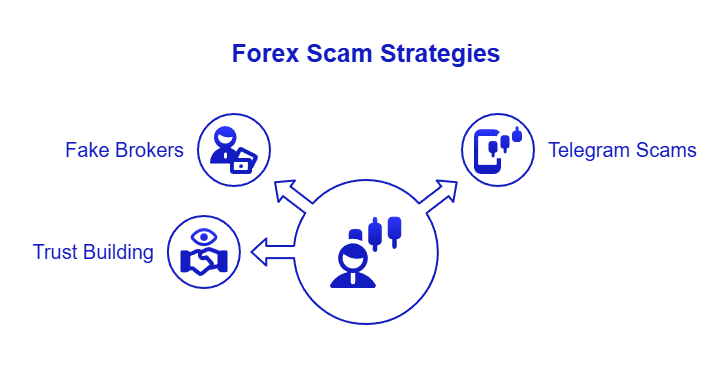
Forex scams are particularly common due to the market’s global nature and varying regulatory frameworks. These scams often involve fake brokers who set up seemingly legitimate operations complete with sophisticated websites and trading platforms. However, when clients attempt to withdraw profits, they encounter numerous obstacles or complete silence.
A Reddit user shared their experience with a Telegram forex scam: “This scam is vicious because it involves an active Forex trading signals channel with pretty good trading results. One a week though, a message is inserted between signals and trading results, with attractive investments propositions”. The initial success builds trust before the scam is executed.
Signal Selling Scams
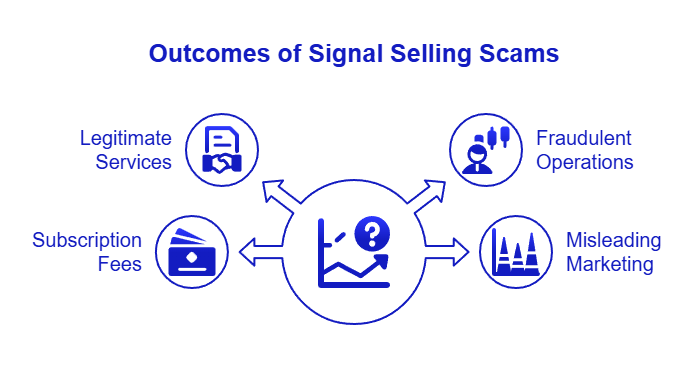
Signal sellers promise to provide winning trade recommendations based on supposed expertise or sophisticated algorithms. While legitimate signal services exist, many are fraudulent operations making random predictions or using hindsight to claim accuracy.
These scammers typically charge subscription fees for “premium signals” that ultimately lead to losses. Their marketing often includes screenshots of successful trades without disclosure of overall performance or losing positions.

Telegram Investment Scams
Telegram has become a popular platform for trading scams due to its encryption and group features. A common approach involves creating legitimate-looking trading channels that occasionally insert investment opportunities promising extraordinary short-term returns.
One victim reported: “Invest $500 for 4 days, and earn $8k in trading profits…This scam is vicious because it involves an active Forex trading signals channel with pretty good trading results”. These operations may provide some genuine signals initially to build credibility before executing their scam.
Indicator Selling Scams
Trading indicators are visual tools that help analyze market conditions. Scammers often sell “proprietary” or “secret” indicators claiming near-perfect accuracy. These products typically cost hundreds or thousands of dollars but provide no edge over freely available tools.
The marketing often includes cherry-picked examples of successful trades while omitting the numerous losses. Legitimate indicator developers provide transparent performance statistics and realistic expectations.

AI Trading Bot Scams
Artificial intelligence has become a popular buzzword in trading scams. These operations claim to have developed sophisticated AI algorithms that can predict market movements with extraordinary accuracy.
As one Reddit user questioned about a potential AI trading service: “If AI trading worked so well, why would they need your money? They would just invest theirs, make billions, and could hand it out”. This logical inconsistency is at the heart of most AI trading scams.

YouTube Trading Guru Scams
Social media platforms, particularly YouTube, have become breeding grounds for fake trading experts. These individuals often showcase luxurious lifestyles supposedly funded by their trading success while selling courses or signals.
A Reddit discussion noted: “Do not waste your time on youtubers who post different strategies each week as this indicates they are a fraud (most of them)”. Legitimate educators maintain consistent approaches rather than constantly jumping between strategies.

Beware of Unrealistic Promises
The promise of extraordinary returns with minimal risk is perhaps the most consistent characteristic of fake trading strategies. The reality of financial markets is that higher returns typically require accepting higher risk there is no magic formula that circumvents this fundamental principle.
Legitimate traders understand and communicate the inherent risks in their approaches. They acknowledge that drawdowns (periods of loss) are inevitable and that no strategy works in all market conditions. When evaluating a trading strategy or service, be highly skeptical of claims like:
- “Guaranteed daily profits”
- “Win rates above 90%”
- “Risk-free investments”
- “Double your money in weeks”
As one source notes, fake traders are characterized by “unrealistic promises of big returns with less risk”. The more extraordinary the claim, the more thorough your verification process should be.

Verify Trader Credentials
Before trusting anyone with your investment capital or following their trading advice, thoroughly verify their credentials and track record.
Steps to verify a trader’s legitimacy:
- Check regulatory compliance: Ensure the trader or platform is registered with appropriate financial authorities. This can be verified through the regulator’s official website.
- Research their background: Look for verifiable trading experience, educational credentials, and professional history. Be skeptical of vague biographies or claims that cannot be independently verified.
- Investigate online presence: Legitimate traders typically maintain a consistent, professional online presence. Look for detailed content that demonstrates actual market knowledge rather than lifestyle marketing.
- Seek independent reviews: Look beyond testimonials on the trader’s own website. Check independent review sites, forums, and regulatory databases for complaints or warnings.
- Verify claimed affiliations: If a trader claims partnerships with known institutions or endorsements from industry figures, verify these claims independently.
The search results specifically mention that fake brokers “may even go as far as to forge documents and licenses”, highlighting the importance of thorough verification through official channels.
Analyze Trading Performance
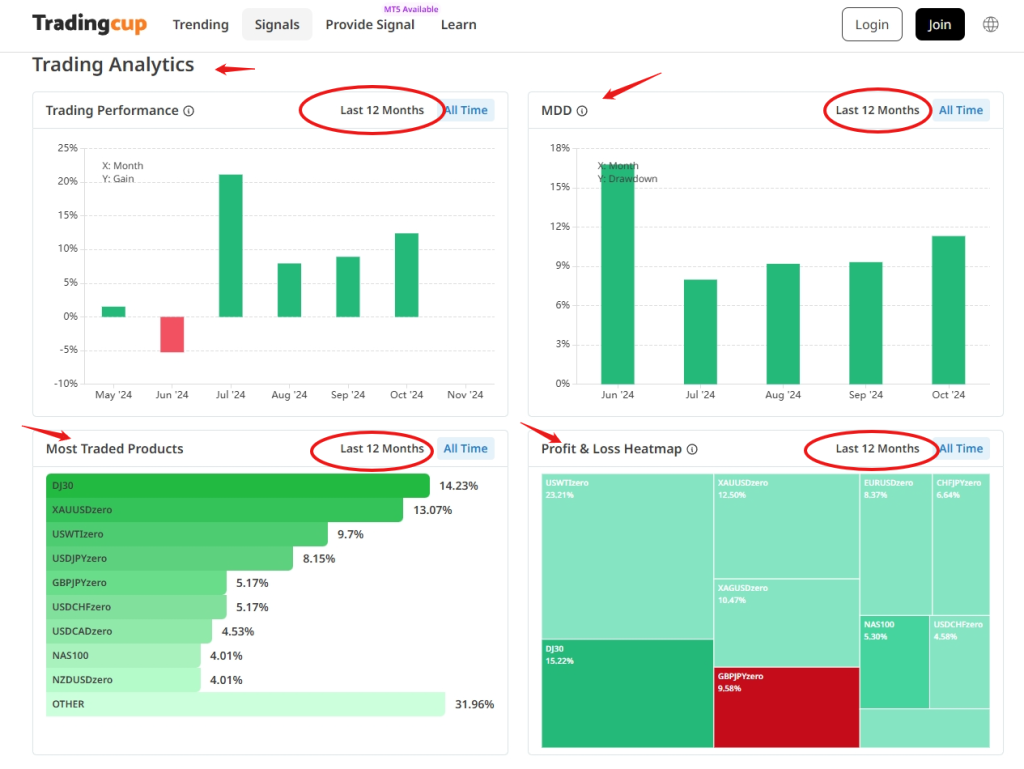
A critical step in evaluating a trading strategy is analyzing its performance using objective metrics rather than marketing claims. Legitimate traders provide comprehensive performance data including:
Key metrics to evaluate:
- Return on Investment (ROI): Not just peak returns, but consistent performance over time
- Maximum drawdown: The largest peak-to-trough decline in account value
- Win rate: The percentage of profitable trades
- Risk/reward ratio: The average profit on winning trades compared to average loss on losing trades
- Sharpe ratio: A measure of risk-adjusted return
- Consistency: Performance across different market conditions
Be extremely cautious of traders who only highlight winning trades or cherry-pick performance periods. Request complete trading history and verify if the performance data matches the claimed strategy.
Test Strategies with Demo Accounts
Before committing actual capital, use demo or paper trading accounts to test the strategy. This allows you to:
- Verify that the strategy works as described in real-time market conditions
- Understand the mechanics and risk profile of the approach
- Identify any discrepancies between claimed and actual performance
- Develop comfort with the execution process
Most reputable brokers offer free demo accounts that simulate real trading conditions with virtual money. Spend at least a few weeks testing any strategy before considering real investment.

Stay Informed and Skeptical
Developing a skeptical mindset and continuously educating yourself about financial markets is your best defense against fraudulent trading schemes.
Best practices for ongoing protection:
- Follow regulatory warnings: Financial authorities regularly publish alerts about known scams
- Join legitimate trading communities: Engage with established forums where experienced traders share insights
- Understand basic market principles: Even without becoming an expert, learn enough to identify implausible claims
- Question extraordinary claims: If something sounds too good to be true, it almost certainly is
- Trust your instincts: If something feels wrong or suspicious, walk away
Real-Life Examples of Trading Scams
The Withdrawal Nightmare
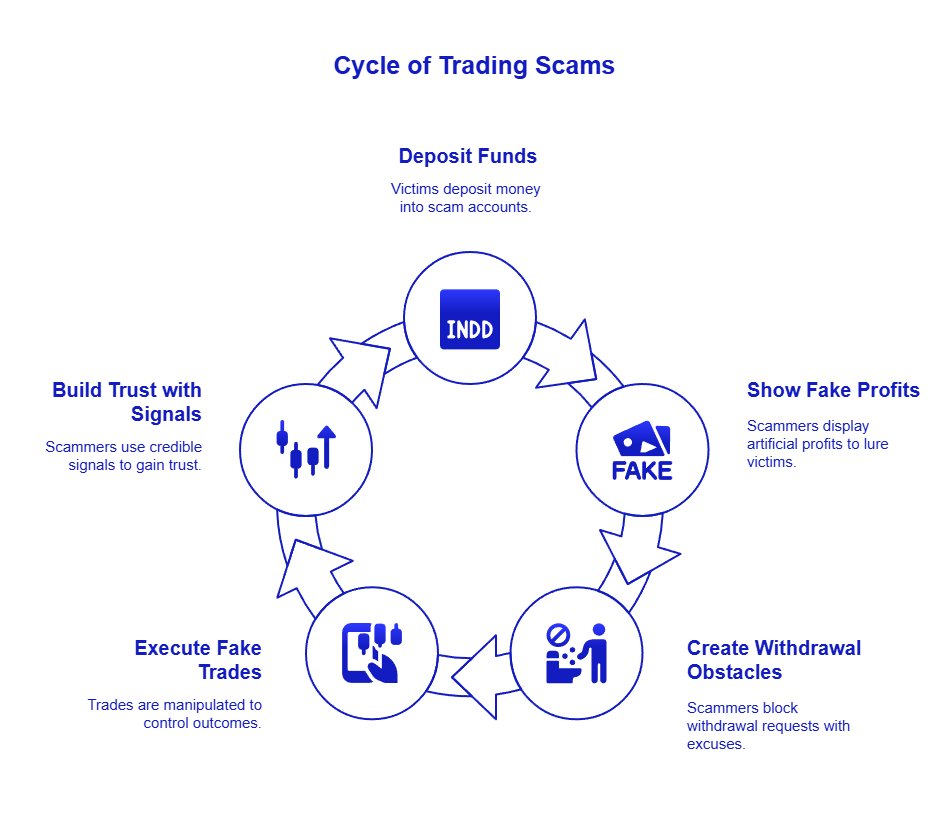
One trader reported depositing $1,100 into a broker account and making a profit of $3,440. However, when attempting to withdraw, the broker “canceled all of my profits and emailed me that I had done fraudulent trading”. The broker offered to return only the initial deposit, effectively stealing the profits.
This pattern repeats across numerous platforms—allowing deposits and showing profits, but creating obstacles when clients attempt to withdraw funds.
The Fake Trading Environment
Many scam platforms operate what one user described as “standalone servers that are not connected to exchanges”. These manipulated environments show artificial prices and execute trades that aren’t placed in real markets, allowing the operators to control outcomes and prevent actual withdrawals.
The Telegram Trap
A particularly sophisticated scam involves legitimate-looking Telegram channels that provide actual trading signals but intermittently insert “special investment opportunities.” As one victim reported, these offers promise extraordinary returns like “$500 for 4 days, and earn $8k in trading profits”.
The initial legitimate signals build trust before the actual scam is executed. This approach is especially effective because it establishes credibility first through accurate market information.

Protecting Your Trading Capital
Use Regulated Brokers Only
Always use brokers regulated by recognized financial authorities. Regulated entities must maintain certain capital requirements, follow specific operational standards, and can face severe penalties for fraudulent activities. Check the regulator’s website directly to verify a broker’s status rather than trusting the broker’s claims.
Start Small and Scale Gradually
When testing a new strategy or service, begin with a minimal amount of capital. Only increase your investment after verifying performance with your own funds in real market conditions. This approach limits potential losses while allowing you to validate claimed results.
Implement Strong Security Practices
Many trading scams begin with compromised accounts or personal information. Protect yourself by:
- Using unique, strong passwords for trading accounts
- Enabling two-factor authentication
- Being cautious of phishing attempts disguised as broker communications
- Using secure, private networks when accessing financial accounts
- Regularly monitoring account activity for unauthorized transactions
Educate Yourself Continuously
The most effective protection against trading scams is knowledge. Understanding basic market principles, risk management concepts, and common scam techniques creates a foundation that makes you less vulnerable to deception.
Conclusion
The trading world is filled with both legitimate opportunities and sophisticated scams. By understanding the warning signs of fake strategies, verifying credentials, analyzing performance objectively, testing approaches thoroughly, and maintaining healthy skepticism, you can significantly reduce your risk of falling victim to trading fraud.
Remember that legitimate trading involves risk, requires knowledge and discipline, and rarely produces the extraordinary returns promised by scammers. Focus on developing solid skills, implementing proper risk management, and partnering only with transparent, regulated entities.
The most successful traders aren’t those chasing get-rich-quick schemes but those who approach markets with patience, discipline, and continuous learning. Protect your capital by applying the principles outlined in this guide, and you’ll be well-positioned to identify and avoid fake trading strategies while discovering legitimate opportunities for financial growth.
FAQs: Spotting Fake Traders and Protecting Your Investments
1. How can I identify a trader with a fake strategy on TradingCup?
Look for unrealistic promises (high returns with no risk), lack of transparency in their strategy, and pressure to invest quickly. Analyze their performance metrics and verify their credentials.
2. What are the red flags of a potential trading scam when considering copy trading?
Red flags include guaranteed profits, difficulty withdrawing funds, unresponsive support, and operating without proper regulation. Be skeptical of “secret” indicators or AI bots promising extraordinary results.
3. How do I verify a trader’s credentials before copy trading on platforms like TradingCup?
Check their regulatory compliance, research their background and online presence, and seek independent reviews. Verify any claimed affiliations with reputable institutions.
4. What performance metrics should I analyze to determine if a TradingCup trader’s strategy is legitimate?
Focus on ROI, maximum drawdown, win rate, risk/reward ratio, Sharpe ratio, and consistency across different market conditions. Avoid traders who only highlight winning trades.
5. How can I test a trader’s strategy on TradingCup before committing real funds?
Use demo accounts to simulate trading conditions with virtual money. This helps verify the strategy’s effectiveness and understand its risk profile before investing real capital.
6. What should I do if I suspect a trader on TradingCup is running a scam?
Stop copying their trades immediately, gather evidence, and report the trader to TradingCup’s support team and relevant regulatory authorities.
7. How can I protect my trading capital when copy trading on TradingCup?
Use regulated brokers only, start with a minimal amount of capital, implement strong security practices (strong passwords, two-factor authentication), and educate yourself continuously.
8. What role does regulation play in protecting me from fake traders on copy trading platforms?
Regulated brokers must adhere to capital requirements and operational standards, providing a layer of protection against fraudulent activities. Always verify a broker’s regulatory status.
9. Are AI trading bots on TradingCup always legitimate?
No. Be skeptical of AI bots promising guaranteed profits. Evaluate their performance metrics and demand transparency about their algorithms. Remember, past performance is not indicative of future results.
10. What are some common tactics used by fake trading “gurus” on platforms like YouTube and Telegram?
They often showcase luxurious lifestyles, promise unrealistic returns, and use high-pressure sales tactics. Be wary of those who constantly change strategies or lack transparency.
For more detailed insights on developing daily trading routines, risk management, and effective position sizing strategies, explore additional articles on Trading Cup. Our trading experts at ACY and FinLogix are also great resources to guide your journey towards trading excellence.

Discover Our Best Trading Signals
At Tradingcup, you can browse through a selection of signals and review past performance before you decide to copy.
Become A Signal Provider
Share your expertise and become a signal provider so other traders can copy your trades.
Stay tuned to our blog for more trader spotlights and leaderboard updates.
Trading involves risks.
Visit the Tradingcup blog through the link below for more updates: https://www.tradingcup.com/learnBest blogs top 8 code to use if needed.
Related Copy Trading blogs:
- Understanding Market Liquidations: Liquidity Sweeps and Runs Explained
- 7 Essential Daily Habits of Successful Traders to Outperform Their Peers
- 10 Strategies You Can Copy off Our Best Copy Traders
- 5 Strategies Every Trader Can Master To Trade Better In A Trading Contest
- 2025 Copy Trading Scams Exposed: How to Spot Fraud
- A Swing Trading Strategy with an 83 Percent Win Rate and Low Drawdowns
- Forex Martingale Strategies Explained, The Good, The Bad and The Ugly
- Pyramiding Trading Tutorial – Pros & Cons & How to Use It