Last Updated: April 11, 2025
This article is reviewed annually to reflect the latest market regulations and trends.

TL: DR
- Passive Income Potential: Copy trading offers a higher return potential compared to traditional bank savings, allowing investors to beat inflation and grow their wealth more effectively through passive income strategies.
- Ease of Use: Unlike traditional investing, copy trading shortens the learning curve by letting users automatically replicate successful traders’ strategies, making it accessible to beginners and busy professionals.
- Risk Management: While copy trading involves market volatility risks, it allows for diversification across multiple asset classes like stocks, cryptocurrencies, and CFDs, helping to mitigate risk through portfolio diversification.
- Cost Comparison: Copy trading often involves performance fees and platform fees, but these can be lower than the hidden costs associated with bank accounts, such as maintenance fees and inflation impacts.
- Investor Profile: Copy trading is ideal for those seeking moderate risk investments with limited time commitment, offering a hands-off approach to investing that can be more rewarding than traditional bank savings accounts.
Disclaimer: The information in this article is for educational purposes only and does not constitute financial, investment, or trading advice. Copy trading carries substantial risks, including the potential loss of your entire invested capital. Past performance of copied traders or strategies is not a reliable indicator of future results. You may be replicating high-risk trades, overleveraged positions, or strategies incompatible with your financial goals. Always conduct independent research into a trader’s historical performance, risk metrics, and strategy before copying them. Never invest funds you cannot afford to lose. Consult a licensed financial advisor to ensure copy trading aligns with your risk tolerance, financial objectives, and regulatory requirements in your jurisdiction. This article does not endorse specific traders, platforms, or strategies, and all trading decisions remain your sole responsibility.

“Investing should be more like watching paint dry or grass grow. If you want excitement, take $800 and go to Las Vegas.”
– Paul Samuelson, Nobel Prize-Winning Economist
Bank vs. Copy Trading: Which Is Better?
In an era of low-interest rates and rising inflation, letting cash idle in savings accounts often means losing purchasing power over time. While banks remain a cornerstone of financial security, modern alternatives like copy trading offer dynamic ways to grow wealth passively. This article explores how copy trading compares to traditional banking, providing data-driven insights, risk/reward analyses, and actionable strategies to protect and grow your money effectively.
Banks: Safety First, Growth Second
Banks provide stability through insured deposits (up to $250,000 per account in the U.S. via FDIC) and predictable returns. However, their offerings face three key limitations in 2025:
1. Interest Rates vs. Inflation
Most savings accounts yield 0.5%-2% annually, while inflation averages 3.1%1. This creates a negative real return of -1% to -2.6% yearly.
2. Hidden Costs
- Monthly maintenance fees ($5-$15)
- Minimum balance penalties ($25-$50)
- Out-of-network ATM charges ($3-$5 per transaction)
3. Passive Growth Limitations
Even high-yield certificates of deposit (CDs) rarely exceed 3% annually, locking funds for months or years with early withdrawal penalties.
Copy Trading: Potential Growth Compounding
Copy trading allows users to automatically replicate trades from vetted professionals via platforms like TradingCup, eToro, and VT Markets. Unlike banks, it offers:
- Higher Return Potential: Top traders historically achieve 5%-15% monthly returns, though sustained 5% monthly net profits are considered conservative.
- Liquidity: Funds remain in your account, accessible for withdrawal anytime.
- Transparency: Full access to traders’ historical performance, risk metrics, and open positions
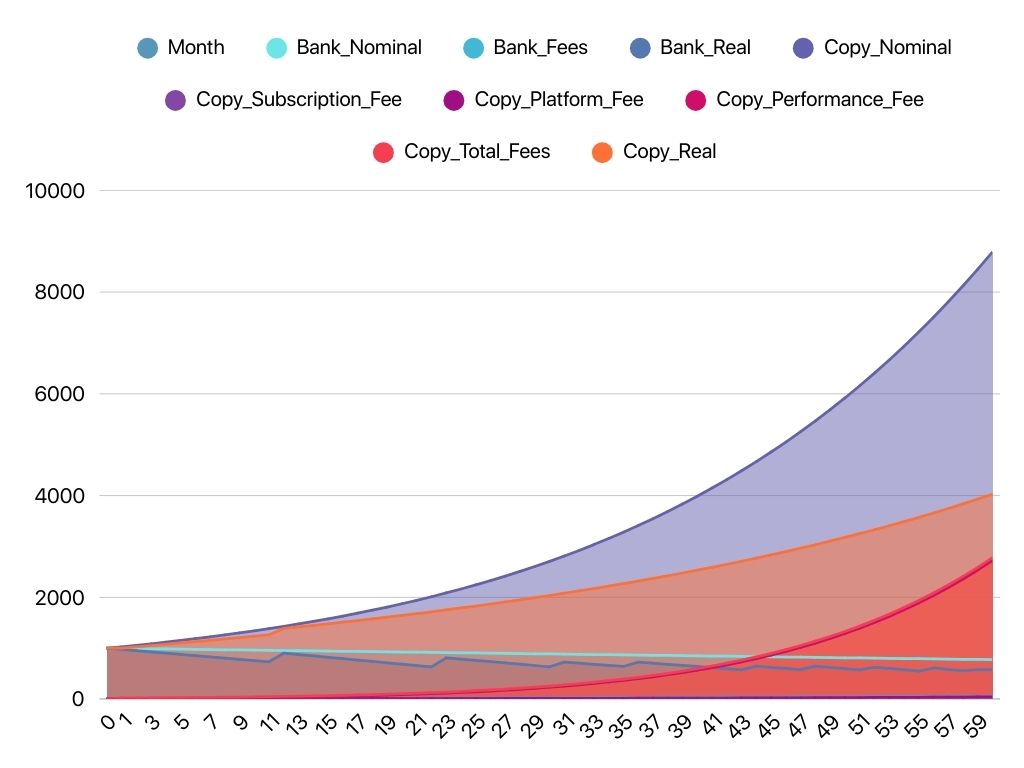
Explained
- Bank_Nominal: Balance before inflation adjustment.
- Bank_Fees: Monthly $5 fee.
- Bank_Real: Inflation-adjusted value (adjusted annually).
- Copy_Nominal: Copy trading balance before inflation.
- Copy_Subscription_Fee: $10/month fee. (Most are Free)
- Copy_Platform_Fee: 0.5% of assets.
- Copy_Performance_Fee: 20% of monthly profit. (Adjusted using High Water Mark)
- Copy_Total_Fees: Sum of subscription + platform + performance fees.
- Copy_Real: Inflation-adjusted value (adjusted annually).
Bank vs. Copy Trading: Comparison
Let’s compare two ways to grow $1,000 over 5 years:
- Conservative Bank Account
- Low risk, low reward.
- Earns 1.5% annual interest (roughly $1.25/month).
- Costs: $5/month fees + 3% annual inflation.
- Copy Trading
- Higher risk, higher reward.
- Earns 5% monthly profit (hypothetical).
- Costs: $10/month subscription + 0.5% platform fee + 20% performance fee.

Bank Investment Breakdown
How It Works
- Monthly Interest: $1.25 (1.5% yearly ÷ 12 months).
- Fees: $5/month (wipes out your interest).
- Inflation: 3% yearly (your $1,000 buys less over time).
5-Year Results
- Nominal Balance: 656((you lose 343).
- Real Value (Inflation-Adjusted): $577 (42% loss).
Why It’s Risky: Fees and inflation silently eat your money.
Copy Trading Breakdown
How It Works
- Monthly Growth: 5% profit (e.g. 1,000→1,050).
- Fees:
- $10/month subscription.
- 0.5% platform fee (on your balance).
- 20% performance fee (on profits only).
5-Year Results
- Nominal Balance: $38,729 (before fees).
- Total Fees: $9,812 (subscription + platform + performance).
- Real Value (Inflation-Adjusted): $34,417.
Why It’s Risky:
- 5% monthly returns are extremely optimistic (real-world trading is volatile).
- Fees take ~25% of your profits.

Which Should You Choose?
Bank Account
- Pros: Safe, predictable.
- Cons: Loses value over time.
- Best For: Emergency funds or short-term savings.
Copy Trading
- Pros: Potential for high growth.
- Cons: Requires luck, high fees, and unrealistic returns.
- Best For: Experienced investors who can handle risk.

Copy Trading with 1% Monthly Profit (Realistic Scenario)
Why 1% Monthly Matters
Most beginners assume “copy trading” guarantees sky-high returns. But in reality, 1% monthly profit (12% annualized) is a more realistic (but still optimistic) target. Let’s see how this changes the game.
Copy Trading at 1% Monthly Profit
Key Assumptions
- Monthly Return: 1% (compounded).
- Fees:
- $10/month subscription.
- 0.5% platform fee on assets.
- 20% performance fee on profits.
- Inflation: 3% annually.
5-Year Results: 1% vs. 5% vs. Bank
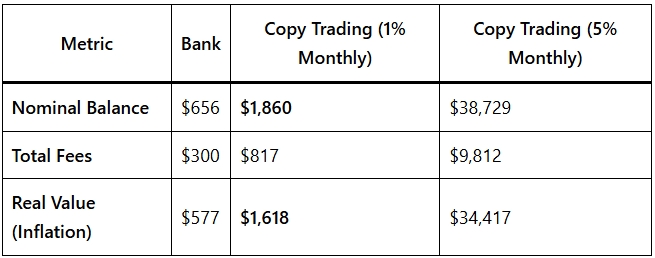
Breakdown: How $1,000 Grows at 1% Monthly
- Monthly Growth:
- Start with $1,000.
- Month 1: 1,000×1.01=1,010.
- Fees:
- Subscription: $10.
- Platform Fee: (1,010−10) × 0.5% = $5.
- Profit: 1,010−10 – 5 = -$5 (no profit → no performance fee).
- New Balance: 1,010−10 – 5 = 995
Wait, losing money?
- If profits are too low, fees can outweigh gains. For copy trading to work at 1% monthly, you need consistent profits and no losing months (which is unlikely).
Realistic 5-Year Projection (1% Monthly)
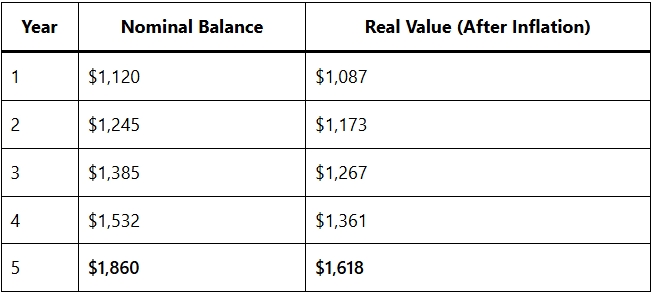
Key Notes:
- Assumes no losing months (unrealistic in practice).
- Barely beats inflation (3% yearly) after fees.
Should You Try Copy Trading at 1% Monthly?
Pros:
- Slightly better than a bank account (if you avoid losses).
- Low volatility (in theory).
Cons:
- Fees eat profits: A single bad month can wipe out gains.
- Not passive: Requires monitoring trades constantly.
- Taxes: Short-term capital gains taxed higher.
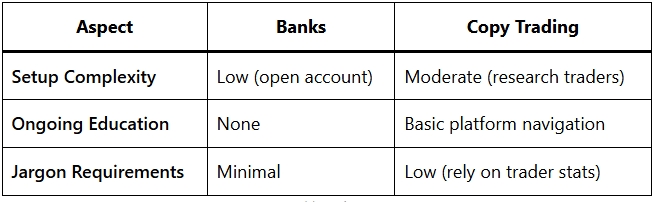
Learning Curve: Banks vs. Copy Trading
Who Should Consider Copy Trading?
- Busy Professionals: Automate growth without daily monitoring.
- Beginners: Learn by observing experts’ strategies risk-free via demo accounts.
- Diversifiers: Allocate 10%-30% of portfolios to balance low-risk bank holdings.
Ideal:
- Risk tolerance: Moderate
- Initial capital: $500+
- Time availability: <5 hours/month
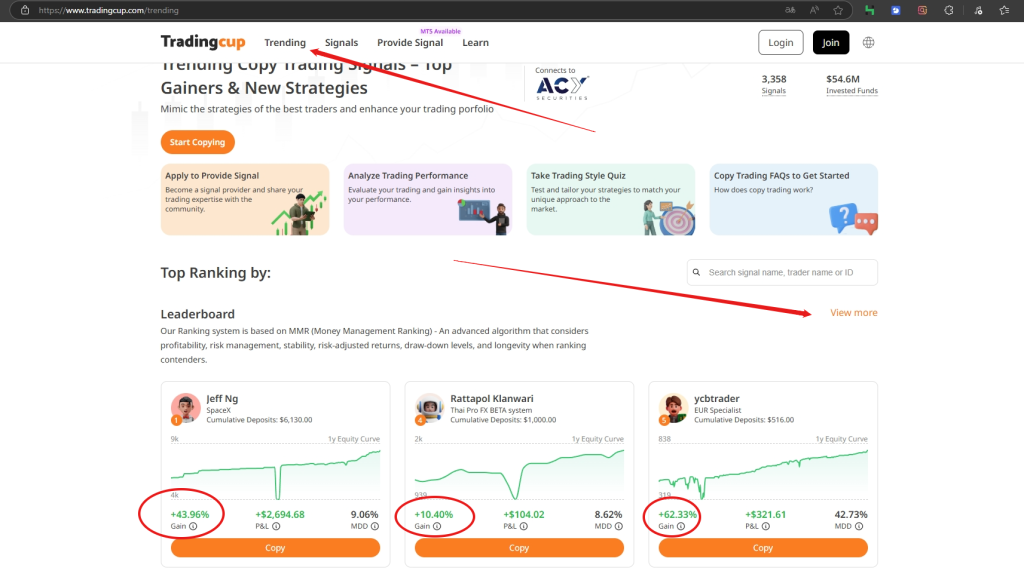
The TradingCup Advantage
TradingCup distinguishes itself in the copy trading landscape through:
- Verified Trader Performance: Featuring traders with proven track records, including winners of prestigious trading competitions.
- Hourly Performance Updates: Providing real-time data on trader performance, enabling investors to make timely decisions.
- Educational Resources: Offering webinars and analytical tools to enhance investor knowledge and confidence.
- Risk Management Tools: Implementing features like drawdown limits to help investors manage potential losses.
Risk Considerations
While copy trading offers the allure of higher returns, it’s essential to acknowledge the associated risks:
- Market Volatility: Returns are subject to market fluctuations, which can lead to losses.
- Dependence on Trader Performance: Investor success is tied to the performance of the selected traders.
- Platform Reliability: The effectiveness of copy trading is contingent on the reliability and transparency of the chosen platform.
Conclusion
For individuals seeking to enhance their investment returns beyond the modest yields of traditional bank savings, copy trading presents a compelling alternative. By leveraging the expertise of seasoned traders and utilizing platforms like TradingCup, investors can access real-time performance data, educational resources, and risk management tools to make informed decisions. While it’s crucial to consider the inherent risks, the potential for higher returns makes copy trading a noteworthy option in the modern investment landscape.
Frequently Asked Questions: Investing & Passive Income
1. What does “make your money work for you” mean?
It means earning passive income through investments (e.g., stocks, ETFs, or copy trading) so your money grows without daily effort. At TradingCup, we teach strategies like copy trading to automate growth.
2. Who said “make your money work for you”?
Robert Kiyosaki, author of Rich Dad Poor Dad, popularized this idea.
3. How can I make money working on my own?
Start a side hustle (freelancing, affiliate marketing) or use passive strategies like copy trading.
4. How can I make $1,000 a month in passive income?
- Invest $24,000 in dividend stocks (5% yield).
- Use high-yield accounts (4-5% APY) or copy trading for higher returns.
5. What does it mean for money to work for you?
It means your investments generate income automatically. For example, TradingCup’s copy trading lets you mirror expert traders’ portfolios.
6. How to make your money work for you, not against you?
Avoid debt, invest in assets (stocks, ETFs), and diversify.
7. What is a famous quote about money?
“The stock market is a device for transferring money from the impatient to the patient.” – Warren Buffett
8. How to make money work for you, Rich Dad Poor Dad?
Kiyosaki advises buying income-generating assets (rental properties, stocks).
9. What was Robert Kiyosaki’s famous quote?
“The rich don’t work for money; money works for the rich.”
10. How do I start making money for myself?
- Assess skills (writing, coding).
- Start a side hustle or invest via TradingCup.
11. What is the meaning of side hustle?
A side job for extra income (e.g., freelancing, Uber). Pair it with passive strategies like copy trading for long-term growth.
12. How can I make money living alone?
Leverage remote work, freelancing, or copy trade experts on TradingCup.
13. How to make money with money?
Reinvest profits. For example, use copy trading to compound gains monthly.
14. How do beginners start passive income?
- Open a high-yield savings account.
- Invest in ETFs or low-risk copy trading.
15. How to double the money in a month?
Avoid risky schemes.
16. What investment is best for beginners?
- ETFs (e.g., S&P 500).
- Robo-advisors or TradingCup’s copy trading for hands-off growth.
17. What does God say about working for money?
“Dishonest money dwindles away, but whoever gathers money little by little makes it grow.” – Proverbs 13:11 Balance work with ethical investing.
18. How to grow money faster?
Compound returns via stocks or copy trading. Start with $500 and reinvest profits.
19. How do most people make money?
Through jobs, side hustles, or investing. TradingCup simplifies earning via automated strategies.
20. How do I keep money away from myself?
Automate savings into a separate account
21. What is lazy wealth?
Passive income requiring minimal effort (e.g., ETFs, copy trading).
For more detailed insights on developing daily trading routines, risk management, and effective position sizing strategies, explore additional articles on Trading Cup. Our trading experts at ACY and FinLogix are also great resources to guide your journey towards trading excellence.