
In the world of copy trading, understanding how performance fees are calculated can significantly impact your allocation strategy. At Trading Cup, our innovative platform offers a simple solution for forex traders to seamlessly copy the trades of our top-performing signal providers.
A key component of this process is the high water mark principle, which determines the performance fees you pay. This article breaks down the high water mark principle in an easy-to-understand way, ensuring you clearly comprehend how fees are applied based on actual profits.
Whether you’re new to copy trading or looking to maximise your returns, this straightforward guide will empower you with the knowledge needed to make informed decisions about performance fees.
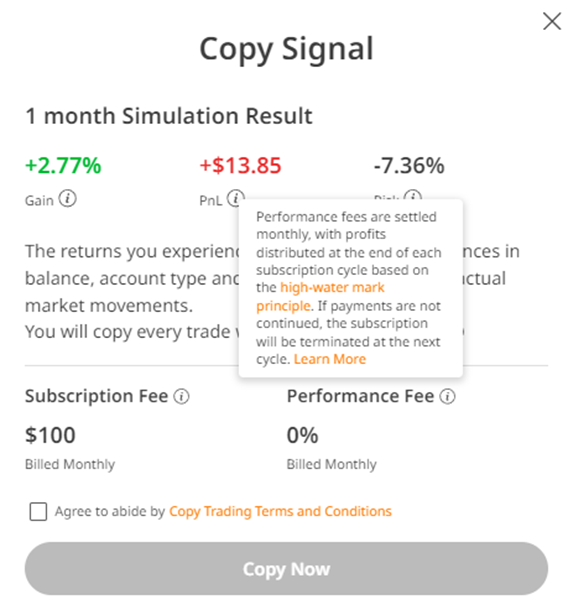
The image below shows how Trading Cup displays key information about performance fees and the high water mark principle, highlighting where you can see the monthly subscription fee, performance fee, and details about profit calculations based on this principle.
What Are Performance Fees and How Do They Impact Your Copy Trading Returns?
In terms of copy trading, performance fees are charges based on a percentage of the profits earned by the copy trader. These fees are a fundamental component of the compensation structure for strategy providers here at Trading Cup. When you choose to copy a trader’s strategy, you agree to share a portion of your profits with them as a performance fee, which aligns their success with yours and incentivises them to maximise returns.
Example with a 20% performance fee on a $1,000 account
For example, let’s say a strategy provider charges a 20% performance fee. If you, as a copy trader, earn a profit of $1,000 in a month, the strategy provider would receive 20% of that profit, amounting to $200 as their performance fee. This model ensures you pay fees when you see gains, making it a fair and transparent way to compensate those who contribute to your trading success.
By understanding how performance fees are calculated and applied, you can make informed decisions when selecting strategy providers to follow. This knowledge helps you align your strategy choices with your financial goals.
What is the High Water Mark and How Does It Impact Performance Fees?
The high water mark is a crucial principle in the world of copy trading that ensures fair and equitable performance fees for copy traders. At its core, the high water mark is a benchmark that represents the highest level of profits previously achieved by a copy trader. This principle ensures performance fees are only charged on new profits, preventing copy traders from paying fees on any profits that merely recover past losses.
Here’s how it works:
If a copy trader’s account reaches a new peak profit level, this becomes the high water mark. Performance fees are then only charged on any profits that exceed this benchmark in subsequent trading periods.
For example, if a copy trader’s account grows to $6,000 from an initial investment of $5,000, the high water mark is set at $6,000. If the account value later falls and then rebounds to $6,500, performance fees are only assessed on the $500 gain above the previous high water mark.
The image below illustrates the concept of profit sharing based on the ‘High Water Mark’ principle, where profits are shared only on gains that exceed the previous peak account value.
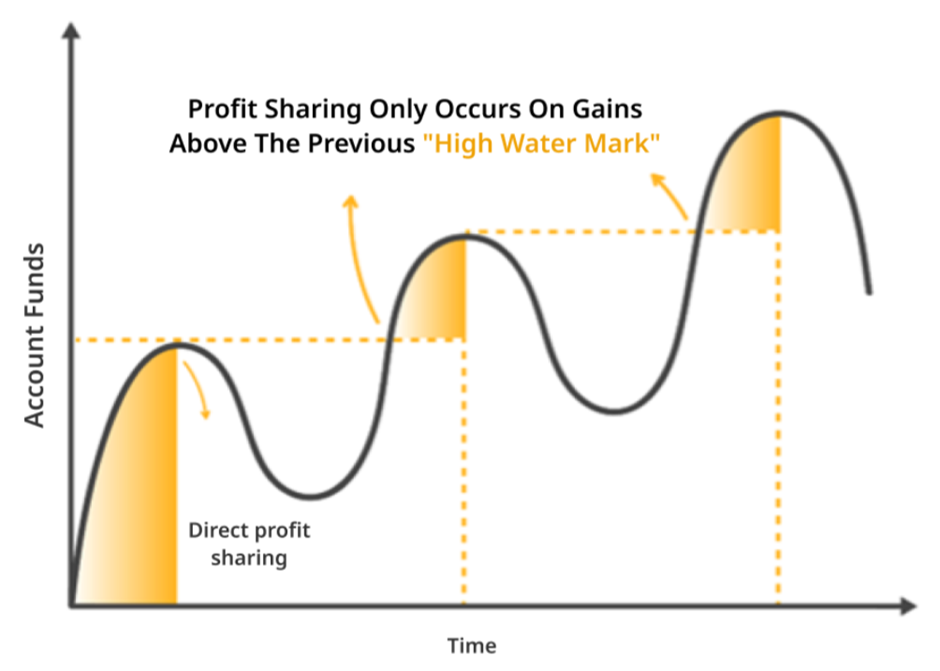
This model benefits copy traders by ensuring they only pay fees on genuine gains, aligning the interests of both the trader and the strategy provider. By understanding the high water mark principle, copy traders at Trading Cup can confidently choose strategies, knowing that their performance fees are based on actual profit growth and not on recovering past losses.
The table below illustrates a practical example of how the high water mark principle and performance fees apply to a copy trader’s account over four months. This example demonstrates how performance fees are calculated based on monthly profits and the high water mark.
| Month | Current Month P&L | Cumulative P&L | Previous High Water Mark | Performance Fee | Explanation |
| Month 1 | $300.00 | $300.00 | $ – | $60.00 | Fee charged based on proportion of profit |
| Month 2 | -$200.00 | $100.00 | $300.00 | $ – | No fee charged |
| Month 3 | $400.00 | $500.00 | $300.00 | $40.00 | Fee charged on profit exceeding previous high water mark |
| Month 4 | $100.00 | $600.00 | $500.00 | $20.00 | Fee charged on profit exceeding previous high water mark |
- Month 1: The copy trader earns a $300 profit, setting a new high water mark. A 20% performance fee is charged on the $300 profit, resulting in a $60 fee.
- Month 2: The trader incurs a $200 loss, lowering the cumulative profit to $100. No fee is charged since the profit is below the previous high water mark.
- Month 3: The copy trader earns a $400 profit, surpassing the previous high water mark of $300. A 20% fee is charged on the $200 profit exceeding the high water mark, resulting in a $40 fee.
- Month 4: A $100 profit is earned, surpassing the high water mark of $500. A 20% fee is charged on the $100 profit exceeding the high water mark, resulting in a $20 fee.
In conclusion, understanding the high water mark principle and how performance fees work is crucial for any trader engaging in copy trading. This powerful concept ensures fees are only charged on new profits, aligning the interests of strategy providers and copy traders.
By safeguarding traders from paying fees on profits that merely recover past losses, the high water mark principle fosters a fair and transparent trading environment. At Trading Cup, this alignment motivates strategy providers to achieve the best results for their clients, creating a win-win situation.
Moreover, the simplicity of this model makes it accessible to traders of all experience levels, empowering them to make informed decisions and maximise their returns. Armed with this knowledge, you can confidently navigate the world of copy trading and take full advantage of the opportunities it presents.